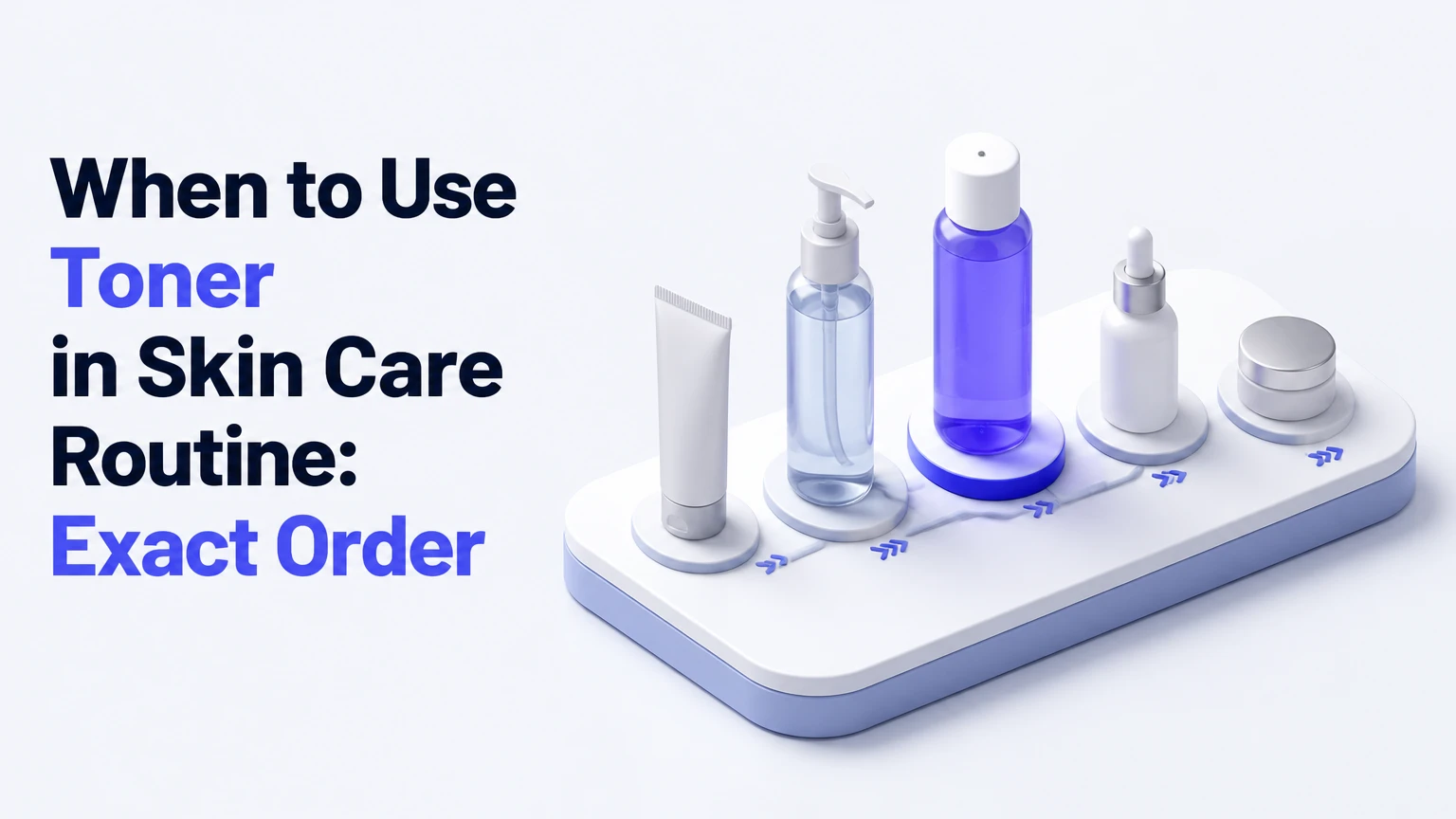
Use facial toner immediately after cleansing and before serum, moisturizer, or sunscreen. Toner is optional, so the correct timing depends on its formula: hydrating toner can be used morning or night, while exfoliating toner usually belongs in an evening routine two or three times weekly. Apply toner to clean skin, then layer the next product when the surface feels comfortable.
Key facts at a glance
Facial toner belongs after cleanser and before treatment products or moisturizer.
Toner is optional; cleanser, moisturizer, and broad-spectrum sunscreen have higher routine priority.
Hydrating toner can be pressed in with clean hands, while exfoliating toner is often easier to distribute with a cotton pad.
A fixed 1-2 minute wait is unnecessary; apply the next layer once toner has settled and is no longer dripping.
Exfoliating toners containing glycolic acid, lactic acid, or salicylic acid should not automatically be used twice daily.
Toner should not cause persistent burning, tightness, scaling, or new bumps.
When to Use Toner in Skin Care Routine
Facial toner is used after cleansing because cleanser removes sunscreen, makeup, sebum, and surface debris that would otherwise interfere with the toner’s distribution. Toner then sits before leave-on products, allowing a hydrating, exfoliating, or soothing formula to contact clean skin.
The modern role of toner is narrower than older skincare advertising suggested. A well-formulated toner may add humectants, deliver a controlled amount of exfoliating acid, reduce the tight feeling caused by cleansing, or provide a convenient first treatment layer. It does not automatically “rebalance” skin pH, remove all impurities, or make every serum absorb better.
The American Academy of Dermatology prioritizes a gentle cleanser, moisturizer, and sun protection in basic skincare. That hierarchy matters because toner can improve comfort or target a specific concern, but it cannot compensate for an irritating cleanser or replace sunscreen.
What does toner do?
Toner changes the routine according to its ingredients, not its liquid texture or packaging. Glycerin and panthenol support surface hydration, salicylic acid helps loosen oil and dead cells inside pores, and fragrance or denatured alcohol may irritate reactive skin.
| Toner category | Representative ingredients | Typical frequency | Primary use |
|---|---|---|---|
| Hydrating | Glycerin, panthenol, beta-glucan | 1-2 times daily | Dryness and post-cleanse tightness |
| Exfoliating AHA | Glycolic acid 5%, lactic acid 5% | 1-3 nights weekly | Uneven texture and dull surface |
| Exfoliating BHA | Salicylic acid 0.5-2% | 2-4 nights weekly | Oiliness and clogged pores |
| Soothing | Allantoin, colloidal oatmeal, centella asiatica | 1-2 times daily | Temporary redness and sensitivity |
A toner is not a medical treatment simply because it contains an active ingredient. Over-the-counter salicylic acid can support acne care, but persistent acne, painful nodules, or scarring may require a clinician’s diagnosis and treatment plan.
What Is the Correct Product Order?
The standard order is cleanser, toner, serum or treatment, moisturizer, and sunscreen in the morning. At night, remove sunscreen or makeup first when necessary, cleanse, apply toner, use treatment products, and finish with moisturizer.
| Routine step | Morning order | Evening order | Typical quantity |
|---|---|---|---|
| Makeup or sunscreen removal | Optional step 1 | Step 1 when needed | 1-2 cotton pads |
| Cleanser | Step 1 | Step 2, or step 1 without makeup | 1-2 mL |
| Toner | Step 2 | Step 3 | 3-6 drops |
| Serum or treatment | Step 3 | Step 4 | 2-4 drops |
| Moisturizer | Step 4 | Step 5 | Pea to nickel size |
| Broad-spectrum SPF 30+ | Step 5 | Not used | Two-finger amount |
The texture rule resolves most layering questions: apply thinner, more watery products before thicker emulsions and creams. Ingredient purpose can override texture when a product label gives specific directions, especially for prescription retinoids, benzoyl peroxide, or dermatologist-directed treatments.
Should toner be used before or after serum?
Toner should be applied before serum because toner is generally more fluid and is intended to prepare the surface for the products that follow. The exception is a toner that functions as a strong exfoliating treatment, where reducing the number of other active products may be safer than adding more layers.
Serum does not need a completely dry face after toner. Waiting approximately 15-60 seconds is a practical estimate, not a biological requirement. If the toner remains wet enough to make the serum slide, wait briefly; if the skin feels comfortable and lightly hydrated, continue.
Does toner go before moisturizer and sunscreen?
Toner goes before moisturizer and sunscreen. Moisturizer forms a more substantial emollient and occlusive layer, while sunscreen must remain the final morning skincare step so its labeled protection can form an even film.
Do not mix toner into sunscreen in your palm. Mixing changes the sunscreen’s film-forming behavior and can reduce uniform coverage, even when both products feel compatible.
How Should You Apply Facial Toner?
Apply toner with clean hands when the formula is hydrating, and use a lightly saturated cotton pad when the formula is designed for exfoliation or residue removal. Use enough product to distribute a thin, even layer across the face and neck without dripping.
- Cleanse for about 30-60 seconds. Use lukewarm water and a gentle cleanser. A two-minute wash is not required for most people, and prolonged massage can increase irritation.
- Pat away excess water. Leave skin slightly damp if the toner is hydrating, but do not apply acid toner over actively wet skin unless the label or clinician instructs you to do so.
- Measure the toner. Use roughly 3-6 drops in your hands or enough to lightly saturate a cotton pad. Soaking the pad increases waste without proving better results.
- Press or sweep gently. Press hydrating toner into the face with fingertips. Sweep exfoliating toner once across the intended areas, avoiding eyelids, corners of the nose, and broken skin.
- Layer the next product. Continue after 15-60 seconds, or sooner if the toner has settled. Finish with moisturizer, and use SPF 30 or higher during daytime exposure.
You will know the application is sufficient when the skin feels comfortable and lightly hydrated rather than dripping, sticky, hot, or tight. Facial toner should not require vigorous rubbing, repeated passes, or visible pooling.
Should toner go on wet or dry skin?
Hydrating toner can be applied to slightly damp skin, which may reduce the immediate tight sensation from water loss. Exfoliating toner is usually easier to control on dry or nearly dry skin because water can spread the acid over a larger area and may increase stinging.
The claim that damp skin is “exponentially more permeable” is too broad for everyday skincare advice. Moisture can alter the feel and spread of some formulas, but penetration depends on pH, concentration, vehicle, contact time, skin condition, and the specific ingredient.
Which Toner Fits Your Skin Type?
Choose toner by skin concern and formula, not by the label “for oily skin” or “for dry skin.” Dry or sensitive skin usually benefits from fewer ingredients and humectants, while oily or acne-prone skin may tolerate a carefully scheduled exfoliant.
| Skin situation | Useful formula features | Ingredients to limit initially | Starting schedule |
|---|---|---|---|
| Dry, flaky skin | Glycerin, ceramides, panthenol | High alcohol, strong fragrance | Once nightly |
| Sensitive or rosacea-prone skin | Allantoin, oat, low-fragrance formula | Glycolic acid, essential oils | 2-3 nights weekly |
| Oily, congested skin | Salicylic acid 0.5-2%, niacinamide | Heavy fragrance, harsh astringents | Every other night |
| Combination skin | Hydrating base, targeted BHA | Full-face strong acids | T-zone only, 2 nights weekly |
| Dehydrated but oily skin | Glycerin, beta-glucan, light emollients | Alcohol-heavy formulas | Once or twice daily |
Skin type is not fixed across every facial area. Many combination-skin users can apply a hydrating toner to the cheeks and reserve a salicylic acid toner for the nose or forehead, rather than exposing the entire face to one formula.
How often should you use toner?
Hydrating toner can typically be used once or twice daily if it causes no irritation. Exfoliating toner should begin at one evening application weekly, then increase only when the skin remains comfortable for at least two weeks.
| Active toner | Beginner frequency | Common upper limit | Do not combine initially with |
|---|---|---|---|
| Glycolic acid 5% | 1 night weekly | 2-3 nights weekly | Retinoid on same night |
| Lactic acid 5% | 1-2 nights weekly | 3 nights weekly | Other leave-on acids |
| Salicylic acid 2% | 2 nights weekly | 4 nights weekly | Benzoyl peroxide if irritated |
| PHA toner | 2 nights weekly | 5 nights weekly | Multiple exfoliating products |
The right frequency is the highest schedule that produces improvement without persistent redness, scaling, burning, or tenderness. More frequent use does not guarantee faster texture or acne improvement because barrier irritation can make skin look rougher and more inflamed.
Can Toner Be Used With Retinol, Vitamin C, or Acne Treatments?
Toner can be used with other actives, but the combination should be planned around irritation load. Hydrating toner is generally compatible with retinoids, vitamin C, niacinamide, and benzoyl peroxide; exfoliating toner creates more potential for dryness when paired with those treatments.
| Combination | Compatibility | Safer scheduling | Main risk |
|---|---|---|---|
| Hydrating toner plus retinol | Usually compatible | Hydrating toner, then retinol at night | Increased dryness from retinol |
| Acid toner plus retinol | High irritation potential | Alternate nights | Peeling and burning |
| Hydrating toner plus vitamin C | Usually compatible | Morning or evening | Stinging from low-pH vitamin C |
| Salicylic toner plus benzoyl peroxide | Use cautiously | Alternate areas or nights | Excess dryness and irritation |
| Hydrating toner plus niacinamide | Usually compatible | Same routine | Irritation from the complete formula |
For a new active toner, patch test according to the product directions and introduce only one new active at a time. Prescription products take priority over general layering advice, so follow the prescriber’s instructions when they differ.
Do you need to wait between toner and serum?
Most people do not need a timed absorption window between toner and serum. Apply serum once toner has stopped dripping and the surface feels stable, because the meaningful goal is even layering rather than waiting for a product to vanish completely.
Pilling usually results from incompatible film-formers, excess product, rubbing, or layers that have not settled. Reducing quantity and pressing rather than rubbing often solves the problem more effectively than waiting several minutes.
Is Toner Necessary in a Skincare Routine?
Toner is not necessary for everyone. A basic routine can be complete with a gentle cleanser, moisturizer selected for the skin’s needs, and broad-spectrum SPF 30 or higher during the day.
Toner earns its place when it solves a specific problem that the rest of the routine does not solve efficiently. Examples include adding glycerin to a dry routine, delivering salicylic acid to a congested T-zone, or replacing a harsher post-cleanse sensation with a soothing formula.
Skipping toner is often the better choice when the skin is peeling, newly sunburned, reacting to multiple products, or already receiving prescription exfoliation. A four-step routine with unnecessary toner is less effective than a three-step routine that the user can follow consistently.
Toner versus essence, micellar water, and facial mist
Toner, essence, micellar water, and facial mist overlap in feel but differ in purpose. Micellar water is a cleansing product that should generally be rinsed or followed by a cleanser, while essence is usually a hydrating treatment layer with a thicker texture.
| Product | Main function | Rinse required | Best placement |
|---|---|---|---|
| Toner | Hydration, exfoliation, or soothing | No, unless irritating | After cleanser |
| Essence | Hydration and conditioning | No | After cleanser or toner |
| Micellar water | Makeup and sunscreen removal | Usually recommended | Before cleanser |
| Facial mist | Temporary surface moisture | No | Before moisturizer |
| Astringent | Oil reduction and temporary tightening | No | Limited use, if tolerated |
A facial mist sprayed over dry skin without moisturizer may evaporate and leave the surface feeling tighter. A toner or essence also cannot replace cleansing when sunscreen, makeup, or water-resistant products are present.
What Should You Do When Toner Causes Problems?
Stop or reduce a toner when it produces persistent burning, swelling, scaling, tightness, or a pattern of new bumps. Rinse an actively irritating product with lukewarm water, simplify the routine, and seek medical advice for swelling, hives, blistering, or worsening dermatitis.
| Symptom | Likely cause | Immediate correction | Restart condition |
|---|---|---|---|
| Burning lasting over 5 minutes | Irritant acid, alcohol, or damaged barrier | Rinse and stop active toner | No burning for 3-5 days |
| Tight, shiny skin | Over-cleansing or astringent formula | Use bland cleanser and moisturizer | Comfortable after cleansing |
| Pilling under serum | Excess product or rubbing | Use half the amount and press | Even finish after 60 seconds |
| Tiny uniform bumps | Occlusive or fragranced formula | Stop toner for 5-7 days | Clear trend after one week |
| Red patches and scaling | Excess exfoliation | Stop acids and retinoids temporarily | Scaling resolved |
| No visible benefit after 8 weeks | Mismatched product or unnecessary step | Reassess the goal | Keep only if comfort improves |
Cold water is not required to neutralize toner irritation. Lukewarm rinsing removes residue while minimizing the thermal stress that hot or very cold water can produce on sensitive skin.
Expert rules that prevent most toner mistakes
- Treat acid toner as an active treatment, not as flavored water. A 5% glycolic acid toner belongs in the same irritation calculation as other exfoliating products.
- Use the smallest effective surface area. Applying BHA only to a congested T-zone can preserve comfort on the cheeks.
- Do not chase tackiness. A slightly hydrated finish can be useful, but stickiness is not evidence that a toner has worked.
- Change one variable at a time. If toner, serum, cleanser, and moisturizer all change in one week, identifying the irritant becomes unnecessarily difficult.
What Routine Should You Use in Common Situations?
Different circumstances change whether toner is useful, how often it belongs in the routine, and which application method creates the least irritation.
A simple morning routine
Use cleanser or rinse with water according to skin tolerance, then apply hydrating toner, serum if needed, moisturizer, and broad-spectrum SPF 30 or higher. Oily skin may prefer a lightweight moisturizer, but skipping moisturizer solely because of oiliness can increase discomfort and encourage over-cleansing.
A simple evening routine
Remove makeup or sunscreen, cleanse, apply toner, use one primary treatment, and moisturize. If the toner contains AHA or BHA, omit other exfoliating products that evening until tolerance is established.
After exercise or sweating
Cleanse when sweat, sunscreen, or grime remains on the skin. Toner cannot remove all particulate matter or water-resistant sunscreen, so applying toner directly over a sweaty face is not an adequate substitute for washing.
For sensitive or barrier-impaired skin
Skip exfoliating toner until stinging, flaking, and unusual tightness have settled. Reintroduce a fragrance-free hydrating toner once daily only if it adds comfort; the routine does not need the product if moisturizer alone performs better.
How much time and money does toner add?
A toner step usually adds 30-90 seconds to a routine and costs approximately $8-$35 for a 100-200 mL over-the-counter product in the United States. Cost per use depends on dispensing, with 3-6 drops from a 150 mL bottle often lasting several months.
| Product choice | Typical US price | Typical size | Approximate use period |
|---|---|---|---|
| Basic hydrating toner | $8-$18 | 150-250 mL | 3-6 months |
| Fragrance-free sensitive toner | $12-$25 | 120-200 mL | 3-5 months |
| AHA or BHA toner | $15-$35 | 100-200 mL | 3-6 months |
| Dermatologist-directed formula | $25-$60 | 100-200 mL | Varies by prescription plan |
Prices are typical retail ranges, not guarantees, and retailer, country, packaging, and prescription status change the final cost. If toner creates no measurable comfort or treatment benefit after six to eight weeks, removing the expense is a rational skincare decision.
FAQ
Can I use toner twice a day?
You can usually use a hydrating toner twice daily when the formula does not sting or dry the skin. Exfoliating toner is different: begin once weekly, increase gradually, and follow the product’s acid concentration and directions. Twice-daily acid use can be excessive for many users, especially alongside retinoids or benzoyl peroxide.
Should I wash my face after applying toner?
Do not routinely wash off a properly formulated leave-on toner. Rinse it if the product causes burning, itching, swelling, or an unusual rash, then simplify the routine. Micellar water is a different category because it is primarily a cleansing product and is commonly followed by rinsing or a regular cleanser.
Can I use toner without cleanser?
You can use a hydrating toner after rinsing when the skin is clean and your morning routine does not contain substantial residue. Toner cannot replace cleanser after sunscreen, makeup, pollution exposure, or exercise because watery toner does not reliably remove those materials.
Is toner good for acne?
Salicylic acid toner may help mild clogged pores by providing a leave-on beta-hydroxy acid, but toner is not automatically an acne treatment. Choose a concentration listed on the label, start slowly, and avoid combining it with several other irritating actives. Painful acne, scarring, or persistent breakouts warrant professional care.
Can toner replace moisturizer?
Toner cannot reliably replace moisturizer. Hydrating toner supplies water-binding ingredients, while moisturizer combines humectants, emollients, and sometimes occlusives that reduce water loss. A toner may be enough for some oily users in humid weather, but dry or barrier-impaired skin generally needs a dedicated moisturizer.
How long should I use toner before judging results?
Judge a hydrating toner by comfort over one to two weeks and an exfoliating toner by texture or congestion over six to eight weeks, provided irritation is absent. Stop earlier when burning, scaling, swelling, or worsening bumps occur. Product tolerance is a prerequisite for evaluating benefit.
The Bottom Line
When to use toner in skin care routine is straightforward: apply facial toner after cleansing and before serum, moisturizer, or sunscreen. Select a hydrating formula for comfort, an exfoliating formula for a defined congestion or texture goal, and skip toner entirely when it adds irritation without a clear benefit.