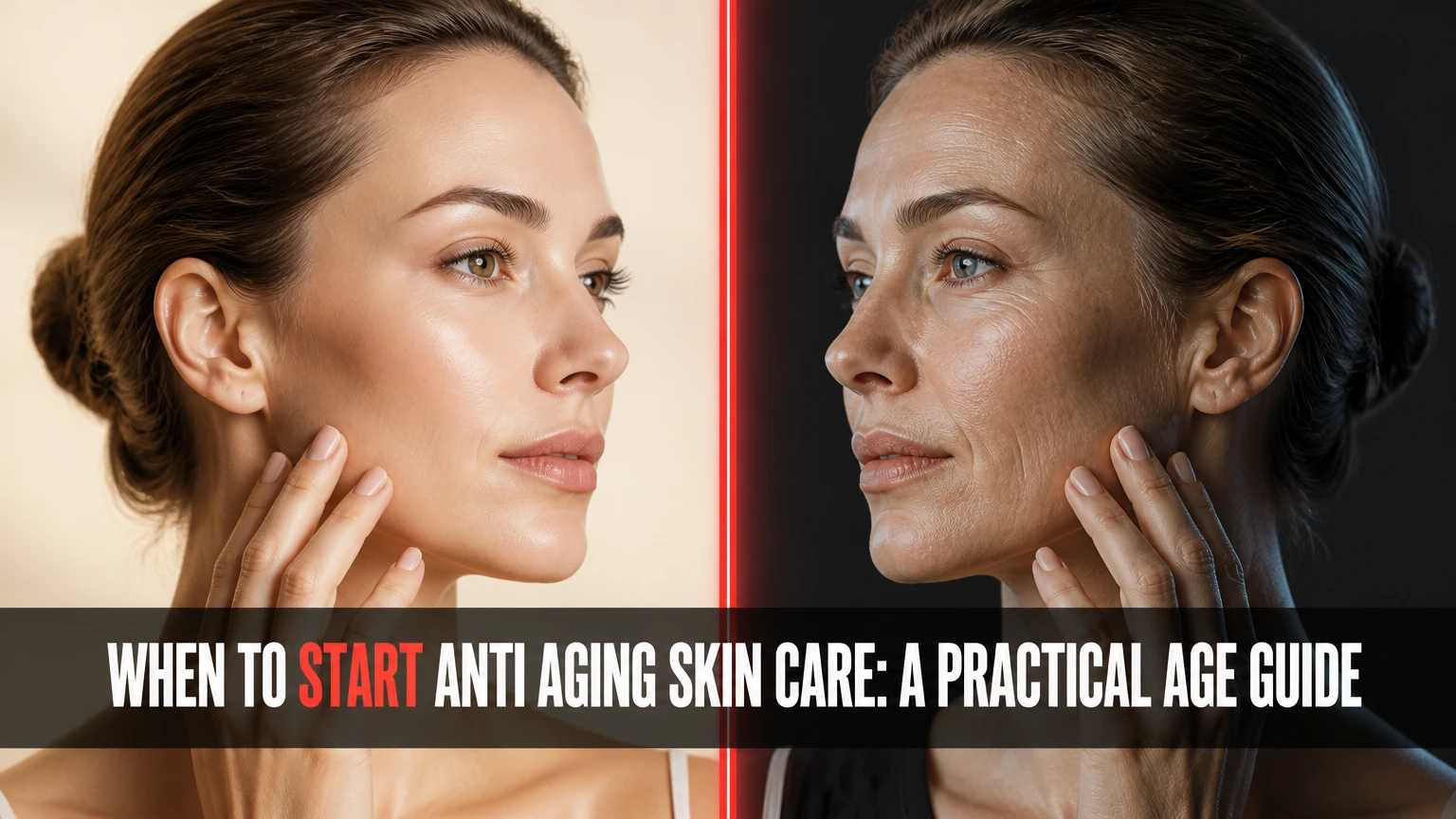
The best time to start anti-aging skin care is when prevention becomes relevant, usually the early to mid-20s, but sunscreen and gentle cleansing can begin much earlier. Start with daily broad-spectrum SPF 30 or higher and moisturizer; add retinoids only when a specific concern or dermatologist-approved plan justifies them.
Key Facts at a Glance
Daily broad-spectrum SPF 30 or higher is the highest-priority anti-aging product at any age.
People in their 20s usually need prevention, not an aggressive wrinkle-treatment routine.
Retinoids can improve fine lines and acne, but irritation increases when beginners start too often.
A basic routine needs cleanser, moisturizer, and sunscreen before vitamin C, acids, or peptides.
Visible improvement commonly takes 8-12 weeks for texture and several months for pigmentation or wrinkles.
Pregnancy and breastfeeding require professional advice before using retinoids.
When to Start Anti Aging Skin Care
Most people should begin a preventive skin-care routine in their 20s, although the correct starting point depends on sun exposure, acne, pigmentation, sensitivity, and family history. Daily sunscreen can start in childhood, while concentrated anti-aging actives are optional and often unnecessary before adulthood.
The phrase “anti-aging” covers two different goals. Prevention means reducing ultraviolet injury, dryness, and inflammation before visible lines develop. Correction means treating established wrinkles, uneven pigmentation, rough texture, or laxity.
The American Academy of Dermatology Association recommends sun protection as a foundation for reducing premature skin aging. The AAD’s consumer guidance states, “The best way to prevent premature skin aging is to protect your skin from the sun,” which is why sunscreen outranks expensive serums in a sensible routine.
Which age needs which routine?
Age is a useful starting point, but skin behavior matters more than a birthday. A 24-year-old outdoor worker with melasma may need more targeted care than a 35-year-old who works indoors and already uses sunscreen consistently.
| Age or situation | Main objective | Recommended starting routine | Usually postpone |
|---|---|---|---|
| Under 13 | Barrier protection and sun safety | Gentle cleanser, moisturizer, SPF 30+ | Retinoids, acids, vitamin C serums |
| 13-19 with acne | Acne control and scar prevention | Cleanser, non-comedogenic moisturizer, SPF 30+ | Multi-acid routines and wrinkle products |
| 20-29 | UV prevention and stable skin barrier | Cleanser, moisturizer, SPF; optional vitamin C or retinoid | Layering five or more actives |
| 30-39 | Prevention plus early correction | SPF, moisturizer, retinoid or antioxidant, targeted treatment | Daily exfoliation without a specific indication |
| 40-49 | Wrinkle, pigment, and dryness management | SPF, retinoid, moisturizer, optional vitamin C | Abrasive scrubs and unplanned procedures |
| 50+ or menopause | Barrier support, pigment, and collagen maintenance | SPF, richer moisturizer, retinoid if tolerated | Assuming stronger products are automatically better |
Why Does Prevention Start Before Wrinkles?
Ultraviolet A and B radiation damage skin through several pathways, including collagen breakdown, oxidative stress, uneven pigment production, and chronic inflammation. The visible result may appear years after the exposure, so waiting for lines to become obvious gives prevention less opportunity to work.
The National Institute on Aging describes intrinsic aging as a gradual biological process, while environmental exposure adds extrinsic damage. Sun exposure, tobacco smoke, air pollution, repeated tanning, and inadequate barrier care can accelerate visible changes.
Collagen production also changes with age, but the exact timing varies by person and study method. Saying that collagen “suddenly stops” at 25 is inaccurate. The practical conclusion is simpler: consistent ultraviolet protection has a larger long-term effect than starting a large collection of actives at a particular birthday.
What Is the Best First Anti-Aging Product?
Sunscreen is the best first anti-aging product because ultraviolet exposure drives many preventable signs of photoaging, including fine lines and discoloration. Choose a broad-spectrum SPF 30 or higher, apply it every morning to exposed skin, and add moisturizer if sunscreen alone does not prevent dryness.
A sunscreen routine fails most often because of insufficient quantity, missed areas, or inconsistent use. Adult facial application typically requires about two finger lengths of lotion for the face and neck, although product texture and finger size make this an approximation rather than a laboratory measurement.
Tinted mineral sunscreens containing iron oxides can be useful for people with melasma or post-inflammatory hyperpigmentation because visible light may worsen pigmentation in some skin types. Water resistance matters for swimming or heavy sweating, but no sunscreen remains fully effective indefinitely in those conditions.
How much sunscreen should you use?
| Body area | Typical amount | Reapplication trigger | Practical note |
|---|---|---|---|
| Face alone | 1 finger length | Every 2 hours outdoors | Use a separate neck amount |
| Face and neck | 2 finger lengths | Sweating, swimming, toweling | Reapply after water exposure |
| Each arm | 1 teaspoon | Outdoor exposure | Include hands and forearms |
| Entire adult body | 1 shot-glass amount | Every 2 hours outdoors | Cover ears, chest, and feet |
| Lips | SPF lip balm layer | After eating or drinking | Choose broad-spectrum protection |
Sunscreen does not need to be reapplied every two hours while sitting indoors all day with no window exposure. Reapplication is most important during prolonged outdoor exposure, sweating, swimming, or toweling.
Sunscreen or Retinol: Which Comes First?
Sunscreen comes first in priority, while retinoids come first among widely used corrective actives. Sunscreen prevents ongoing ultraviolet injury; retinoids can improve cell turnover, acne, texture, and fine lines, but they cannot compensate for unprotected sun exposure.
Retinol is an over-the-counter cosmetic retinoid. Retinal, adapalene, tretinoin, and tazarotene are related but differ in potency, regulation, and evidence. Prescription tretinoin has stronger clinical evidence for photoaging than typical cosmetic retinol, but stronger action also raises the risk of irritation.
A 2019 systematic review in the International Journal of Dermatology found topical retinoids useful for photoaging, while also noting irritation as a common limitation. Retinoids are not instant moisturizers, lifting creams, or replacements for sunscreen.
| Ingredient | Main benefit | Typical onset | Main limitation |
|---|---|---|---|
| Broad-spectrum SPF 30+ | Reduces UV-driven aging | Immediate protection | Requires consistent application |
| Retinol | Texture and fine-line improvement | 8-12 weeks | Dryness, peeling, irritation |
| Tretinoin | Strong photoaging and acne treatment | 8-24 weeks | Prescription and irritation |
| Vitamin C | Antioxidant and pigment support | 8-16 weeks | Formula instability and stinging |
| Niacinamide | Barrier support and uneven tone | 4-12 weeks | High concentrations may irritate |
| Peptides | Limited signaling and hydration support | 8-16 weeks | Evidence varies by formula |
| AHA or BHA | Texture or clogged pores | 4-8 weeks | Overuse damages the barrier |
What Should the Morning Routine Include?
A practical morning routine has four essential actions: cleanse when needed, moisturize, apply any optional antioxidant, and finish with sunscreen. Product order generally moves from the thinnest water-based formula to thicker products, but sunscreen remains the final skin-care layer.
Step 1: Cleanse according to skin needs
Use a gentle cleanser in the morning if skin is oily, sweaty, or prone to acne. Dry or sensitive skin may need only a lukewarm water rinse, because repeated detergent exposure can increase tightness and irritation.
Step 2: Add one optional antioxidant
Vitamin C can support antioxidant protection and uneven-tone treatment, but it is not mandatory. A pre-formulated serum is safer than mixing vitamin C powder at home, where concentration, pH, oxidation, and contamination are difficult to control.
Step 3: Moisturize the barrier
Choose a moisturizer with ingredients such as glycerin, ceramides, squalane, or petrolatum according to skin type. Oily skin may prefer a light lotion, while retinoid users, eczema-prone users, and people in dry climates often need a cream.
Step 4: Apply sunscreen generously
Apply sunscreen as the final morning step, then allow it to set before makeup or outdoor activity. A high SPF does not permit proportionally less product or unlimited time in direct sunlight.
What Should the Night Routine Include?
The nighttime routine should remove sunscreen and makeup, apply one treatment if needed, and finish with moisturizer. Beginners should stabilize cleansing and hydration for at least two weeks before adding a retinoid, acid, or multiple treatment serums.
Is double cleansing necessary?
Double cleansing is useful when removing water-resistant sunscreen, heavy makeup, or substantial pollution. It is unnecessary for everyone, and prolonged cleansing methods such as the 4-2-4 rule can worsen dryness when they involve excessive rubbing or long contact times.
Use an oil or balm cleanser first, rinse, then use a gentle water-based cleanser for approximately 20-30 seconds. Stop when the skin feels clean, not squeaky or tight.
How should beginners add retinoids?
Apply a pea-sized amount of retinoid to completely dry skin two nights per week for two weeks, then increase to every other night only if redness, burning, and persistent peeling remain absent. Moisturizer before or after retinoid application can reduce irritation without making the treatment useless.
| Week | Retinoid frequency | Application method | Advancement rule |
|---|---|---|---|
| 1-2 | 2 nights weekly | Moisturizer, retinoid, moisturizer | No burning or persistent redness |
| 3-4 | 3 nights weekly | Pea-sized amount for full face | Increase only if comfortable |
| 5-8 | Every other night | Dry skin, avoid eyelids and nostrils | Hold frequency during irritation |
| 9+ | Every other night or nightly | Based on tolerance and product | More frequent is not always better |
Avoid retinoids on the corners of the nose, lips, eyelids, broken skin, and active sunburn. Use approximately one pea-sized amount for the entire face, not one pea per wrinkle.
Retinoids are contraindicated during pregnancy, and many clinicians advise avoiding them while breastfeeding because alternatives are available. Ask an obstetric clinician or dermatologist for individualized advice.
How Much Does a Basic Routine Cost?
A basic anti-aging routine typically costs $25-$80 initially and $15-$60 per month after product replacement, depending on sunscreen size, prescription fees, and brand selection. A larger routine with vitamin C, retinoid, acids, and specialized moisturizers commonly reaches $80-$200 initially.
Costs vary by country and pharmacy. A higher price does not prove better clinical performance, especially when the active ingredient concentration, packaging, stability, and tolerability are unknown.
| Routine level | Products | Typical initial cost | Typical replacement interval |
|---|---|---|---|
| Essential | Cleanser, moisturizer, SPF | $25-$70 | 1-3 months |
| Preventive | Essential routine plus vitamin C | $45-$110 | 2-4 months |
| Retinoid | Essential routine plus retinol | $50-$130 | 2-4 months |
| Prescription | Essential routine plus tretinoin visit | $75-$200 | 2-4 months |
| Extensive | Essential routine plus acids and peptides | $90-$220 | 2-5 months |
Practitioner rule: spend first on a sunscreen you will apply generously, not on a serum that makes you ration every drop. Under-application changes the product’s real-world protection.
How Should Sensitive or Acne-Prone Skin Adapt?
Sensitive skin should begin with a fragrance-free cleanser, bland moisturizer, and sunscreen for two to four weeks before introducing an active. Acne-prone skin may use adapalene or salicylic acid for a clinical reason, but a dermatologist can distinguish acne treatment from unnecessary anti-aging layering.
People with rosacea, eczema, seborrheic dermatitis, or a history of contact allergy need a lower-irritation plan. Burning and persistent redness are signs to reduce the routine, not evidence that a product is working.
Darker skin tones are not biologically immune to photoaging. They may show more visible post-inflammatory hyperpigmentation after irritation, so gradual retinoid introduction and daily sunscreen are especially important when treating discoloration.
How should you patch-test a new product?
Apply a small amount to a limited area near the jaw or behind the ear once daily for several days, then introduce the product to the face gradually. A forearm test can miss facial irritation because facial skin, oil production, and exposure patterns differ.
Stop a new product if swelling, hives, intense itching, blistering, or facial burning develops. Seek urgent care for breathing difficulty, throat swelling, or widespread hives.
What Are the Most Common Anti-Aging Mistakes?
The most damaging mistakes are inconsistent sunscreen, too many simultaneous actives, and treating irritation as a requirement for results. Skin improves when treatment is repeated at a tolerable dose, not when the barrier is repeatedly injured.
| Failure mode | Likely cause | Corrective action | Expected recovery |
|---|---|---|---|
| Burning and tightness | Over-cleansing or acids | Stop actives, use moisturizer | 3-14 days |
| Peeling around nose | Retinoid migration | Apply less, buffer with moisturizer | 1-3 weeks |
| New dark marks | Irritation or UV exposure | Sunscreen, simplify routine | 4-16 weeks |
| Persistent breakouts | Comedogenic product or acne | Review products, seek assessment | 6-12 weeks |
| No visible improvement | Inadequate duration or dose | Photograph monthly, reassess at 12 weeks | 3-6 months |
| Watery, stinging eyes | Product too close to eyelids | Keep actives away from eye margins | Several days |
Two expert observations matter here. First, “natural” fragrance oils can trigger irritation even when a label sounds gentle. Second, exfoliating acids and retinoids often produce more redness than benefit when used on the same night by a beginner.
When Are Professional Treatments Appropriate?
A dermatologist is appropriate when pigmentation changes rapidly, acne scars persist, irritation lasts more than two weeks, or over-the-counter care has produced no meaningful change after three to six months. Professional treatments can address deeper wrinkles or laxity, but they carry cost, downtime, and procedure-specific risks.
Common options include prescription tretinoin, chemical peels, laser resurfacing, microneedling, neuromodulators, and fillers. These treatments do different jobs: microneedling may improve selected scars and texture, while fillers restore volume and neuromodulators reduce movement-related lines.
No procedure makes sunscreen optional. A clinician should also assess changing moles, rough scaly lesions, persistent sores, or bleeding spots because those findings may require medical diagnosis rather than cosmetic treatment.
Can You Start Anti-Aging Skin Care After 40?
Starting after 40 can still improve texture, pigmentation, dryness, and fine lines, although treatment cannot erase every structural change. Begin with sunscreen, moisturizer, and one evidence-supported active, then measure progress with consistent photographs taken under the same lighting.
Menopause can increase dryness and sensitivity because hormonal changes affect the skin barrier and collagen environment. Richer moisturizers, shorter cleansing, and slower retinoid introduction may be more useful than adding stronger exfoliants.
What results should you expect?
| Concern | Earliest realistic change | More reliable assessment point |
|---|---|---|
| Dryness and tightness | 1-2 weeks | 4 weeks |
| Rough texture | 4-8 weeks | 12 weeks |
| Acne lesions | 6-8 weeks | 12-16 weeks |
| Uneven pigmentation | 8-12 weeks | 4-6 months |
| Fine lines | 12 weeks | 6-12 months |
| Deep folds or laxity | Limited topical change | Dermatology assessment |
Take one baseline photograph before starting. Monthly comparisons are more reliable than inspecting the mirror every morning, because gradual changes are difficult to notice day to day.
FAQ
Should I use anti-aging products if I have no wrinkles?
Yes, but prevention should remain simple. Daily sunscreen, moisturizer, and gentle cleansing protect the skin barrier and reduce cumulative UV exposure; adding retinol without a concern can create irritation without a meaningful benefit.
Is vitamin C necessary in your 20s?
Vitamin C is optional in your 20s. A stable, pre-formulated serum may help uneven tone and provide antioxidant support, but sunscreen delivers a more important preventive benefit and should be established first.
Can I use retinol every night from the beginning?
Most beginners should not use retinol nightly at first. Start with two nights per week, use a pea-sized amount, and increase only after the skin remains comfortable for at least two weeks.
Should anti-aging skin care include the neck?
Yes. Apply moisturizer and sunscreen to the neck and upper chest, but introduce irritating actives cautiously because those areas may react more easily than the cheeks.
Can sunscreen reverse existing wrinkles?
Sunscreen cannot reverse established wrinkles, but consistent use reduces additional UV damage and may allow other treatments to work more predictably. Retinoids, procedures, and realistic expectations are needed for established lines.
Is expensive skin care more effective?
Expensive products are not automatically more effective. Compare the active ingredient, concentration when disclosed, packaging stability, fragrance load, sunscreen protection, and whether the formula remains comfortable enough for consistent use.
The Bottom Line
When to start anti aging skin care depends less on a precise birthday than on the goal and the condition of your skin. Start prevention with broad-spectrum SPF 30 or higher, gentle cleansing, and moisturizer; consider one retinoid or antioxidant in adulthood when a specific concern justifies it. Add slowly, protect the barrier, and allow at least 8-12 weeks before judging texture changes.