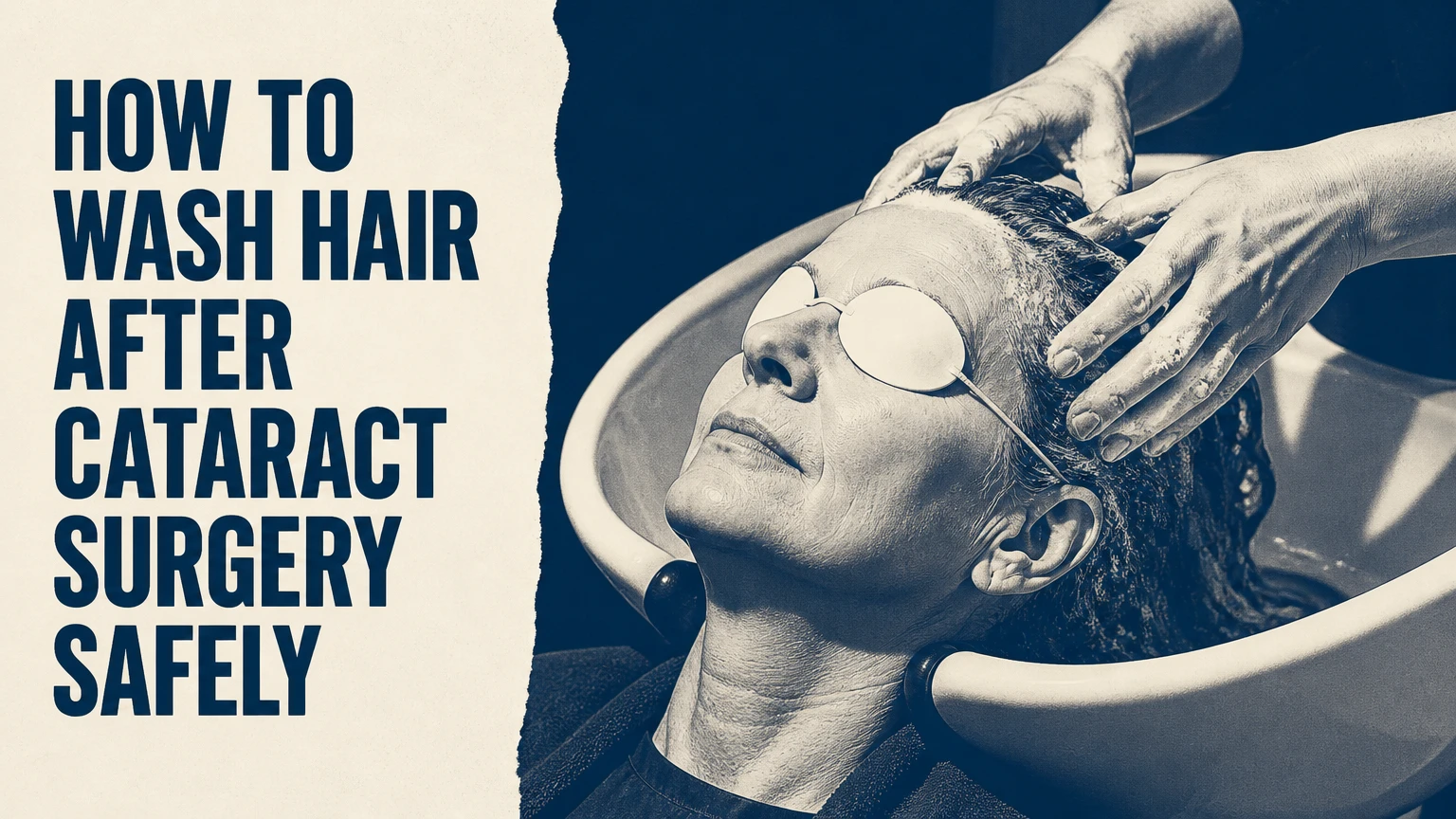
You can usually wash your hair after cataract surgery by keeping water, shampoo, and towel pressure away from the operated eye. The safest approach is an assisted backward wash over a sink, using lukewarm water directed toward the back of the head. Follow your ophthalmologist’s exact timing because postoperative instructions vary by incision, complications, and surgical technique.
Key Facts at a Glance
Cataract surgery recovery commonly requires avoiding direct water, soap, and rubbing around the eye for at least the first several days.
Many patients can shower within 24-48 hours, but normal hair washing may require modified positioning for approximately 1-2 weeks.
An assistant washing hair backward over a sink provides better splash control than a solo shower.
Dry shampoo or a rinse-free cap eliminates running-water exposure but does not replace scalp cleansing indefinitely.
Do not rub, press, tightly tape, or blast the operated eye with a hair dryer after cataract surgery.
Increasing pain, worsening vision, marked redness, light sensitivity, swelling, or discharge requires prompt ophthalmology advice.
What changes after cataract surgery?
Cataract surgery removes the cloudy natural lens through a small corneal incision and places an intraocular lens inside the eye. The incision often self-seals, but the ocular surface remains sensitive while the epithelium, tear film, and internal tissues recover.
The main hair-washing hazards are splash exposure, shampoo irritation, accidental rubbing, bending-related dizziness, and falls. Tap water is not sterile, although a brief splash does not automatically cause an infection; the practical rule is to prevent water from deliberately entering the eye and to contact the surgical team if symptoms develop.
The American Academy of Ophthalmology’s patient guidance uses a simple rule after eye surgery: “Do not rub or press on your eye.” That instruction matters more than trying to create a perfectly waterproof seal with tape or goggles, because rubbing can injure the ocular surface and move debris across it.
Which risks matter most?
| Hazard | Typical trigger | Potential problem | Safer control |
|---|---|---|---|
| Water splash | Handheld shower spray | Irritation or contamination | Use a sink and backward flow |
| Shampoo contact | Suds running over forehead | Burning, tearing, rubbing | Keep lather behind the hairline |
| Eye rubbing | Towel, itch, soap sting | Surface injury or inflammation | Blot nearby skin and use prescribed tears |
| Bending | Standing quickly over a tub | Dizziness or fall | Use a stable chair and helper |
| Hair dryer airflow | High heat near face | Dryness and airborne particles | Low, cool setting directed away |
| Steam and heat | Hot bathroom or shower | Sweating and discomfort | Ventilate and use lukewarm water |
When is hair washing allowed?
Hair washing is often possible within 24-48 hours, but the permitted timing comes from the operating ophthalmologist, not a universal calendar. Some surgeons advise avoiding direct water exposure for several days; others allow careful showering the day after uncomplicated surgery while still prohibiting shampoo in the eye.
A longer delay may apply after complicated surgery, wound leakage, corneal swelling, severe dry eye, poor wound healing, infection, or combined procedures. A patient who received different instructions for each eye should follow the stricter instruction.
| Recovery period | Common practical approach | What to avoid | Decision checkpoint |
|---|---|---|---|
| Surgery day | Use a dry cloth or dry shampoo | Running water near the face | Confirm discharge instructions |
| First 24 hours | Wash body only if approved | Direct eye splash and bending | Keep protective shield available |
| Days 2-3 | Consider assisted sink wash if approved | Solo tub washing and eye rubbing | Ask whether shampoo is permitted |
| Days 4-7 | Continue backward or controlled washing | Shower spray toward face | Check vision and redness |
| Days 8-14 | Gradually resume normal routine if cleared | Scrubbing the operated eye | Maintain no-rubbing habit |
| After 2 weeks | Many patients return to ordinary washing | Swimming until separately cleared | Follow the surgeon’s final restrictions |
The table gives typical ranges, not a prescription. The Royal College of Ophthalmologists and hospital discharge protocols commonly emphasize keeping water and irritants out of the eye during early healing, but protocols differ between clinics. A surgeon’s written instructions override general online advice.
How to Wash Hair After Cataract Surgery: Safe Method
The safest method is a five-stage assisted sink wash that takes approximately 10-15 minutes: prepare the room, position the head backward, wet from the crown, shampoo away from the face, and rinse toward the back. Success depends on water direction and assistance, not on squeezing the eyelids shut.
Before you start
| Requirement | Typical specification | Why it matters |
|---|---|---|
| Total time | 10-15 minutes | Limits fatigue and prolonged exposure |
| Water temperature | Lukewarm, about 35-38°C | Reduces heat, sweating, and irritation |
| Helper | One adult with clear vision and steady hands | Controls spray and towel placement |
| Towels | Two clean towels, 50 x 90 cm typical | One supports the neck, one dries hair |
| Shampoo | 5-10 mL mild, non-medicated formula | Limits suds and rinse time |
| Equipment | Sink, cup or handheld sprayer, chair | Keeps the patient stable |
| Eye medication | Prescribed drops only | Avoids introducing unapproved products |
Remove loose jewelry, secure long hair with a soft tie if needed, and place the chair on a dry, non-slip surface. Keep the postoperative eye shield, prescribed eye drops, and a clean towel nearby, but do not place fabric directly on the eye unless the surgeon specifically allows it.
Step 1: Set up a backward position
Sit facing away from a sink and lean the back of the head over its edge, with the neck supported by a rolled towel. Keep the operated eye above the sink and keep the face angled upward, not tilted sideways toward the drain.
The helper should test the water on their wrist before approaching the hair. You will know the position is suitable when the neck feels supported, the patient can breathe comfortably, and water can flow backward without crossing the forehead.
A common mistake is using a kitchen sink that is too shallow. A deep basin, salon basin, or bathtub edge may provide better clearance, but the helper must prevent the head from slipping.
Step 2: Protect the face without pressure
Ask the helper to place a dry towel across the shoulders and use a second towel to shield the forehead without pressing on the eyelids. Do not tape plastic, gauze, or waterproof material directly to the skin around the eye unless the surgeon supplied it.
A loose barrier catches stray droplets; it does not make eye contact safe. You will know the protection is adequate when the forehead, eyelids, and cheeks remain dry during a test pour.
The frequent error is placing a washcloth over closed eyes and then pressing it down. Pressure over a healing eye is unnecessary and can encourage rubbing when the cloth shifts.
Step 3: Wet the hair from the crown backward
Use a cup or low-pressure handheld sprayer to wet the crown and back of the scalp first. Direct every stream toward the back of the head, and stop several centimeters before the front hairline if water begins to track forward.
Section thick hair into four or more parts so the helper can wet the scalp without increasing water pressure. The checkpoint is simple: water reaches the scalp while the forehead remains dry.
Do not use a high-pressure showerhead. Strong spray increases bounce-back from the sink and makes accidental facial splashes more likely.
Step 4: Apply shampoo behind the hairline
Use approximately 5-10 mL of mild shampoo, applying it to the crown, sides, and back rather than directly at the forehead. Massage with fingertips, not fingernails, for 30-60 seconds while keeping suds away from the face.
Medicated shampoos, hair dyes, bleach, oils, and fragranced treatments are poor choices during the initial wash because they create more irritation if they migrate toward the eye. Shampooing is complete when the scalp feels clean and no painful scratching has occurred.
A common mistake is shampooing the front hairline first because it is easiest to reach. Begin at the back instead, then use a damp cloth to clean the front hairline later without allowing moisture to run toward the eye.
Step 5: Rinse, blot, and stand slowly
Rinse from the front of the crown toward the back, keeping the stream away from the forehead. Continue until the helper feels no slippery residue in the hair, then wrap the hair in a towel before the patient returns upright.
Stand slowly after at least 30 seconds of supported sitting. You will know the wash worked when the eye and surrounding skin are dry, the scalp has no shampoo residue, and vision has not changed from its pre-wash state.
Never rub the face with the drying towel. Blot the cheeks and forehead only if needed, keeping the towel away from the operated eyelids.
Should you bend forward over a sink?
A forward sink wash can work for a mobile adult with good balance, but it is less forgiving than an assisted backward wash. The face must point directly down toward the drain, and water must flow from the back of the head into the basin rather than toward the forehead.
Avoid this technique if you have vertigo, arthritis, spinal disease, recent falls, weakness, poor depth perception, or difficulty standing from a bent position. Cataract surgery can temporarily alter visual balance between the eyes, making a seemingly simple bend more hazardous.
| User situation | Forward sink wash | Assisted backward wash | Preferred alternative |
|---|---|---|---|
| Stable adult, short hair | Usually feasible | Safer | Either method |
| Long, thick hair | Time-consuming | More complete rinse | Helper or salon |
| Vertigo or falls | Avoid | Appropriate with support | Rinse-free cap |
| Neck arthritis | Usually avoid | Use neck cushion | Dry shampoo |
| Living alone | Possible with caution | Requires planning | Waterless wash |
| Child or dependent adult | Not suitable | Adult supervision required | Caregiver wash |
If approved by the surgeon, bend from the hips over a deep sink, keep both feet planted, and direct lukewarm water from the nape toward the drain. Do not rise while the hair is dripping, because wet hair and sudden posture changes increase slipping and dizziness.
Which hair-washing option is safest?
The assisted backward wash is usually the best balance of cleanliness and splash control. A waterless product is safest for the first day or when balance is limited, while a shower shield offers convenience but cannot prevent every leak or replace careful positioning.
| Method | Typical time | Typical cost | Best use | Main limitation |
|---|---|---|---|---|
| Family-assisted sink wash | 10-15 minutes | $0-$10 | Early recovery at home | Needs a helper |
| Professional salon basin | 20-30 minutes | $25-$60 | Thick or long hair | Travel and chair transfer |
| Dry shampoo powder or aerosol | 3-5 minutes | $5-$15 | One temporary refresh | Does not remove all buildup |
| Rinse-free shampoo cap | 5-10 minutes | $6-$20 | Limited mobility or bed rest | Can leave residue |
| Forward sink wash | 10-20 minutes | $0-$10 | Independent, stable adult | Neck and fall strain |
| Shower visor or goggles | 10-15 minutes | $8-$25 | Later controlled washing | Seal and splash limitations |
Typical prices are United States retail or service ranges and vary by city, brand, hair length, and insurance. A salon wash is not medically superior by itself; its advantage is controlled water flow and trained assistance.
Waterless options
Dry shampoo absorbs some oil and improves hair appearance, but it does not remove sweat, skin cells, styling products, or scalp microorganisms in the way water and shampoo do. Use the smallest amount needed, apply it away from the face, and avoid aerosol clouds around an irritated eye.
Rinse-free caps are more useful when the scalp genuinely needs cleaning. Warm the cap only according to its package instructions, keep the fluid away from the eye, and stop if fragrance or residue causes itching.
Waterless products are temporary tools, not a two-week substitute for every patient. Someone with seborrheic dermatitis, heavy styling product, or a sweaty scalp may need an assisted wash sooner.
Protective equipment
A visor can reduce overhead splashes, and swimming goggles may block droplets when they fit comfortably around, rather than pressing on, the operated eye. Neither device guarantees protection, particularly when water runs down the forehead or shampoo is rinsed from the hairline.
Do not use goggles as permission to take a normal high-pressure shower. The better combination is low water pressure, a backward-facing position, a helper, and a visor only as secondary protection.
Can you shower while protecting the operated eye?
Many patients can take a brief shower after the surgeon permits bathing, but the showerhead should not point at the face, and soap should not pass over the operated eye. Stand with the back or side of the head away from the spray, keep the shower under 10 minutes, and wash the face separately with a damp cloth.
| Shower feature | Safer setting | Avoid during early recovery |
|---|---|---|
| Water temperature | Lukewarm, 35-38°C | Hot water and heavy steam |
| Spray direction | Shoulder or body level | Face-level spray |
| Duration | 5-10 minutes | Long, steamy showers |
| Floor | Non-slip mat | Wet tub without support |
| Hair position | Lean backward or sideways | Face under showerhead |
| Drying | Pat body and hair | Rubbing eyelids |
A shower chair is worthwhile for patients with low blood pressure, weakness, or balance concerns. Keep shampoo on the back of the scalp and rinse with the face turned away from the flow.
What should you avoid during recovery?
The highest-value restrictions are mechanical and chemical: avoid rubbing the eye, direct water pressure, shampoo migration, and unstable bathroom movements. Eye drops should be used exactly as prescribed, and no cosmetic or cleansing product should be introduced into the operated eye.
- Do not squeeze the eyelids tightly to block water.
- Do not rub or press the eye with fingers, towels, cotton pads, or goggles.
- Do not use hair dye, bleach, perm solution, or strong fragrance near the eye during early healing.
- Do not direct a hair dryer toward the face; use a cool, low setting pointed away.
- Do not swim, use a hot tub, or submerge the head until the surgeon clears it.
- Do not share towels, washcloths, or eye-drop bottles.
- Do not use tap water to rinse an eye unless a clinician specifically instructs you.
One counterintuitive rule matters: a clean towel is not automatically safe if it touches the eyelid with pressure. Blotting nearby skin is safer than wiping across the eye, even when the towel has just been laundered.
What if water or shampoo enters the eye?
If a small amount of water or shampoo enters the eye, do not rub it and do not panic. Close the eyelids gently, blink normally, and follow your ophthalmologist’s instructions about preservative-free artificial tears; contact the surgical team promptly if pain, redness, discharge, light sensitivity, or vision changes persist.
Do not deliberately flush the eye with tap water unless your surgeon, emergency clinician, or poison-control service directs you to do so. If a substantial chemical product enters the eye, call Poison Control in the United States at 1-800-222-1222 or seek urgent medical guidance, because chemical exposure may require a specific irrigation plan.
| Symptom after exposure | Action | Suggested urgency |
|---|---|---|
| Brief stinging that resolves | Stop washing and monitor | Same day if uncertain |
| Persistent burning | Contact ophthalmology | Prompt advice |
| New blurred or reduced vision | Call surgical team | Immediate |
| Increasing redness or swelling | Contact ophthalmology | Same day |
| Thick discharge | Seek clinical assessment | Same day |
| Severe pain, nausea, or halos | Urgent eye evaluation | Emergency |
| Light sensitivity with worsening pain | Urgent eye evaluation | Emergency |
Do not place antibiotic, redness-relief, or leftover prescription drops in the eye without medical direction. Different drops have different preservatives and purposes.
When do symptoms suggest an infection?
Endophthalmitis is uncommon but serious, and symptoms often include worsening vision, increasing eye pain, marked redness, light sensitivity, eyelid swelling, or new discharge rather than a minor transient sting. The American Academy of Ophthalmology identifies pain, redness, decreased vision, and discharge as warning signs that need medical attention after eye surgery.
Symptoms may arise several days after surgery, so a normal first-day examination does not eliminate later risk. Call the operating ophthalmologist or the emergency eye service immediately when vision worsens or pain increases; do not wait for the next scheduled appointment.
How should limited-mobility patients plan?
Patients with limited mobility should arrange the first hair wash with a caregiver, home-health worker, or salon that can support a backward basin position. A forward bend is a poor choice when balance, neck movement, vision, or transfer ability is limited.
Schedule the wash at a time when prescribed drops have already been administered and fatigue is low. Place nonslip footwear, a stable chair, towels, and the telephone within reach, and have the helper do the rinsing.
What works for long or textured hair?
Long, dense, curly, or textured hair usually needs sectioning and more rinse time than short hair. Divide the hair into four to eight sections, apply small shampoo amounts, and rinse each section separately so residue does not travel toward the face.
A salon or experienced helper is often more practical than dry shampoo alone for this hair profile. If the hair takes more than 20 minutes to rinse, pause while seated rather than keeping the head tilted backward until the neck becomes painful.
Typical time and cost
A home sink wash generally takes 10-20 minutes and costs $0-$10 when household towels and shampoo are already available. A professional wash commonly costs $25-$60, while dry shampoo, rinse-free caps, visors, and goggles typically add $5-$25.
| Plan | Preparation time | Wash time | Typical total cost | Suitable scenario |
|---|---|---|---|---|
| Dry shampoo | 2 minutes | 3-5 minutes | $5-$15 | Surgery day or first 24 hours |
| Caregiver sink wash | 5 minutes | 10-15 minutes | $0-$10 | Most uncomplicated recoveries |
| Salon basin wash | 10-20 minutes | 20-30 minutes | $25-$60 | Thick hair or no helper |
| Shower with visor | 5 minutes | 5-10 minutes | $8-$25 | Surgeon-approved later washing |
| Rinse-free cap | 2 minutes | 5-10 minutes | $6-$20 | Limited mobility |
These costs are planning estimates, not medical fees. Transportation, an assistant’s time, and a shower chair can change the total substantially.
Common mistakes and how to fix them
| Mistake | Why it fails | Immediate correction | Prevention |
|---|---|---|---|
| Washing face under the shower | Direct spray reaches the incision area | Stop and dry by blotting | Turn away from spray |
| Tight eye squeezing | Increases discomfort and encourages rubbing | Relax eyelids gently | Use positioning, not force |
| Starting at the forehead | Suds run toward the eye | Rinse backward immediately | Begin at the nape |
| Standing too quickly | Wet floor and dizziness increase falls | Sit and wait 30 seconds | Dry floor first |
| Using a hot dryer | Heat worsens dryness | Switch to cool, low airflow | Point dryer away |
| Trusting goggles completely | Leaks can still occur | Stop if moisture enters | Add low pressure and a helper |
A practitioner’s rule of thumb is to test the complete movement with plain water before adding shampoo. The test exposes sink depth, neck strain, spray bounce, and drainage problems while recovery is still protected.
Frequently Asked Questions
Can I wash my face at the same time as my hair?
Wash the face separately with a clean, damp cloth during early recovery. Keep the cloth away from the operated eyelid, use gentle strokes on the cheeks and forehead, and avoid facial cleanser near the eye until the surgeon permits ordinary washing.
Is tap water safe after cataract surgery?
Tap water is suitable for ordinary hygiene but is not sterile for deliberate eye irrigation. Prevent tap water from entering the operated eye, avoid swimming and hot tubs until cleared, and follow the surgeon’s instructions if a splash causes persistent symptoms.
Can I use my prescribed eye drops immediately after washing?
Use prescribed drops according to the written schedule rather than adding extra doses automatically after hair washing. Wash and dry your hands first, keep the bottle tip away from the eye, and ask the clinic whether a dose was missed or contaminated.
Can I wash my hair alone after cataract surgery?
A stable adult may manage a careful forward sink wash after approval, but assistance is safer during the first several days. Do not wash alone if dizziness, poor balance, neck pain, reduced vision, or difficulty transferring in and out of a tub is present.
When can I dye or chemically treat my hair?
Postpone dye, bleach, relaxers, perms, and other chemical treatments until the ophthalmologist confirms that the eye has healed adequately. Hair chemicals can irritate the ocular surface, and salon rinsing makes accidental exposure more likely than ordinary shampooing.
Can I sleep after washing my hair?
Sleep with hair fully dry and continue using the protective eye shield if the surgeon prescribed one. Do not sleep face-down or press the operated side into a pillow, because pressure and unconscious rubbing can disturb the healing eye.
The Bottom Line
The safest answer to how to wash hair after cataract surgery is to use an assisted, backward sink wash with lukewarm water, low pressure, shampoo kept behind the hairline, and no towel contact with the operated eye. Dry shampoo or a rinse-free cap can bridge the first day or two. Your ophthalmologist’s discharge instructions determine the exact timing, and worsening pain, redness, discharge, or vision requires urgent professional advice.