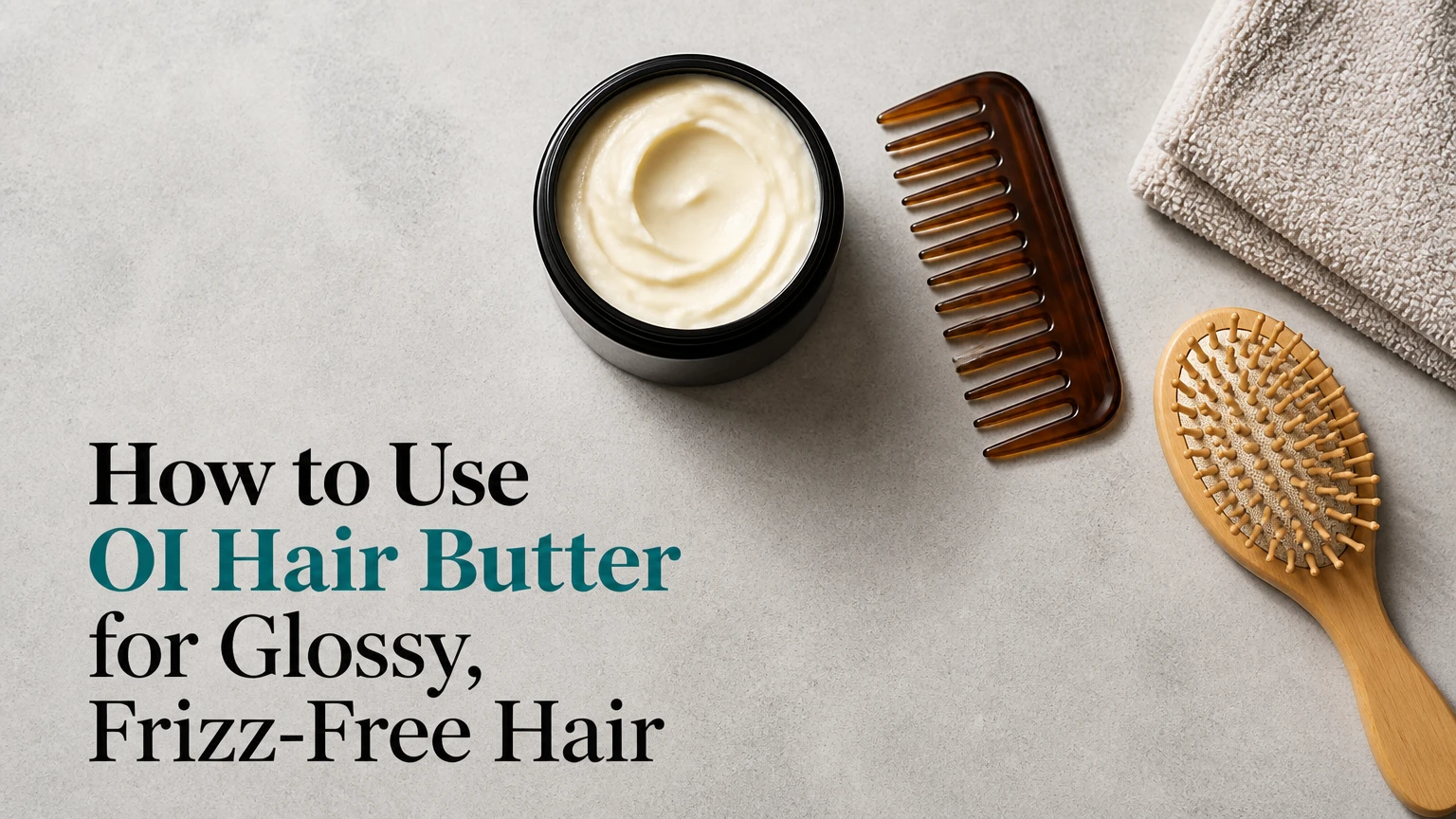
Davines OI Hair Butter is a rinse-out treatment mask for dry, coarse, frizzy, or chemically processed hair. Apply a small amount to clean, towel-dried mid-lengths and ends, leave it on for 5-10 minutes, then rinse thoroughly; fine hair often performs better with a 10-minute pre-shampoo application on dry lengths.
Key Facts at a Glance
Davines OI Hair Butter is a rinse-out mask, not a daily leave-in conditioner.
Apply the product below the ears, keeping it away from the scalp and roots.
Fine hair usually benefits from dry, pre-shampoo use, while thick hair generally tolerates damp, post-shampoo use.
A typical starting amount is 5 ml, approximately one teaspoon, for shoulder-length medium-density hair.
Leave Davines OI Hair Butter on for 5-10 minutes, then rinse until the hair feels soft rather than coated.
Davines OI Hair Butter can improve softness, shine, detangling, and surface frizz, but it does not repair split ends permanently.
What Is Davines OI Hair Butter?
Davines OI Hair Butter is a concentrated conditioning treatment designed to soften the hair fiber and reduce visible frizz. The formula contains roucou oil, also called annatto oil, and apricot butter, which give the product its dense texture and rich emollient profile.
The product creates a temporary cosmetic effect on the hair surface. Davines describes the result as “extraordinary softness, shine and anti-frizz action,” which accurately describes what users can assess after rinsing: easier detangling, a smoother feel, and greater light reflection.
OI Hair Butter is most useful when hair feels rough after cleansing, expands in humidity, tangles at the ends, or loses gloss because the cuticle surface is uneven. The mask is less suitable for people who need daily root volume, a lightweight conditioner, or a styling product that remains in the hair.
How does OI Hair Butter work?
Roucou oil and apricot butter coat and condition the outer hair fiber, while the water-based application helps spread the formula across the cuticle. The result is smoother friction between strands, better slip during combing, and a more uniform surface that reflects light.
The terms “restructuring” and “repair” describe the product’s cosmetic performance rather than permanent biological repair. Hair shafts are nonliving keratin fibers, so a mask cannot fuse a split end or reverse chemical alteration permanently. It can temporarily fill rough areas, reduce friction, and make damaged hair behave more smoothly until the coating wears away through washing and friction.
Which Application Method Fits Your Hair?
Fine or medium-density hair usually benefits from applying OI Hair Butter to dry hair before shampooing, while coarse, thick, curly, or highly porous hair usually benefits from applying it after shampooing to damp hair. Hair density, strand diameter, porosity, and desired volume matter more than a rigid universal rule.
The official Davines directions commonly position OI Hair Butter as a post-shampoo treatment on wet hair. The pre-shampoo method is a practical adaptation used when a rich mask makes fine roots or lengths feel flat. Test one method for two washes before changing the amount and timing.
| Hair profile | Starting method | Processing time | Starting frequency |
|---|---|---|---|
| Fine, straight, shoulder length | Dry, before shampoo | 10 minutes | Every 10-14 days |
| Medium-density, wavy | Damp, after shampoo | 5-10 minutes | Every 7-10 days |
| Thick, coarse, straight | Damp, after shampoo | 10 minutes | Once weekly |
| Curly, porous, or bleached | Damp, after shampoo | 5-10 minutes | Every 1-2 washes |
| Very short or low-density hair | Dry, pre-shampoo | 5-10 minutes | Every 2-3 weeks |
Fine and medium hair
Apply OI Hair Butter to dry lengths and ends before cleansing if your hair loses volume easily. Dry hair limits product spread, so use less than you would on wet hair and divide the lengths into two or four sections before smoothing the butter through.
Leave the treatment on for 10 minutes, rinse, and shampoo normally. Fine hair often needs no second conditioner because the butter already supplies substantial slip. If the ends still feel rough, use a pea-sized amount of lightweight conditioner only on the final 5 cm.
Coarse, curly, and chemically treated hair
Apply OI Hair Butter after shampooing when thick or porous hair needs maximum lubrication and detangling. Remove excess water first, because dripping-wet hair dilutes the product and causes it to slide toward the drain before the strands receive an even coating.
Curly hair can benefit from sectioning and gentle finger distribution, but avoid aggressive brushing that disrupts the curl pattern. Bleached hair may need a richer treatment, although a mask cannot replace a bond-building product when breakage results from chemical damage rather than surface dryness.
How to Use OI Hair Butter
Use Davines OI Hair Butter in five controlled steps: cleanse or dry-prep according to hair type, emulsify a small amount, apply below the ears, distribute through the ends, and rinse after 5-10 minutes. The most important factor is product control, because excess butter creates weight faster than extra shine.
Before you start
| Requirement | Typical specification | Why it matters |
|---|---|---|
| Product amount | 2.5-10 ml | Prevents coating fine or short hair |
| Application area | Mid-lengths to ends | Keeps roots from becoming oily |
| Processing time | 5-10 minutes | Allows conditioning without unnecessary exposure |
| Tools | Towel, wide-tooth comb, timer | Controls water, spread, and timing |
| Total routine time | 15-25 minutes | Includes washing, treatment, and rinsing |
| Water temperature | Lukewarm | Removes residue without excessive heat |
Step 1: Choose dry or damp preparation
Choose dry application before shampooing for fine, low-density hair, and choose damp application after shampooing for medium to coarse hair. If your hair is between categories, begin with the post-shampoo method and use half the amount recommended for thick hair.
For the dry method, brush or finger-detangle gently before applying the product. For the damp method, shampoo first, rinse fully, and squeeze the lengths with your hands until water no longer streams from them.
Success checkpoint: Hair should be sectionable without dripping water, or fully dry if you are using the fine-hair method.
Common mistake: Applying a rich treatment to dripping hair and assuming poor results mean the product is ineffective.
Step 2: Emulsify the butter between your palms
Start with approximately 2.5 ml, about half a teaspoon, for short or fine hair. Begin with 5 ml, about one teaspoon, for shoulder-length medium-density hair, and increase gradually toward 10 ml for long, thick hair.
Rub the product between your palms for about five seconds until the opaque butter spreads into a thin, translucent film. Warming the product improves control and prevents one dense clump from landing on a single section.
Success checkpoint: Your palms should show an even film rather than a white mound of product.
Common mistake: Placing a cold scoop directly on the hair, which produces uneven saturation and encourages overuse.
Step 3: Apply OI Hair Butter below the ears
Smooth the emulsified product over the mid-lengths and ends, beginning approximately at ear level. Press the palms around each section rather than rubbing randomly, then add a small amount only where the ends remain dry.
Keep the scalp and first several centimetres of root hair free of the mask unless a professional has specifically recommended otherwise. Scalp application can increase oiliness, flatten the root area, and make cleansing more difficult.
Success checkpoint: Each treated section feels lightly lubricated, with no visible white residue or sticky patches.
Common mistake: Applying the same quantity to the roots as to the porous ends.
Step 4: Distribute with fingers or a wide-tooth comb
Use your fingers first, then a wide-tooth comb if your hair tangles easily. Start at the ends and move upward in short passes, because forcing a comb from the roots downward can tighten knots and increase mechanical breakage.
A comb is optional for tightly curled hair. Finger-raking or praying-hands distribution often spreads the formula while preserving curl grouping. Divide dense hair into four to eight sections so the outer layer does not receive all the product.
Success checkpoint: The hair separates into smooth sections, and the ends glide without repeated pulling.
Common mistake: Combing too aggressively while the hair is saturated and elastic from water.
Step 5: Process for 5-10 minutes and rinse completely
Leave OI Hair Butter on for five minutes when your hair is fine, lightly dry, or easily weighed down. Use up to 10 minutes for coarse, porous, curly, or bleached lengths; a shower cap can retain warmth, but added heat is unnecessary.
Rinse with lukewarm water until the hair feels soft and flexible rather than waxy or slippery. Rinse longer around the nape and underneath the hair, where dense sections can retain residue.
Success checkpoint: Wet hair feels conditioned but clean, and fingers can pass through without a greasy film.
Common mistake: Rinsing for only a few seconds and interpreting leftover coating as superior conditioning.
How Much Product Is Enough?
A teaspoon is a practical starting point for shoulder-length, medium-density hair, while fine or short hair may need only 2.5 ml and very thick, long hair may need up to 10 ml. Hair length alone does not determine dosage, because density and porosity control how much surface area needs conditioning.
| Hair length and density | Approximate amount | Visual guide | Adjustment |
|---|---|---|---|
| Short, fine | 1-2.5 ml | Pea to half teaspoon | Add 1 ml only to dry ends |
| Shoulder length, medium | 5 ml | One level teaspoon | Add 1-2 ml by section |
| Long, medium density | 5-7.5 ml | One to 1.5 teaspoons | Concentrate on the bottom half |
| Long, thick or coarse | 7.5-10 ml | 1.5-2 teaspoons | Divide into four or more sections |
| Very porous ends only | 2.5-5 ml | Half to one teaspoon | Keep the application below ear level |
The best dosage is the smallest quantity that creates even slip. If hair feels heavy after drying, reduce the next application by 25-50 percent before reducing the processing time.
How Long Should You Leave It On?
Leave OI Hair Butter on for 5-10 minutes, because the treatment is designed to produce a rinse-out conditioning effect rather than an overnight soak. Fine hair should begin at five minutes after shampooing or 10 minutes before shampooing, while coarse and porous hair can use the upper end of the range.
Longer processing does not guarantee deeper repair. Once the hair feels evenly coated, additional time mainly increases the chance of residue and does not reverse split ends or chemical breakage.
Do not sleep in OI Hair Butter unless a stylist who knows your hair has given you a specific reason. Overnight use adds little predictable benefit, complicates rinsing, and transfers oily product to bedding and skin.
How Often Should You Use It?
Use OI Hair Butter once every 7-14 days as a starting schedule, then adjust according to texture, porosity, and post-wash weight. Thick, bleached, or highly porous hair may tolerate use every wash, while fine, straight hair often needs only two applications per month.
| Hair concern | Starting schedule | Signs to increase | Signs to reduce |
|---|---|---|---|
| Fine hair without damage | Every 14 days | Ends remain rough after shampoo | Flat roots or rapid oiliness |
| Frizz and humidity exposure | Every 7-10 days | Surface remains expanded | Hair lacks movement |
| Coarse or dry hair | Once weekly | Ends still snag | Hair feels waxy |
| Bleached or heat-damaged hair | Every 5-7 days | Breakage-prone ends feel rough | Build-up or limp curls |
| Curly, porous hair | Every 1-2 wash days | Curls feel dry and tangle | Curl clumps separate or stretch |
Use a clarifying shampoo occasionally if multiple oils, silicones, styling creams, or masks accumulate. Clarification frequency depends on the entire routine, not on OI Hair Butter alone.
What Are the Sizes and Typical Costs?
Davines OI Hair Butter commonly appears in 75 ml, 250 ml, and 1000 ml formats, with retail prices varying by country, retailer, tax, and professional distribution. The 250 ml tub is usually the practical home size, while the 1000 ml format makes financial sense only for frequent, high-volume use.
| Format | Typical retail range | Best fit | Approximate applications |
|---|---|---|---|
| 75 ml | $25-$29 | Trial use or travel | 8-30 |
| 250 ml | $45-$52 | Regular home care | 25-100 |
| 1000 ml | $110-$120 | Salon or thick-hair users | 100-400 |
| Professional availability | Varies by market | Licensed salon purchasing | Depends on service dosage |
Application estimates assume approximately 2.5-10 ml per use. A fine-haired user applying 2.5 ml every two weeks could use a 75 ml container for roughly 12 weeks, while a thick-haired user applying 10 ml weekly could use 250 ml in about six months.
Check the current Davines regional website or an authorized salon for current pricing and packaging. Marketplace listings can vary widely and may not represent authorized stock.
How Does It Compare With Alternatives?
OI Hair Butter is the stronger choice for intense softness and surface frizz control, while a daily conditioner is better for quick rinsing, lightweight detangling, and frequent washing. Hair oil, leave-in conditioner, and bond-building treatments solve different problems and should not be treated as interchangeable versions of the same product.
| Product type | Main use | Rinse required | Best timing |
|---|---|---|---|
| OI Hair Butter | Rich conditioning and shine | Yes | Weekly or occasional wash day |
| Daily conditioner | Fast detangling | Yes | Most wash days |
| Hair oil | Surface lubrication and shine | Usually no | Before washing or after styling |
| Leave-in conditioner | Ongoing softness and detangling | No | Damp hair after washing |
| Bond-building treatment | Support for chemically stressed fibers | Product-specific | Scheduled treatment day |
Is OI Hair Butter a conditioner?
OI Hair Butter functions as a rinse-out conditioning mask, but it is richer and more concentrated than a typical daily conditioner. Use it in place of conditioner when hair needs extra softness, or use a lightweight conditioner on another wash day when the hair feels healthy and manageable.
A daily conditioner usually offers faster application and lower risk of flattening fine hair. OI Hair Butter earns its place when roughness, frizz, or tangling persists after ordinary conditioning.
Does OI Hair Butter protect against heat?
OI Hair Butter should not be treated as a complete heat protectant. The product improves lubrication and softness after rinsing, but blow-drying, curling irons, and flat irons require a dedicated heat-protection product used according to its label.
Davines OI All In One Milk is one example of a separate leave-in styling product associated with the OI line. Apply the appropriate heat protectant to towel-dried hair after rinsing the butter, then follow the protectant’s temperature and usage instructions.
Can hair oil replace OI Hair Butter?
Hair oil can reduce surface friction and add shine, but oil does not replace a water-based rinse-out mask for every hair type. Oil is often more useful for sealing the ends or pre-shampoo lubrication, whereas OI Hair Butter provides a broader conditioning film during the treatment step.
For fine hair, a few drops of oil may be easier to control than a rich mask. For coarse or porous hair, the two products can work in separate steps, but combining them immediately may create excess weight.
Why Does OI Hair Butter Make Hair Heavy?
OI Hair Butter makes hair heavy when the dose exceeds the hair’s absorption and surface-conditioning needs, when the product reaches the roots, or when residue is not rinsed from dense sections. Fine, low-porosity hair shows this problem sooner because it needs less lubrication.
| Symptom after drying | Likely cause | Next-wash correction | Expected result |
|---|---|---|---|
| Flat roots | Application too close to scalp | Start below ears | More root lift |
| Greasy lengths | Excess quantity | Cut amount by 50% | Cleaner movement |
| Stringy ends | Uneven clumps | Emulsify and section | More uniform texture |
| Waxy feel | Incomplete rinsing | Rinse for an extra 60 seconds | Softer, cleaner finish |
| Dry upper lengths, oily tips | Product migration | Apply only to porous areas | Better balance |
Fixing coated or oily hair
Wash the hair with your normal shampoo, concentrating the lather on the scalp and allowing the rinse water to clean the lengths. If the coating remains, use a clarifying shampoo once, then follow with a light conditioner only on the ends.
Do not immediately apply more butter to correct a rough feel. Residue can make hair both greasy and stiff, and adding more emollient compounds the problem. Wait until the next clean wash, then restart at half the previous dose.
Which Situations Need a Different Routine?
Hair goals change the correct placement, dose, and frequency of OI Hair Butter. Fine hair needs volume protection, curls need even section coverage, and bleached hair needs conditioning combined with a separate strategy for structural damage.
For fine hair that frizzes
Use 2.5 ml on dry lengths for 10 minutes, then shampoo thoroughly. Apply no product above the ears, and begin with once every two weeks.
This method gives the ends contact with the butter while shampoo removes excess surface residue. If the hair still looks flat, reduce the amount before reducing the treatment frequency.
For curly hair
Apply 5-10 ml to clean, damp sections, then distribute with fingers or a wide-tooth comb from ends upward. Rinse thoroughly, leaving no heavy film that could stretch curl formation.
Use the mask every one or two wash days only if the curls remain soft and springy after drying. If curl groups look elongated or separated, reduce the amount and use a lighter conditioner on the next wash.
For bleached or heat-damaged hair
Use OI Hair Butter for softness, detangling, and reduced friction, but pair it with a bond-building or strengthening product if bleaching has caused breakage. Apply the mask below the most fragile area, leave it for up to 10 minutes, and avoid rough towel handling.
Chemically damaged hair often needs alternating treatment categories. A rich emollient mask addresses feel and manageability, while a strengthening formula addresses a different performance need.
For frequent heat styling
Use OI Hair Butter once weekly after shampooing, followed by a dedicated heat protectant before blow-drying. A treatment mask can make the surface smoother, but it cannot make high-temperature styling risk-free.
Keep the dryer moving and use the lowest effective heat setting. Avoid applying extra butter as a substitute for heat protection.
What Is OI Hair Butter Not Good For?
OI Hair Butter is not a scalp treatment, permanent split-end repair, substitute for heat protectant, or reliable solution for active scalp conditions. The product is designed for cosmetic conditioning of the hair lengths, so applying more cannot correct problems outside that purpose.
Stop use if burning, swelling, persistent itching, or a rash develops, and rinse the product away. People with known fragrance or botanical sensitivities should review the current ingredient list and patch-test cautiously according to professional advice.
Avoid using the mask on the scalp to treat dandruff, excess sebum, or irritation. Those concerns require diagnosis and products formulated for the scalp rather than a rich hair-length treatment.
Finishing the Routine
After rinsing OI Hair Butter, gently squeeze out water and apply leave-in conditioner or heat protectant only if your styling routine requires it. The post-treatment product should be lighter than the mask when hair is fine or low porosity.
Use a microfiber towel or soft cotton T-shirt to reduce rough handling, then detangle from the ends upward. Finish with a small amount of styling cream or oil only after the hair is partly dry and you can assess whether the butter already supplied enough smoothness.
The best finish is movement with reduced friction, not a visibly coated strand. If hair feels soft while wet but becomes greasy when dry, the correction is usually less product, more rinsing, or less frequent use.
Frequently Asked Questions
Can I use OI Hair Butter before shampooing?
Yes, pre-shampoo use is often effective for fine or easily weighed-down hair. Apply approximately 2.5-5 ml to dry mid-lengths and ends, leave it for 10 minutes, rinse, and shampoo. Thick or very porous hair may receive better detangling from the standard post-shampoo application on damp lengths.
Should I use conditioner after OI Hair Butter?
Usually, no additional conditioner is necessary after OI Hair Butter because the mask already supplies substantial conditioning. Add a small amount of lightweight conditioner only when the ends still feel rough after rinsing, and keep it away from the roots to avoid excess weight.
Can I leave OI Hair Butter on overnight?
Overnight use is unnecessary for the intended rinse-out treatment. Davines OI Hair Butter is generally used for 5-10 minutes, and leaving it on overnight can increase residue, transfer to fabric, and irritate sensitive skin around the hairline. Rinse the product after the recommended processing time.
Can I apply OI Hair Butter to the roots?
Avoid applying OI Hair Butter to the roots and scalp during normal use. The dense conditioning base can flatten root volume and make the scalp appear oily, especially on fine or straight hair. Begin around ear level and concentrate the product on the drier lower lengths.
Does OI Hair Butter repair split ends?
OI Hair Butter can temporarily smooth the feel and appearance of split ends, but it cannot permanently reconnect a split hair shaft. Regular trims remove existing splits, while conditioning masks reduce friction that can contribute to further roughness and tangling.
Can I use OI Hair Butter every wash day?
Some coarse, curly, or highly porous hair can use OI Hair Butter every wash day, but daily use is excessive for many fine or medium textures. Start once weekly, assess the hair after drying, and reduce the dose or frequency if the result becomes flat, waxy, limp, or oily.
The Bottom Line
The most reliable way to use OI Hair Butter is to match the application method to hair density: apply a small amount to dry hair before shampooing when hair is fine, or to damp hair after shampooing when hair is coarse, curly, or porous. Leave Davines OI Hair Butter on for 5-10 minutes, keep it below the ears, and rinse until no coating remains. Used with controlled dosage, OI Hair Butter can improve softness, shine, detangling, and visible frizz without sacrificing movement.