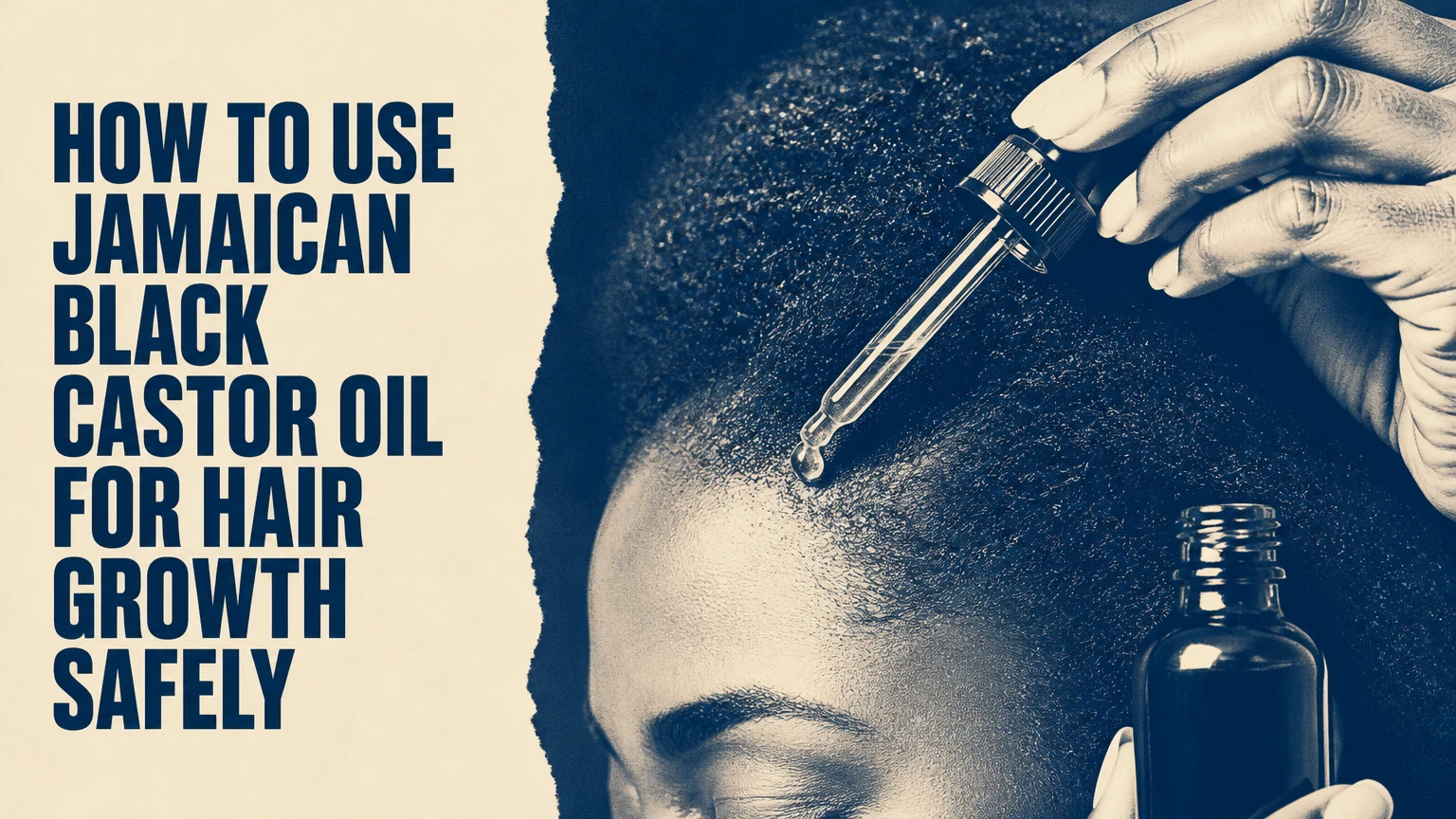
Jamaican black castor oil can be used as a pre-shampoo scalp oil, a moisture sealant, or a small additive to conditioner, but it has not been proven to stimulate new human hair growth. Apply 5-10 drops to a clean, dry scalp once weekly, massage gently for 3-5 minutes, leave it on for 30-60 minutes, then shampoo thoroughly.
Key Facts at a Glance
Jamaican black castor oil is a thick, roasted castor-bean oil that may contain alkaline ash from traditional processing.
Castor oil can reduce friction and improve the feel and shine of hair, but cosmetic conditioning is different from follicle regrowth.
No high-quality clinical trial establishes JBCO as a treatment for androgenetic alopecia, traction alopecia, or alopecia areata.
A practical starting dose is 5-10 drops for the scalp, used once weekly rather than daily.
Oil seals water-based moisture; oil alone does not hydrate dry hair.
Sudden shedding, bald patches, scalp pain, or recession require diagnosis rather than increasingly frequent oiling.
What Is Jamaican Black Castor Oil?
Jamaican black castor oil is traditionally made by roasting castor seeds, crushing them, adding water, and boiling the mixture until oil separates. Roasting can leave suspended ash and give the product a darker color, thicker texture, and smoky odor. Manufacturing varies, so “black” on a label does not prove a specific traditional method.
Castor oil is rich in ricinoleic acid, a fatty acid that contributes to its viscosity and lubricating properties. Those properties can help hair feel softer and reduce surface friction, especially on dry, tightly curled strands. They do not establish that the oil enters the follicle, increases circulation enough to restart growth, or produces new terminal hairs.
Traditional JBCO and clear cold-pressed castor oil are related products, not completely different medicines. The black version may contain more plant solids and ash, while clear oil is generally mechanically pressed and filtered. Neither version has strong clinical evidence for treating a diagnosed hair-loss disorder.
What does the roasting ash actually do?
Roasting ash may make some JBCO products more alkaline, but the final pH depends on extraction, filtration, storage, and formulation. A higher pH does not automatically make an oil penetrate the follicle or improve hair growth. Alkaline substances can also increase cuticle swelling and friction when exposure is excessive.
The claim that JBCO “opens the cuticle,” cleans buildup, and stimulates dormant follicles overstates the evidence. Clarifying shampoos remove many residues more predictably, and dormant follicles are not reliably reactivated by scalp massage or cosmetic oil.
Does Jamaican Black Castor Oil Grow Hair?
Jamaican black castor oil may improve lubrication, shine, and moisture retention, but evidence does not show that it reliably increases the rate or density of scalp-hair growth. A 2003 review in the Journal of Cosmetic Science discussed castor oil’s cosmetic uses and chemistry, not proof that castor oil reverses human alopecia. A 2015 systematic review in Journal of Cosmetic Dermatology found insufficient evidence for castor oil as a hair-growth treatment.
The distinction matters. Hair breakage can make length retention appear slow, so reducing friction may help a person keep more of the hair they already grow. That is different from increasing follicle activity. The American Academy of Dermatology Association states, “The sooner you find the cause, the better your chances of getting effective treatment,” because shedding can result from genetics, inflammation, nutrition, hormones, medications, or physical tension.
What benefits are realistic?
| Possible outcome | Evidence level | What JBCO may do | What it cannot establish |
|---|---|---|---|
| Softer hair | Cosmetic experience | Lubricates the cuticle and reduces rough feel | New follicle production |
| More shine | Cosmetic experience | Forms a reflective oil film | Greater biological density |
| Less breakage | Plausible, indirect | Reduces friction during handling | Faster anagen growth |
| Less scalp dryness | Short-term cosmetic effect | Reduces water loss from the surface | Treatment of eczema or psoriasis |
| Reduced dandruff flakes | Unreliable | May temporarily loosen dry scale | Eradication of seborrheic dermatitis fungus |
| New baby hairs | Unproven | May make existing fine hairs more visible | Reversal of scarring alopecia |
Expert insight: a thicker oil can improve length retention while making roots look thinner because clumped, coated strands separate into fewer visible sections. Judge progress with monthly photographs in identical lighting, not by shine or the appearance immediately after oiling.
How to Use Jamaican Black Castor Oil for Hair Growth
Use Jamaican black castor oil as a controlled, once-weekly pre-shampoo treatment first. The process takes about 45-75 minutes, costs approximately $0.20-$2 per use depending on the bottle, and requires the oil, sectioning clips, fingertips or a dropper, and shampoo. The factor that most determines success is tolerance: an irritated scalp cannot be improved by applying more oil.
Before you start
| Item | Typical specification | Practical target |
|---|---|---|
| JBCO quantity | 5-10 drops for scalp | Begin with 5 drops |
| Treatment duration | 30-60 minutes | Start at 30 minutes |
| Frequency | Once every 7-10 days | Increase only if no irritation |
| Tools | Dropper, clips, shampoo, towel | Clean and dry equipment |
| Patch test | 24-48 hours | Test behind the ear or inner arm |
| Wash method | Two light shampoo passes | Rinse until roots feel clean |
Step 1: Check the product and patch-test it
Read the ingredient list before opening the bottle. Choose a product that identifies castor seed oil, avoids undisclosed fragrance blends, and states whether it is traditionally roasted, filtered, or mixed with other carrier oils.
Apply one small drop behind the ear or to the inner forearm, then leave the area undisturbed for 24-48 hours. Do not use the product on a scratched, inflamed, or freshly exfoliated scalp.
You will know this step worked when: the test area has no persistent redness, burning, swelling, hives, or itching after 48 hours.
Common mistake: testing on the hand and assuming the scalp will react identically.
Step 2: Section the hair
Divide the hair into four to eight sections, depending on density. Work on a clean, dry or slightly damp scalp, because heavy oil applied over sweat, styling residue, or flakes can trap debris against the skin.
Expose the scalp with a clip or comb rather than coating the hair lengths. The scalp treatment needs far less product than a full-length oil mask.
You will know this step worked when: you can see narrow scalp lines where the drops will be placed.
Common mistake: applying oil to the whole head first, then trying to distribute it with more oil.
Step 3: Apply a measured amount
Place one small drop along each part, spreading five drops across the frontal hairline, crown, sides, and back. Ten drops is a reasonable upper starting point for a dense scalp, but very fine hair may need only 2-5 drops.
Do not pour JBCO directly from the bottle. Thick oil is difficult to remove when overapplied, and excess product does not improve follicle exposure.
You will know this step worked when: the scalp feels lightly conditioned rather than wet, sticky, or coated.
Common mistake: treating “more oil” as “more growth.”
Step 4: Massage gently
Massage with the pads of clean fingertips for 3-5 minutes. Use small circular movements with light pressure, avoiding fingernails, vigorous rubbing, and tight pulling at the edges.
Massage can distribute the oil and feel relaxing, but no established evidence shows that five minutes of friction revives genetically inactive follicles. Stop if the scalp becomes hot, painful, or increasingly itchy.
You will know this step worked when: the oil is spread evenly and the scalp feels comfortable.
Common mistake: scratching through the hair, which can create small abrasions and worsen inflammation.
Step 5: Process for 30-60 minutes
Cover the hair with a disposable cap if desired and leave JBCO on for 30-60 minutes. Gentle warmth from a cap may improve comfort, but high heat is unnecessary and can irritate sensitive skin.
Overnight use has no proven growth advantage. It increases contact time, transfers oil to bedding, and may worsen folliculitis or facial breakouts in susceptible users.
You will know this step worked when: the scalp remains calm, with no burning, swelling, or new bumps.
Common mistake: sleeping in a heavy application because a longer treatment seems more powerful.
Step 6: Shampoo and assess the scalp
Wet the hair thoroughly, apply shampoo to the scalp, and rinse. Repeat with a smaller amount if the roots still feel waxy or sticky, then condition the lengths rather than adding more oil to the scalp.
After drying, inspect for redness, scaling, tenderness, pimples, or residue. Record the date, amount, and reaction so you can identify whether weekly use is tolerable.
You will know this step worked when: the scalp feels clean without tightness and the hair lengths remain flexible.
Common mistake: using harsh scrubbing or very hot water to remove excess oil.
How Should You Use JBCO on Hair Lengths?
Jamaican black castor oil works best on hair lengths as a final sealant after water or a water-based leave-in conditioner. Apply a small amount to the ends, where friction and dryness are usually greatest, rather than coating the entire strand from root to tip.
The LOC sequence means liquid, oil, cream; the LCO sequence means liquid, cream, oil. Neither sequence is a hair-growth treatment. Both are styling methods that can reduce moisture loss and improve manageability, with the final order chosen according to hair density and porosity.
| Hair situation | Water-based step | JBCO amount | Frequency |
|---|---|---|---|
| Fine, straight hair | Leave-in spray | 1-2 drops on ends | Every 7-10 days |
| Wavy, medium-density hair | Light leave-in | 2-3 drops on ends | Once weekly |
| Dense coily hair | Leave-in plus cream | 3-6 drops per section | 1-2 times weekly |
| Dry chemically treated ends | Conditioner or leave-in | 2-4 drops on ends | After wash day |
| Low-porosity hair | Light mist only | 1-2 drops after drying | Every 10-14 days |
Apply water first because oil contains little water and cannot hydrate a dry fiber by itself. If the hair becomes limp, coated, or difficult to cleanse, reduce the dose before changing products.
Can You Add JBCO to Deep Conditioner?
You can add a small amount of JBCO to a single-use portion of deep conditioner, but adding oil to the entire container can destabilize the formula and increase contamination risk. Mix approximately 1 teaspoon of JBCO into 2-4 tablespoons of conditioner, apply mainly from mid-length to ends, and rinse after 10-20 minutes.
A hooded dryer is optional. Use the conditioner’s instructions and avoid heat if the scalp is sensitive, recently chemically treated, or already inflamed. This method supports softness and detangling, not follicle regrowth.
| Conditioner method | JBCO dose | Contact time | Best use |
|---|---|---|---|
| Fine hair | 1/4 teaspoon per 2 tablespoons | 10 minutes | Light softness |
| Medium-density hair | 1/2 teaspoon per 3 tablespoons | 10-15 minutes | Detangling |
| Coily, dry lengths | 1 teaspoon per 4 tablespoons | 15-20 minutes | Slip and sealing |
| Sensitive scalp | 0-1/4 teaspoon on lengths only | 10 minutes | Avoiding scalp contact |
Which JBCO Type Should You Choose?
Choose filtered, fragrance-free traditional JBCO for thick, dry hair when you want a pre-shampoo oil. Choose a diluted serum or mist for fine, low-porosity hair, and avoid essential-oil-infused products when your scalp is reactive.
“Extra dark” usually describes color or roasting intensity, not a clinically measured potency. Peppermint, rosemary, and tea tree additions may change scent and sensation, but they also add separate irritation and allergy risks.
| Product format | Texture and scent | Starting dose | Suitable situation |
|---|---|---|---|
| Traditional JBCO | Thick, smoky, dark brown | 5 drops scalp | Coarse, dry hair |
| Filtered JBCO | Thick, fewer visible solids | 5-10 drops scalp | Pre-shampoo treatment |
| Extra-dark formula | Very dark, strong odor | 2-5 drops scalp | Users tolerating heavy oils |
| JBCO blend | Variable, often scented | Follow label | Users wanting lighter spread |
| JBCO mist | Diluted, lightweight | 3-6 sprays | Fine or low-density hair |
| JBCO cream | Emulsified, softer feel | Pea-sized amount | Ends and protective styles |
Avoid products that list mineral oil, fragrance, or multiple essential oils if you are trying to identify the cause of a reaction. Product transparency matters more than the darkest color.
JBCO Versus Clear Castor Oil: Which Is Better?
Neither Jamaican black castor oil nor clear cold-pressed castor oil is a proven hair-loss medication. JBCO is more appropriate when you prefer a traditional roasted product and can tolerate its odor and heaviness; clear castor oil is often easier to use on lighter, finer, or buildup-prone hair.
| Decision factor | Jamaican black castor oil | Clear cold-pressed castor oil |
|---|---|---|
| Typical appearance | Brown to nearly black | Clear to pale yellow |
| Processing | Roasted traditional extraction varies | Mechanical pressing and filtration vary |
| Texture | Very thick and sticky | Thick and sticky, often slightly cleaner-feeling |
| Odor | Smoky or roasted | Mild, earthy, or nearly neutral |
| Residue risk | Higher when ash or solids remain | Lower if well filtered |
| Growth evidence | No established clinical proof | No established clinical proof |
| Best starting use | 30-minute pre-shampoo treatment | Ends or diluted scalp treatment |
| Main drawback | Odor, heaviness, possible irritation | Still difficult to wash from fine hair |
The black ash does not provide a confirmed pH-based route to the follicle. A product’s pH is meaningful for water-based formulations, while pure oil has limited measurable aqueous pH; alkaline residue may irritate skin rather than improve growth.
How Often Should You Use It?
Start with once weekly for four weeks, then continue only if the scalp remains comfortable and the hair does not accumulate residue. Coarse, dry hair may tolerate a second weekly application on the ends, while fine or oily hair often does better with a 10-14-day interval.
Daily scalp application is unnecessary for conditioning and increases the chance of folliculitis, itching, acne, and difficult cleansing. There is no validated schedule showing that two or three weekly applications produce faster growth.
What timeline should you expect?
| Time period | Reasonable observation | Unsupported expectation |
|---|---|---|
| Same day | More shine, slip, and reduced roughness | Follicle activation |
| 1-4 weeks | Better manageability if breakage was caused by dryness | Proven reduction in genetic hair loss |
| 2-3 months | Longer retained ends if breakage decreases | Guaranteed baby hairs |
| 3-6 months | Hair-loss pattern may become easier to document | JBCO alone reversing baldness |
| Any period | Irritation can occur immediately | “Detox” removing a medical cause |
Scalp hair commonly grows around 1 centimeter per month, although individual rates vary. A three-week change is usually too short to distinguish growth from styling, shrinkage, shedding cycles, or lighting. Photograph the same areas once monthly with consistent distance and illumination.
What Problems Can JBCO Cause?
Jamaican black castor oil can cause irritant or allergic contact dermatitis, folliculitis, facial acne, staining, and heavy buildup. The risk increases with fragranced blends, essential oils, broken skin, overnight use, and repeated application without thorough cleansing.
| Symptom | Likely response | What to do next |
|---|---|---|
| Mild greasy roots | Excess product | Shampoo twice and reduce dose |
| Burning or marked itching | Irritation or allergy | Wash immediately and stop use |
| Small scalp bumps | Occlusion or folliculitis | Stop oil and seek advice if persistent |
| Facial pimples | Transfer or comedogenic response | Keep oil away from hairline and pillow |
| White or brown residue | Solids, ash, or buildup | Clarify once, then discontinue if repeated |
| Swelling or hives | Possible allergic reaction | Rinse and obtain prompt medical care |
Do not add peppermint, lavender, or tea tree oil to disguise the smoky smell. Essential oils can trigger sensitization, and “natural” does not mean non-irritating. If eye exposure occurs, rinse with clean lukewarm water and seek medical guidance if pain or vision changes continue.
When Is JBCO the Wrong Treatment?
JBCO is the wrong first treatment for sudden diffuse shedding, sharply defined bald patches, scarring, severe scale, scalp pain, pus, or rapid recession. Those patterns may indicate telogen effluvium, alopecia areata, infection, inflammatory disease, traction, androgenetic alopecia, or medication-related shedding.
The American Academy of Dermatology Association recommends medical evaluation when hair loss is concerning or persistent. A clinician may examine the scalp, review medications and recent illness, and order targeted tests rather than assuming the problem is dryness.
Hair pulled tightly into braids, extensions, ponytails, or loc styles can develop traction alopecia. Oil cannot offset continued tension. Reduce traction, vary styles, and obtain assessment early because prolonged traction can become permanent.
What treatments have stronger evidence?
Topical minoxidil has substantially stronger evidence than castor oil for some forms of pattern hair loss, but it has contraindications, side effects, and a need for continued use. Finasteride is a prescription option for selected men and requires clinician discussion because of potential adverse effects and pregnancy-related precautions.
Electrolysis belongs to a different category. Licensed electrologists use a probe to destroy individual hair follicles for permanent removal of unwanted facial or body hair; electrolysis does not regrow scalp hair and is not an alternative treatment for thinning edges or baldness. Laser hair reduction also targets unwanted hair, not scalp restoration.
| Goal | More appropriate route | Why JBCO is insufficient |
|---|---|---|
| Pattern scalp thinning | Dermatology evaluation, minoxidil discussion | No established follicle-regrowth evidence |
| Sudden shedding | Medical history and examination | Oil cannot identify the trigger |
| Traction at edges | Remove tension and assess early | Oil does not reverse mechanical injury |
| Scaly, itchy scalp | Diagnosis-directed shampoo or medicine | Oil may trap scale |
| Unwanted chin hair | Electrolysis or laser consultation | JBCO does not remove follicles |
| Dry, breaking ends | Conditioner, gentle handling, optional JBCO | Cosmetic lubrication may help |
Variations for Common Hair Situations
Coily or high-density hair
Use JBCO mainly on the ends or as a short pre-shampoo scalp treatment. Sectioning prevents overapplication, and a water-based leave-in should precede the oil when the goal is moisture retention.
Fine or low-porosity hair
Use 1-3 drops on the ends or choose a diluted mist. Avoid overnight treatments because the heavy film can flatten volume and require aggressive shampooing.
Chemically treated hair
Keep JBCO on the lengths and ends, where breakage and friction are common. Do not use oil to compensate for overlapping relaxer, excessive heat, or infrequent conditioning.
Oily or acne-prone scalp
Skip routine scalp oiling and use conditioner on the lengths instead. Keep JBCO away from the forehead, temples, and pillowcase if those areas break out.
Common Questions About JBCO and Hair Growth
Can JBCO regrow thinning edges?
JBCO cannot be relied on to regrow thinning edges because edge loss often results from traction, androgenetic alopecia, alopecia areata, or inflammation. Stop tight hairstyles first, photograph the hairline monthly, and arrange a dermatology assessment if thinning continues, the skin looks shiny, or bald patches appear.
Can I leave Jamaican black castor oil on overnight?
Overnight use is not necessary and has no established growth advantage. Longer contact can increase residue, pillow transfer, acne, folliculitis, and dermatitis. A 30-60 minute pre-shampoo treatment is a lower-risk starting routine, particularly for people with sensitive, oily, or flaky scalps.
Is JBCO good for dandruff?
JBCO is not a proven dandruff treatment. Dandruff commonly involves seborrheic dermatitis, and heavy oil can trap scale or aggravate symptoms in some people. Use a diagnosed treatment, such as an appropriate anti-dandruff shampoo, and ask a clinician about persistent redness, thick scale, or soreness.
Can castor oil make hair grow faster?
Castor oil has not been shown in high-quality clinical research to accelerate human scalp-hair growth. Castor oil can make strands feel smoother and may reduce breakage-related length loss, which can look like faster growth. That cosmetic effect should not be confused with increased follicle production.
Can I use JBCO on eyebrows or eyelashes?
Avoid putting JBCO into the eyes or directly along the eyelid margin. Evidence does not establish castor oil as a safe eyelash-growth treatment, and contamination can cause irritation. For eyebrow thinning, assess plucking, dermatitis, alopecia areata, thyroid disease, and other causes with a clinician.
Does JBCO work for beard growth?
JBCO may condition beard hair and skin, but it has not been proven to create new beard follicles or correct patchy growth. Apply a tiny amount only to intact skin, patch-test first, and stop if acne or itching develops. Sudden facial-hair loss warrants medical evaluation.
The Bottom Line
Use Jamaican black castor oil as an optional conditioning treatment, not as a proven hair-growth medicine. Start with 5 drops on a patch-tested scalp once weekly, massage gently for 3-5 minutes, leave it on for 30-60 minutes, and shampoo it out. For true thinning, persistent shedding, or unwanted facial hair, diagnosis, evidence-based treatment, or electrolysis is more appropriate than increasing oil frequency.