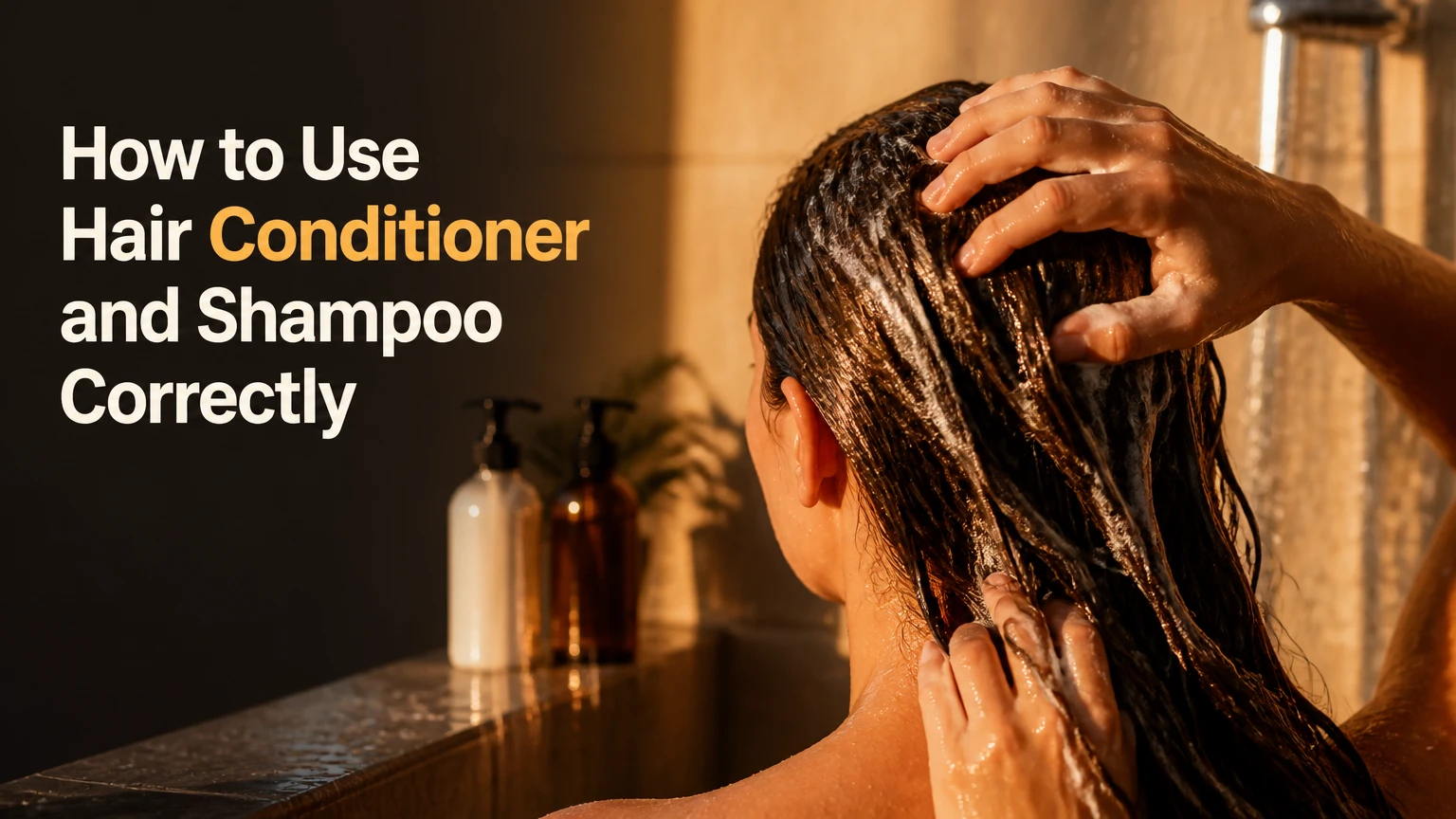
To use hair conditioner and shampoo correctly, wet the hair thoroughly, massage shampoo into the scalp, rinse completely, then apply conditioner from the mid-lengths to the ends. Leave rinse-out conditioner for 2-3 minutes and rinse with lukewarm or cool water. The best routine depends on scalp oil, hair texture, damage, styling buildup, and wash frequency.
Key Facts at a Glance
- Shampoo primarily cleans the scalp, while conditioner primarily lubricates and detangles the hair shaft.
- Shampoo should usually be applied to wet roots for 30-60 seconds, not aggressively scrubbed through the lengths.
- Rinse-out conditioner belongs mainly on the mid-lengths and ends, although scalp-formulated conditioners are an exception.
- Cool water can feel more comfortable than hot water, but it does not permanently seal the hair cuticle.
- Fine, oily hair may need washing every day or every other day, while dry, curly, or coily hair may need washing once or twice weekly.
- A complete wash commonly takes 5-10 minutes, excluding a deep-conditioning treatment.
What Do Shampoo and Conditioner Actually Do?
Shampoo removes sebum, sweat, dead skin cells, particles, odor, and styling residue from the scalp. Its cleansing agents, called surfactants, surround oily soil so water can carry it away. Conditioner deposits lubricating ingredients such as cationic conditioning agents, fatty alcohols, oils, and sometimes silicones onto the hair surface.
Hair is made largely of keratin and becomes more vulnerable to friction when wet. Conditioner reduces combing force and strand-to-strand friction, which can reduce tangling and mechanical breakage during detangling. Conditioner does not permanently repair split ends or restore hair to an undamaged biological state.
The American Academy of Dermatology Association recommends applying shampoo to the scalp rather than scrubbing the full length of the hair. That guidance matches the practical reason for scalp-focused cleansing: the scalp produces most of the oil, while repeated rubbing can roughen already weathered ends.
Shampoo and Conditioner Compared
| Product | Main target | Typical contact time | Primary result |
|---|---|---|---|
| Daily shampoo | Scalp and roots | 30-60 seconds | Removes oil, sweat, and residue |
| Rinse-out conditioner | Mid-lengths and ends | 2-3 minutes | Improves slip and reduces tangling |
| Deep conditioner | Dry or damaged lengths | 5-20 minutes | Adds heavier lubrication and softness |
| Leave-in conditioner | Damp lengths | Until next wash | Provides ongoing detangling and frizz control |
How to Use Hair Conditioner and Shampoo: 7 Steps
A standard hair-washing routine takes approximately 5-10 minutes and has seven practical steps: prepare, shampoo, rinse, remove excess water, condition, rinse again, and dry gently. The factor that most determines success is product placement, because shampoo belongs mainly on the scalp and conditioner belongs mainly on the lengths.
Before You Start
| Item | Typical amount or setting | Why it matters |
|---|---|---|
| Water | Lukewarm, approximately 35-38°C | Cleans without the discomfort of very hot water |
| Shampoo | 5-10 mL for shoulder-length hair | Enough for one scalp application in many formulas |
| Conditioner | 5-15 mL for shoulder-length hair | Covers lengths without unnecessarily coating roots |
| Wide-tooth comb | 1 comb, used on conditioned hair | Distributes conditioner with less pulling |
| Soft towel or cotton T-shirt | 1, used by pressing | Removes water with less friction than rubbing |
Amounts are typical starting points, not universal rules. A concentrated salon shampoo may require less than a dilute formula, and waist-length or very dense hair may require more. Use the smallest amount that produces adequate coverage after dilution with water.
Step 1: Detangle and Wet the Hair
Remove large knots gently before washing, especially if the hair is curly, coily, extension-worn, or prone to matting. Then wet the scalp and hair with lukewarm water for 30-60 seconds, lifting dense sections so water reaches the roots.
You will know the hair is ready when no dry patches remain and water reaches the scalp without beading only on the surface. Thorough wetting dilutes oil and helps shampoo spread, so you do not need to compensate with excessive product.
A common mistake is applying shampoo to partly dry hair. That concentrates surfactants in small areas, encourages aggressive rubbing, and often leads to a second unnecessary handful of shampoo.
Step 2: Apply Shampoo to the Scalp
Dispense approximately 5 mL, about one teaspoon, for short or medium-density hair, then spread the shampoo between wet palms. Place it on the scalp in several areas, including the crown, temples, nape, and behind the ears.
Massage with the pads of your fingers for 30-60 seconds using small movements and light-to-moderate pressure. Do not rake with fingernails, twist the hair into a tight bundle, or scrub the ends directly. As you rinse, diluted foam will pass over the lengths and remove surface residue.
You will know the technique worked when the scalp feels clean without stinging, tightness, or soreness. If the scalp still feels oily, repeat with a smaller second application rather than using a very large first dose.
The common mistake is judging cleansing by foam volume. Lather depends on formula, water hardness, and oil load; abundant foam does not prove better cleaning.
Step 3: Rinse Until No Slippery Residue Remains
Rinse the scalp for approximately 30-60 seconds, using your fingers to separate dense areas. Direct water along the hair length while avoiding rough scrubbing.
The rinse is complete when the scalp no longer feels coated and the water flows freely through the hair. A small amount of conditioner-like slip is not necessarily shampoo residue, because some shampoos contain conditioning polymers.
A common mistake is shortening the rinse because the hair already feels clean. Residual cleanser can contribute to dryness or irritation, particularly for people with eczema-prone or sensitive scalps.
Step 4: Remove Excess Water
Gently squeeze the lengths with both hands until the hair is wet but no longer dripping heavily. Do not wring, twist, or pull the hair into a tight rope.
Conditioner can still work on wet hair, but removing excess water prevents the product from sliding away and reduces unnecessary dilution. Hair with high porosity or heavy damage may benefit from more squeezing because it holds substantial water.
You will know the moisture level is suitable when conditioner spreads smoothly without immediately disappearing into the shower water. The common mistake is rubbing the hair with a terry towel before conditioning, which increases friction and tangling at the point when strands are most vulnerable.
Step 5: Apply Conditioner to the Lengths
Start at the ends, then work upward toward the mid-lengths. For shoulder-length hair, place conditioner from approximately the level of the ears downward; keep ordinary rinse-out conditioner away from the scalp if your roots become flat or greasy easily.
Use enough to coat the surface lightly, usually 5-15 mL depending on density and length. Detangle from the ends upward with your fingers or a wide-tooth comb, holding the hair above the knot to reduce pulling at the roots.
You will know coverage is even when the strands feel slippery and separate easily. The common mistake is applying a heavy mask like a lightweight daily conditioner, which can leave fine hair limp and create more frequent shampooing.
Where Should Conditioner Go?
Rinse-out conditioner should generally cover the mid-lengths and ends, while shampoo should focus on the scalp. The rule is based on oil distribution and damage exposure, not a strict two-inch boundary: very short hair may require conditioner close to the roots, and a dermatologist may prescribe a scalp conditioner for a specific condition.
| Hair situation | Conditioner placement | Starting quantity | Adjustment |
|---|---|---|---|
| Fine, oily, shoulder-length hair | Ends and lower 15-20 cm | 3-5 mL | Use a lightweight formula |
| Straight, medium-density hair | Mid-lengths to ends | 5-10 mL | Increase slightly for long hair |
| Thick, coarse hair | Mid-lengths through ends | 10-20 mL | Section hair for full coverage |
| Curly or coily hair | Most lengths, avoiding oily roots | 10-25 mL | Use slip for detangling |
Step 6: Leave Conditioner on Briefly
Leave a standard rinse-out conditioner on for 2-3 minutes, or follow the label if its formula specifies a different time. This interval gives conditioning agents time to spread across the cuticle surface, but leaving a rinse-out product on for 20 minutes does not automatically create a deep treatment.
Rinse-out conditioner is designed to be removed. Deep conditioners and masks have different concentrations and directions, commonly requiring 5-20 minutes. Leave-in conditioner remains on damp hair and should never be substituted for a rinse-out product unless the label explicitly permits that use.
You will know the timing is sufficient when the lengths feel flexible and detangled rather than coated with a waxy film. The common mistake is allowing product to dry on the hair, which can increase residue without improving conditioning.
Step 7: Rinse and Dry Without Damage
Rinse conditioner thoroughly with lukewarm or cool water until the lengths feel conditioned but not greasy. Cool water may feel soothing and can reduce heat discomfort, but hair science does not support the popular claim that cold water permanently seals the cuticle or locks in moisture.
Press water out with a microfiber towel or cotton T-shirt. Allow the hair to air-dry partly, or use a blow-dryer on low or medium heat with the dryer moving continuously. Apply heat protectant when using hot tools or prolonged blow-drying.
The final checkpoint is a clean scalp, flexible lengths, and no heavy film at the roots. The common mistake is towel-rubbing, which increases mechanical friction and can worsen frizz, breakage, and tangling.
How Often Should You Wash Your Hair?
Wash frequency should follow scalp oil, sweat, odor, product accumulation, and medical needs rather than a universal calendar. Fine oily hair may need daily or alternate-day cleansing, while dry, tightly curled, or coily hair may remain comfortable for 5-10 days between full shampoo washes.
The American Academy of Dermatology Association advises washing according to how quickly hair becomes dirty or oily and notes that people with oily scalps may need more frequent shampooing. Washing more often does not reliably cause the scalp to “panic” and produce extra oil; irritation, product choice, hormones, climate, and natural sebum production have stronger practical effects.
| Scalp and hair profile | Typical wash interval | Shampoo choice | Conditioner approach |
|---|---|---|---|
| Oily, fine, straight | Every 1-2 days | Lightweight daily cleanser | Ends only, 3-5 mL |
| Normal, medium-density | Every 2-4 days | Balanced cleanser | Mid-lengths to ends |
| Dry, thick, wavy | Every 4-7 days | Moisturizing cleanser | Rich rinse-out conditioner |
| Curly or coily | Every 5-10 days | Gentle cleanser or co-wash rotation | Sectioned application with slip |
Sweat, swimming, occupational dust, and heavy styling products can shorten these intervals. A person who exercises daily may rinse or cleanse more often, while a person with a dry scalp may need a gentler formula rather than simply extending the interval.
Which Shampoo and Conditioner Should You Choose?
Choose products according to the scalp’s needs and the hair fiber’s needs separately. An oily scalp may need effective cleansing even when the ends are dry, so one product does not have to solve both problems.
| Need | Shampoo attributes | Conditioner attributes | Avoid or limit |
|---|---|---|---|
| Oily scalp | Lightweight surfactants, low residue | Fluid lotion, lower oil load | Heavy rootside masks |
| Dry or coarse hair | Gentle cleansing, humectants | Fatty alcohols, oils, conditioning polymers | Frequent strong clarifiers |
| Fine or limp hair | Lightweight, volumizing formula | Spray or light rinse-out formula | Large amounts of butter or oil |
| Color-treated hair | Gentle cleanser, color-care label | Slip and UV or thermal support | Frequent high-detergency washing |
| Flakes or itching | Anti-dandruff active listed on label | Keep ordinary conditioner off scalp | Scratching and fragranced irritants |
“Sulfate-free” describes one formulation choice, not a guarantee that a shampoo is gentler or more effective. Sulfates can cleanse well, while sulfate-free formulas can still irritate or leave buildup; the complete formula and the user’s response matter more than one ingredient label.
Silicones are also not inherently harmful. Ingredients such as dimethicone can reduce friction and improve combability, but repeated use may create a film for some users, especially when paired with oils and heavy stylers. If hair becomes dull, coated, or difficult to wet, clarify according to the product label rather than abandoning a product solely because hair “got used to it.”
When Should You Change the Washing Order?
Reverse washing, conditioner before shampoo, can help fine hair that becomes flat after conventional conditioning. Apply a small amount of conditioner to the lengths, rinse lightly, shampoo the scalp, and rinse again; the method sacrifices some conditioning intensity for root volume.
Traditional washing, shampoo followed by conditioner, remains the best default for most people because it cleans the scalp first and restores slip afterward. Co-washing, using conditioner or a cleansing conditioner without conventional shampoo, can suit very dry curls or coils but may not remove sebum, mineral film, or heavy stylers effectively.
| Strategy | Sequence | Typical benefit | Main limitation |
|---|---|---|---|
| Traditional | Shampoo, then conditioner | Clean scalp and conditioned lengths | Can flatten very fine hair |
| Reverse washing | Conditioner, then shampoo | More root lift and less coating | May leave dry ends under-conditioned |
| Co-washing | Cleansing conditioner only | Less detergent exposure | Limited removal of oil and buildup |
| Double cleansing | Shampoo, rinse, shampoo | Better removal after heavy oil or styling | Greater dryness risk if done routinely |
Reverse washing is not a repair treatment, and co-washing is not a complete solution for every curly texture. Test one change for two or three wash cycles, then assess scalp comfort, root oil, tangling, and residue.
What Are the Main Treatment Types?
Rinse-out conditioner is the everyday option for reducing tangling after shampoo. Deep conditioner or a mask is a periodic, heavier treatment for dry, porous, bleached, or heat-stressed lengths, while leave-in conditioner stays on damp hair to improve detangling and styling.
| Treatment | Application point | Typical duration | Typical frequency |
|---|---|---|---|
| Rinse-out conditioner | Mid-lengths and ends | 2-3 minutes | Every wash |
| Deep conditioner | Lengths and ends | 5-20 minutes | Every 1-2 weeks |
| Protein treatment | Damaged or porous lengths | Label-specific, often 5-15 minutes | Every 2-6 weeks |
| Leave-in conditioner | Damp lengths | Until next wash | As needed or each wash |
Protein products can improve the feel of porous hair temporarily, but excessive protein may make some hair feel stiff or brittle. Bond-building products may support the appearance and manageability of chemically processed hair, but they cannot reverse every structural change caused by bleaching.
Common Mistakes and How to Fix Them
Using the same amount on every wash
A fixed quarter-sized dose ignores hair length, density, concentration, and oil load. Start with 5 mL, add water, and increase only when the scalp remains inadequately covered.
Scrubbing the lengths
Length-focused scrubbing creates friction without targeting the main source of oil. Massage the scalp and let the rinse water carry diluted cleanser through the ends.
Putting every conditioner on the scalp
Ordinary rinse-out conditioner can weigh down roots and leave residue, but scalp-specific conditioners are formulated for direct application. Follow the label and avoid assuming every scalp product has the same purpose.
Rinsing with very hot water
Very hot water can worsen scalp dryness and discomfort, particularly with eczema or irritant dermatitis. Lukewarm water is sufficient; hot water does not remove oil so effectively that it justifies irritation.
Clarifying too often
Clarifying shampoo can remove styling residue and some mineral film, but frequent use may increase dryness and tangling. Use it when symptoms indicate buildup, often every 2-4 weeks for users with regular styling products, unless the label or a professional recommends another interval.
Brushing aggressively while wet
Wet hair stretches more easily than dry hair. Apply conditioner first, detangle from ends upward, and use a wide-tooth comb or flexible brush designed for wet hair.
Routine Variations for Specific Situations
Curly and coily hair benefits from sectioning because dense hair can hide dry areas and knots. Apply cleanser mainly to the scalp, distribute conditioner through sections, detangle while saturated with product, and rinse partially if the chosen conditioner label permits it.
Bleached or chemically treated hair needs lower friction and less aggressive cleansing. Wash according to scalp oil, use a gentle cleanser, condition every wash, limit high heat, and add a deep conditioner or bond-focused treatment when the hair feels rough or snaps during detangling.
Hard water can leave calcium and magnesium deposits that make hair feel dull, stiff, or coated. A chelating shampoo is designed for mineral removal and differs from an ordinary clarifying shampoo, so follow the label and avoid weekly use unless the product specifically supports it.
Hair extensions and protective styles require scalp access without rough pulling. Clean between extension sections, rinse longer than usual, and keep heavy conditioner away from attachment points because oils and conditioners can weaken some adhesives or cause slippage.
For dandruff, persistent itching, sores, or sudden shedding, cosmetic shampoo advice has limits. The AAD recommends considering dandruff shampoos with recognized active ingredients and following label directions; persistent or severe symptoms warrant assessment by a dermatologist.
Time, Quantity, and Typical Cost
A basic wash usually requires 5-10 minutes, including wetting, two rinses, and conditioning. A deep treatment adds 5-20 minutes. Product cost varies by country, brand, size, and concentration, so the ranges below are typical retail estimates in U.S. dollars rather than fixed prices.
| Routine component | Typical quantity per wash | Typical product price | Approximate use |
|---|---|---|---|
| Shampoo, 250-400 mL | 5-15 mL | $6-$35 | 17-80 washes |
| Rinse-out conditioner, 250-400 mL | 5-20 mL | $6-$40 | 12-80 washes |
| Deep conditioner, 200-500 mL | 10-30 mL | $10-$45 | 7-50 treatments |
| Clarifying or chelating shampoo, 250-400 mL | 5-15 mL | $8-$35 | 1-8 uses monthly |
A practical monthly budget can range from approximately $6-$25 for infrequent washing with basic products to $25-$80 for frequent washing, premium formulas, masks, and leave-ins. Actual consumption rises sharply with long, dense hair and falls when concentrated products are diluted and applied only where needed.
FAQ
Can I use conditioner without shampoo?
Yes, conditioner-only washing can work temporarily for very dry, curly, or coily hair when the scalp has little oil and styling buildup. Co-washing does not remove residue as effectively as conventional shampoo, so alternate with a suitable cleanser when the scalp becomes itchy, coated, oily, or odorous.
Should I shampoo twice?
Shampoo twice when the first application fails to spread or when substantial oil, sunscreen, dry shampoo, or styling product is present. Use a small second amount and avoid making double shampooing a default habit if the scalp and hair are already clean after one wash.
Should I use shampoo every day?
Daily shampooing is acceptable when the scalp becomes oily, sweaty, or uncomfortable within 24 hours and the cleanser does not cause dryness or irritation. People with dry, curly, or coily hair may need a longer interval, but extending washes despite an oily or itchy scalp is not automatically healthier.
Is conditioner good for hair fall?
Conditioner can reduce tangling and breakage from combing, but it does not treat hair loss from the follicle. Apply it to the lengths, and seek medical advice for sudden shedding, widening part lines, bald patches, scalp pain, or persistent excessive hair fall.
Can conditioner make hair greasy?
Yes, conditioner can make hair look greasy when the formula is too rich, the quantity is excessive, or the product reaches an oily scalp. Reduce the amount, move application toward the ends, rinse more thoroughly, or choose a lighter formula before changing shampoo frequency.
How do I know whether buildup or dryness is the problem?
Buildup usually causes a coated, dull, waxy, or poorly wetting feel, while dryness more often causes roughness, static, tangling, and brittle ends. If one clarifying wash improves the coated feel, buildup was likely involved; if it worsens roughness, return to gentler cleansing and richer conditioning.
The Bottom Line
The correct way to use hair conditioner and shampoo is to cleanse the scalp with shampoo, rinse thoroughly, then condition the mid-lengths and ends for 2-3 minutes before rinsing. Adjust the product strength, amount, order, and frequency to your scalp and hair profile. For the query how to use hair conditioner and shampoo, placement and gentle handling matter more than cold-water claims, rigid measurements, or expensive products.