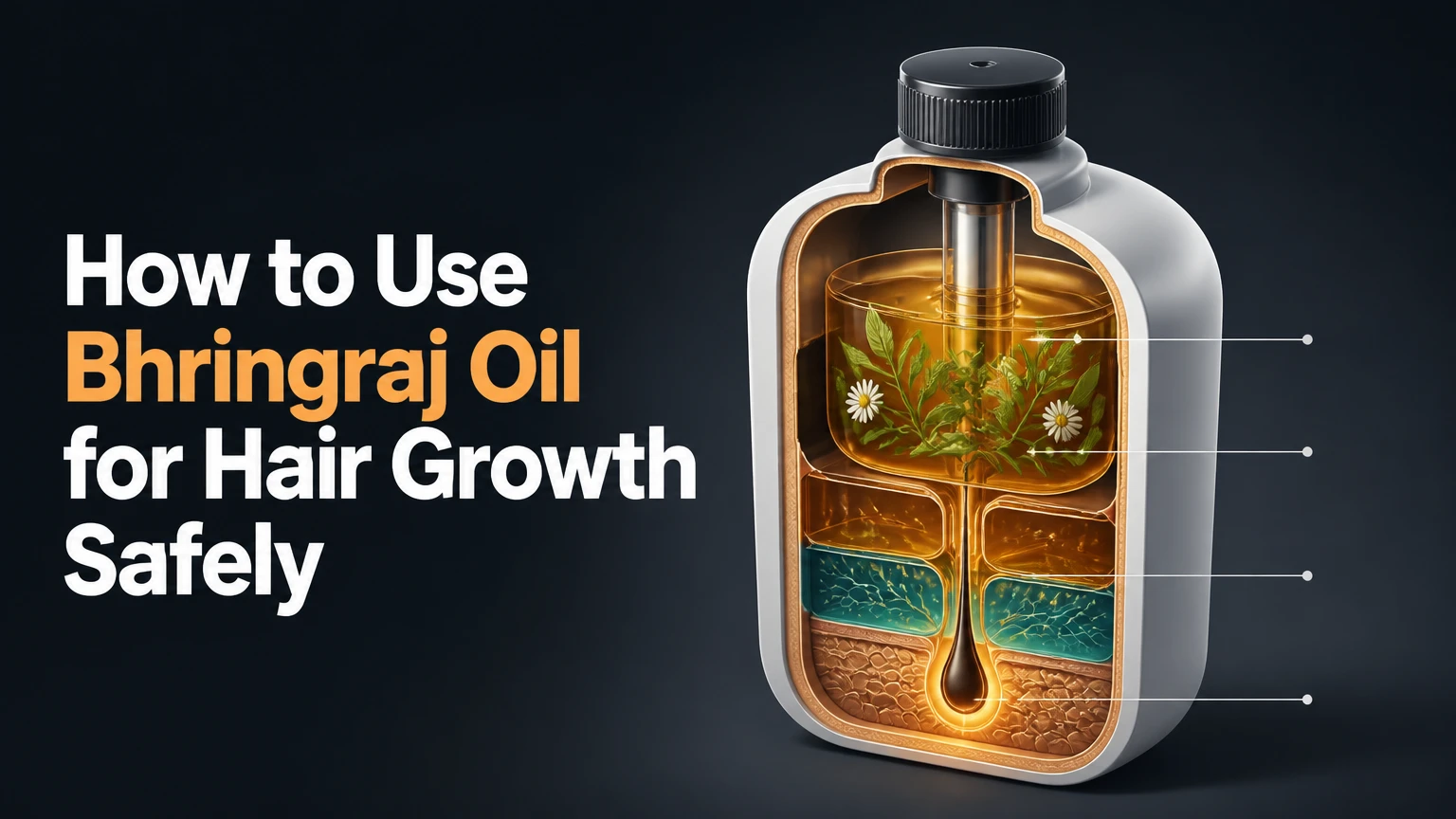
Bhringraj oil is best used as a pre-shampoo scalp treatment: apply a small amount to a clean, dry scalp, massage gently for 5-10 minutes, leave it on for 30 minutes to 2 hours, then shampoo thoroughly. Use it once or twice weekly for 8-12 weeks, while treating persistent or sudden hair loss as a medical issue rather than relying on oil alone.
Key Facts at a Glance
- Bhringraj oil usually contains Eclipta alba or Eclipta prostrata extract diluted in sesame, coconut, mineral, or blended carrier oil.
- Human clinical evidence for Bhringraj oil causing meaningful scalp-hair regrowth remains limited; much of the direct evidence comes from laboratory or animal research.
- A practical starting dose is 5-10 milliliters for the scalp, not a palmful of oil.
- Leave Bhringraj oil on for 30 minutes to 2 hours initially; overnight use is optional, not automatically superior.
- Massage can distribute oil and reduce application friction, but current evidence does not prove that massage forces Bhringraj compounds into follicles.
- Bhringraj oil can condition hair and reduce friction-related breakage, but it cannot repair a destroyed follicle or reliably reverse established gray hair.
What Is Bhringraj Oil?
Bhringraj oil is a topical hair treatment made by infusing or blending Eclipta alba extract with a carrier oil. Ayurveda traditionally calls Bhringraj a hair-supporting herb, while modern products may combine it with amla, hibiscus, neem, indigo, fenugreek, or essential oils.
The label matters more than the front of the bottle. Some products contain a concentrated botanical extract, while others contain a small amount of herb in mostly coconut or sesame oil. A product named “Mahabhringraj” may contain several herbs and does not necessarily have a standardized Bhringraj concentration.
| Label feature | What it tells you | Practical implication |
|---|---|---|
| Eclipta alba or Eclipta prostrata | Botanical identity of Bhringraj | Prefer a product that names the plant |
| Sesame or coconut oil | Main carrier | Affects weight, scent, and wash-out |
| Mineral oil or paraffin | Occlusive carrier | May suit dry hair but feel heavy |
| Fragrance or essential oils | Added scent ingredients | Raises irritation risk for reactive skin |
| Preservatives | Protection for water-containing formulas | Important when the product includes aqueous extracts |
| Batch, expiry, and manufacturer | Traceability | Avoid unlabelled homemade or rancid stock |
Bhringraj oil is not the same as Bhringraj juice, powder, or an oral Ayurvedic supplement. Oral products create different safety questions and should not be substituted for a topical routine without qualified medical advice.
Does Bhringraj Oil Actually Grow Hair?
Bhringraj oil may support scalp conditioning and reduce breakage, but reliable human evidence that it regrows hair is not yet established. A frequently cited Eclipta alba study in the Journal of Ethnopharmacology in 2008 reported hair-growth activity in rats, but animal results cannot establish an effective human dose or prove treatment of pattern hair loss.
Bhringraj contains compounds including wedelolactone and other phytochemicals that have attracted laboratory interest. Proposed actions include antioxidant activity and effects on follicular cycling, yet commercial oils vary widely in extraction method, concentration, carrier, and stability.
Massage introduces another variable. A 2016 small study in Eplasty reported increased hair thickness after standardized scalp massage, but the research did not prove that Bhringraj itself caused the change. The sensible interpretation is narrower: Bhringraj oil may improve lubrication and hair feel, while regrowth remains an uncertain claim.
What can Bhringraj oil realistically improve?
Bhringraj oil can make dry strands feel smoother because oil reduces surface friction and temporarily coats the cuticle. That effect may reduce tangling and mechanical breakage, which can make hair appear fuller without increasing the number of follicles.
Bhringraj oil is not a proven treatment for androgenetic alopecia, alopecia areata, scarring alopecia, thyroid-related shedding, iron deficiency, or chemotherapy-related loss. Sudden shedding, bald patches, scalp pain, scaling, or shiny areas without visible follicle openings require diagnosis.
How to Use Bhringraj Oil for Hair Growth
Use the following seven-step routine once or twice weekly. The full process usually takes 20-35 minutes of active time, plus 30 minutes to 2 hours of contact time; the factor that most affects results is consistent scalp coverage without irritation.
Before You Start
| Requirement | Typical specification |
|---|---|
| Oil quantity | 5-10 mL for scalp; 10-20 mL for scalp and long lengths |
| Active time | 20-35 minutes |
| Contact time | 30 minutes-2 hours initially |
| Tools | Bowl, dropper, sectioning comb, towel, shampoo |
| Water temperature | Warm, never hot enough to burn skin |
| Starting frequency | 1 application weekly for sensitive or oily scalps |
| Typical product cost | About $8-$30 for 100-200 mL, depending on formulation and location |
Perform a patch test 24-48 hours before full use. Apply a small amount behind the ear or to the inner forearm, leave it undisturbed, and discontinue the product if burning, swelling, hives, or persistent redness develops.
Step 1: Warm a Small Amount Indirectly
Place 5-10 mL of Bhringraj oil in a heat-safe bowl and set that bowl in warm water for several minutes. Test the oil on the inside of your wrist before touching the scalp.
Comfortably warm oil may spread more easily, but heating does not proveably increase follicular absorption. Never microwave the oil in a sealed container, heat it directly over a flame, or use oil that feels hot on the skin.
Success checkpoint: The oil feels neutral to mildly warm, with no stinging.
Common mistake: Using boiling water or a heated appliance that creates hot spots.
Step 2: Section the Hair
Divide the hair into four to six sections with a comb. Create partings across the areas where the scalp is most visible, including the crown, temples, and central part if those areas are thinning.
Sectioning prevents the common failure of coating the upper hair while leaving the scalp untreated. People with short hair can usually use two to four partings.
Success checkpoint: You can see separate scalp lines before application.
Common mistake: Pouring oil over the top of the head and assuming it reached the roots.
Step 3: Apply Bhringraj Oil to the Scalp
Use a dropper, clean fingertips, or a narrow applicator to place small amounts along each parting. Start with approximately 0.5-1 mL per section, then add only enough to lightly moisten the scalp.
Concentrate on the scalp rather than saturating the hair. A greasy, dripping scalp does not indicate better treatment and creates a longer cleansing cycle.
Success checkpoint: The scalp feels lightly coated, not wet enough for oil to run down the face or neck.
Common mistake: Applying 20-30 mL to a short-haired scalp, which increases residue without increasing evidence-based benefit.
Step 4: Massage Gently for 5-10 Minutes
Use the pads of your fingers, not fingernails, and move the scalp skin gently in small circles. Use light pressure around the hairline and temples, where aggressive rubbing can aggravate fragile skin or break short hairs.
Massage supports even distribution and may provide a mechanical benefit independent of Bhringraj. Avoid claims that massage “drives” oil into follicular openings, because the depth and absorption of botanical compounds in commercial oils are not well standardized.
Success checkpoint: The scalp feels relaxed and warm, without pain, scratching, or increased shedding from pulling.
Common mistake: Scrubbing with nails or dragging fingers through tangled hair.
Step 5: Smooth Excess Oil Through the Lengths
Use the residue on your hands to coat the mid-lengths and ends, especially if the hair is coarse, bleached, curly, or prone to tangling. Fine hair usually needs no extra oil beyond the scalp dose.
Oil reduces friction temporarily but does not seal split ends permanently. Trim visibly split ends and reduce heat or chemical damage if breakage is the main reason for reduced length.
Success checkpoint: The ends feel lubricated but remain flexible rather than sticky.
Common mistake: Treating oily roots and dry ends with the same large quantity.
Step 6: Leave the Oil On for 30 Minutes to 2 Hours
Start with 30-60 minutes, then extend to 2 hours if the scalp remains comfortable. Overnight application is not required for effectiveness and may increase pillow contact, facial acne, folliculitis, or irritation in susceptible users.
People with dermatitis, dandruff, or a history of clogged follicles should use the shortest comfortable contact time. Stop immediately if itching, burning, swelling, or a rash appears.
Success checkpoint: The scalp has no increasing itch, heat, tenderness, or redness during contact.
Common mistake: Sleeping in oil because longer exposure is assumed to produce faster growth.
Step 7: Shampoo the Scalp Thoroughly
Apply shampoo directly to the scalp before fully soaking the hair if the oil layer is heavy, then add water gradually and massage gently. Rinse with lukewarm water and repeat once when residue remains.
A mild shampoo is not automatically sulfate-free, and sulfate-free formulas are not automatically better for every scalp. Choose a cleanser that removes the specific product without leaving the scalp tight, burning, or flaky.
| Hair or scalp situation | Oil dose | Contact time | Cleansing approach |
|---|---|---|---|
| Fine, oily hair | 3-5 mL | 30-60 minutes | Shampoo twice if needed |
| Thick, dry hair | 8-15 mL | 1-2 hours | Shampoo once, repeat only for residue |
| Curly or coily hair | 5-10 mL | 1-2 hours | Detangle before washing |
| Sensitive scalp | 3-5 mL | 20-30 minutes | Fragrance-free cleanser preferred |
| Dandruff-prone scalp | 3-5 mL | 30 minutes | Do not replace medicated shampoo |
Success checkpoint: The scalp feels clean without squeaking, tightness, or visible oily film.
Common mistake: Scrubbing harder instead of using a second gentle shampoo pass.
How Often Should You Use Bhringraj Oil?
Use Bhringraj oil once weekly for two weeks, then increase to twice weekly if the scalp remains calm and clean. Three or more applications weekly are generally unnecessary for growth claims and can worsen buildup, acne, follicle plugging, or irritant dermatitis.
| User situation | Starting frequency | Maximum practical trial | Adjustment |
|---|---|---|---|
| Oily scalp | Every 7-10 days | 1-2 times weekly | Reduce if buildup appears |
| Dry, coarse hair | Weekly | 2 times weekly | Apply more to lengths than scalp |
| Sensitive scalp | Every 10-14 days | Weekly | Stop with burning or rash |
| Normal scalp | Weekly | 2 times weekly | Review after 8-12 weeks |
| Active dandruff | Do not rely on oil | Not a substitute | Treat the scalp condition |
Track progress with monthly photographs under the same lighting and part position. Daily hair counts vary with washing frequency and do not reliably measure follicle growth.
Which Bhringraj Formulation Should You Choose?
Choose a formula with a full ingredient list, named botanical ingredients, an expiry date, and a clear manufacturer. Carrier oil determines much of the product’s feel, while added fragrance and essential oils create more irritation risk than a simple, unscented formula.
| Formulation | Typical carrier or additions | Best fit | Main drawback |
|---|---|---|---|
| Bhringraj in sesame oil | Sesame oil, Bhringraj extract | Dry, coarse hair | Strong scent and heavier feel |
| Bhringraj in coconut oil | Coconut oil, Bhringraj extract | Porous or textured hair | May feel stiff on some hair |
| Bringadi-style blend | Bhringraj, amla, indigo, sesame | Users wanting a multi-herb product | More ingredients mean more allergy variables |
| Bhringraj with essential oils | Bhringraj, rosemary, peppermint, fragrance | Scent preference | Greater irritation potential |
| Water-based scalp tonic | Bhringraj extract, water, preservatives | Oily or fine hair | Different preservation and stability needs |
Do not infer potency from the words “pure,” “herbal,” or “Ayurvedic.” Look for the botanical name, carrier, ingredient order, batch information, and contact details. A rancid smell, separation that does not remix, cloudiness in an oil-only product, or expired date is a reason to discard it.
Bhringraj Oil Compared With Other Hair-Loss Options
Bhringraj oil is more defensible as a conditioning scalp ritual than as a replacement for treatments with stronger human evidence. Minoxidil has regulatory approval for some forms of pattern hair loss, while rosemary oil has smaller clinical evidence and electrolysis has a completely different purpose.
| Option | Main use | Evidence position | Typical routine | Key limitation |
|---|---|---|---|---|
| Bhringraj oil | Conditioning and traditional scalp care | Limited human regrowth evidence | 1-2 times weekly | Variable formulations |
| Rosemary oil | Investigational topical growth support | Small human trial, limited evidence | Usually diluted and regular | Irritation and dilution risks |
| Minoxidil | Pattern hair-loss treatment | Substantially stronger clinical evidence | Daily or label-directed | Initial shedding and ongoing use |
| Ketoconazole shampoo | Dandruff and scalp inflammation support | Evidence for seborrheic dermatitis | Label-directed washing | Not a stand-alone regrowth treatment |
| Electrolysis | Permanent removal of selected unwanted hairs | Established hair-removal method | Multiple professional sessions | Does not regrow scalp hair |
Can You Use Bhringraj Oil With Minoxidil?
Do not layer Bhringraj oil directly over minoxidil unless a dermatologist or pharmacist confirms the schedule. Oil may alter drying, spread the medication beyond the target area, or increase irritation, and applying oil immediately before minoxidil can complicate contact with the scalp.
A practical separation is to use minoxidil according to its product directions and reserve Bhringraj oil for a separate pre-shampoo session. Never stop prescribed treatment solely because an herbal oil feels more natural. The FDA-approved status of minoxidil applies to specific products and indications, not to every pattern of hair loss.
Does Electrolysis Help Scalp Hair Growth?
Electrolysis removes unwanted individual hairs by delivering electrical energy through a probe into the follicle, so it does not stimulate scalp growth and should not be included as a Bhringraj alternative for thinning hair. Electrolysis can be relevant when a person wants to remove unwanted facial or body hair, including isolated hairs around a receding hairline, but it does not restore density.
Laser hair removal and electrolysis also differ from scalp treatments. Electrolysis targets selected follicles for hair removal, whereas Bhringraj oil is applied as a conditioning and traditional scalp-care product.
What Bhringraj Oil Cannot Treat
Bhringraj oil cannot diagnose the cause of shedding, reopen a scarred follicle, correct a nutritional deficiency, or reliably reverse genetic miniaturization. Persistent hair loss can result from androgenetic alopecia, telogen effluvium, alopecia areata, traction, fungal infection, thyroid disease, medication effects, or inflammatory scalp disease.
Seek medical assessment when shedding lasts longer than three months, bald patches develop, the scalp hurts or scales, eyelashes or eyebrows fall out, or hair loss follows childbirth, illness, rapid weight loss, or a new medicine. A clinician may examine the scalp and consider blood tests such as ferritin or thyroid testing when the history supports them.
Premature graying deserves realistic expectations. Antioxidant activity in a plant extract does not demonstrate that Bhringraj oil can restore pigment to established gray hair. Hair color changes may signal aging, genetics, smoking, nutritional issues, or autoimmune disease, but oil alone should not be presented as a reversal treatment.
Common Problems and How to Fix Them
| Problem | Likely cause | Immediate fix | Prevention |
|---|---|---|---|
| Greasy hair after washing | Excess dose or heavy carrier | Shampoo twice gently | Reduce dose by half |
| Itching or burning | Fragrance, essential oil, or allergy | Rinse and stop product | Patch test and choose simpler formula |
| More flakes | Oil buildup or untreated dermatitis | Stop oil and assess scalp | Use appropriate medicated shampoo |
| Hair breakage | Aggressive massage or detangling | Handle hair gently | Apply with sections and finger pads |
| Facial pimples | Oil transfer or overnight contact | Wash face and shorten contact | Keep oil off forehead and pillow |
| No visible growth | Wrong diagnosis or insufficient time | Photograph and reassess | Seek evaluation for persistent loss |
One practitioner rule is especially useful: a scalp treatment should leave the scalp calmer after washing, not progressively itchier between washes. If each application creates more flakes, increasing frequency is the wrong response.
Another counterintuitive point is that heavy oiling can make apparent shedding look worse. Loose hairs trapped in an oily coating may come out together during shampooing, while the oil itself has not caused follicle loss. Compare monthly photographs rather than judging one wash day.
Situational Routines for Different Hair Types
For Fine or Oily Hair
Use 3-5 mL on the scalp and leave it for 30-60 minutes. Keep oil away from the forehead and use a second shampoo pass only when the first pass leaves visible residue.
For Dry, Curly, or Coily Hair
Use 5-10 mL on the scalp and a small amount on the ends, then detangle with fingers or a wide-tooth comb before washing. Reduce friction during shampooing because breakage, rather than follicle loss, may account for reduced retained length.
For Sensitive or Dandruff-Prone Scalps
Start with a fragrance-free, simple formulation for 20-30 minutes once every 10-14 days. Bhringraj oil should not replace treatment for seborrheic dermatitis, psoriasis, contact dermatitis, or suspected infection.
How Long Does Bhringraj Oil Take to Work?
Softness and shine may appear after one application because oil coats the hair shaft, but visible scalp-density changes, if they occur, require at least 8-12 weeks and may not occur at all. Hair grows slowly, and a short trial cannot distinguish cosmetic conditioning from follicular change.
| Time period | Reasonable observation | What not to conclude |
|---|---|---|
| First use | Smoother feel and reduced tangling | New follicles formed |
| Weeks 2-4 | Less friction-related breakage in some users | Genetic loss stopped |
| Weeks 8-12 | Compare standardized photographs | Proven regrowth |
| After 12 weeks | Continue only if benefit and tolerance justify it | Oil failure explains all shedding |
Stop or change the plan if irritation develops. Continue only if the product is tolerated, affordable, and compatible with appropriate medical care.
Frequently Asked Questions
Can I apply Bhringraj oil every day?
Daily application is usually unnecessary and may increase residue, acne, follicle plugging, or dermatitis. Start once weekly, increase to twice weekly only if the scalp remains comfortable, and apply the smallest amount that lightly coats the scalp. Daily use on the hair lengths may still feel appropriate for very dry hair, but the scalp does not need daily oiling.
Should I apply Bhringraj oil to wet or dry hair?
Apply Bhringraj oil to a dry or mostly dry scalp so the oil does not become unnecessarily diluted by water. Slightly damp lengths can be easier to detangle, but wet hair is more vulnerable to stretching and breakage. Sectioning matters more than the exact moisture level.
Can Bhringraj oil stop hair fall immediately?
Bhringraj oil cannot be expected to stop shedding immediately because hair loss has many possible causes and follicle cycles change over months. The oil may reduce breakage and improve strand lubrication, but sudden or severe shedding requires evaluation rather than repeated oil treatments.
Is coconut oil or sesame oil better for Bhringraj?
Neither carrier is universally better. Coconut oil may suit porous, coarse, or textured hair, while sesame oil often feels richer and spreads well on dry scalps. Choose based on tolerance, wash-out, climate, and ingredient simplicity. The Bhringraj extract concentration is usually more relevant than the carrier’s traditional reputation.
Can Bhringraj oil reverse gray hair?
Bhringraj oil has no reliable clinical proof of reversing established gray hair. Antioxidant findings and traditional claims do not demonstrate restoration of pigment in human hair shafts. New gray growth should be assessed in context, especially when graying is unusually early or accompanied by other symptoms.
Should I stop minoxidil when I start Bhringraj oil?
Do not stop minoxidil without discussing the change with the prescriber or pharmacist. Bhringraj oil has weaker human evidence for pattern hair-loss treatment, and combining or alternating products requires attention to irritation, application timing, and the specific minoxidil label.
The Bottom Line
The safest answer to how to use bhringraj oil for hair growth is to apply 5-10 mL to a sectioned scalp, massage with finger pads for 5-10 minutes, leave it on for 30 minutes to 2 hours, and shampoo it out once or twice weekly. Bhringraj oil may improve conditioning and reduce breakage, but it should complement, not replace, diagnosis and evidence-based treatment for persistent hair loss.