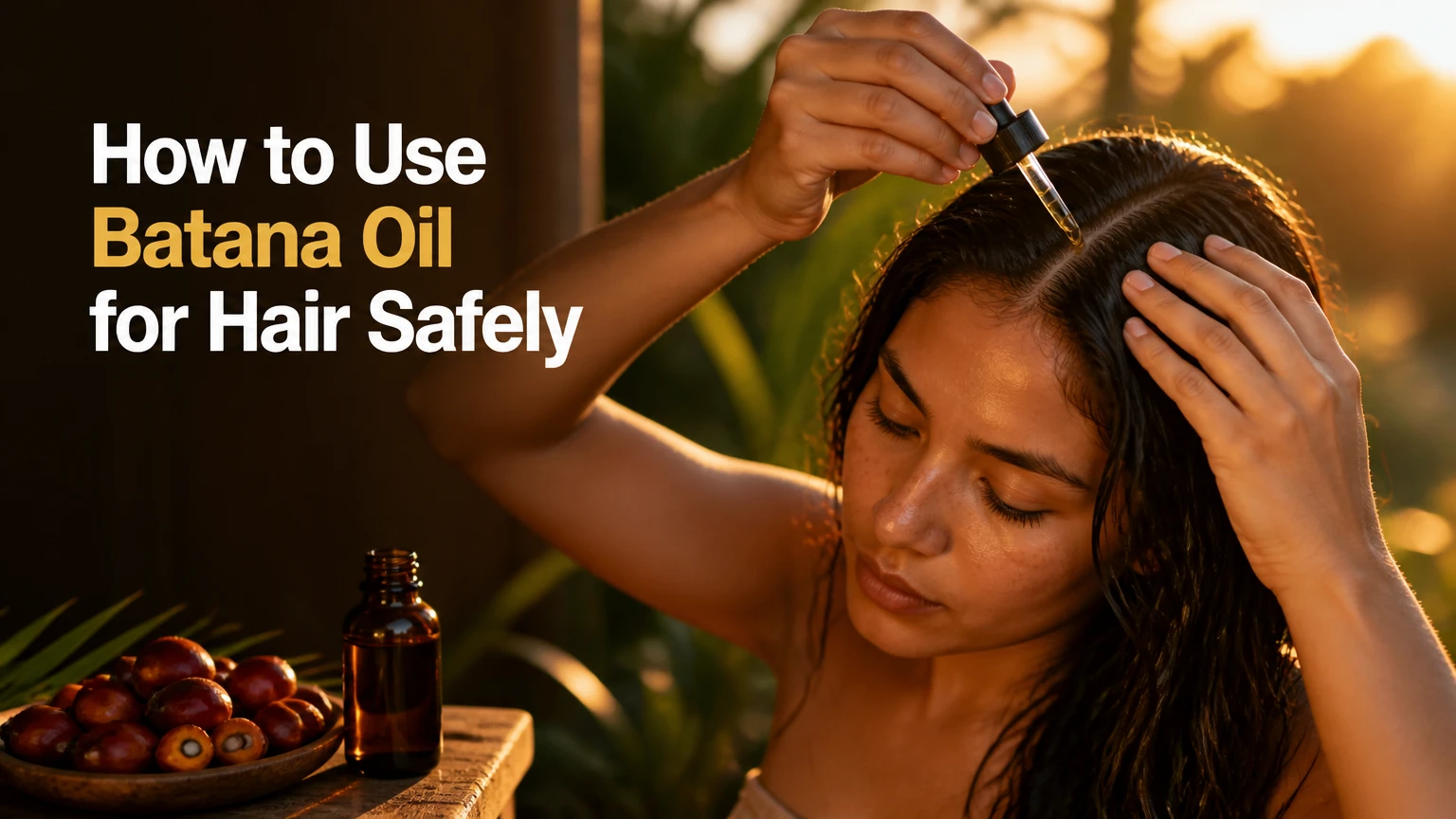
To use batana oil for hair, apply a small amount to dry lengths or the scalp, leave it for 20-30 minutes, then shampoo thoroughly. Start with 1/4 teaspoon for short or fine hair and up to 1 teaspoon for long, dense hair. Batana oil can improve temporary softness and shine, but it has not been proven to regrow hair.
Key facts
Batana oil is derived from the nuts of the American palm, Elaeis oleifera, which grows in parts of Central and South America.
A pre-shampoo treatment is the safest starting method because batana oil is heavy and difficult to remove from fine hair.
Batana oil may reduce friction, dryness, and frizz, but it cannot repair a split end or reverse follicle miniaturization.
Leave batana oil on for 20-30 minutes initially; overnight use increases residue and irritation risk without established extra benefit.
Hair-growth claims currently rely mainly on tradition, testimonials, and product marketing rather than controlled clinical trials.
Patch-test every new product, especially raw paste containing fragrance, botanical extracts, or additional carrier oils.
What Is Batana Oil?
Batana oil is a plant oil made from the kernels of the American palm, Elaeis oleifera. In Honduras, batana has a documented cultural association with the Tawira, a Miskito community whose traditional hair practices helped popularize the ingredient internationally.
Raw batana is often semi-solid, dark amber to brown, and strongly scented. Commercial products may contain refined batana, another carrier oil, fragrance, rosemary, almond oil, or only a small amount of batana extract, so the product label matters more than the front-of-package name.
The oil contains fatty acids and minor compounds such as tocopherols, tocotrienols, and carotenoid pigments. Those constituents can support a conditioning effect. They do not automatically establish a medical effect on follicles.
What can batana oil realistically do?
Batana oil can coat the hair surface, reduce friction between strands, and slow moisture loss from the fiber. Those effects can make dry hair feel smoother after one application, particularly when the oil is used over water-based conditioner.
Batana oil cannot rebuild broken keratin structure, permanently seal split ends, or prove that new follicles will grow. The American Academy of Dermatology Association recommends evaluating persistent hair loss medically rather than relying on cosmetic oils alone. A receding hairline, widening part, bald patch, or sudden shedding requires a different level of assessment.
The best-supported use is cosmetic conditioning. Treat growth claims as unconfirmed.
How Does Batana Oil Affect Hair?
Batana oil affects hair mainly by lubrication and occlusion, not by demonstrated follicle stimulation. Fatty acids can reduce the friction that causes tangling and mechanical breakage, while an oil film can limit water exchange at the cuticle surface.
Claims that oleic and linoleic acids “repair” the hair shaft need precision. Hair fiber is nonliving keratin, so an oil can temporarily improve feel and reduce roughness, but it cannot biologically repair damaged cuticle cells. Coconut oil has stronger published evidence for reducing protein loss in hair than batana oil, while batana-specific human hair studies remain limited.
Vitamin E compounds and carotenoids may contribute antioxidant activity in the oil. That chemistry does not establish protection against ultraviolet damage, scalp aging, or hair loss in people. Formulation quality, oxidation, dose, and contact time also affect performance.
Batana oil benefits by hair concern
| Hair concern | Likely cosmetic effect | Recommended placement | Evidence limit |
|---|---|---|---|
| Dry ends | Softer feel and more shine | Mid-lengths and ends | Temporary conditioning only |
| Frizz | Reduced surface friction | Ends and raised cuticles | Does not change hair structure |
| Tangling | Easier detangling after washing | Damp lengths with conditioner | Results vary by porosity |
| Breakage | Less mechanical stress from lubrication | Fragile lengths, not wounds | Does not treat follicle disease |
| Flaking | May soften adherent scale briefly | Avoid diagnosing with oil | Cannot treat seborrheic dermatitis |
| Hair loss | No established regrowth effect | Do not replace diagnosis | Clinical evidence is insufficient |
How to Use Batana Oil for Hair
The most reliable starting routine is a 20-30 minute pre-shampoo treatment applied to dry hair, followed by shampoo at the scalp and conditioner on the lengths. The main success factor is dose: enough oil to lightly coat the hair, but not enough to saturate the scalp or leave a waxy film.
Before you start
| Item | Typical requirement | Practical specification |
|---|---|---|
| Batana oil | 1/4-1 teaspoon | Use the lowest amount that coats the target area |
| Application time | 5-10 minutes | Section dense hair into four to eight parts |
| Processing time | 20-30 minutes | Use a plastic cap, not high heat |
| Washing time | 5-10 minutes | Shampoo the roots twice if residue remains |
| Total session | 35-50 minutes | Add detangling time for coily or long hair |
| Starting frequency | Once weekly | Increase only if hair remains light and clean |
Step 1: Choose the treatment area
Choose the scalp, the lengths, or both according to your goal. Use the lengths and ends for dryness, roughness, tangling, or color-related brittleness; use the scalp only when it is comfortable, intact, and free of active rash.
Avoid applying oil to broken skin, an infected area, or a scalp with intense itching and thick scale. Oil can make cleansing harder and may aggravate some scalp conditions.
You will know this step worked when: you can identify a specific target area instead of coating every strand automatically.
Common mistake: treating shedding as if it were dry hair. Oil may improve the appearance of the hair shaft while leaving the cause of shedding untouched.
Step 2: Measure a small dose
Begin with 1/4 teaspoon for short, fine, or straight hair, 1/2 teaspoon for shoulder-length medium-density hair, and 1 teaspoon for long, thick, curly, or coily hair. A fingertip amount is enough for ends used as a leave-in.
Warm raw batana paste between clean palms for 10-20 seconds. Do not microwave the product or heat it directly on the scalp, because overheating can degrade the formula and burn skin.
| Hair profile | Starting pre-wash amount | Leave-in amount for ends |
|---|---|---|
| Short, fine, straight | 1/4 teaspoon | 1/8 teaspoon |
| Medium-length, wavy | 1/3 teaspoon | 1/8-1/4 teaspoon |
| Shoulder-length, dense | 1/2 teaspoon | 1/4 teaspoon |
| Long, curly | 3/4 teaspoon | 1/4 teaspoon |
| Long, coily, very dense | 1 teaspoon | 1/4-1/2 teaspoon |
You will know this step worked when: the oil feels spreadable rather than pooled in your palm.
Common mistake: starting with a tablespoon. Excess oil increases washing difficulty without producing proportional conditioning.
Step 3: Apply batana oil to dry hair
Part the hair into four sections. Smooth the oil over the mid-lengths and ends first, then use whatever remains on your fingertips for the scalp if scalp application is part of your plan.
For curly or coily hair, gently rake or press the oil over separated sections instead of aggressively combing through dry strands. For fine hair, skip the roots and concentrate on the last 5-8 centimeters, where dryness and friction are most visible.
You will know this step worked when: the hair looks lightly coated and flexible, not wet, stringy, or dripping.
Common mistake: applying oil only to the visible top layer. Work underneath dense hair so the dose is distributed rather than concentrated in one greasy area.
Step 4: Massage the scalp gently, if appropriate
Use finger pads, not fingernails, for up to five minutes. Circular massage can distribute the product and may feel soothing, but increased local blood flow during massage is not proof that batana oil stimulates growth.
Do not use a sharp scalp tool or forceful massage. Stop if burning, swelling, pain, or worsening itch develops. People with seborrheic dermatitis may find that heavy oils worsen residue or make symptoms harder to manage.
You will know this step worked when: the scalp feels comfortable and evenly coated, with no burning or tightness.
Common mistake: interpreting temporary tingling as follicle activation. Tingling often indicates fragrance, essential oil, irritation, or damaged skin.
Step 5: Cover for 20-30 minutes
Place a plastic cap over the hair for 20-30 minutes. A warm towel over the cap can improve comfort, but direct high heat is unnecessary and increases the chance of scalp irritation.
Overnight application is not required. Longer contact may leave more residue, transfer oil to bedding, and create a heavier cleansing burden without clinical evidence of better growth or repair.
You will know this step worked when: the hair remains pliable and the scalp feels normal throughout processing.
Common mistake: leaving the oil overnight because a label promises faster growth. Contact time has not been established as a growth variable for batana oil.
Step 6: Shampoo the roots and condition the lengths
Rinse with lukewarm water, apply shampoo to the scalp, and work the lather through the lengths during rinsing. Repeat shampoo once if the roots still feel coated. Apply conditioner from the mid-lengths to the ends, then rinse thoroughly.
Do not use very hot water to force oil removal. Hot water can increase dryness and scalp discomfort while providing no special cleansing advantage.
You will know this step worked when: the roots feel clean, the lengths feel conditioned, and no oily film remains after drying.
Common mistake: scrubbing the lengths repeatedly. Clean the scalp with shampoo and let diluted lather pass through the ends.
Which Batana Oil Formula Should You Choose?
Raw unrefined paste suits dense, coarse, curly, or coily hair that needs a pre-wash treatment. A liquid formula is easier to dose, but “liquid batana oil” may mean refined batana, a blend, or a product with fragrance, so read the full ingredient list.
| Product form | Typical texture at 20-25°C | Typical scent | Best use | Main drawback |
|---|---|---|---|---|
| Raw unrefined paste | Semi-solid or thick balm | Smoky, earthy, nutty | 20-30 minute pre-shampoo mask | Heavy residue |
| Unrefined liquid | Pourable oil | Strong earthy scent | Scalp or length treatment | Can oxidize faster after opening |
| Refined batana | Thin to medium liquid | Mild or neutral | Fine-hair pre-wash use | Fewer naturally occurring minor compounds |
| Batana blend | Liquid, depends on carrier | Fragranced or blended | Leave-in ends or massage | Batana percentage may be undisclosed |
| Batana cream mask | Emulsion | Product-specific | Easier rinse-out conditioning | May contain silicones, waxes, or fragrance |
Look for Elaeis oleifera kernel oil in the ingredient list, a batch or lot number, an expiration or PAO symbol, and packaging that limits light exposure. A low price does not prove adulteration, and a high price does not prove purity. The $25-$50 range for 2-4 ounces is a typical retail range reported across specialty listings, not a quality standard.
How Often Should You Use Batana Oil?
Use batana oil once weekly for the first month, then adjust between every 7 and 14 days according to buildup, hair density, and scalp response. Daily use is usually unnecessary for fine or straight hair, while very dry, dense hair may tolerate a small amount more often on the ends.
| Hair situation | Frequency | Contact time | Placement |
|---|---|---|---|
| Fine, straight hair | Every 7-14 days | 15-20 minutes | Ends only |
| Wavy, medium-density hair | Once weekly | 20-30 minutes | Mid-lengths and ends |
| Curly, dry hair | Once weekly | 20-30 minutes | Lengths, optional scalp |
| Coily, high-density hair | Every 5-10 days | 20-30 minutes | Sections and ends |
| Color-treated hair | Every 7-14 days | 20 minutes | Mid-lengths and ends |
| Oily or flaky scalp | Avoid routine scalp oiling | Not applicable | Use only if a clinician approves |
Hair porosity changes the result. High-porosity hair often loses moisture quickly and may benefit from oil over conditioner, while low-porosity hair can become coated and dull from heavy layers.
Is Batana Oil Good for Hair Growth?
Batana oil is not clinically established as a hair-growth treatment. Traditional use and online testimonials support interest in the ingredient, but there is no widely accepted randomized human trial showing that batana oil increases follicle count, reverses androgenetic alopecia, or reliably shortens the growth cycle.
A healthier-looking head of hair can result from less breakage, improved shine, or reduced frizz. Those changes may create the appearance of greater thickness without producing new hairs. The American Academy of Dermatology Association lists evidence-based options for several hair-loss causes, including minoxidil for appropriate users, but batana oil is not a substitute for those treatments or for diagnosis.
Seek medical evaluation for sudden shedding, scalp pain, patchy loss, eyebrow loss, or hair loss accompanied by fatigue or weight change. A dermatologist may assess androgenetic alopecia, alopecia areata, telogen effluvium, thyroid disease, iron deficiency, medication effects, or inflammatory scalp disorders.
Batana Oil Compared With Other Hair Oils
Batana oil is most defensible as a rich conditioning oil, not as the universal best oil. Coconut oil has better-known evidence for reducing protein loss, jojoba oil is often easier for oily scalps to tolerate, argan oil is lighter for finishing, and mineral oil can reduce friction without adding botanical allergens.
| Oil | Relative feel | Strongest practical use | Typical starting amount | Key limitation |
|---|---|---|---|---|
| Batana | Heavy, rich | Pre-shampoo mask for dry dense hair | 1/4-1 teaspoon | Limited hair-growth evidence |
| Coconut | Medium to heavy | Pre-wash protection from protein loss | 1/4-1 teaspoon | Can feel stiff or cause buildup |
| Jojoba | Light to medium | Scalp and light length conditioning | 3-8 drops | Less intensive for very dry hair |
| Argan | Light | Finishing frizz and ends | 1-4 drops | Often expensive per ounce |
| Mineral oil | Light to medium | Slip and friction reduction | 2-6 drops | No plant-derived antioxidant profile |
| Olive oil | Heavy | Occasional coarse-hair pre-wash | 1/4-1/2 teaspoon | Can leave a persistent film |
Choose coconut oil when protein-loss reduction is the priority and your hair tolerates it. Choose jojoba or argan when a lightweight finish matters more than intensive pre-wash conditioning.
What Problems Can Batana Oil Cause?
Batana oil most often causes cosmetic problems, including greasy roots, limp volume, difficult rinsing, odor transfer, and dull buildup. Allergic or irritant reactions are less common but more important, especially when the formula includes fragrance, nut oils, rosemary, or other essential oils.
Patch-test before scalp application
Apply a small amount of the finished product to a limited area of the inner forearm or behind the ear. Keep the area unchanged for 24-48 hours and discontinue use if redness, itching, swelling, blistering, or burning appears.
A forearm patch test cannot guarantee that the scalp will tolerate a product. It reduces uncertainty, but it does not rule out irritation caused by repeated exposure or occlusion.
Fix greasy or heavy hair
Use less product at the next session and shorten contact time to 15-20 minutes. Shampoo the roots twice, rinse well, and avoid adding another oil or silicone-heavy styling product until the residue is gone.
Do not respond by scrubbing harder. Repeated harsh cleansing can create dryness that encourages another heavy oil application, producing a cycle of coating and stripping.
Stop for scalp symptoms
Stop scalp use if itching, burning, tenderness, pustules, worsening flakes, or a persistent odor develops. Wash the product out and seek medical advice if symptoms continue beyond several days or spread.
Batana oil is not a treatment for dandruff, psoriasis, folliculitis, or contact dermatitis. Those conditions may require antifungal, anti-inflammatory, or antimicrobial treatment selected for the diagnosis.
What Results and Cost Should You Expect?
Smoother texture and increased shine can appear after one properly dosed application because oil changes the surface feel of existing fibers. Reduced shedding from improved hair growth should not be promised, and a meaningful change in density cannot be attributed to batana oil without controlled measurement.
| Outcome | Earliest plausible timeframe | How to assess it | Confidence |
|---|---|---|---|
| More surface shine | First application | Same-light photographs | Moderate cosmetic expectation |
| Softer ends | First to third use | Tactile comparison after washing | Moderate cosmetic expectation |
| Less tangling | First to third use | Count comb snags per wash | Variable |
| Less breakage | 4-8 weeks | Compare broken short hairs and routine | Low to moderate |
| New growth | Not established | Standardized monthly photographs | Insufficient evidence |
| Product buildup | 1-3 uses | Greasy roots or dull lengths | Common with excess dose |
Typical retail pricing ranges from about $10-$20 for blended or small-volume products and $25-$50 for specialty 2-4 ounce raw products. Price depends on sourcing, packaging, certification, and whether the product contains a blend, so cost alone cannot authenticate batana oil.
Variations for Different Hair Situations
Fine or straight hair
Use liquid batana or a blend on the final 5-8 centimeters of dry hair. Apply 1/4 teaspoon or less, leave it for 15-20 minutes, and shampoo the scalp once or twice depending on residue.
Skip overnight scalp use. Fine strands show oil buildup quickly because a small amount spreads across a large visible surface.
Curly or coily hair
Use raw paste as a pre-shampoo treatment on sectioned, dry hair. Apply 1/2-1 teaspoon according to density, cover for 20-30 minutes, shampoo the scalp, and condition the lengths.
A tiny amount can be smoothed over damp ends after leave-in conditioner, but test this on one section first. Batana oil may define shine while reducing volume if the dose is too large.
Damaged or color-treated hair
Keep batana oil mainly on the mid-lengths and ends, where chemical processing creates porosity and roughness. Use it every 7-14 days and avoid vigorous scalp massage if the scalp is sensitive after coloring.
Oil cannot restore lost pigment or reverse chemical bonds. Combine the routine with gentle cleansing, conditioner, heat protection, and trimming of irreversibly split ends.
Low-porosity hair
Choose a liquid, low-dose formula and use 15-20 minutes rather than overnight. If hair feels coated after washing, replace batana with a lighter conditioner-focused routine.
High-porosity hair
Apply batana over a water-based leave-in or conditioner after washing, or use it as a pre-shampoo mask. The oil can help slow moisture loss, but it cannot compensate for repeated bleaching, high heat, or mechanical damage.
Common Mistakes and How to Fix Them
| Mistake | Visible symptom | Immediate fix | Better rule |
|---|---|---|---|
| Using 1 tablespoon or more | Stringy, wet-looking hair | Shampoo twice and pause oils | Start at 1/4 teaspoon |
| Leaving it overnight | Pillow transfer and heavy roots | Wash with lukewarm water | Begin with 20-30 minutes |
| Coating every strand on fine hair | Flat volume after drying | Clarify once if needed | Use ends only |
| Massaging with fingernails | Scratches or burning | Rinse and stop scalp use | Use finger pads for 5 minutes |
| Mixing several oils | Unclear cause of irritation | Return to one formula | Change one variable at a time |
| Treating hair loss with oil alone | Continued thinning or patches | Arrange clinical evaluation | Separate conditioning from treatment |
One practitioner rule is to judge the dose after the hair dries, not while the oil is wet. Wet oil makes every application look smaller than it will appear after drying.
Another is to test a single section before using a new formula over the whole head. This catches odor, stiffness, residue, and color interaction at low cost.
A third is to treat scalp oiling as optional. The hair fiber often needs conditioning more than the scalp needs an occlusive layer.
Frequently Asked Questions
Can you use batana oil on wet hair?
Yes, but use less on wet hair because water and conditioner help distribute the oil. Apply 1-3 drops to damp ends after leave-in conditioner, then assess the result after drying. For a deeper treatment, dry hair provides easier control over the amount and makes the pre-shampoo method more predictable.
Can batana oil replace conditioner?
Batana oil cannot fully replace conditioner. Conditioner supplies water, cationic conditioning agents, and detangling ingredients that improve wet combing, while batana oil mainly reduces surface friction and moisture loss. Use conditioner after shampoo, then add a very small amount of oil only when the ends still feel dry.
Does batana oil work for a dry, itchy scalp?
Batana oil may temporarily soften dry-feeling skin, but it is not a reliable treatment for an itchy scalp. It can worsen residue in seborrheic dermatitis and may irritate sensitive skin if fragranced. Persistent itch, scale, redness, sores, or hair loss requires diagnosis rather than repeated oiling.
How do you remove batana oil without damaging hair?
Apply shampoo to the scalp first, massage gently, rinse with lukewarm water, and repeat once if the roots remain coated. Follow with conditioner on the lengths. Avoid repeated harsh scrubbing, very hot water, and detergent-heavy washing because those steps can increase dryness and breakage.
Can batana oil be used with rosemary oil?
It can be blended with rosemary oil, but adding rosemary increases the risk of irritation and makes it harder to identify the cause of a reaction. Never apply undiluted rosemary essential oil to the scalp. A ready-made product with a complete ingredient list is easier to dose safely.
How long does batana oil last after opening?
Follow the manufacturer’s expiration date or period-after-opening symbol, and store the container closed in a cool, dark, dry place. Discard it if the scent becomes sharply rancid, the texture changes unexpectedly, or contamination appears. Natural oils oxidize faster when exposed to heat, air, light, or wet fingers.
The Bottom Line
To use batana oil for hair, start with a 1/4-1 teaspoon pre-shampoo application, leave it on for 20-30 minutes, and shampoo the scalp thoroughly. Use less for fine hair and more only for dense, coarse, curly, or coily hair. Batana oil can improve temporary softness, shine, and manageability, but it is not a proven treatment for hair loss or follicle regrowth.