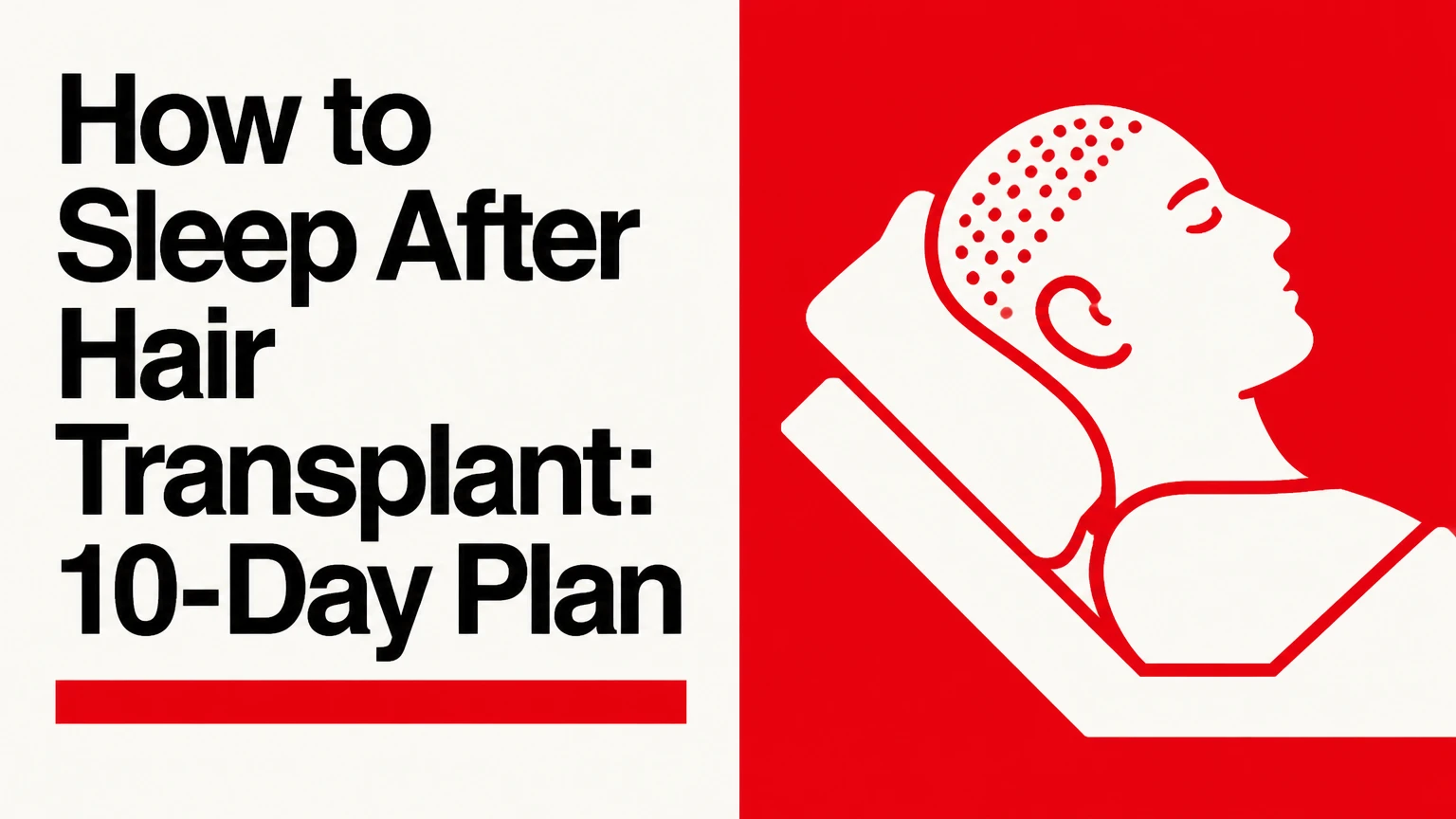
After a hair transplant, sleep on your back with the recipient area away from the pillow, and elevate your head approximately 30-45 degrees for the first several nights unless your surgeon gives different instructions. Maintain this position long enough to limit swelling and accidental rubbing, then resume side or stomach sleeping only after the grafts and incisions have adequately healed.
Key Facts at a Glance
- A hair transplant patient should keep newly implanted grafts free from direct pillow pressure during the early healing period.
- Head elevation commonly remains useful for 3-5 nights because facial swelling can increase during the first postoperative days.
- A stable wedge or recliner is safer than a loose stack of pillows that slides flat during sleep.
- Graft security improves substantially during the first week, but the exact return to normal sleeping depends on healing and clinic instructions.
- Satin or silk bedding may reduce friction, but no fabric makes direct pressure on fresh grafts safe.
- Persistent bleeding, fever, spreading redness, severe pain, or visual symptoms requires prompt contact with the surgical clinic or urgent medical care.
Why Sleep Position Matters After a Hair Transplant
Sleep position matters because friction, pressure, sweat, and uncontrolled movement can irritate the recipient area while grafts remain vulnerable. A transplanted follicular unit is placed into a small recipient-site incision, and the surrounding skin needs time to form a stable clot and begin healing.
Head elevation also helps manage dependent swelling. Fluids from the scalp may move toward the forehead and eyelids when a patient lies completely flat, so many clinics recommend a raised upper body during the first few nights. Saraswat Hospital and Harley Street Hair Transplant describe elevated back sleeping as a common aftercare measure, although neither a universal angle nor a single duration applies to every patient.
The practical goal is simple: keep the implanted area from touching the pillow, avoid compressing the scalp, and reduce the chance that swelling or oozing disturbs sleep. Sleeping correctly cannot guarantee graft survival, because surgical technique, blood supply, infection, smoking, medication use, and individual healing also influence the outcome.
What does graft security mean?
Graft security describes how firmly transplanted follicular units have become integrated into the recipient skin. The first days carry the highest risk from rubbing or picking, while scabs and early tissue healing gradually improve stability.
The often-repeated “day 7” rule is a useful approximation, not a biological deadline. Hair transplant clinics differ in their washing schedules, graft-placement depth, recipient-area size, and advice about side sleeping. A patient with extensive frontal work may receive different instructions from a patient with only a small crown procedure.
Before You Start: Night-One Requirements
Prepare the sleeping arrangement before the procedure or before the first evening at home. The setup usually takes 10-15 minutes and requires a stable incline, clean bedding, optional side barriers, and any medication specifically prescribed by the surgical team.
| Item | Typical quantity or specification | Typical cost | Purpose |
|---|---|---|---|
| Wedge pillow | 20-30 cm high, full upper-body support | $30-$90 | Maintains a stable incline |
| U-shaped travel pillow | One, medium-firm foam | $10-$35 | Limits neck rotation |
| Clean pillowcase | Two, smooth tightly fitted covers | $10-$30 | Reduces snagging and laundering delays |
| Absorbent underpad | Two to four disposable pads | $5-$20 | Protects bedding from fluid |
| Knee pillow | One, 10-15 cm thick | $15-$40 | Reduces lower-back strain |
| Recliner | One chair with a secure backrest | Existing furniture or $200+ | Provides consistent elevation |
Use a clean towel or disposable underpad over the pillow rather than placing an unwashed towel against the scalp. Keep pets and children out of the bed during the early recovery period, because an unexpected paw, elbow, or head movement can cause more trauma than ordinary tossing.
How to Sleep After Hair Transplant Surgery
The safest first-night routine has five actions: elevate the upper body, sleep on the back, protect the donor area from pressure, stabilize the neck, and inspect the bedding without touching the grafts. The routine is low difficulty, but maintaining a stable position matters more than buying expensive accessories.
Step 1: Elevate the Upper Body
Raise the upper torso to approximately 30-45 degrees, or use the exact angle recommended by the surgeon. A wedge pillow or adjustable recliner is preferable to two or three loose pillows because a wedge supports the back continuously and is less likely to collapse overnight.
Do not bend only at the neck. The shoulders and upper back should rise together, while the head remains neutral. Place a pillow under the knees if the inclined position pulls on the lower back.
You will know the setup works when the upper body remains raised without chin-to-chest pressure, neck twisting, or sliding toward the foot of the bed. A common mistake is creating a steep pile that forces the head forward. Lower the incline slightly and support the torso if breathing or neck comfort worsens.
Step 2: Sleep on Your Back
Lie on the back and position the head so the recipient area does not touch the pillow. For a frontal hairline transplant, the pillow should support the neck and back of the skull without pressing the hairline.
A U-shaped travel pillow can limit rotation, but it should sit around the neck rather than across the implanted hairline. Bulky pillows placed tightly beside the head may push the face forward or create accidental contact, so test the arrangement while awake for 15-20 minutes.
You will know the position works when the grafted region remains suspended above the bedding and the neck feels supported. Do not use a tight band, adhesive, hat, or improvised restraint to immobilize the head unless the surgeon specifically supplied it.
Step 3: Protect the Donor Area Without Compressing It
FUE donor sites usually involve many small extraction points distributed across the back and sides of the scalp. FUT donor sites involve a linear incision, so direct pressure may be uncomfortable or inappropriate until the surgeon confirms that the incision is healing normally.
Place the head gently rather than dropping backward onto the pillow. If a FUT strip incision is tender, ask the clinic whether a modified recliner position or additional neck support is appropriate. Do not place a hard object under the incision to create a gap.
You will know the donor arrangement works when the donor area is supported without throbbing, tight pulling, or fresh blood on the pillow. A frequent error is focusing only on the recipient area and compressing the donor wound for eight hours.
Step 4: Use Clean, Smooth Bedding
Use a freshly laundered, fitted pillowcase with a smooth surface. Satin or silk can reduce friction compared with rough fabric, but the material does not prevent graft damage if the scalp is pressed into it.
Keep the bedding dry and replace any cover contaminated with blood, saline, ointment, or other fluid. Do not apply household oils, disinfectants, hair products, or fabric softener directly to the recipient area.
You will know the bedding is appropriate when it remains taut and does not bunch under the head. Loose fabric creates folds that can rub scabs and catch on dressings.
Step 5: Follow the Clinic’s Night Instructions
Use only the washing schedule, saline spray, antibiotic, pain medication, and anti-inflammatory medication supplied or approved by the surgical team. Do not take a sedative or sleep aid simply to prevent movement unless a clinician has prescribed it and reviewed interactions.
Alcohol can worsen dehydration, interact with medication, and increase the chance of poor judgment or accidental contact. Smoking and nicotine exposure may also impair wound healing, so follow the clinic’s restrictions rather than treating sleep position as the only recovery variable.
You will know the evening plan is complete when medication timing, water, clean bedding, and a contact number for the clinic are ready before bedtime.
Which Sleeping Setup Protects Grafts Best?
A wedge pillow with a neck pillow is usually the most practical home setup, while a recliner can be easier for people who roll onto their side. A pillow stack costs less, but it is less stable and often becomes flat after several hours.
| Setup | Elevation stability | Best use | Main limitation |
|---|---|---|---|
| Orthopedic wedge | High, typically 30-45 degrees | First 3-5 nights at home | May aggravate hip or lumbar pain |
| Recliner chair | High, adjustable 20-60 degrees | Restless sleepers and short-term recovery | Can cause neck or leg stiffness |
| Pillow stack | Low to medium, often shifts overnight | Budget setup for one night | Collapses and creates neck flexion |
| Adjustable bed | High, commonly 25-45 degrees | Patients already owning one | Purchase cost is high |
| Side-sleeping cushion system | Medium, depends on placement | Later recovery after clearance | Does not protect fresh recipient sites |
A recliner is not automatically safer. A patient can slide downward, flex the neck, or roll toward an armrest, especially in a soft chair. Secure the feet, support the lumbar region, and keep the head aligned.
How high should your head be?
A 30-45-degree upper-body incline is a common postoperative range, but the surgeon’s prescribed angle takes priority. The objective is to keep the head above the heart and reduce facial swelling without forcing the neck into a painful forward bend.
Exact angle claims deserve caution. Clinics such as HairPol and Emrah Cinik recommend elevated sleeping, but protocols differ by procedure and patient. No reliable universal rule proves that precisely 45 degrees is necessary for every transplant.
Recovery Timeline: When Can You Change Position?
Most patients use elevated back sleeping for approximately 3-5 nights, avoid direct recipient-area pressure for about 7-10 days, and return to side sleeping only after the clinic confirms adequate healing. The timeline changes with bleeding, swelling, graft location, FUT incision discomfort, and the surgeon’s washing protocol.
| Recovery period | Typical position | Main risk | Practical checkpoint |
|---|---|---|---|
| Night 1 | Back, 30-45 degrees | Rubbing, oozing, swelling | Grafts remain untouched |
| Nights 2-3 | Back, 30-45 degrees | Increased facial swelling | No worsening bleeding |
| Nights 4-6 | Back, 20-45 degrees | Itching, scab disruption | Scabs remain undisturbed |
| Days 7-10 | Back, often lower incline | Pressure on healing grafts | Clinic-approved washing and position |
| Days 11-14 | Side sleeping if cleared | Residual scab friction | No open or bleeding sites |
| After day 14 | Gradual normal sleep | Irritation from scratching | Scalp tolerates contact normally |
When can you sleep on your side?
Many patients can resume side sleeping around day 7-10, but side sleeping is appropriate only when the recipient area is no longer vulnerable to ordinary contact and the clinic has given clearance. Side sleeping earlier than advised can press grafts against the pillow and disturb scabs.
Patients with a crown transplant may contact the pillow sooner than patients with only a frontal hairline transplant. Patients with FUT may also need to modify side sleeping because the linear donor incision can remain tender after the recipient grafts are secure.
When can you sleep on your stomach?
Avoid stomach sleeping until at least the early healing period has passed, commonly around day 10-14 or later if the surgeon advises it. Stomach sleeping places the face and forehead against the mattress, increases heat and moisture, and makes it difficult to keep the recipient area untouched.
Normal sleep should be resumed gradually. If lying flat causes throbbing, swelling, or tenderness, return to a modest incline and contact the clinic if symptoms are worsening rather than improving.
How Do FUE and FUT Change Sleep Advice?
FUE and FUT change sleeping comfort mainly through the donor wound, while recipient-graft protection remains important for both procedures. FUE produces multiple small extraction sites, whereas FUT leaves a linear donor incision that may respond poorly to prolonged pressure or neck stretching.
| Procedure feature | FUE | FUT |
|---|---|---|
| Donor wound pattern | Multiple small sites | Linear strip incision |
| Common donor discomfort | Tenderness and pinpoint scabs | Tightness and pulling |
| Pillow concern | Pressure on scattered sites | Pressure along incision |
| Position modification | Neck support may help | Recliner may reduce incision strain |
| Clinic review priority | Recipient and donor healing | Incision integrity and sutures |
The extraction method does not create permission to sleep directly on fresh grafts. Follow the procedure-specific instructions, particularly if the clinic used sutures, staples, a dressing, or a large number of grafts.
What If You Wake Up on Your Side?
Waking briefly on your side does not automatically mean graft loss, especially if there is no fresh bleeding, displaced tissue, or visible graft on the bedding. Return gently to the recommended position, avoid inspecting by rubbing or picking, and contact the clinic if bleeding or unusual pain appears.
Do not assume that every missing scab is a lost graft. A scab may detach during approved washing without taking the follicular unit with it. Conversely, a visible small tissue fragment with persistent bleeding deserves professional assessment.
What should you do if a graft bleeds?
Apply clean sterile gauze with continuous gentle pressure for 10 minutes without lifting the gauze to check repeatedly. If bleeding continues, becomes heavy, or recurs after pressure is released, contact the transplant clinic promptly.
Do not dab, scrub, use alcohol, apply hydrogen peroxide, or pull at the area. Treatment Rooms London and Capital Hair Restoration both describe pressure and clinical escalation as appropriate responses to postoperative bleeding.
How Can You Control Itching at Night?
Control itching with the saline spray, washing routine, and medication approved by the clinic, while keeping fingernails away from the recipient area. Itching often becomes more noticeable as the skin dries and scabs develop, but scratching can remove scabs before the skin is ready.
Use a clean spray bottle only if supplied or approved by the clinic. An antihistamine may be suitable for some patients, but it can interact with other medicines and cause drowsiness, so obtain approval before taking one.
Expert practice rule: nighttime itching is often made worse by dry air, overheated rooms, and tight hats. A cool, clean room and prescribed saline are safer first adjustments than adding cosmetic products.
Common Mistakes and How to Fix Them
| Mistake | Why it causes trouble | Immediate correction | When to call |
|---|---|---|---|
| Flat pillow stack | Head loses elevation | Replace with a wedge or recliner | If swelling worsens rapidly |
| Scratching scabs | Can cause bleeding or irritation | Stop, spray only as approved | Persistent bleeding |
| Tight cap overnight | Adds pressure and heat | Remove unless prescribed | If grafts appear displaced |
| Alcohol with medication | May increase adverse effects | Stop alcohol and follow prescription | Dizziness, vomiting, confusion |
| Sleeping on FUT incision | Increases tenderness and pulling | Modify recliner or back support | Wound opening or drainage |
| Pet in the bed | Raises accidental-contact risk | Sleep separately | Bite, scratch, or contamination |
Cotton is not inherently dangerous, and silk is not protective equipment. The relevant variables are pressure, friction, cleanliness, and whether the recipient area contacts the fabric.
Heavy sedatives also create a trade-off. A prescribed medicine may improve sleep, but unapproved sedation can impair safe medication use, balance, and recognition of bleeding or breathing problems.
Variations for Difficult Sleepers
If you are a side or stomach sleeper
Practice back sleeping before surgery, then use a wedge and a loose side barrier around the torso rather than hard objects beside the head. A recliner can reduce rolling during the first 2-5 nights, but test it before surgery to identify neck and leg problems.
If you have back pain
Support the knees with a pillow and keep the incline distributed through the torso. A rolled towel may support the lumbar area, but remove it if it increases pressure or forces the pelvis forward.
If you are a restless sleeper
Choose a stable recliner or adjustable bed and remove excess bedding that can wrap around the neck. Ask another adult to check the setup only if needed, but do not use restraints or take extra medication to prevent movement.
How Much Do Recovery Sleep Options Cost?
Typical recovery equipment costs $0-$250, depending on whether the patient already owns a recliner or adjustable bed. A household pillow arrangement may cost nothing, while a wedge, neck pillow, underpads, and replacement bedding commonly total $55-$175.
| Option | Typical price | Setup time | Expected useful period |
|---|---|---|---|
| Existing pillows and clean towel | $0-$20 | 10 minutes | 1-3 nights |
| Wedge and neck pillow | $40-$125 | 10 minutes | 1-3 weeks |
| Recliner already owned | $0 additional | 5 minutes | 3-7 nights |
| New manual recliner | $200-$600 | 20-45 minutes | Several years |
| Adjustable bed rental or purchase | $50-$300 rental or $800+ purchase | 15-30 minutes | 1-4 weeks or longer |
Cost does not predict safety. A stable household recliner may outperform an expensive pillow set if the pillow set slides or bends the neck.
When Should You Contact the Clinic?
Contact the surgical clinic for bleeding that does not stop after continuous pressure, increasing rather than decreasing swelling, wound separation, foul drainage, or pain that remains severe despite the prescribed plan. Seek urgent medical care for breathing difficulty, facial swelling affecting vision, confusion, fainting, or a serious allergic reaction.
| Symptom | Possible concern | Action |
|---|---|---|
| Mild pink staining | Expected early oozing | Follow clinic instructions |
| Persistent active bleeding | Vessel or wound problem | Apply pressure and call clinic |
| Increasing redness and warmth | Possible infection | Same-day clinical advice |
| Fever with pus or foul odor | Possible infection | Prompt medical assessment |
| Vision change with swelling | Orbital or severe swelling issue | Urgent care |
| Severe headache with vomiting | Medication or postoperative complication | Urgent clinical advice |
Aftercare websites, including Wimpole and MCan Health, describe individual assessment as necessary when symptoms exceed ordinary swelling or discomfort. Online guidance cannot determine whether a particular graft, incision, or medication reaction needs treatment.
Frequently Asked Questions
Can I sleep flat after a hair transplant?
A patient may be allowed to sleep flatter after several nights when swelling has settled and the clinic confirms that the recipient area remains protected. Many clinics maintain some elevation for 3-5 nights, but a flat position on the first night may increase swelling and makes accidental contact more likely.
Should I wear a hat to bed after a transplant?
Do not wear a hat to bed unless the surgeon specifically approves it. A tight or rough hat can press on grafts, trap heat, and catch on scabs. If protection from sunlight or dust is required, use only the loose, clean covering and timing recommended by the clinic.
Can I take melatonin after hair transplant surgery?
Ask the surgeon or pharmacist before taking melatonin because postoperative medicines, alcohol, medical conditions, and personal sensitivity affect suitability. Melatonin may help some patients sleep, but it does not prevent contact with the pillow and should not replace a stable sleeping setup.
How long should I use a neck pillow after FUE?
A neck pillow is commonly useful for the first 3-5 nights, when limiting head rotation is most valuable. Continue longer if it improves comfort, but remove or reposition it if the device presses on the recipient area, causes neck pain, or restricts normal breathing.
Can hair electrolysis replace a hair transplant?
Hair electrolysis cannot replace a hair transplant when the goal is to restore density in an area affected by androgenetic hair loss. Electrolysis permanently destroys individual follicles and is generally used for unwanted hairs, while transplantation redistributes donor follicles; never use electrolysis over healing grafts without medical clearance.
Will one bad night ruin my transplant?
One brief episode of side sleeping does not necessarily ruin a transplant, particularly when there is no bleeding or visible trauma. Resume the prescribed position, avoid picking, and contact the clinic if bleeding, graft displacement, severe pain, or rapidly increasing swelling occurs.
The Bottom Line
To sleep after a hair transplant, elevate the upper body approximately 30-45 degrees, sleep on the back, keep the recipient area off the pillow, and use a stable wedge or recliner during the first several nights. Maintain protection from direct contact for roughly 7-10 days unless the surgeon gives another timeline, then return to side or stomach sleeping gradually after healing is confirmed.
The most reliable plan is the one your operating clinic can support for your exact graft location, FUE or FUT technique, medication list, and wound condition. How to sleep after hair transplant is therefore a protection problem, not a pillow-shopping problem: reduce pressure, friction, moisture, and uncontrolled movement while watching for symptoms that need medical review.