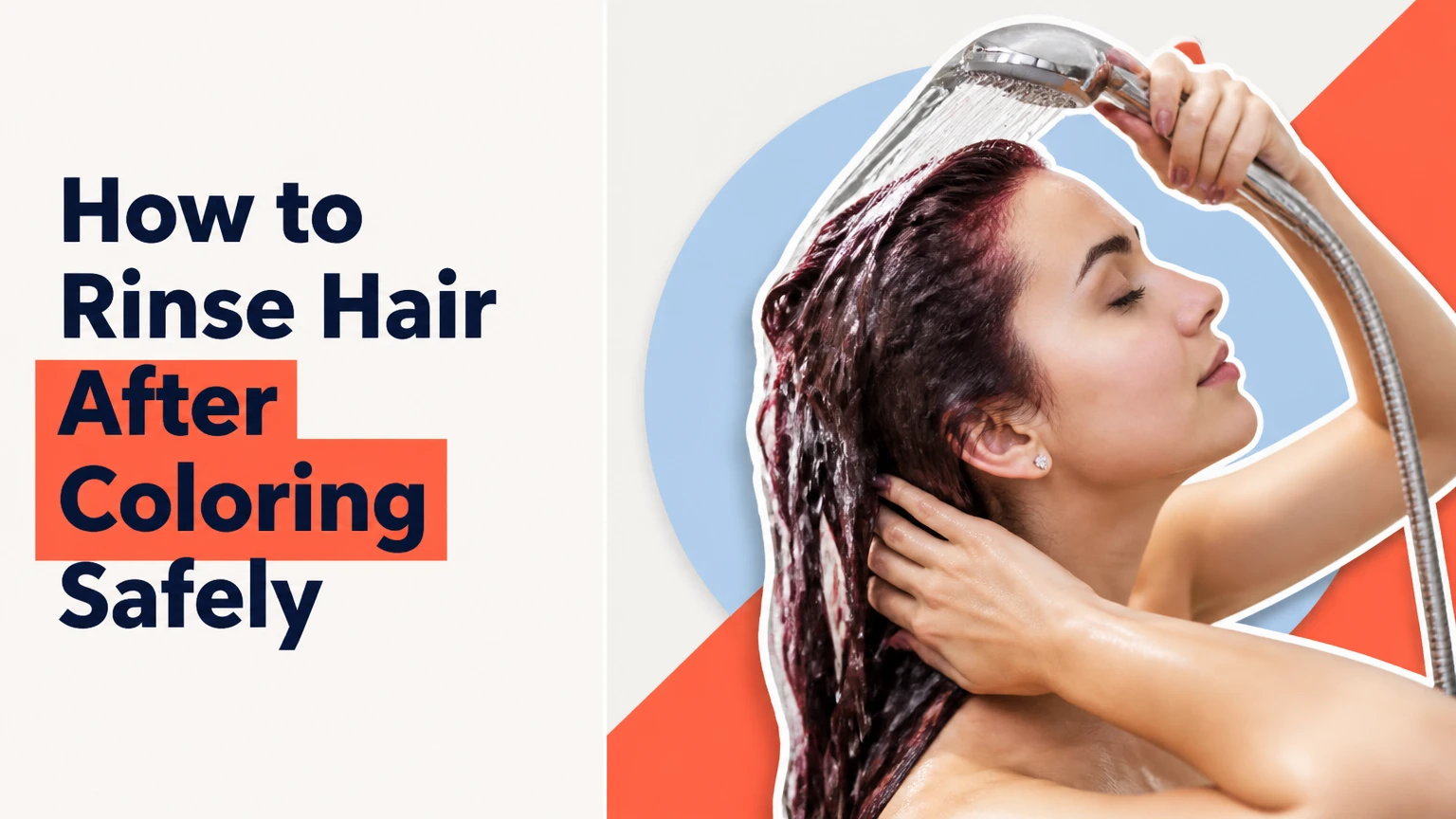
To rinse hair after coloring, emulsify the color with a small amount of lukewarm water, rinse thoroughly without scratching, follow the product instructions about shampoo, condition the lengths, and blot dry gently. Most rinses take 5-10 minutes, but direct dyes may continue releasing pigment without indicating that the color treatment failed.
Key Facts at a Glance
Use lukewarm water, approximately 32-38°C (90-100°F), rather than hot water.
Follow the dye manufacturer’s instructions before deciding whether to shampoo immediately.
Permanent and demi-permanent color can release some tint during rinsing; direct dyes often bleed for several washes.
A cool final rinse can reduce comfort issues and runoff, but cold water does not physically seal the cuticle.
Do not scratch a freshly colored scalp or force a comb through tangled, wet hair.
Burning, facial swelling, blistering, or breathing difficulty requires immediate medical attention.
What Does Rinsing Hair After Coloring Do?
Rinsing removes excess color mixture, developer residue, alkalizing ingredients, and unattached pigment from the scalp and hair surface. Rinsing does not reverse the chemical process inside the cortex, and water alone does not permanently “lock” color into the hair.
Permanent hair color typically uses an alkaline ingredient and hydrogen peroxide to swell the fiber, lighten some natural melanin, and form or deposit color within the hair. Demi-permanent formulas generally use lower alkalinity and deposit more color than they lighten. Semi-permanent and temporary products rely largely on preformed direct dyes that sit in or around the cuticle.
The rinse therefore has three practical goals:
- Remove residual formula from the scalp.
- Remove loose surface pigment without stripping more color than necessary.
- Leave the hair conditioned enough to detangle without breakage.
The final condition of the cuticle depends more on the formula, pH, porosity, conditioning ingredients, and mechanical handling than on cold water alone. Hair’s isoelectric behavior is complex, so claims that a 20°C rinse “closes” every cuticle are oversimplified.
What You Need Before Starting
Prepare an old dark towel, a gentle conditioner or the product’s included after-color treatment, and a clean shower or basin before processing time ends. The product leaflet is the controlling instruction because some kits require shampoo, some specify conditioner only, and salon toners may have separate removal directions.
| Item | Typical quantity or setting | Why it matters | Suitable substitute |
|---|---|---|---|
| Water | 32-38°C, lukewarm | Removes formula without excessive heat | Comfortable tap water |
| After-color conditioner | 5-15 mL for shoulder-length hair | Adds slip and reduces wet friction | Color-safe conditioner |
| Dark towel | 1 towel, preferably microfiber | Limits visible staining | Dark cotton T-shirt |
| Wide-tooth comb | 1 comb, used only after conditioning | Reduces pulling on wet hair | Fingers |
| Rinse time | 5-10 minutes typical | Allows scalp and lengths to clear | Longer for dense hair |
| Gloves | 1 pair during handling | Protects hands from dye stains | Nitrile gloves |
What Should You Check on the Label?
Check whether the package says “rinse until water runs clear,” “shampoo,” “condition,” or “use the included post-color treatment.” A boxed permanent dye, a professional demi-permanent gloss, and a direct blue pigment may require different finishing steps, so generic internet rules cannot replace the manufacturer’s sequence.
Do not use an oxidative color product after its stated development time simply because the water looks tinted. Do not add household vinegar, baking soda, bleach, or detergent to speed removal. Those substances can irritate skin or create unpredictable changes in porosity and color.
How to Rinse Hair After Coloring
Use the following sequence after the stated processing time ends. The complete procedure usually takes 5-10 minutes, and the most important success factor is thorough, gentle removal of product from the scalp without excessive heat or friction.
Step 1: Emulsify the Color With Lukewarm Water
Turn the shower or tap to lukewarm water and add a small splash to the hair before using full water flow. Massage the color gently with the finger pads for 30-60 seconds, concentrating on the hairline, temples, crown, and nape.
Emulsification loosens dried product and helps distribute the remaining color mixture before the main rinse. It can also reduce staining around the hairline, but vigorous rubbing is unnecessary and may irritate sensitized skin.
You’ll know it worked when: the color mixture feels more fluid and the scalp is no longer covered by thick cream.
Common mistake: using fingernails or scrubbing as though removing shampoo buildup.
Step 2: Rinse the Scalp Before the Lengths
Direct the lukewarm stream at the scalp first, lifting sections with your fingers so water reaches the roots. Keep the head tilted backward when possible, because concentrated dye runoff can irritate the eyes, ears, neck, or face.
Work from the hairline toward the crown, then the sides and nape. For thick hair, divide the hair into four sections and rinse each section separately rather than allowing the outer layer to shield the interior.
You’ll know it worked when: no thick cream remains at the roots, behind the ears, or along the neck.
Common mistake: rinsing only the top layer while leaving developer trapped underneath dense hair.
Step 3: Rinse the Lengths Until the Formula Is Removed
Squeeze the lengths gently under running water, then allow water to pass from roots to ends. Continue for approximately 3-7 minutes, adjusting for density, hair length, and the amount of product applied.
“Until clear” is a useful endpoint for many oxidative formulas, but it is not a strict test of final color permanence. Red, violet, blue, and highly porous hair may release a light tint even after the cream has been removed. Direct-dye users should stop when the product is thoroughly rinsed rather than extending the process indefinitely to chase perfectly colorless water.
You’ll know it worked when: the water contains no cream, slippery developer residue, or thick ribbons of dye.
Common mistake: treating every trace of colored water as evidence that all deposited color is being lost.
Step 4: Decide Whether Shampoo Is Appropriate
Use shampoo only when the instructions require it or when residual formula remains after thorough water rinsing. Choose a gentle, color-safe cleanser and apply it mainly to the scalp, allowing diluted suds to pass through the lengths.
For many semi-permanent direct dyes, conditioner-only rinsing preserves more pigment than immediate shampooing. For permanent boxed color, instructions vary by brand. Some formulas specify shampoo; others direct the user to rinse and apply the included conditioner. A sulfate-free label alone does not guarantee that a shampoo is appropriate immediately after coloring.
You’ll know it worked when: the scalp feels clean without tightness, burning, or heavy residue.
Common mistake: using clarifying, medicated, or anti-dandruff shampoo because the hair feels coated. These products can remove more loose pigment than necessary.
Step 5: Apply the Recommended Conditioner
Apply the included after-color treatment or a color-safe conditioner from mid-length to ends, then use the remaining product near the roots if the scalp is comfortable. Leave the treatment on for the label’s stated duration, commonly 2-5 minutes.
Conditioner improves slip and reduces friction during detangling. An acidic conditioner may reduce surface friction and help the fiber feel smoother, but the product does not permanently seal the cuticle or repair broken internal bonds.
You’ll know it worked when: the hair separates more easily under the fingers and feels lubricated rather than squeaky.
Common mistake: applying a heavy mask to fine hair and then failing to rinse away the coating.
Step 6: Finish With Cool, Comfortable Water
Rinse the conditioner with cool or comfortably lukewarm water for approximately 20-30 seconds. Cool water may reduce scalp discomfort and can limit rapid, superficial color runoff, but it does not create a mechanical “cold shock” that permanently closes hair cuticles.
Avoid water so cold that it causes discomfort or makes you rush the rinse. Thorough removal at a comfortable temperature is safer and more useful than a brief icy rinse that leaves product behind.
You’ll know it worked when: the hair feels clean, smooth, and free of conditioner film.
Common mistake: using very hot water to dissolve residue faster.
Step 7: Blot and Detangle Without Pulling
Press the hair with a dark microfiber towel or old cotton T-shirt. Do not twist, wring, or rub freshly processed hair, because wet hair stretches more easily and bleached or highly porous fibers have less tolerance for tension.
Apply a small amount of leave-in conditioner if the hair is difficult to separate. Finger-detangle first, then use a wide-tooth comb from the ends upward. Allow the hair to air-dry when practical, or use low heat with a thermal protectant.
You’ll know it worked when: the hair dries without new snapping, rough clumps, or excessive transfer onto the towel.
Common mistake: brushing from the roots downward while the hair is saturated and unconditioned.
Which Rinse Method Fits Your Color?
The best method depends on pigment type, hair density, scalp sensitivity, and mess control. A shower is the most practical choice for permanent color, while a basin can help contain runoff from highly staining fashion shades.
| Method | Typical duration | Best use | Main limitation |
|---|---|---|---|
| Shower rinse | 5-10 minutes | Permanent, demi-permanent, toner | Runoff can stain skin or grout |
| Salon backbar rinse | 5-15 minutes | Professional color and glosses | Requires a stylist and salon visit |
| Sink or basin rinse | 8-15 minutes | Short hair and vivid direct dye | Awkward for long or dense hair |
| Conditioner-assisted rinse | 5-12 minutes | Dry, curly, or porous hair | Can weigh down fine hair |
| Water-only first rinse | 5-10 minutes | Most direct dyes when labeled | May leave scalp residue if overused |
A basin is not automatically gentler. Submerging long hair can spread pigment through the entire mass and create more tangling. A controlled shower stream usually gives better scalp access.
Should You Shampoo After Different Color Types?
Shampoo timing should follow the product directions, not a universal 72-hour rule. Modern permanent and demi-permanent colors are designed to be rinsed and finished immediately, while additional shampooing can be delayed if the scalp is comfortable and the product instructions permit it.
| Color type | First-rinse default | Shampoo decision | Typical next wash |
|---|---|---|---|
| Permanent oxidative color | Rinse thoroughly | Follow package or stylist directions | 24-72 hours, if comfortable |
| Demi-permanent gloss | Rinse thoroughly | Often conditioner or gentle cleanser | 24-48 hours |
| Semi-permanent direct dye | Rinse until product is removed | Usually skip unless label says otherwise | 24-72 hours |
| Toner after highlights | Rinse thoroughly | Follow salon formula instructions | 24-48 hours |
| Temporary spray or wax | Rinse until water is mostly clean | Gentle shampoo usually needed | Same day if desired |
The often-repeated 72-hour rule is a practical color-preservation habit, not a universal chemical requirement. Color does not remain unstable for exactly three days in every formula, and delaying shampoo does not compensate for harsh water, frequent washing, high heat, or porous bleached ends.
How Do Water Temperature and Product Choice Affect Fading?
Hot water can increase swelling and remove cosmetic oils, which may accelerate dullness and color loss over repeated washes. A lukewarm rinse is the best compromise because it provides enough comfort and flow to remove residue without the unnecessary heat of a hot shower.
| Choice | Immediate benefit | Color consequence | Better use |
|---|---|---|---|
| 32-38°C water | Comfortable, thorough removal | Lower heat exposure | First rinse for all formulas |
| 39-43°C water | Dissolves residue quickly | Greater dryness and runoff risk | Avoid immediately after coloring |
| Cool water, 20-30°C | May soothe warmth | Does not seal the cuticle | Final brief rinse |
| Clarifying shampoo | Removes heavy buildup | Can strip loose pigment | Use later, only when needed |
| Color-safe shampoo | Cleans scalp gently | Usually lower stripping potential | Later wash days |
| Conditioner-only wash | Preserves direct dye | May leave oil or residue | Dry, curly hair with suitable dye |
A color-safe shampoo is not defined by one ingredient. Formula pH, surfactant strength, washing frequency, water hardness, and hair porosity all influence fading. Fine hair may need a light cleanser sooner than coarse hair because excess conditioner can flatten the roots.
What Changes for Bleached, Curly, Gray, or Vivid Hair?
Bleached and highlighted hair requires less friction, curly hair benefits from more slip, gray coverage requires careful scalp rinsing, and vivid direct dye requires realistic expectations about continued bleeding. Hair condition matters as much as color category.
Bleached and Highlighted Hair
Use the lowest practical water pressure and apply conditioner before detangling. Bleached hair is more porous and mechanically fragile, so rough squeezing, repeated combing, and hot blow-drying create more risk than a short period of tinted runoff.
A bond-building product may improve the feel of damaged hair, but it cannot restore every broken disulfide bond. Purple shampoo is not an immediate post-color requirement unless the toner or stylist specifically calls for it; premature use can make porous blonde hair look gray, violet, or uneven.
Curly and Coily Hair
Keep curls grouped while rinsing and support the lengths with one hand. Apply conditioner generously enough to create slip, then finger-detangle from ends upward instead of pulling a brush through saturated coils.
A conditioner-only first rinse can suit dry or curly hair colored with a direct dye, but it may not remove oxidative color residue from the scalp. If the roots feel coated, use a small amount of gentle cleanser at the scalp only.
Gray Coverage and Root Touch-Ups
Spend most of the rinse time at the scalp, hairline, temples, and behind the ears. Gray-coverage formulas can leave visible staining along the hairline, especially when a dark shade is applied over pale skin.
Do not scrub staining with alcohol, acetone, or abrasive products. A damp cloth and mild cleanser may remove fresh surface color, while persistent irritation should take priority over cosmetic stain removal.
Vivid and Pastel Direct Dyes
Expect some bleeding during the first several washes, especially with red, magenta, blue, and turquoise pigments. Rinse with lukewarm-to-cool water until the heavy product is gone, skip shampoo if the label permits, and use a dark towel and pillowcase.
Pastel shades often sit on lightened, porous hair and can become uneven when over-rinsed. Water that never becomes perfectly clear does not necessarily mean the application failed.
What If the Rinse Goes Wrong?
Most rinse problems can be corrected by stopping unnecessary manipulation and matching the response to the symptom. Persistent burning, swelling, blistering, or systemic symptoms are safety issues rather than routine color-care problems.
| Problem | Likely cause | Immediate response | When to escalate |
|---|---|---|---|
| Water remains tinted after 10 minutes | Direct dye or porous hair | Stop chasing clear water; condition and blot | Contact stylist if color is patchy |
| Scalp burns during rinsing | Irritation or allergic reaction | Rinse with cool water and remove product | Medical advice for persistent or severe symptoms |
| Hair feels straw-like | High porosity, alkalinity, or friction | Condition, pause combing, air-dry | Stylist assessment for breakage |
| Hair feels greasy after rinsing | Excess conditioner or incomplete cleansing | Rinse again with lukewarm water | Gentle shampoo later if label permits |
| Color looks too dark while wet | Wet hair temporarily appears deeper | Wait until fully dry | Corrective advice after 24 hours |
| Dye stains skin or towel | Surface pigment transfer | Blot, wash gently, use dark textiles | Seek advice for irritated skin |
If Your Scalp Burns or Itches
Rinse immediately and stop using the product. The U.S. Food and Drug Administration advises consumers to follow package directions and perform the recommended allergy skin test; a burning sensation is not a reason to leave dye on longer or cover the head.
Cool water may provide temporary comfort, but conditioner should not be used to mask a suspected reaction. Facial swelling, hives, blistering, dizziness, or breathing difficulty requires urgent medical care.
If Hair Mats or Snaps
Stop pulling and saturate the tangled area with conditioner. Separate the section with fingers, beginning at the ends, and postpone heat styling until the hair is dry and manageable.
If strands snap during gentle handling, do not repeat the rinse multiple times. Excessive manipulation can worsen damage without improving color.
If You Shampooed a Direct Dye
Do not immediately recolor the hair to compensate. Rinse away the cleanser, apply conditioner, dry the hair, and assess the result in natural light. A color-depositing conditioner may be a safer later correction, but product compatibility and strand porosity must be considered first.
How Long Does Rinsing Take and What Does It Cost?
A home post-color rinse usually takes 5-10 minutes and costs approximately $0-$20 when the kit includes conditioner. A separate color-safe conditioner typically costs $8-$25, while professional acidic treatments or salon finishing services commonly add $15-$45, depending on brand and location.
| Scenario | Rinse time | Additional product cost | Practical endpoint |
|---|---|---|---|
| Short permanent color | 5-7 minutes | $0-$15 | No cream or thick residue |
| Long, dense permanent color | 8-12 minutes | $0-$25 | Roots and underlayers fully rinsed |
| Vivid direct dye | 5-10 minutes | $0-$25 | Heavy pigment removed, light tint acceptable |
| Bleached toner | 5-8 minutes | $5-$30 | Smooth, conditioned lengths |
| Salon backbar service | 5-15 minutes | Included or $15-$45 | Stylist confirms removal |
Water temperature and handling matter more than buying an expensive sealer. A premium conditioner cannot undo hot-water exposure, repeated shampooing, or mechanical breakage.
Can Hair Electrolysis Be Done Near a Color Rinse?
Hair electrolysis should not be performed on a scalp or facial area that has recently been exposed to hair dye and remains irritated. Electrolysis creates localized heat and chemical activity around the follicle, so combining it with active dye irritation can increase discomfort and complicate assessment of a reaction.
Keep hair coloring and electrolysis separate when both involve nearby skin. Ask the electrologist for the clinic’s interval, and postpone treatment if redness, itching, broken skin, or swelling remains. Hair electrolysis is unrelated to cuticle sealing and cannot remove or stabilize cosmetic hair color.
Common Mistakes and How to Fix Them
Using Hot Water
Hot water makes the process comfortable but can increase dryness and runoff. Switch to lukewarm water for the main rinse and cool water only if comfortable for the final 20-30 seconds.
Scratching the Scalp
Scratching can worsen irritation and create tiny breaks in the skin. Use finger pads, not fingernails, and stop if the scalp stings.
Chasing Perfectly Clear Water
Direct dyes may bleed lightly for multiple washes. Stop once the cream and heavy residue are gone, then condition and use a dark towel.
Using Clarifying Shampoo Immediately
Clarifying shampoo removes buildup efficiently, but that strength can remove loose cosmetic pigment. Reserve it for later buildup problems unless the product instructions specifically require it.
Rubbing With a Towel
Rubbing increases friction while the fiber is wet and vulnerable. Press the towel around the hair, then air-dry or use low heat.
Applying Purple Shampoo Automatically
Purple shampoo is designed to counter yellow tones, not to rinse every type of color. It can over-deposit on porous blonde hair and is unnecessary for most brown, red, or direct-dye first rinses.
Frequently Asked Questions
Can I rinse hair dye with only water?
Yes, water-only rinsing is appropriate when the product instructions say to rinse thoroughly and condition afterward. Water-only rinsing is especially common for direct dyes, but permanent formulas may require shampoo. Remove all cream and residue from the scalp rather than relying on water alone when the hair still feels coated.
Why is my colored hair still bleeding after rinsing?
Continued bleeding usually comes from loose direct pigment, porous hair, frequent washing, hot water, or friction. Red, blue, violet, and magenta dyes commonly release visible tint beyond the first rinse. Use cooler water, wash less frequently, and protect light towels and bedding.
Can I rinse colored hair in cold water?
Yes, but cold water is optional rather than chemically necessary. Lukewarm water cleans more effectively and is less uncomfortable, while a brief cool rinse can reduce heat and limit some surface runoff. Cold water does not permanently close the cuticle or guarantee longer-lasting color.
Should I wait 72 hours before washing colored hair?
A 72-hour delay is not mandatory for every formula. Follow the package or stylist instructions, and delay the next shampoo when practical if the scalp is comfortable. The product type, hair porosity, washing frequency, water temperature, and cleanser strength affect fading more than a universal three-day deadline.
Can I sleep on colored hair after rinsing?
Yes, once the hair is thoroughly rinsed and mostly or completely dry. Use a dark pillowcase or towel for strongly staining shades, and avoid sleeping with wet hair twisted tightly because wet tension can increase tangling and breakage.
The Bottom Line
The safest answer to how to rinse hair after coloring is to emulsify first, use lukewarm water, rinse the scalp and lengths thoroughly, follow the product’s shampoo instructions, condition, and blot dry without friction. Do not rely on a universal 72-hour rule, an icy “cuticle-sealing” rinse, or perfectly clear water when using direct pigment. Protect the scalp first, then preserve color with gentle washing, controlled heat, and low-friction handling.