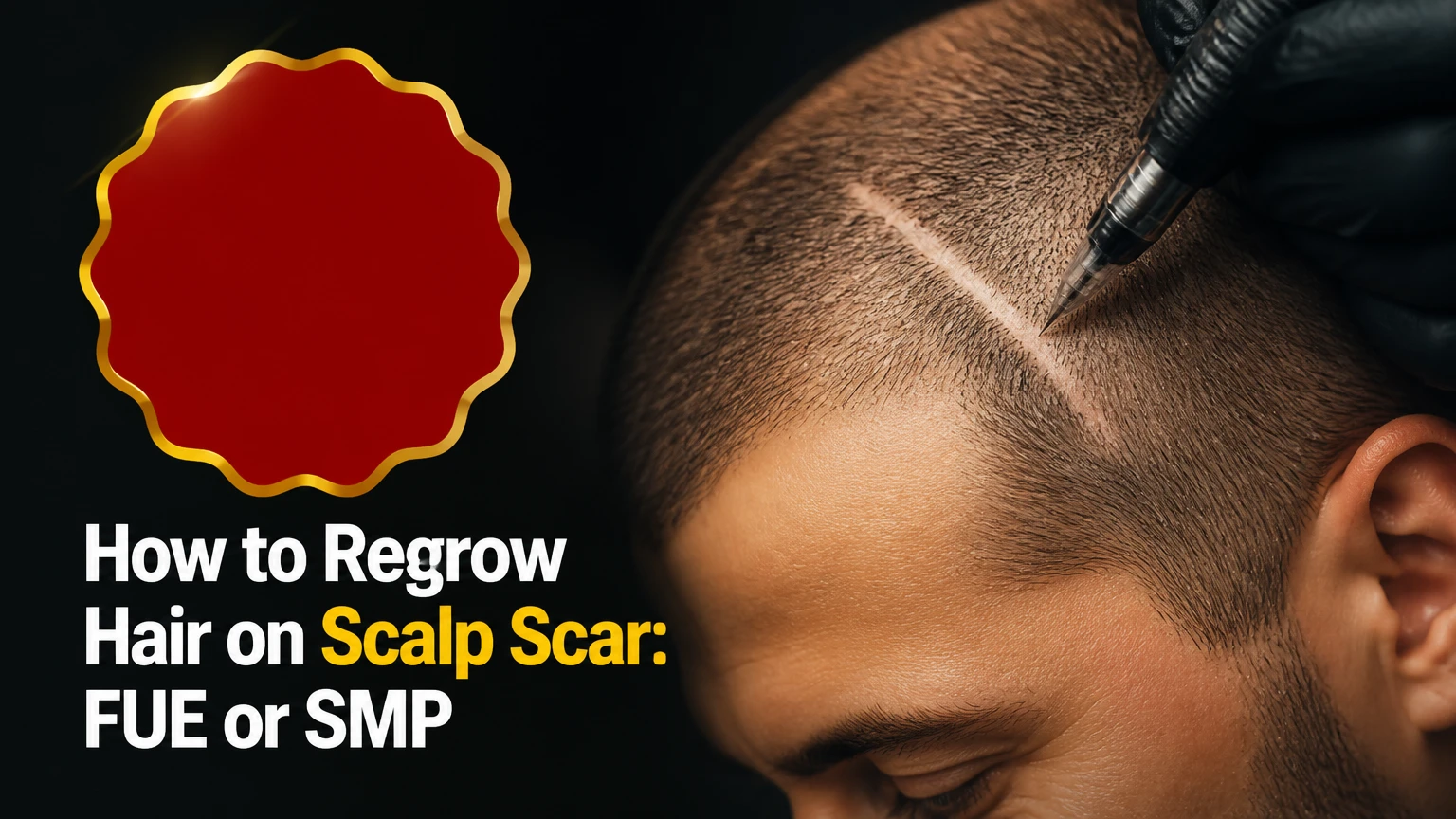
A mature scalp scar usually cannot grow hair by itself because scarring may destroy follicles and replace normal skin architecture with fibrous tissue. The most reliable way to restore biological hair is a carefully planned follicular unit transplant, usually FUE, after a dermatologist confirms that the scar is stable and suitable; scalp micropigmentation provides visual coverage without growing hair.
Key facts at a glance
A true scar cannot generate a new hair follicle through minoxidil, oils, supplements, or ordinary hair-growth shampoos.
Hair transplantation can place living donor follicles into selected mature scars, but graft survival is less predictable than on unscarred scalp.
A scar that is raised, painful, expanding, draining, or still changing needs medical assessment before cosmetic treatment.
Scalp micropigmentation conceals contrast between scar and surrounding scalp, but it does not produce hair or increase density.
Electrolysis permanently destroys individual hair follicles and is therefore a hair-removal treatment, not a method for regrowing scalp hair.
Final transplant results commonly require 9-18 months, while scar revision and SMP follow different timelines.
Can hair grow naturally through a scalp scar?
Hair cannot reliably regrow inside mature scar tissue when the injury has destroyed the follicle and its supporting structures. Hair follicles sit in the dermis and depend on a specialized stem-cell region, blood supply, nerves, and surrounding connective tissue; deep burns, surgery, trauma, and inflammatory scarring can damage several of these components at once.
The statement that every scar contains “zero active follicles” is too absolute. Some superficial scars retain functioning follicles, and hair may continue growing through a narrow or partially injured scar. Hair at the perimeter can also create the impression that the scar itself is producing hair. A dermatologist or hair-restoration surgeon must distinguish surviving follicles from permanent scarring alopecia.
The International Society of Hair Restoration Surgery describes transplantation into scarred scalp as possible but technically more demanding because scar tissue can have altered blood supply, stiffness, and unpredictable healing. That clinical distinction matters: a flat, pale, stable surgical line is a different problem from an active, raised burn scar or a patch caused by an autoimmune disease.
What must be diagnosed first?
A consultation should identify the cause, age, shape, texture, color, symptoms, and behavior of the scar. Trichoscopy can help a clinician inspect follicular openings and detect signs of scarring alopecia, while a biopsy may be appropriate when inflammation or autoimmune disease is suspected.
| Scar feature | Likely treatment implication | Typical next action |
|---|---|---|
| Flat, pale, stable line older than 12 months | Often suitable for limited grafting | Hair-restoration consultation |
| Raised, firm, red, or itchy area | Higher inflammation and recurrence risk | Dermatology assessment first |
| Depressed or tethered scar | Uneven surface can distort hair angles | Scar revision or soft-tissue treatment assessment |
| Expanding scar beyond original wound | Possible keloid behavior | Treat active scar before transplantation |
| Pain, crusting, pus, or bleeding | Possible infection or active disease | Prompt medical examination |
| Smooth patch with inflammation elsewhere | Possible scarring alopecia | Trichoscopy and sometimes biopsy |
A scar should generally be mature before elective transplantation. “Mature” does not mean that every scar must wait exactly 6 or 12 months; it means the color, thickness, tenderness, and dimensions have stabilized. A surgeon may recommend longer observation after a burn, infection, radiation injury, or recurrent keloid.
How does a hair transplant restore hair to a scar?
A hair transplant relocates living follicles from a donor area into prepared recipient sites within the scar. The surgeon selects follicles that match the surrounding hair, makes small openings at natural angles, and places grafts conservatively because scar tissue may not nourish a dense first pass.
Follicular unit extraction, or FUE, removes individual follicular units with a small punch. Follicular unit transplantation, or FUT, removes a strip of donor scalp and dissects it into grafts. FUE is often favored for scar repair because it allows detailed selection and placement, although the surgeon’s experience with scarred scalp matters more than the acronym alone.
Transplanted follicles do not become scar tissue-resistant in a magical way. They must establish a new blood supply, and the recipient tissue must heal without excessive inflammation, infection, or pressure. For that reason, a surgeon may place fewer grafts initially than would be used for a comparable area of normal scalp, then assess density after growth has matured.
FUE versus FUT for scar restoration
| Criterion | FUE | FUT |
|---|---|---|
| Harvest method | Individual follicular units | Linear donor strip |
| Donor-area mark | Multiple small dot scars | One linear scar |
| Scar placement control | High for small repairs | High graft yield in one session |
| Typical use | Small or irregular recipient scars | Larger sessions with strong donor density |
| Main limitation | Longer harvesting time and donor dotting | Linear donor scar and closure tension |
| Recipient precision | Useful for varied angles | Equally possible after graft dissection |
The recipient scar itself may need a different strategy from the donor area. Single-hair grafts can soften a visible border, while larger follicular units may add central coverage when the scar is broad enough to accept them. Overpacking is a common technical error because the surgeon cannot create normal vascularity by simply adding more incisions.
What determines transplant success?
The strongest predictors are scar maturity, cause, thickness, vascularity, surface quality, surgeon technique, donor-hair quality, and control of any underlying inflammatory condition. No universal graft-survival percentage applies to every scar. Clinic claims of 55%, 70%, or 85% should be treated cautiously unless the clinic defines its measurement method, follow-up period, scar type, and number of patients.
A small, flat scar may approach a good cosmetic result after one session. A wide burn scar may need staged grafting, camouflage, scar revision, or a combination. The goal is usually natural blending, not the same density as untouched scalp.
Which treatment is best for a scalp scar?
FUE is usually the best biological hair-restoration option for a stable, flat, hairless scar with adequate donor hair. Scar revision can be better for a wide linear defect, while SMP is often the most practical choice when the scar is large, the donor supply is limited, or the wearer keeps the hair very short.
| Treatment | Produces real hair | Typical course | Best candidate | Main limitation |
|---|---|---|---|---|
| FUE into scar | Yes | 1 session, sometimes 2 | Stable flat scar | Variable graft survival |
| FUT-based restoration | Yes | 1 larger session possible | Larger repair with strong donor area | Linear donor scar |
| Scar revision | No, narrows defect | 1 operation, later review | Wide or tethered linear scar | Creates a new scar |
| Fractional laser | No | Several sessions over weeks | Texture or thickness concerns | Does not create follicles |
| PRP | No proven new follicles | Several injections | Adjunct selected by clinician | Evidence and response vary |
| SMP | No | 2-4 sessions often used | Short hairstyles or poor donor supply | Pigment can fade or change |
| Electrolysis | No, removes hair | Repeated follicle-by-follicle sessions | Unwanted stray hairs | Cannot restore density |
When is scar revision better than grafting?
Scar revision may be preferable when a scar is wide, stretched, depressed, or poorly vascularized across most of its surface. A surgeon removes or releases selected scar tissue and closes the defect with surrounding scalp, reducing the bald area to a narrower line. A later transplant can add hair beside or within the revised line if necessary.
Scalp reduction is not automatically a cure. Tight closure can widen the new scar, increase tension, or reduce scalp mobility. Patients with a history of keloids, poor wound healing, smoking, uncontrolled diabetes, or previous radiation require especially careful surgical assessment.
Can laser or PRP make hair grow in the scar?
Fractional laser and PRP may improve scar texture or support a later transplant in selected patients, but neither treatment reliably creates new hair follicles in destroyed scar tissue. Fractional laser makes controlled microscopic injuries that can remodel collagen; PRP delivers concentrated platelets and growth factors, although clinical protocols and results vary.
The American Academy of Dermatology and Cleveland Clinic describe PRP as an adjunct for some forms of hair loss, not as a guaranteed follicle-creation procedure. Evidence for injecting PRP into a scalp scar specifically is smaller and less standardized than evidence for ordinary androgenetic hair loss. Nanofat and fat grafting also remain technique-dependent procedures rather than universal solutions.
What does the treatment process involve?
The clinical process usually takes several months from diagnosis to a meaningful result, and the final transplant assessment commonly occurs around 12 months. The deciding factor is whether the scar is stable and capable of supporting grafts, not whether a clinic can schedule surgery quickly.
Step 1: Document the scar and surrounding hair
Ask the clinician to record photographs, dimensions, texture, symptoms, and donor density. The examination should include the scar edges, because healthy follicles bordering a scar may need treatment for ordinary male or female pattern hair loss as well.
Success checkpoint: The cause and stability of the hairless area are documented.
Common mistake: Treating a changing patch as a cosmetic scar without investigating inflammation.
Step 2: Control active disease or inflammation
Pain, scaling, pustules, crusting, rapid enlargement, or new hair loss outside the original injury can indicate infection or inflammatory alopecia. Transplantation should wait until the condition is diagnosed and controlled.
Success checkpoint: The scar has no untreated infection or progressive inflammatory activity.
Common mistake: Using steroid injections or laser without a diagnosis, which can mask disease or worsen tissue injury.
Step 3: Choose biological restoration or camouflage
Select FUE or FUT when the objective is living hair and the donor area can support the repair. Select SMP when visual blending matters more than hair growth, particularly for a person who keeps a close buzz cut or has insufficient donor follicles.
Success checkpoint: The chosen method matches hair length, scar type, budget, and donor supply.
Common mistake: Buying a high-graft package when the scar needs conservative staged placement.
Step 4: Prepare the scar when indicated
A surgeon may recommend observation, scar massage after wound closure, laser, steroid treatment for raised scars, or other scar-management methods before transplantation. PRP is an optional adjunct, not a required preparation step for every flat scar.
Success checkpoint: Scar thickness, color, and symptoms are stable enough for the planned procedure.
Common mistake: Assuming that more preparation sessions guarantee graft survival.
Step 5: Place grafts conservatively
During FUE, the surgeon harvests donor follicles and places them into recipient incisions aligned with nearby hair. Scar tissue may require shallow, irregularly spaced sites and a lower initial density than normal scalp.
Success checkpoint: Grafts remain secure, and the aftercare plan specifies washing, medication, sun protection, and activity restrictions.
Common mistake: Scratching crusts, wearing tight headwear, or exposing the area to intense sun during early healing.
Step 6: Assess growth at the correct time
Transplanted shafts may shed during the first several weeks while follicles remain beneath the skin. Early growth often appears around months 3-5, but scarred tissue can show slower or less uniform maturation; the meaningful assessment is usually around month 9-12.
Success checkpoint: The surgeon compares standardized photographs at 6, 9, and 12 months.
Common mistake: Scheduling a touch-up at month 4 before delayed follicles have had time to mature.
How long do results take, and what do they cost?
Typical US pricing for scar-focused FUE is approximately $3,000-$12,000, while SMP commonly costs $800-$2,500; actual pricing depends on graft count, location, surgeon expertise, donor harvesting, and whether scar revision is required. These are planning ranges, not standardized medical fees.
| Stage or treatment | Typical timeframe | Typical cost range | Important variable |
|---|---|---|---|
| Scar observation | 6-12 months or longer | $100-$400 consultation range | Cause and ongoing symptoms |
| Fractional laser | 2-4 sessions | $300-$1,000 per session | Scar thickness and clinic |
| PRP adjunct | 2-4 sessions | $300-$800 per session | Protocol and region |
| Scar-focused FUE | 1 operative day | $3,000-$12,000 | Graft number and country |
| Scar revision | 1 operation | $2,000-$10,000 typical planning range | Width and closure complexity |
| SMP | 2-4 appointments | $800-$2,500 total | Area, pigment, practitioner |
| Final transplant review | Month 9-18 | Often included | Touch-up policy |
A lower overseas price does not reveal whether the procedure is safer or more suitable. Travel can complicate postoperative review, emergency care, revision planning, and management of a raised scar. Ask for the surgeon’s credentials, who performs extraction and implantation, documented scar cases, graft-count rationale, and a written revision policy.
Is minoxidil useful on a scalp scar?
Minoxidil cannot create a follicle in scar tissue that has lost its follicular structures. Topical minoxidil may help living follicles beside the scar when androgenetic alopecia or another responsive hair-loss condition is also present, so applying it to the surrounding scalp can still have a role after medical advice.
Minoxidil can irritate compromised skin, especially when the product contains alcohol or propylene glycol. Do not apply it to an open wound, draining lesion, recently operated area, or inflamed scar unless the treating clinician gives specific instructions. Oral minoxidil has systemic risks and requires medical supervision.
Hair oils, biotin, collagen supplements, onion juice, and ordinary anti-hair-loss shampoos have no credible mechanism for rebuilding a destroyed follicle inside established scar tissue. Correcting iron deficiency or thyroid disease can improve diffuse shedding elsewhere, but it will not reverse a mature scar.
Is SMP or electrolysis a better non-surgical option?
SMP is the relevant non-surgical camouflage option because it deposits pigment dots that reduce the visual contrast between scar and surrounding scalp. Electrolysis has the opposite purpose: a probe delivers energy to destroy individual follicles, so electrolysis cannot regrow hair or fill a bald scar.
SMP requires a practitioner experienced with scar tissue because scars can accept pigment unevenly, fade faster, or change color during healing. A conservative first session and a planned review after healing reduce the risk of an overly dark or sharply outlined patch.
Electrolysis can be useful when a scar revision leaves a few unwanted hairs, when stray hairs grow in an irregular direction, or when a patient wants permanent removal around a reconstructed hairline. It is not a substitute for FUE, FUT, or cosmetic scalp coverage.
What can go wrong after scar hair restoration?
The most important failures are poor graft growth, recurrent hypertrophic scarring, infection, unnatural direction, visible donor scarring, and progressive hair loss around the repair. Scarring alopecia can recur if the underlying inflammatory disease remains active, even after an apparently successful transplant.
| Problem | When it may appear | Warning sign | Appropriate response |
|---|---|---|---|
| Temporary shedding | 2-8 weeks | Implanted shafts fall out | Continue prescribed aftercare |
| Delayed growth | Months 4-8 | Sparse early coverage | Review at month 9-12 |
| Infection | Days 3-14 | Increasing pain, pus, fever | Contact surgeon promptly |
| Hypertrophic scar | Weeks to months | Raised, firm, itchy tissue | Dermatology treatment |
| Keloid recurrence | Months to years | Scar grows beyond wound edges | Specialist scar review |
| Poor graft yield | Month 9 onward | Persistent low density | Investigate, then consider touch-up |
| Unnatural angles | After growth | Hair points across scar | Corrective planning after maturity |
A raised or itchy scar after surgery is not merely a cosmetic inconvenience. Intralesional corticosteroids such as triamcinolone may flatten hypertrophic scars, but injection depth and dose must be chosen by a clinician because excessive steroid can thin skin or damage nearby tissue.
What should you do if growth is poor?
Wait for the planned review point unless the area is painful, infected, or rapidly changing. A second transplant pass may improve density after the first grafts have matured, but the surgeon should first reassess scar vascularity, implantation technique, donor depletion, and any continuing hair-loss disorder.
A touch-up cannot solve every problem. Severe tissue damage, inadequate donor hair, active keloid disease, or a poor hair-length match may make SMP or scar revision more sensible than additional grafting.
Which approach fits each scar situation?
Treatment selection changes substantially with scar cause, size, texture, and donor supply. A small flat surgical scar often needs a different plan from a burn scar, and a stable traumatic scar differs from a widening patch caused by autoimmune inflammation.
| Situation | Preferred first discussion | Why | Usually avoid first |
|---|---|---|---|
| Small flat childhood injury | FUE consultation | Limited graft requirement | High-density packing |
| Narrow neurosurgical scar | FUE or revision | Hair direction can follow the line | Unplanned SMP without color testing |
| Large burn scar | Dermatology plus staged reconstruction | Tissue quality is unpredictable | Immediate dense grafting |
| Raised keloid-prone scar | Scar specialist | Recurrence risk needs control | Elective grafting during activity |
| Limited donor hair | SMP or revision | Avoids excessive donor depletion | Large transplant promise |
| Person who shaves closely | SMP or FUE plus SMP | Dot camouflage blends at short length | Long-hair-only planning |
| Active patchy hair loss | Diagnostic work-up | Disease may continue spreading | Cosmetic procedure first |
Patients with darker skin tones may face a higher risk of post-inflammatory pigment change or keloid formation in some contexts, although individual risk depends on genetics, scar history, procedure, and healing response. A test area can help with SMP pigment selection, but it cannot predict every delayed reaction.
Questions people ask before treatment
Can a scalp scar be treated with hair-growth vitamins?
Vitamins help only when a documented deficiency contributes to hair shedding. Vitamin supplements cannot rebuild follicles destroyed by scar formation, and excessive vitamin A or selenium can itself cause hair loss. A clinician can order targeted tests when diffuse shedding exists beyond the scar.
Can hair transplant grafts fail completely in scar tissue?
Complete failure is possible but uncommon in every case and cannot be predicted from scar appearance alone. Extensive burns, radiation injury, severe vascular damage, infection, active inflammation, and aggressive graft packing increase concern. A conservative test session may be considered for especially uncertain tissue.
Should a scar be at least one year old?
Many clinicians prefer a scar to be stable for roughly 6-12 months, and longer after burns or recurrent inflammation. Age alone is not the deciding criterion. A pale, flat, unchanged scar at eight months may be more suitable than a red, expanding scar several years after injury.
Can hair from another person be transplanted into a scalp scar?
Routine hair transplantation uses the patient’s own follicles because donor tissue from another person triggers immune rejection. Immunosuppressive treatment would create risks that are not justified for cosmetic hair restoration. Synthetic fibers also have infection, extrusion, and inflammatory complications.
Can a scar disappear after a hair transplant?
A transplant can reduce visibility by adding hair, but it does not remove the scar. The scar may remain palpable, lighter, darker, raised, or depressed. Scar revision, laser, SMP, or camouflage styling may be combined with grafting when surface texture remains visible.
The Bottom Line
The safest answer to how to regrow hair on scalp scar is to confirm the diagnosis first, wait until the scar is stable, and match treatment to tissue quality and donor supply. FUE offers the most direct route to real hair for suitable mature scars, while scar revision can reduce a large defect and SMP can conceal scars when surgery is unsuitable. PRP and laser may support scar management, but neither reliably creates follicles, and electrolysis removes hair rather than restoring it. A dermatologist and an experienced hair-restoration surgeon should assess active inflammation, keloid risk, donor density, and realistic density before any procedure.