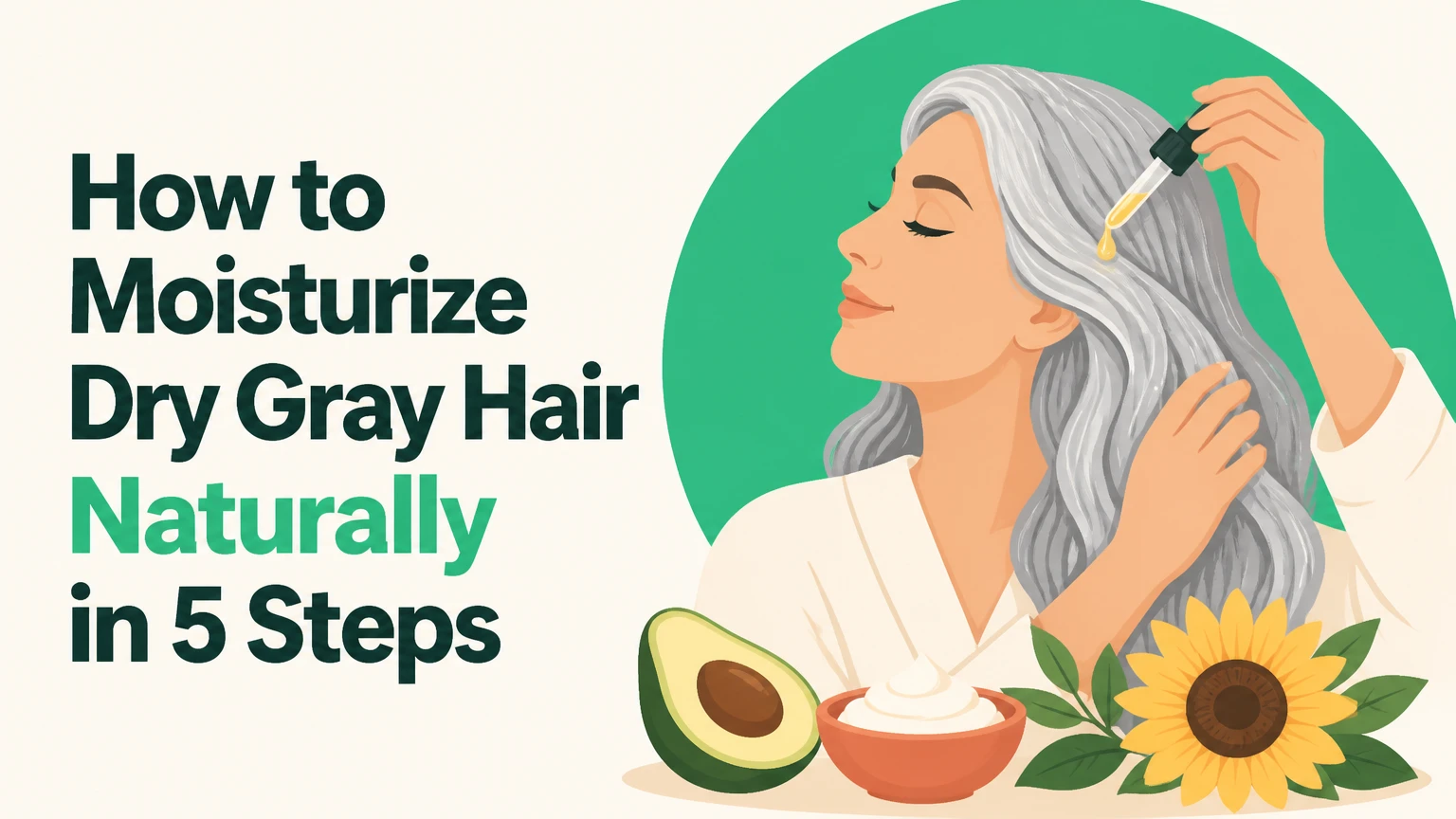
To moisturize dry gray hair naturally, apply a water-based conditioner or aloe product to damp hair, add a small amount of botanical oil or butter, and reduce heat and buildup. Gray hair often benefits from gentle cleansing, weekly conditioning, and lightweight sealing, but the best ingredient and quantity depend on texture, porosity, density, and climate.
Key Facts at a Glance
- Gray hair is not automatically dehydrated, but reduced pigment and aging-related fiber changes can increase roughness, porosity, and breakage risk.
- Water and conditioner provide softness; oils and butters mainly reduce friction and slow moisture loss.
- Apply oil to damp, conditioned hair rather than using oil alone on completely dry strands.
- Fine gray hair usually needs 1-3 drops of oil, while dense, coarse gray hair may tolerate 5-10 drops.
- Coconut oil can reduce protein loss in some hair, yet it can make some porous or coarse hair feel stiff.
- Apple cider vinegar is a diluted rinse for buildup and cuticle feel, not a replacement for conditioner.
Why Does Gray Hair Become Dry and Wiry?
Gray hair can feel dry because the fiber loses melanin and often develops a less uniform cuticle, while aging skin may produce less scalp sebum. Melanin loss does not directly drain water from the strand, and gray hair is not biologically identical in every person, but white or silver fibers commonly feel coarser, less flexible, and more resistant to styling.
Hair fiber is nonliving once it exits the follicle. A topical oil cannot repair a split end or restore melanin. It can reduce friction, improve combing, and make the cuticle feel smoother.
The American Academy of Dermatology Association identifies aging and genetics as common causes of gray hair and notes that gray hair can be more difficult to manage because its texture changes. Chemical coloring, ultraviolet exposure, repeated heat, hard-water minerals, and infrequent conditioning can add dryness to the underlying age-related change.
Dry Hair Versus a Dry Scalp
Dry hair describes the fiber from the roots outward. Dry scalp describes skin discomfort, tightness, scaling, or itching. Heavy oil on the scalp may worsen folliculitis or seborrheic dermatitis, so a hair-moisturizing routine should concentrate conditioner, butter, and oil on the lengths unless a clinician recommends scalp treatment.
Sudden dryness accompanied by hair loss, painful scaling, sores, or severe itching deserves medical assessment. Thyroid disease, nutritional deficiency, psoriasis, eczema, medication changes, and chemical damage can produce symptoms that household oils will not correct.
How Does Natural Moisturization Work?
Natural moisturization works through three separate actions: water adds temporary hydration, conditioners and plant lipids reduce friction, and a thin oil layer slows evaporation. Aloe vera and glycerin are water-compatible humectants, while fatty alcohols, shea butter, jojoba oil, and argan oil improve slip and surface lubrication.
A practical routine follows this order:
- Wet or dampen the hair.
- Apply conditioner or a small amount of aloe-based product.
- Add a compatible cream or butter if the hair needs more weight.
- Seal the ends with a few drops of oil.
- Dry with low heat or air.
Oil does not hydrate dry hair by itself. Oil placed on bone-dry hair may make the fiber feel smoother, but it does not add water and can trap existing stiffness beneath the coating.
The L.O.C. Method for Gray Hair
The liquid, oil, cream method can work for coarse, curly, or highly porous gray hair, but the full sequence is excessive for many fine-haired people. Use water or a water-based leave-in as the liquid, a few drops of oil as the oil, and conditioner or butter as the cream.
A useful modification is L.O., not L.O.C. Fine gray hair often needs liquid plus oil, whereas dense coils may need liquid, cream, and oil. Product layering should follow hair behavior, not a fixed formula.
Which Natural Ingredients Work Best?
The best natural moisturizer depends on the strand’s thickness and porosity. Aloe vera or a water-based conditioner suits fine hair, jojoba or argan oil suits light sealing, and shea butter suits thick or coily hair that loses softness quickly.
| Ingredient | Main function | Typical starting amount | Best match | Main limitation |
|---|---|---|---|---|
| Aloe vera gel | Water-based hydration | 1 teaspoon per shoulder-length section | Fine, wavy, medium hair | Can feel sticky or stiff when overdosed |
| Vegetable glycerin | Humectant support | 1-2 drops mixed into conditioner | Dry, moderate climates | Can increase frizz in very humid weather |
| Jojoba oil | Lightweight lubrication | 2-5 drops per head | Fine to medium gray hair | Excess creates limpness and buildup |
| Argan oil | Surface smoothing | 2-5 drops per head | Medium, frizzy, heat-exposed hair | Higher cost; not a water source |
| Coconut oil | Reduced protein loss before washing | 1 teaspoon pre-shampoo | Thick, damaged hair | Can cause stiffness or brittleness for some users |
| Shea butter | Heavy emollient coating | Pea-sized amount per section | Coarse, coily, wiry hair | Easily weighs down fine hair |
| Mango butter | Medium-weight softening | Pea-sized amount per section | Medium to coarse hair | May still accumulate with daily use |
| Sunflower oil | Affordable sealing | 3-6 drops per head | Budget-conscious routines | Can feel greasy when overapplied |
Coconut oil has stronger evidence than many household oils for reducing protein loss from damaged hair. A study by Rele and Mohile in the Journal of Cosmetic Science found that coconut oil reduced protein loss when used before or after washing, unlike mineral oil and sunflower oil in the tested conditions. That finding supports pre-wash use, not unlimited daily application.
What About Apple Cider Vinegar and Hibiscus?
Diluted apple cider vinegar may help remove some residue and temporarily improve the feel of the cuticle, but it does not moisturize the cortex. Use one tablespoon of ACV in one cup, about 240 milliliters, of water, apply after shampoo, leave for 30-60 seconds, and rinse thoroughly.
Do not use undiluted vinegar. Stop if burning, redness, or increased scalp sensitivity occurs. A hibiscus rinse may add slip or cosmetic shine, but evidence for permanent hydration or gray-hair color protection is limited. Treat both as occasional rinses, not primary conditioners.
How to Moisturize Dry Gray Hair Naturally
A complete routine takes about 10-15 minutes to apply, plus 20-30 minutes for an optional deep-conditioning period. The main success factor is using enough water-based conditioning and little enough oil to avoid coating the strand with residue.
Before You Start
| Requirement | Typical specification |
|---|---|
| Time | 10-15 minutes application; 20-30 minutes optional conditioning |
| Frequency | Once weekly for most hair; twice weekly for very dry coarse hair |
| Basic materials | Gentle shampoo, rinse-out conditioner, towel, wide-tooth comb |
| Optional materials | Aloe gel, jojoba or argan oil, shea butter |
| Starting cost | About $12-$35, or approximately 300-2,500 BDT |
| Heat setting | Cool or low warm airflow, never the hottest setting |
| Prerequisite | Patch test new botanical products 24 hours beforehand |
Step 1: Cleanse the Hair Gently
Wash the scalp with lukewarm water and a mild shampoo, then let the suds run through the lengths without scrubbing them aggressively. Shampoo frequency commonly ranges from once every 3-7 days, but oily scalps, exercise, styling products, and dandruff may require more frequent washing.
Use a clarifying shampoo every 2-4 weeks when hair feels coated, dull, or resistant to water. A diluted ACV rinse is an occasional alternative, but shampoo removes oil and styling residue more predictably.
You will know this step worked when the scalp feels clean and the lengths remain flexible rather than squeaky. Scratching, very hot water, and repeated sulfate-heavy cleansing can worsen surface roughness for some people, although sulfates are not universally harmful.
Step 2: Apply Conditioner to Soaking-Wet Hair
Squeeze out excess water without rubbing, then apply approximately one teaspoon of conditioner for short hair, two teaspoons for shoulder-length hair, or one tablespoon for long or dense hair. Distribute from mid-lengths to ends, and use a wide-tooth comb only after the conditioner creates slip.
A conditioner containing fatty alcohols such as cetyl alcohol or stearyl alcohol can soften hair without being the same as drying alcohols such as ethanol or isopropyl alcohol. “Natural” labeling does not guarantee better performance; a well-formulated conditioner may outperform a kitchen ingredient because it spreads evenly and rinses cleanly.
You will know this step worked when fingers glide through the ends with less snagging. If hair feels waxy after rinsing, reduce the amount or clarify during the next wash.
Step 3: Add Aloe or a Water-Based Leave-In
On towel-damp hair, spread about one teaspoon of plain aloe gel through shoulder-length hair, or use the manufacturer’s amount for a formulated leave-in conditioner. Choose a product without added fragrance if the scalp reacts easily, and avoid storing fresh kitchen aloe at room temperature because microbial contamination is possible.
Aloe is a base layer, not a complete treatment for brittle ends. If aloe leaves a crunchy film, dilute a small amount with water in your palm or replace it with a lightweight leave-in conditioner.
You will know this step worked when the hair feels pliable and slightly slippery rather than wet and sticky. Do not combine several humectants automatically; glycerin, aloe, honey, and similar ingredients can create a tacky film when layered heavily.
Step 4: Add Butter Only Where Hair Needs Weight
Warm a pea-sized amount of shea or mango butter between the palms, then press it into the driest mid-lengths and ends. Dense, coarse, coily, and highly porous hair may need one pea-sized amount per major section, while fine hair should usually skip butter.
Butter reduces friction and protects the surface, but it does not replace water or conditioner. Keep it away from the scalp when the scalp is oily, itchy, acne-prone, or prone to dandruff.
You will know this step worked when flyaways settle and the ends bend without a greasy coating. If hair looks dull or collapses at the roots, use half as much next time or remove this step.
Step 5: Seal the Ends With a Few Drops of Oil
Rub 2-5 drops of jojoba or argan oil between the palms and press the oil over the damp lengths, concentrating on the last 5-8 centimeters. Use 1-3 drops for fine short hair and up to 8-10 drops for very long, dense, coarse hair.
Air-dry when practical, or use a diffuser or dryer on low heat while keeping the tool moving. The AAD recommends limiting heat exposure and using the lowest effective setting because excessive heat damages hair of every color.
You will know this step worked when the ends feel smoother after drying and the hair remains light enough to move. If the hair feels oily before it dries, blot gently with a microfiber towel and reduce the next application.
How Much Time and Money Does the Routine Require?
A basic natural gray-hair routine usually costs $12-$35 initially and takes 10-15 minutes, excluding drying time. Imported argan oil and specialty butters can raise the cost substantially, while aloe, sunflower oil, and an ordinary conditioner keep the routine inexpensive.
| Routine component | Typical quantity | Replacement interval | Typical USD cost | Typical BDT cost |
|---|---|---|---|---|
| Gentle shampoo | 5-10 mL per wash | 1-3 months | $6-$15 | 500-1,500 |
| Rinse-out conditioner | 5-15 mL per wash | 1-2 months | $6-$18 | 500-1,800 |
| Aloe gel | 5 mL per treatment | 1-2 months | $4-$10 | 300-700 |
| Jojoba oil | 2-5 drops per treatment | 4-8 months | $8-$20 per 30 mL | 1,200-2,500 per 100 mL |
| Shea butter | 2-8 g per treatment | 4-10 months | $6-$15 per 250 g | 800-1,800 |
| ACV | 15 mL per rinse | 6-12 months | $3-$8 | 300-700 |
Prices vary by country, certification, packaging, and import costs. The routine does not require every ingredient in the table. Start with conditioner and one lightweight oil before adding aloe, butter, or rinses.
Which Routine Fits Your Hair Type and Climate?
Fine gray hair generally needs water-based conditioning and minimal oil, while coarse or coily gray hair can tolerate richer layers. Climate changes the balance: humid air can amplify glycerin-related frizz, while very dry air can leave humectant-heavy formulas feeling tight unless an emollient follows.
| Hair situation | Base layer | Sealer | Starting frequency | Avoid first |
|---|---|---|---|---|
| Fine, straight gray hair | Lightweight conditioner or aloe | 1-3 drops argan oil | Weekly | Shea butter and daily oil |
| Medium, wavy gray hair | Conditioner plus small leave-in | 2-5 drops jojoba oil | Weekly | Heavy scalp application |
| Coarse, wiry gray hair | Rich conditioner or aloe | 5-10 drops jojoba oil | 1-2 times weekly | Hot tools and dry brushing |
| Coily, porous gray hair | Water, leave-in, cream | 5-10 drops oil | 1-2 times weekly | Clarifying too often |
| Humid climate | Conditioner, low glycerin | Light jojoba layer | Every 5-10 days | Heavy humectant layering |
| Very dry climate | Conditioner, aloe or leave-in | Oil or butter seal | 1-2 times weekly | Aloe alone on dry hair |
For Fine or Thin Gray Hair
Use conditioner, rinse thoroughly, and apply no more than 1-3 drops of oil to the ends. Fine hair often looks dry because of flyaways, yet adding butter can reduce volume before it improves softness.
A weekly clarifying wash may be appropriate if styling products accumulate quickly. Do not interpret limpness as proof that hair lacks moisture; limp, coated hair may need less product and better cleansing.
For Coarse, Wiry, or Coily Gray Hair
Use the full liquid, cream, and oil sequence once weekly, with a 20-30 minute conditioning period under a plastic cap if desired. Detangle from ends toward roots while conditioner is present, and sleep with loose protection such as a satin bonnet or pillowcase to reduce friction.
Coarse hair may need richer products, but more product is not always better. If the strand feels waxy, use a reset wash and return with half the previous amount.
What Common Problems Occur?
Most natural gray-hair failures involve incorrect quantity, incompatible porosity, or residue rather than a missing miracle ingredient. A troubleshooting routine should change one variable at a time so the cause remains identifiable.
| Symptom | Likely cause | Immediate correction | Next routine |
|---|---|---|---|
| Stiff after coconut oil | Individual sensitivity or excess pre-wash oil | Shampoo twice if needed | Replace with jojoba or argan |
| Greasy and flat | Too much oil or butter | Clarify or shampoo normally | Cut oil quantity by half |
| Crunchy after aloe | Dried film or excess humectant | Rinse and condition | Mix less aloe into wet hair |
| Yellow or dull silver | Minerals, smoke, UV, product residue | Clarify; use purple shampoo if appropriate | Test water and reduce buildup |
| Frizzy in humidity | Swelling, friction, humectant overload | Use lighter leave-in and oil | Reduce glycerin and heavy layers |
| Scalp itchy after product | Irritant or allergic reaction | Stop product and rinse | Patch test fragrance-free alternatives |
Why Does Coconut Oil Make Some Gray Hair Stiff?
Coconut oil can make some gray hair stiff because its affinity for the fiber may alter the feel of porous or protein-sensitive strands when too much remains after washing. The same oil can reduce protein loss in other hair, so the result is individual rather than universally good or bad.
Use coconut oil as a pre-shampoo treatment for 20-60 minutes, not necessarily as a daily leave-in. If stiffness persists after two trials, switch to jojoba or argan oil.
Why Does Gray Hair Look Yellow?
Gray hair can look yellow or dingy after exposure to smoke, pollution, ultraviolet light, styling residue, or hard-water minerals. Yellowing is not proof that the hair needs more oil.
Clarify every 2-4 weeks if buildup is likely, and consider a purple shampoo according to its label if the issue is cosmetic brassiness. ACV at a 1:16 dilution, one tablespoon in one cup of water, may improve residue but cannot remove every mineral deposit. Frequent acidic rinses can irritate skin and roughen hair.
Can Aloe Vera Dry Hair Out?
Aloe vera can leave hair feeling dry or crunchy when the gel forms a film, the formula contains alcohol or fragrance, or the surrounding air is very dry. Aloe is not inherently drying, but humectants work best when followed by conditioner or a light seal.
Use a small amount on wet hair and observe the result over two washes. Stop if the scalp burns, itches, or develops a rash.
What Is Natural Hair Electrolysis Used For?
Hair electrolysis removes unwanted hair by treating individual follicles with an electrical current; it does not moisturize, condition, or repair the scalp-hair fiber. Electrolysis may be relevant to facial hair or stray hairs during a gray-hair transition, but it has no place in a routine for dry lengths and ends.
The U.S. Food and Drug Administration describes electrolysis as a permanent hair-removal method when follicles are successfully treated, while laser devices generally provide permanent hair reduction rather than guaranteed removal. Neither procedure restores moisture to scalp hair.
Do not apply oils, aloe, vinegar, or homemade rinses to freshly treated electrolysis skin unless the electrologist gives that instruction. Irritated skin needs a procedure-specific aftercare plan, not a hair-conditioning layer.
How Can You Avoid Natural Moisturizing Mistakes?
Avoid five predictable errors: applying oil without water, using butter on fine hair, cleansing too aggressively, treating the scalp and lengths identically, and assuming “natural” means irritation-free. A patch test and one-variable approach prevent many avoidable reactions.
- Oil on completely dry hair: Dampen and condition first.
- Daily heavy oiling: Reserve rich oils and butters for weekly use.
- Undiluted ACV: Always dilute and rinse.
- Fresh kitchen aloe stored too long: Use a preserved cosmetic product or refrigerate safely according to preparation guidance.
- High heat after conditioning: Use low heat and keep the dryer moving.
- Aggressive brushing: Detangle conditioned hair from the ends upward.
Essential oils require extra caution because fragrance compounds can cause allergic contact dermatitis. DermNet identifies essential oils and fragrance ingredients as recognized causes of contact reactions, so they are unnecessary additions for a basic moisturizing routine.
When Should You Stop Home Treatment?
Stop home treatment when a product causes burning, swelling, hives, persistent itching, or worsening redness. Seek dermatology care for sudden severe dryness, patchy hair loss, scalp sores, extensive scale, or breakage that continues after reducing heat and chemical processing.
Natural routines improve feel and manageability, not follicle biology. They cannot reverse gray pigment loss, permanently mend split ends, cure scalp disease, or replace treatment for thyroid or nutritional disorders.
A practical evaluation period is four weeks. Softness and easier detangling may appear after the first wash, while reduced breakage requires consistent handling over several growth cycles. Photograph the hair in the same light and track product quantity, wash frequency, and scalp symptoms.
Frequently Asked Questions
Does gray hair need more moisture than pigmented hair?
Gray hair does not have a universal moisture requirement, but many people find it needs more conditioning because fiber texture, porosity, heat exposure, and reduced scalp oil change with age. Judge by tangling, roughness, elasticity, and breakage rather than color alone. Fine gray hair may need less product than thick brown hair.
Is olive oil safe for white or silver hair?
Olive oil is generally usable on hair, but unrefined olive oil can feel heavy and may leave a yellowish cast on very light fibers when residue accumulates. Use a small amount before shampoo or choose a clearer, lighter oil such as jojoba or argan. Clarify if silver hair becomes dull or coated.
Should you moisturize gray hair every day?
Most gray hair does not need a full moisturizing treatment every day. Fine hair may need a water mist or tiny amount of leave-in between washes, while coarse hair may need a richer treatment once or twice weekly. Daily oiling commonly creates buildup before it solves dryness.
Can hard water make gray hair dry?
Hard water can leave calcium and magnesium deposits that make gray hair feel rough, dull, or difficult to wet. A clarifying shampoo every 2-4 weeks, a shower filter, or a chelating product can help, although ordinary shower filters do not remove every dissolved mineral. Persistent deposits may require a salon chelating treatment.
Can natural oils repair split ends?
Natural oils cannot fuse split ends or restore permanently damaged keratin. Oils temporarily reduce friction and improve the appearance of frayed ends, while trimming removes the damaged portion. Prevent new splitting with conditioner, gentle detangling, lower heat, and reduced chemical processing.
What is the simplest routine for dry gray hair?
Wash gently, apply conditioner to wet lengths, rinse, and press 2-5 drops of jojoba or argan oil onto damp ends. Repeat weekly, then adjust the amount according to texture. Add aloe for extra slip or shea butter for coarse hair, but introduce only one new ingredient at a time.
The Bottom Line
The most reliable way to moisturize dry gray hair naturally is to condition damp strands first, add a texture-appropriate emollient, and seal only the lengths with a small amount of oil. Fine gray hair usually needs aloe or conditioner plus 1-3 drops of oil, whereas coarse or coily gray hair may need cream and 5-10 drops. Use the five-step routine weekly, clarify accumulated residue, limit heat, and remember that hair electrolysis removes unwanted follicles rather than moisturizing scalp hair.