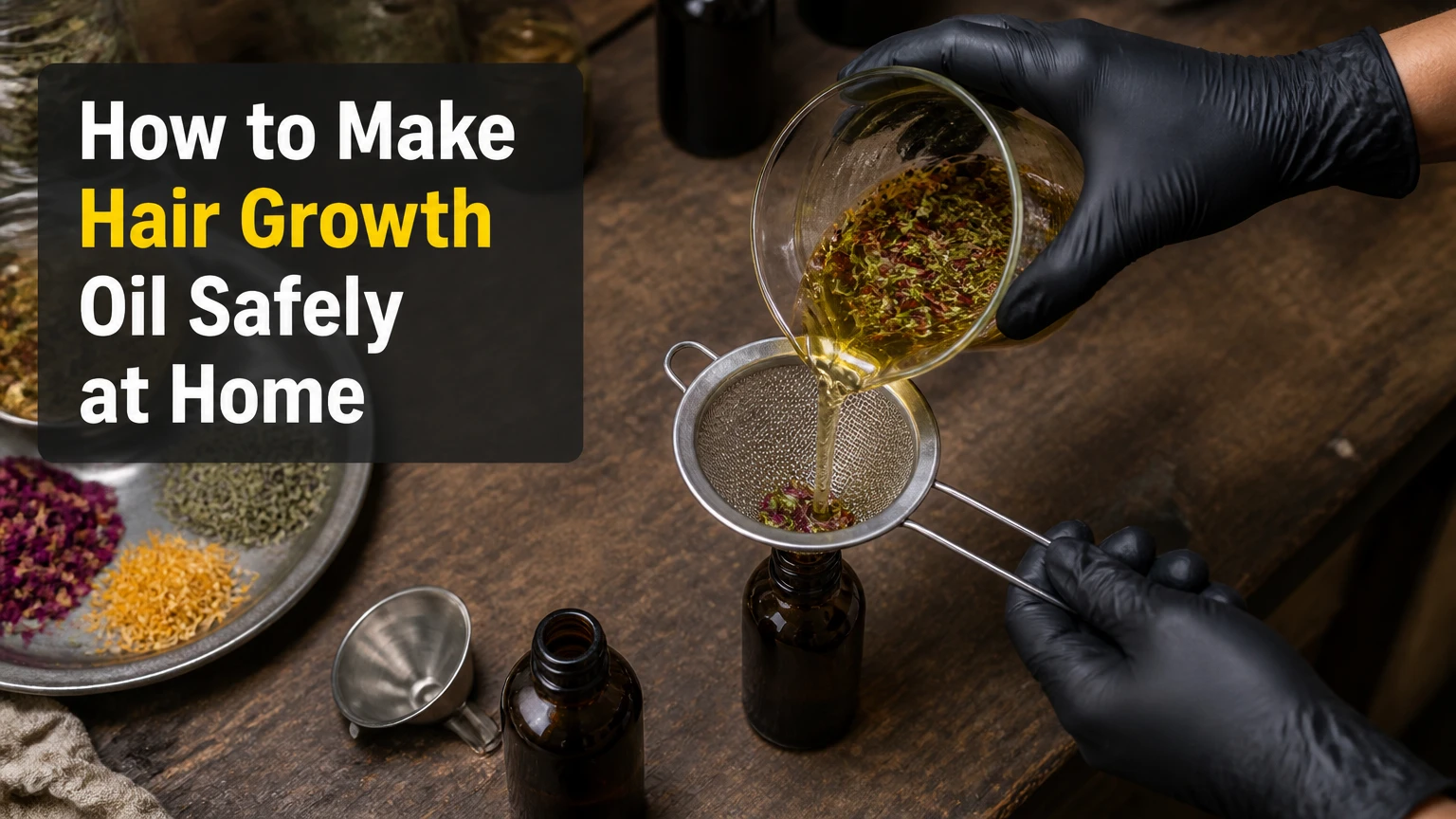
To make hair growth oil, combine 28.65 g of a lightweight carrier blend with 0.30 g rosemary essential oil and 0.15 g vitamin E in a dry, sanitized 30 ml bottle. Apply a small amount to the scalp two or three times weekly, but treat the mixture as a conditioning aid rather than a proven cure for every form of hair loss.
Key Facts at a Glance
- A conservative scalp formula uses 1% essential oil dilution, equal to 0.30 g in a 30 g batch.
- Rosemary essential oil must be diluted before scalp application; undiluted essential oil can cause irritation or allergic contact dermatitis.
- Vitamin E slows oxidation in oil-based products, but it does not preserve water contamination or prevent all spoilage.
- Fresh herbs are unsuitable for a beginner’s homemade oil because their water content increases microbial and mold risk.
- The 2015 randomized trial by Panahi and colleagues compared rosemary lotion with 2% minoxidil over six months, but the study did not prove that every homemade rosemary oil matches minoxidil.
- Hair oils can reduce friction and improve softness, while sudden shedding, bald patches, or scalp inflammation require medical assessment.
What Is Hair Growth Oil?
Hair growth oil is an anhydrous blend of carrier oils and, optionally, diluted essential oils or oil-compatible botanical extracts. The blend can lubricate hair fibers, reduce dryness-related friction, and make scalp massage easier, but visible density depends primarily on the cause of shedding and the condition of the follicle.
The phrase “hair growth oil” describes a cosmetic category, not a standardized medical treatment. Jojoba, grapeseed, argan, sunflower, and pumpkin seed oils mainly provide emollience. Rosemary essential oil adds a biologically active fragrance ingredient, but the evidence for rosemary oil is narrower than online claims suggest.
A 2015 randomized comparative trial in SKINmed followed 100 people with androgenetic alopecia for six months and reported improvement in both the rosemary-lotion and 2% minoxidil groups, with more scalp itching in the minoxidil group. The trial used a defined lotion, not a kitchen-made oil, so the result cannot be transferred directly to an unstandardized recipe.
What Can Hair Oil Actually Improve?
Hair oil is better at improving fiber condition than reversing advanced follicle miniaturization. Oil coats the cuticle, lowers combing friction, and can reduce the appearance of frizz and breakage, especially on coarse, curly, chemically treated, or high-porosity hair.
Scalp massage may temporarily increase local blood flow, but temporary circulation is not the same as clinically proven follicle stimulation. DHT-related pattern hair loss also cannot be assumed from ordinary shedding, and pumpkin seed oil should not be presented as a guaranteed topical DHT blocker.
What Ingredients Should You Use?
The most practical beginner formula uses one lightweight carrier oil, one richer carrier oil in a limited amount, rosemary essential oil at 1%, and tocopherol at 0.5%. Keeping the ingredient list short makes irritation, oxidation, and cause-and-effect easier to assess.
Carrier Oils Compared
| Carrier oil | Main fatty-acid profile | Typical texture | Best use |
|---|---|---|---|
| Jojoba | Wax esters, high oxidative stability | Light, low-grease | Oily or sensitive scalps |
| Grapeseed | Linoleic acid, lightweight triglycerides | Very light | Fine hair and frequent washing |
| Argan | Oleic and linoleic acids, tocopherols | Medium-light | Dry lengths and shine |
| Castor | Ricinoleic acid, highly viscous | Thick and tacky | Small amounts on dry ends |
| Pumpkin seed | Linoleic and oleic acids | Medium | Carrier base when fragrance is tolerated |
Jojoba is a strong default because its wax-ester structure feels closer to scalp sebum than many liquid vegetable oils. Grapeseed oil feels lighter but oxidizes more readily, so small batches and dark storage matter. Castor oil can improve slip, yet 50% castor oil often produces a sticky blend that is difficult to shampoo out.
Essential Oils and Botanical Additions
Rosemary essential oil is the most defensible active choice for a simple scalp blend because a human comparative trial exists, although the evidence remains limited. Peppermint oil has animal and laboratory evidence, but a cooling sensation does not prove human hair regrowth. Tea tree oil may help some dandruff-related symptoms, but it can also irritate sensitive skin.
Amla and bhringraj are traditional Ayurvedic ingredients used in hair oils, but homemade oil does not automatically retain the water-soluble vitamin C associated with fresh amla. Use fully dried, commercially prepared oil-soluble extracts when available, and do not claim that an infused herb has the same composition as a standardized extract.
| Ingredient | Suggested amount in 30 g | Primary role | Main limitation |
|---|---|---|---|
| Jojoba oil | 17.70 g | Lightweight carrier | Higher cost than common seed oils |
| Grapeseed oil | 10.65 g | Reduces heaviness | Oxidizes faster than jojoba |
| Rosemary essential oil | 0.30 g | Fragrance and experimental scalp active | Irritation risk; limited clinical evidence |
| Vitamin E, tocopherol | 0.15 g | Antioxidant support | Not a broad-spectrum preservative |
| Dried rosemary leaf | Optional, 1-2 g | Botanical infusion | Adds filtration and oxidation risk |
How Do You Make Hair Growth Oil?
Make hair growth oil in seven controlled steps: sanitize and dry equipment, weigh the carrier oils, infuse only fully dried herbs if desired, cool the mixture, filter sediment, add rosemary essential oil and vitamin E, then package and label the batch. A simple blend takes about 30 minutes; a cold infusion takes four weeks.
Before You Start
| Requirement | Typical specification |
|---|---|
| Batch size | 30 g, approximately 30 ml |
| Active dilution | 1% rosemary essential oil |
| Preparation time | 25-35 minutes without infusion |
| Typical ingredient cost | US$5-US$15, depending on oils and bottle |
| Equipment | 0.01 g scale, glass beaker, funnel, 30 ml amber bottle |
| Prerequisite | Fully dry equipment and a patch-test plan |
Step 1: Sanitize and Dry the Equipment
Wash the glass vessel, funnel, spatula, and bottle with hot soapy water. Rinse thoroughly, wipe compatible surfaces with 70% isopropyl alcohol, and allow every part to dry completely before measuring.
Water is the main avoidable hazard in a small oil batch. Alcohol does not make wet equipment safe for immediate filling because residual water can remain in seams, caps, or herb material. You will know the equipment is ready when no droplets, condensation, or damp film remains.
The common mistake is sanitizing the bottle and then touching the inside of the cap or dropper with bare fingers. Keep contact limited to the outside surfaces.
Step 2: Weigh the Carrier Oils
Measure 17.70 g jojoba oil and 10.65 g grapeseed oil into the dry glass vessel. Stir slowly for 30 seconds, then inspect the mixture for cloudiness, particles, or an off odor before adding any active ingredient.
A digital scale is more reliable than drops or tablespoons because oil density varies by ingredient. The 28.35 g carrier phase leaves room for 0.30 g rosemary essential oil and 0.15 g tocopherol.
The common mistake is using half castor oil because online recipes equate thickness with effectiveness. Texture does not predict follicle response, and excessive viscosity increases residue and washout difficulty.
Step 3: Choose a Botanical Infusion Method
Skip infusion for the safest beginner version, or use 1-2 g of completely dried rosemary leaf in the carrier oils. For a warm method, use a double boiler at 45-50°C for two to four hours, then cool the oil fully. For a cold method, seal dried herbs in oil for four weeks in a dark cupboard.
Do not place the jar directly on a stove burner. Low indirect heat reduces the chance of scorching plant material and accelerating oxidation. You will know the warm infusion is complete when the oil has a consistent herbal aroma without smoke, bubbling, or dark burnt particles.
The common mistake is adding fresh rosemary, aloe, onion, or amla pulp. These ingredients introduce water and can create microbial growth even when the finished product looks oily.
Step 4: Cool and Filter the Oil
Cool a warm infusion to room temperature before filtration. Pour the oil through a fine stainless-steel sieve lined with clean, dry cheesecloth, then filter a second time through an unbleached paper filter if visible sediment remains.
Sediment contains plant particles that can irritate the scalp and speed oxidation. Do not squeeze wet or visibly contaminated cloth into the finished batch. You will know the oil is ready when the liquid is clear to slightly tinted and contains no floating leaf fragments.
The common mistake is adding essential oil while the mixture is still hot. Excess heat increases evaporation of volatile compounds and makes the final concentration less predictable.
Step 5: Add Rosemary Essential Oil and Vitamin E
Add 0.30 g rosemary essential oil and 0.15 g vitamin E to the cooled 29.00 g carrier or infused-oil phase. Stir for 60 seconds and transfer the mixture immediately to the final bottle.
A 1% dilution is a conservative starting point for a leave-on scalp product. The exact safe concentration varies with the essential-oil chemotype, supplier, user age, skin condition, and exposure time. The International Fragrance Association and aromatherapy safety guidance support using dermal limits rather than assuming that 3% is universally safe.
You will know the batch is mixed when no separate droplets or thick tocopherol streaks remain. The common mistake is measuring essential oil by an assumed drop count. Drop size varies, so weight is preferable.
Step 6: Package, Label, and Store
Fill a clean 30 ml amber glass bottle, leave minimal headspace, and close the cap firmly. Label the bottle with the ingredients, 1% dilution, batch date, and discard date.
Store hair oil in a cool, dark cupboard away from a shower, window, radiator, and wet hands. Make a small batch for six to eight weeks rather than preparing 100 ml before you know whether your scalp tolerates the formula.
Vitamin E is an antioxidant, not a preservative. Vitamin E can slow rancidity, but it cannot make water-contaminated oil microbiologically safe.
Step 7: Patch Test Before Scalp Application
Apply a small amount of the diluted oil to a limited area behind the ear or on the inner forearm, then observe the area for 24-48 hours. A patch test lowers risk but cannot guarantee that repeated scalp use will never cause sensitization.
Do not apply the blend to broken skin, active eczema, psoriasis flares, or a sunburned scalp. Stop immediately if burning, swelling, hives, blistering, or worsening redness develops, and seek medical care for facial swelling or breathing difficulty.
Which Formulation Fits Your Hair and Scalp?
The best hair oil formula depends more on scalp oiliness, hair-fiber thickness, and wash frequency than on a single “growth” ingredient. Fine hair usually needs a low-residue blend, while coarse or curly hair can tolerate more emollient oil on the lengths.
| User situation | Carrier formula for 30 g | Rosemary amount | Application pattern |
|---|---|---|---|
| Fine hair, oily scalp | 21 g jojoba, 8.70 g grapeseed | 0.30 g | 4-6 drops, shampoo after 30 minutes |
| Dry, coarse hair | 14 g jojoba, 14.70 g argan | 0.30 g | Scalp pre-wash once or twice weekly |
| Curly, fragile lengths | 12 g jojoba, 8.70 g argan, 8 g castor | 0.30 g | Scalp sparingly, lengths after washing |
| Fragrance-sensitive scalp | 29.85 g jojoba | 0 g essential oil | Use as a plain pre-shampoo emollient |
| Mature, thinning scalp | 17.70 g jojoba, 10.65 g pumpkin seed | 0.30 g | Use only after medical causes are assessed |
How Much Essential Oil Belongs in 30 ml?
Use 0.30 g of essential oil for a 1% 30 g batch, 0.15 g for 0.5%, and 0.60 g for 2%. A 3% dilution equals 0.90 g, but that concentration is not a default recommendation for leave-on scalp use.
| Target dilution | Essential oil in 30 g | Approximate volume | Practical use |
|---|---|---|---|
| 0.5% | 0.15 g | About 3 drops | Sensitive or first-use formula |
| 1% | 0.30 g | About 6 drops | Conservative leave-on starting point |
| 2% | 0.60 g | About 12 drops | Only with proven tolerance |
| 3% | 0.90 g | About 18 drops | Not a routine beginner concentration |
Drop estimates are approximate because droppers and oil viscosities differ. A scale provides better control, especially when combining several essential oils.
How Should You Apply the Oil?
Apply four to eight drops along the scalp, massage gently for two minutes, and leave the oil for 30-60 minutes before shampooing. Use the product two times weekly for the first month, then increase to three times weekly only if the scalp remains comfortable.
Hair growth oil should be applied to a dry or slightly damp scalp in sections rather than poured over the entire head. Heavy saturation can worsen folliculitis, acne around the hairline, or seborrheic dermatitis in some users. Keep the oil away from the eyes and wash hands after application.
Measure progress with monthly photographs taken in the same lighting and parting pattern. Hair cycles are slow, so judging the formula after one week encourages overuse and makes irritation more likely.
| Use variable | Conservative starting point | Adjustment rule |
|---|---|---|
| Amount per application | 4-8 drops | Reduce for fine or oily hair |
| Massage duration | 2 minutes | Avoid vigorous scratching |
| Contact time | 30-60 minutes | Wash sooner if burning occurs |
| Weekly frequency | 2 applications | Increase to 3 only if tolerated |
| Evaluation period | 12-24 weeks | Stop earlier for dermatitis |
How Does Hair Oil Compare With Other Options?
Hair oil is the lowest-cost option for lubrication and breakage control, but minoxidil has stronger evidence for common pattern hair loss. Hair electrolysis is different altogether: electrolysis destroys individual hair follicles to remove unwanted hair and does not stimulate scalp growth.
| Option | Primary purpose | Typical timeframe | Evidence and limitation |
|---|---|---|---|
| Homemade scalp oil | Lubrication and conditioning | 2-8 weeks for feel | Limited regrowth evidence |
| Rosemary formulation | Experimental scalp support | 3-6 months | One small six-month comparative trial |
| Minoxidil | Treatment of pattern hair loss | Often 3-6 months | FDA-recognized option with possible irritation |
| Dermatology assessment | Diagnose shedding cause | Appointment-based | Needed for patches, scarring, or sudden loss |
| Hair electrolysis | Permanent removal of individual hairs | Multiple sessions | Opposite goal from hair regrowth |
The Food and Drug Administration recognizes topical minoxidil for certain forms of hair loss, but users must follow the product label and discuss contraindications with a clinician. Rosemary oil should not be described as equivalent to minoxidil based on one limited study, especially when the preparations and concentrations differ.
Electrolysis belongs in the comparison because people sometimes confuse “hair removal” technologies with hair restoration. A licensed electrologist inserts a probe into individual follicles and applies electrical energy; the procedure is intended to prevent regrowth in treated follicles, not restore thinning scalp areas.
What Does Rosemary Oil Replace?
Rosemary oil can replace a fragrance-free carrier oil’s neutral feel with a more active, higher-risk ingredient. Rosemary oil cannot replace diagnosis, minoxidil when clinically appropriate, treatment for iron deficiency, management of thyroid disease, or care for inflammatory scalp disorders.
This is the important limitation. An oil may make hair look fuller by reducing frizz and breakage while the underlying follicle continues to miniaturize.
How Long Does Homemade Hair Oil Last?
A dry, filtered, antioxidant-supported oil blend typically remains usable for six to eight weeks when stored well, although the true shelf life depends on the freshness and oxidative stability of the carrier oils. Discard the batch immediately if it smells sour, paint-like, bitter, or unusually stale.
| Storage condition | Typical usable period | Main risk |
|---|---|---|
| Dry amber bottle, jojoba-heavy blend | 6-12 weeks | Gradual oxidation |
| Grapeseed-heavy blend | 4-8 weeks | Faster rancidity |
| Warm-infused, well-filtered oil | 4-8 weeks | Heat and sediment oxidation |
| Fresh-herb or wet-ingredient batch | 0 days recommended | Microbial and mold risk |
| Bathroom storage near shower | Less than labeled estimate | Heat and moisture exposure |
Do not taste homemade cosmetic oil or attempt to rescue rancid oil with more vitamin E. Oxidized oil can irritate skin, and dilution only spreads the damaged batch across a larger volume.
What Common Mistakes Cause Problems?
The most common failures are excessive essential oil, wet botanicals, large batches, aggressive massage, and confusing reduced breakage with new follicle growth. Each failure has a different remedy, so adding more ingredients rarely fixes the underlying problem.
| Failure mode | Likely cause | Immediate response | Prevention |
|---|---|---|---|
| Burning or rash | Essential-oil irritation or allergy | Wash with mild cleanser; stop use | Patch test and use 0.5%-1% |
| Greasy acne near hairline | Too much oil or occlusion | Clean skin and reduce amount | Use 2-4 drops, pre-shampoo |
| Sour or paint-like odor | Oxidation or contamination | Discard entire batch | Small dry batches, dark storage |
| Difficult shampoo removal | Excess castor oil | Shampoo twice or dilute next batch | Keep castor oil below 10%-20% |
| Increased flakes | Irritant or seborrheic flare | Stop oil and assess scalp | Avoid oil during active inflammation |
| No visible density change | Wrong diagnosis or insufficient time | Photograph and seek evaluation | Assess at 12-24 weeks |
A practitioner rule is to change one variable at a time. If rosemary, peppermint, castor oil, and several herbs enter the same batch, an adverse reaction cannot be traced efficiently.
Another counterintuitive rule is that a cleaner-looking scalp can be more informative than a stronger-feeling formula. Tingling indicates sensory nerve activation, not proof that follicles are receiving more nutrients.
The National Center for Complementary and Integrative Health states, “Natural does not necessarily mean safe.” That warning applies directly to concentrated essential oils, which are natural substances capable of causing sensitization and chemical irritation.
When Should You See a Dermatologist?
See a dermatologist for sudden shedding, sharply defined bald patches, scalp pain, pustules, scarring, eyebrow loss, or hair loss accompanied by fatigue or unexplained weight change. These patterns can indicate alopecia areata, infection, inflammatory disease, thyroid dysfunction, nutritional deficiency, or medication effects.
| Hair-loss pattern | Possible category | Recommended action |
|---|---|---|
| Gradual widening part | Pattern hair loss | Book a dermatology evaluation |
| Hair shedding 2-3 months after illness | Telogen effluvium | Review trigger and medical history |
| Smooth round patches | Alopecia areata | Seek clinical assessment |
| Broken hairs with scale | Infection or inflammation | Avoid oils until diagnosed |
| Shiny skin with absent follicles | Scarring alopecia | Prompt specialist referral |
Oil should not delay evaluation. A dermatologist may examine the scalp, review medications, order selected blood tests, or recommend evidence-based treatment according to the diagnosis.
Pregnant people, children, individuals with asthma or fragrance allergy, and people taking medication for scalp disease should obtain professional advice before using essential oils. Essential-oil safety depends on route, concentration, age, and exposure.
Frequently Asked Questions
Can I Use Coconut Oil as Hair Growth Oil?
Coconut oil can reduce protein loss from the hair shaft and improve lubrication, particularly before washing, but it is not established as a treatment for follicle-driven hair loss. Use 5-10 g on the lengths or a small scalp amount if your skin tolerates it, and avoid it if it worsens acne or flakes.
Should Hair Oil Go on Wet or Dry Hair?
Apply scalp oil to a dry scalp so the amount remains predictable and the product does not trap excess water against irritated skin. A few drops on damp hair lengths can reduce friction, but soaking wet hair with oil makes distribution uneven and usually requires more shampoo.
Can I Leave Rosemary Oil on Overnight?
Overnight use is unnecessary and increases cumulative exposure to a potentially irritating essential oil. Start with 30-60 minutes before shampooing, twice weekly, and stop if itching, redness, scaling, or burning appears.
Does Castor Oil Make Hair Grow Faster?
Castor oil can make hair feel coated and reduce friction, which may improve the appearance of thickness, but strong clinical evidence that castor oil accelerates scalp hair growth is lacking. Use it at 10%-20% of a blend because higher proportions become sticky and difficult to remove.
Can Hair Oil Cure Dandruff?
Hair oil cannot reliably cure dandruff and may worsen seborrheic dermatitis for some people by adding occlusion to an already inflamed scalp. Persistent flakes, redness, or itching usually require a clinician-recommended anti-dandruff treatment rather than a more complex oil blend.
How Do I Know Whether Hair Oil Is Working?
Assess scalp comfort, reduced breakage, and consistent photographs after 12-24 weeks rather than relying on immediate shine or tingling. If shedding remains heavy, bald patches appear, or density declines, stop treating the issue as a cosmetic problem and arrange a medical evaluation.
The Bottom Line
The safest way to make hair growth oil is to prepare a small, dry 30 g batch with jojoba and grapeseed oils, add rosemary essential oil at 1%, and use 0.5% vitamin E as oxidation support. Apply it twice weekly for 30-60 minutes, track changes for three to six months, and remember that hair oil cannot diagnose or treat every cause of hair loss.