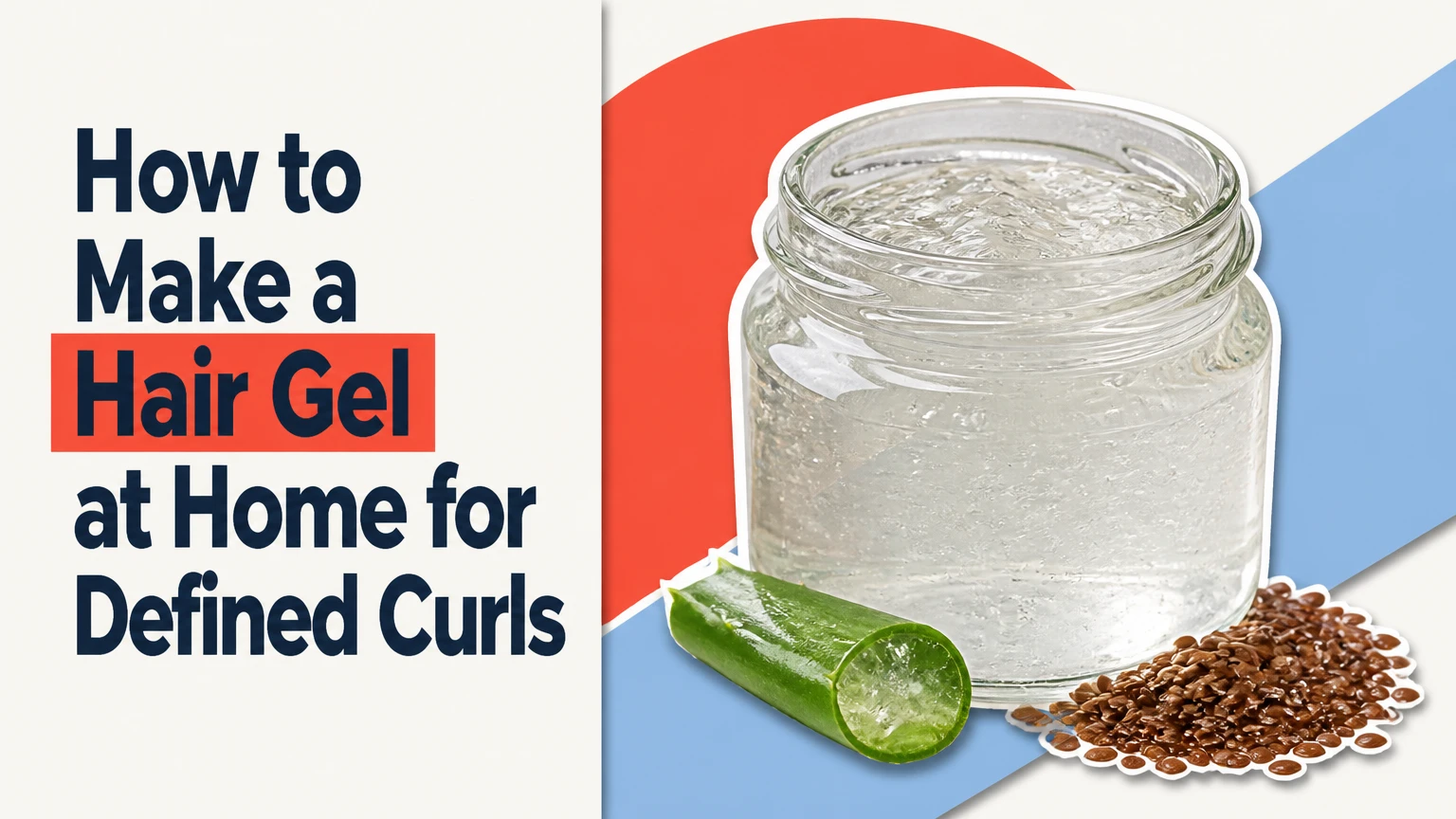
To make a hair gel at home, simmer 2 tablespoons of whole flaxseeds in 1 cup of distilled water for 5-8 minutes, strain the mucilaginous liquid while hot, and cool it before use. Apply the finished flaxseed gel to wet or damp hair, allow a firm cast to dry, then scrunch gently for softer definition.
Key Facts
A refrigerated, preservative-free flaxseed gel batch typically lasts about 5-7 days, not several months.
Whole flaxseeds and distilled water produce a simple medium-hold styling gel for wavy, curly, and coily hair.
A gel cast forms when the dried styling film temporarily stiffens around the hair strands.
Xanthan gum creates a no-cook gel, but excess powder can cause tackiness, clumps, or white residue.
Fresh aloe vera gel requires extra caution because plant material and water can support microbial growth.
A broad-spectrum preservative does not make a kitchen recipe automatically shelf-stable without correct dosage, pH, packaging, and testing.
What Makes Homemade Hair Gel Work?
Homemade hair gel is a water-based styling product that uses a hydrocolloid or plant mucilage to form a temporary film over hair. Flaxseed mucilage, xanthan gum, aloe polysaccharides, and gelatin each thicken water differently, so they produce different combinations of slip, stiffness, shine, and residue.
When the water evaporates, the dissolved or dispersed styling material remains on the hair surface. That dry film groups curls, reduces strand movement, and improves shape retention. The result is a cast, which feels crunchy until the hair is completely dry and the film is gently broken by scrunching.
Hair gel does not permanently reshape the hair fiber. Humidity, friction, oils, and brushing progressively disrupt the film. Gel also cannot repair split ends or replace a conditioner, although a flaxseed formula can make wet hair feel more lubricated during styling.
Which Base Should You Choose?
Flaxseed is the best starting point for most people who want curl definition at low cost. Xanthan gum is more convenient when straining is impractical, aloe vera gives lighter control, and gelatin supplies firmer stiffness but has more limitations for repeated use.
| Gel base | Typical hold | Preparation | Best use | Main limitation |
|---|---|---|---|---|
| Flaxseed mucilage | Medium, 3-6 hours of shape retention | 10-15 minutes simmering | Wavy, curly, and coily styling | Spoils quickly without preservation |
| Aloe vera gel | Light, 1-4 hours | No cooking with commercial gel | Fine hair and refreshers | Weak structure and variable ingredients |
| Xanthan gum | Medium to strong, 4-8 hours | 10-15 minutes cold process | Smooth, no-cook batches | Sticky or flaky when overdosed |
| Gelatin | Strong, 6-10 hours | Hot-water hydration | Slick-backs and temporary spiking | Protein-like stiffness and animal origin |
Flaxseed Gel
Flaxseed gel provides the strongest balance of slip, curl grouping, affordability, and simple ingredients. Brown and golden flaxseeds both work, although seed age and cooking time affect the final viscosity more than seed color.
Aloe Vera Gel
Commercial aloe vera gel is easier to use than gel scraped from a leaf. Choose a product with a short ingredient list and avoid formulas containing high levels of alcohol, added fragrance, or ingredients that form flakes with your conditioner.
Fresh aloe leaf also contains yellow latex near the rind. Remove the rind and rinse the clear inner gel thoroughly. Do not apply unprocessed leaf material to a sensitive scalp.
Xanthan Gum
Xanthan gum is a fermented polysaccharide that thickens water at low concentrations. A practical starting concentration is 0.25-0.5% by weight, which equals approximately 0.6-1.2 grams per 240 grams of water. A teaspoon can vary substantially by powder density, so a small digital scale gives more reliable results.
Gelatin
Gelatin can create a hard, temporary film, but strong hold does not mean improved hair health. Frequent use may leave hair stiff or rough, especially when the hair already responds poorly to protein-containing products. Gelatin is also unsuitable for people avoiding animal-derived ingredients.
Before You Start
The safest home batch is small, refrigerated, and made with clean equipment. Distilled water reduces mineral variability, but it does not make the gel sterile or prevent microbial growth.
| Requirement | Typical specification | Why it matters |
|---|---|---|
| Batch size | 120-180 ml finished gel | Limits waste if spoilage occurs |
| Active preparation time | 10-15 minutes | Covers heating, straining, or mixing |
| Cooling time | 30-45 minutes | Prevents heat damage to hair and packaging |
| Refrigerated storage | 5-7 days, typical | Water-based food ingredients spoil quickly |
| Equipment | 250 ml pot, spoon, fine strainer, clean bottle | Supports controlled preparation |
| Typical cost | $0.50-$2.00 per batch | Depends on seeds, packaging, and water |
| Optional pH strips | Range 4-7 | Helps identify strongly alkaline or acidic batches |
Wash the pot, spoon, strainer, bottle, and your hands. Rinse equipment thoroughly, then allow it to air-dry. A pump or squeeze bottle is preferable to an open jar because repeated finger contact introduces more contamination.
How Do You Make Flaxseed Hair Gel?
The following recipe makes approximately 100-160 ml, depending on evaporation and straining losses. The decisive checkpoint is viscosity: the liquid should form a short, elastic strand from a spoon rather than run like water.
Step 1: Measure the Ingredients
Add 2 tablespoons of whole flaxseeds and 1 cup, or 240 ml, of distilled water to a small saucepan. Do not grind the seeds first because ground flaxseed produces a thicker, harder-to-filter mixture with more suspended solids.
Success checkpoint: The seeds are fully submerged before heating.
Common mistake: Adding extra seeds to force stronger hold, which often creates difficult straining and a sticky finish.
Step 2: Heat the Flaxseeds
Bring the mixture to a steady simmer over medium heat. Stir every 30-60 seconds so seeds do not settle and stick to the pan.
Success checkpoint: The water becomes slightly cloudy and begins forming a slippery coating around the seeds.
Common mistake: Using high heat, which increases foaming and evaporation without reliably improving the gel.
Step 3: Simmer for 5-8 Minutes
Continue simmering for 5-8 minutes. Lift a spoon from the pot to inspect the drip. A ready mixture falls in a thin, elastic ribbon similar to lightly beaten egg white.
| Cooking result | Visual sign | Expected styling result | Adjustment |
|---|---|---|---|
| Under-extracted | Watery drip, clear liquid | Light or negligible hold | Simmer 2 additional minutes |
| Standard | Elastic ribbon, moderate slip | Medium curl definition | Strain immediately |
| Over-reduced | Very thick rope, heavy foam | Stronger cast, more residue risk | Add 1-2 tablespoons distilled water |
| Burned | Brown odor or stuck solids | Unpleasant smell and contamination risk | Discard the batch |
The gel continues thickening slightly as it cools. Stop cooking when the spoon test shows an elastic ribbon, not when the hot liquid reaches its final texture.
Step 4: Strain the Hot Gel
Place a fine-mesh strainer over a heat-resistant bowl or jar. Pour the hot mixture through it immediately. Press the seeds gently with a clean spoon, but do not force large particles through the mesh.
A clean nylon stocking can provide finer filtration than ordinary cheesecloth, but it must be unused or freshly washed and rinsed. Small seed particles can later appear as rough flakes on dark hair.
Success checkpoint: The strained liquid contains no visible seeds or gritty particles.
Common mistake: Waiting until the gel cools, when the mucilage becomes much harder to pass through the strainer.
Step 5: Cool the Batch
Allow the strained gel to cool uncovered until warm rather than hot, then transfer it to a clean bottle. Do not add essential oils as a substitute for a preservative. Essential oils may irritate skin and do not reliably protect a water-based cosmetic from bacteria, yeast, and mold.
Success checkpoint: The bottle feels room temperature before refrigeration.
Common mistake: Sealing a hot bottle tightly, which can create condensation and increase contamination risk.
Step 6: Label and Refrigerate
Write the preparation date on the bottle and refrigerate the gel at 4°C or below. Keep the container closed between uses and dispense only what you need.
A conservative home-use limit is 5-7 days. Discard the batch earlier if it develops gas, visible mold, a sour odor, unusual separation, or a color change.
Step 7: Apply to Damp Hair
Start with 1 teaspoon for short or fine hair, 2 teaspoons for shoulder-length medium-density hair, and 1-2 tablespoons for long, dense, or highly porous hair. Spread the gel over wet or damp hair using praying-hands motions, then scrunch upward.
Allow the hair to air-dry or use a diffuser on low heat and low airflow. Touching curls while they dry disrupts the forming film and increases frizz.
Can You Make a No-Cook Hair Gel?
You can make a no-cook xanthan gum gel by dispersing 0.75-1 gram of xanthan gum into 240 grams of distilled water, but glycerin is optional rather than essential. Glycerin improves slip for some users, while humid conditions can make a humectant-heavy formula feel wetter or frizzier.
Xanthan Gum Recipe
- Weigh 0.75 gram of xanthan gum and 240 grams of distilled water.
- Mix the gum into 1 teaspoon of vegetable glycerin, if desired, to create a smooth slurry.
- Add the water slowly while whisking continuously.
- Let the mixture rest for 10-15 minutes.
- Whisk again and transfer the gel to a clean pump bottle.
Success checkpoint: The gel is uniform, with no floating beads or rubbery lumps.
Common mistake: Dumping dry xanthan gum directly into water, which causes clumps that remain hydrated on the outside and dry inside.
For humid weather, omit glycerin during the first test batch. For dry indoor air, 0.5-1 teaspoon of glycerin per 240 grams of water may improve softness, but test the result on one section of hair before increasing it.
How Should You Customize the Gel?
Customization should change one variable at a time. Oils, glycerin, aloe, fragrance, and botanical powders can alter hold, compatibility, microbial risk, or residue.
| Hair situation | Recommended base | Starting modification | Avoid first |
|---|---|---|---|
| Fine, easily weighed-down hair | Aloe or dilute flaxseed | 1 part gel plus 1 part distilled water | Shea butter and heavy oil |
| Dry, dense curls | Standard flaxseed | Add 2-4 drops argan or jojoba oil per 100 ml | More than 1% oil |
| High humidity | Flaxseed or xanthan | Omit glycerin initially | Large humectant additions |
| Slick-back style | Xanthan or gelatin | Use a thin layer over damp hair | Applying thick gel to dry buildup |
| Protein-sensitive hair | Flaxseed or aloe | Avoid gelatin | Repeated gelatin applications |
| High-porosity hair | Flaxseed or xanthan | Layer over conditioner or leave-in | Excess oil that blocks water |
Oil does not dissolve in a water gel without an appropriate emulsifier. A few drops may disperse temporarily, but the mixture will separate and create uneven dosing. Shake before use and keep the batch small if you add oil.
How Do You Apply Homemade Gel Without Flakes?
Apply homemade gel to wet or very damp hair, use less product than expected, and test compatibility with the leave-in conditioner before applying both products widely. Flakes commonly result from excess dried polymer, incompatible product layers, or rubbing hair before the film has dried.
Perform a palm test first. Mix a pea-sized amount of leave-in conditioner with the same amount of gel. If the mixture becomes curdled, stringy, cloudy, or grainy within 60 seconds, use the products separately or change the order.
| Symptom | Likely cause | Immediate fix | Prevention |
|---|---|---|---|
| White flakes | Too much gel or product incompatibility | Rinse and dilute gel 1:1 | Palm-test layered products |
| Sticky hair | Excess xanthan, glycerin, or oil | Rewet and rinse lightly | Reduce additive concentration |
| Weak hold | Excess water or short flaxseed cooking | Simmer a fresh batch longer | Use the spoon-ribbon test |
| Crunchy hair | Thick cast or incomplete drying | Scrunch only when fully dry | Apply a thinner, even layer |
| Frizz during drying | Touching, wind, or high airflow | Rewet small areas and reshape | Diffuse on low airflow |
| Gritty texture | Seed particles or botanical powder | Filter or discard | Use a finer strainer |
An important practitioner rule is to judge hold only after complete drying. Many users add more gel while hair is still wet, then create a brittle cast that flakes during scrunching.
How Long Does Homemade Hair Gel Keep?
Unpreserved flaxseed, aloe, and xanthan gum gels typically keep for 5-7 days in a clean refrigerator, although the exact limit cannot be guaranteed without microbial testing. Room-temperature storage for several months requires a correctly formulated broad-spectrum preservative and validated stability and preservation testing.
The U.S. Food and Drug Administration states that the maker is responsible for ensuring a cosmetic product is safe, and a home kitchen batch has none of the controlled manufacturing conditions used by commercial formulators. Refrigeration slows growth; it does not sterilize the product.
| Storage approach | Typical usable period | Risk level | Recommendation |
|---|---|---|---|
| Open jar, room temperature | 1-3 days | High | Avoid |
| Clean squeeze bottle, refrigerator | 5-7 days | Moderate | Best for small batches |
| Frozen single-use portions | Up to 1 month for quality | Lower handling exposure | Thaw one portion once |
| Preserved formula, room temperature | Formula-specific | Variable | Use only with proper formulation |
| Batch with mold or sour odor | 0 days | Unsafe | Discard immediately |
Do not rely on Liquid Germall Plus, Geogard ECT, or another named preservative unless you know the supplier’s permitted use level, pH range, addition temperature, compatibility, and local cosmetic regulations. A preservative added by teaspoons can be dangerously inaccurate.
What Does Homemade Hair Gel Cost?
A small flaxseed batch typically costs about $0.50-$2.00 before labor, depending on seed price, distilled water, and packaging. The finished yield is usually 100-160 ml, while straining losses can remove 15-35% of the starting liquid.
| Cost component | Typical quantity | Typical cost | Cost-control option |
|---|---|---|---|
| Whole flaxseeds | 2 tablespoons | $0.10-$0.40 | Buy food-grade seeds in bulk |
| Distilled water | 240 ml | $0.10-$0.50 | Use a fresh sealed bottle |
| Bottle | 150-250 ml | $0.30-$1.50 | Reuse only after thorough cleaning |
| Optional oil | 2-4 drops | $0.05-$0.25 | Omit for fine hair |
| Total batch | 100-160 ml | $0.50-$2.00 | Make only one week’s supply |
DIY gel is inexpensive, but lower price does not compensate for a spoiled batch or irritated scalp. The practical savings come from making small quantities and avoiding discarded oversized batches.
Is Homemade Hair Gel Safe for the Scalp?
Homemade hair gel is usually safest when applied mainly to the hair lengths, used on intact skin, and discarded at the first sign of spoilage. Patch-test a small amount behind the ear or on the inner arm for 24 hours, especially when using aloe, fragrance, oils, or botanical additives.
Stop using the product if burning, swelling, itching, hives, or persistent redness occurs. Do not apply homemade gel to broken skin, infected follicles, or a scalp with an active dermatitis flare without professional guidance.
Hair electrolysis is unrelated to styling gel. Electrolysis uses a fine probe and electrical current to target individual hair follicles for permanent hair removal; homemade gel should never be used inside the follicle, on an electrolysis probe, or as a substitute for professional aftercare.
Common Mistakes and How to Fix Them
Why Is the Gel Too Watery?
Watery flaxseed gel usually reflects insufficient extraction, excessive starting water, or premature straining. Simmer a fresh batch for another 1-2 minutes, then repeat the spoon test rather than adding large amounts of xanthan gum after cooking.
Why Did the Gel Turn Moldy?
Mold indicates contamination or inadequate preservation, and the batch must be discarded rather than reheated. Dirty bottles, wet fingers, food residue, and long refrigerator storage are common causes.
Why Does the Gel Flake?
Flaking usually comes from applying too much dried polymer or combining incompatible styling products. Dilute the gel with distilled water, apply less, and complete the palm compatibility test before layering products.
Why Is the Hair Stiff and Brittle?
Stiffness results from a heavy cast, excess gelatin, low moisture under the film, or repeated product buildup. Wash the hair, condition it, and use less gel on the next application; avoid gelatin if the hair repeatedly feels hard after use.
Why Does Aloe Gel Irritate the Scalp?
Fresh aloe may retain latex compounds, while commercial aloe gels can contain fragrance, alcohol, preservatives, or colorants. Rinse fresh aloe thoroughly, select a simple commercial formula, and discontinue use after any irritation.
Which Homemade Gel Should You Choose?
Choose flaxseed gel for the best general-purpose curl definition, xanthan gum for a no-cook formula, aloe for lightweight control, and gelatin only when firm temporary structure matters more than softness. Hair density, humidity, product compatibility, and preservation needs determine the practical winner.
| User priority | Best choice | Starting formula | Expected finish | Reason to reject it |
|---|---|---|---|---|
| Defined curls on a budget | Flaxseed | 2 tbsp seeds, 240 ml water | Slippery, medium cast | Short storage life |
| Fine hair volume | Aloe | Commercial aloe, used alone | Light, low residue | Limited hold |
| No-cook preparation | Xanthan gum | 0.75-1 g gum, 240 g water | Smooth, medium cast | Gum clumps if mixed poorly |
| Firm slick-back | Gelatin | 0.5 tsp gelatin, 120 ml hot water | Hard, structured film | Can feel brittle |
| Humid-weather control | Flaxseed or xanthan | Omit glycerin first | Moderate film and shape | Neither prevents all humidity frizz |
FAQ
Can I Use Tap Water in Homemade Hair Gel?
You can use tap water for a single-use batch, but distilled water gives more consistent results and reduces mineral variation. Tap water does not automatically make gel unsafe, yet minerals, chlorine, and local water quality can affect texture and storage. Refrigerate any water-based batch and use it promptly.
Can I Add Coconut Oil to Flaxseed Gel?
Add only a few drops after cooling, and expect separation because oil and water do not naturally remain mixed. Coconut oil can weigh down fine hair and may feel waxy when layered. Jojoba or argan oil is usually easier to control in tiny amounts, but neither replaces a proper emulsifier.
Can Homemade Gel Replace Mousse or Commercial Styling Gel?
Homemade gel can replace a light or medium-hold commercial styler for some curls, but it offers less predictable preservation, fragrance control, humidity resistance, and batch consistency. Commercial gel is the better choice when you need verified shelf life, strong long-term hold, or reliable performance during travel.
Should I Apply Flaxseed Gel Before or After Leave-In Conditioner?
Apply leave-in conditioner first, then flaxseed gel, because the gel forms the outer styling film. Use a small amount of each product and perform a palm test first. If the mixture pills or turns grainy, apply the products separately with several minutes between layers.
Can I Freeze Homemade Flaxseed Gel?
You can freeze small single-use portions for approximately one month with reasonable texture retention. Thaw one portion in the refrigerator, stir it, and do not refreeze it. Freezing slows quality loss but does not correct contamination introduced before freezing.
How Do I Get Stronger Hold Without Making More Gel?
Remove more water through a slightly longer simmer, apply gel in thinner sections, and allow the cast to dry fully before touching it. Stronger hold does not require a large amount of product. Excess gel increases flaking and stiffness faster than it improves shape retention.
The Bottom Line
The most reliable answer to how to make a hair gel at home is a small flaxseed batch: simmer 2 tablespoons of whole seeds with 1 cup of distilled water for 5-8 minutes, strain it hot, refrigerate it, and use it within 5-7 days. Start with a thin layer on damp hair, test product compatibility, and discard any batch that changes odor, color, or texture.