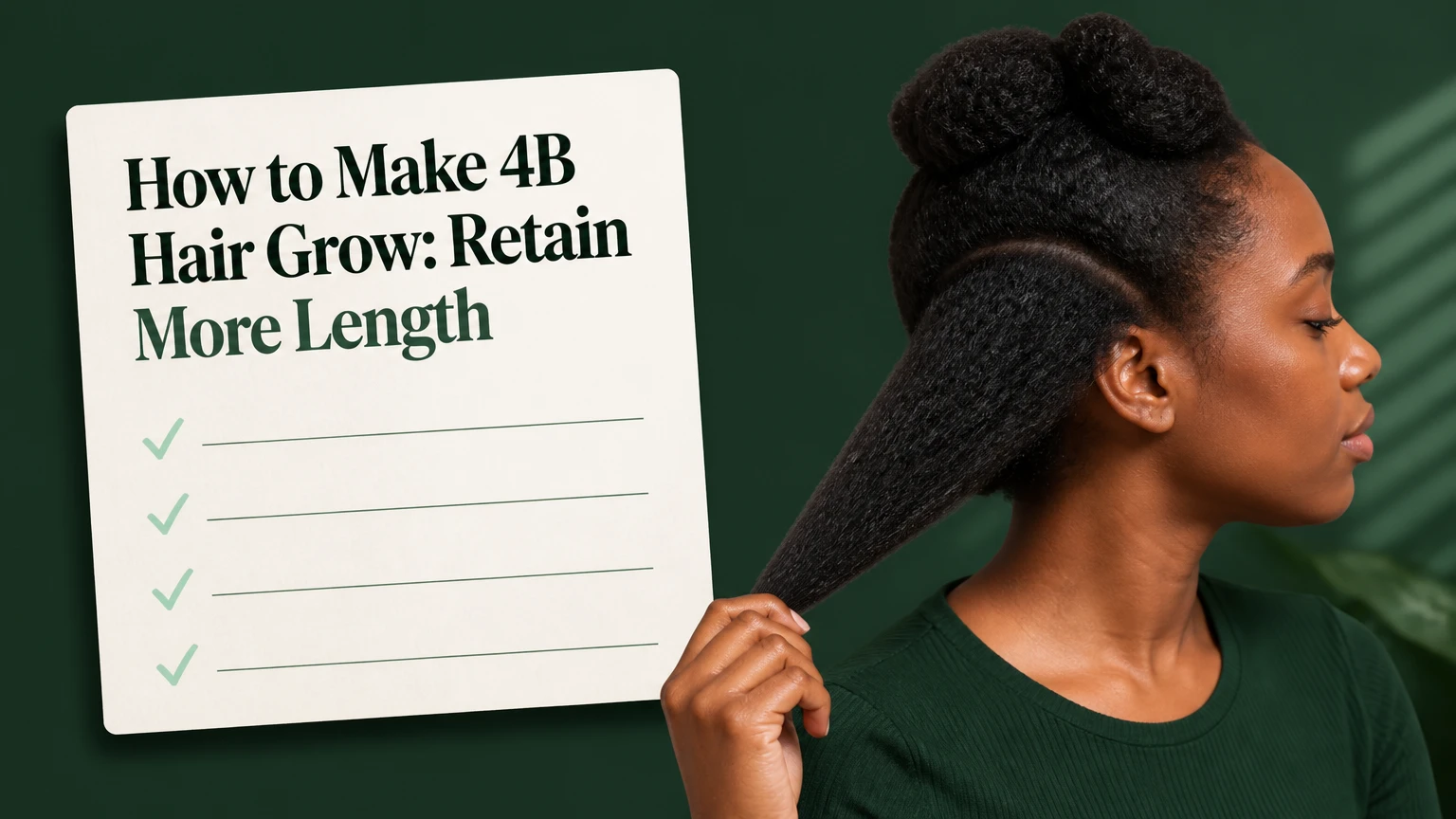
4B hair grows from the follicle at roughly the same biological rate as other hair, often about 0.25-0.5 inches per month. To make 4B hair appear longer, protect fragile ends from dryness, knots, friction, heat, and excessive tension so new growth is retained instead of broken before it becomes visible.
Key Facts at a Glance
- 4B hair commonly shrinks substantially, so stretched measurements are more useful than wash-day appearance.
- A typical scalp-hair growth range is 0.25-0.5 inches monthly, but genetics, age, health, and hormones affect the rate.
- Moisture reduces friction and improves handling, but water and oils cannot repair a split or permanently damaged strand.
- Protective styling supports length retention only when the style has low tension and the scalp remains clean.
- Tight braids, extensions, slicked ponytails, and repeated edge tension can cause traction alopecia.
- Hair electrolysis removes unwanted hair by destroying targeted follicles; it does not stimulate scalp-hair growth.
What Makes 4B Hair Different?
4B hair forms tightly coiled, angular bends that can create a fluffy or cotton-like appearance, while shrinkage makes the visible length much shorter than the stretched length. The bends do not make the follicle grow more slowly, but they increase opportunities for neighboring strands to interlock and for handling to create stress.
The Andre Walker typing system is a descriptive classification, not a medical diagnosis or a complete measurement of hair behavior. Two people with 4B hair can have different strand diameters, densities, porosity, elasticity, and damage histories, so the same product sequence will not work identically for both.
Why Does 4B Hair Break Before Length Becomes Visible?
4B hair tends to lose length when repeated friction and bending create weak points along the fiber, particularly at dry ends and previously colored or heat-damaged sections. Natural scalp oils also move less readily along tightly coiled strands, although dryness varies with washing habits, climate, product use, and individual scalp oil production.
Shrinkage creates a measurement problem. A person may retain 3 inches of stretched growth while seeing only 1 inch in its shrunken state. Measure one small section when dry and stretched every eight weeks, using the same section and method.
How Fast Does 4B Hair Grow?
4B hair typically grows about 0.25-0.5 inches per month, or approximately 3-6 inches per year before breakage and trimming. The American Academy of Dermatology Association identifies about one-half inch per month as a general scalp-hair average, while individual anagen cycles and health conditions produce meaningful variation.
Growth speed is not the same as retained length. If the scalp produces 0.4 inches monthly but breakage removes 0.3 inches, the visible gain is only 0.1 inches. The most useful measurement is therefore the difference between stretched length at baseline and stretched length after three, six, and twelve months.
| Period | Typical new growth at 0.25-0.5 in/month | Practical retained-length target |
|---|---|---|
| 3 months | 0.75-1.5 inches | 0.5-1.25 inches |
| 6 months | 1.5-3 inches | 1-2.5 inches |
| 9 months | 2.25-4.5 inches | 1.5-3.75 inches |
| 12 months | 3-6 inches | 2-5 inches |
The retained-length column is a planning range, not a guarantee. A person with low breakage may retain nearly all new growth, while frequent coloring, tight styling, or severe scalp disease may produce no visible increase.
Before You Start: Build the Right Routine
A workable 4B hair routine needs a cleanser, rinse-out conditioner, leave-in conditioner, detangling tool, styling cream or gel, and a satin or silk covering. Typical home costs range from $20-$60 monthly, while the first routine setup may cost $35-$100 depending on product size and brand.
| Item | Useful specification | Typical quantity | Typical cost |
|---|---|---|---|
| Shampoo | Sulfate-free or gentle cleansing formula, 8-16 oz | 1 bottle per 2-4 months | $8-$18 |
| Conditioner | High-slip rinse-out formula, 12-24 oz | 1 bottle per 1-3 months | $10-$25 |
| Leave-in | Water-based formula, 8-16 oz | 1 bottle per 2-4 months | $10-$20 |
| Satin protection | Bonnet or satin pillowcase, washable | 1-2 items | $8-$30 |
| Detangling tool | Fingers plus wide-tooth comb or flexible brush | 1 tool | $5-$20 |
Record your starting length, wash frequency, current styles, breakage location, scalp symptoms, and any chemical or heat services. A simple monthly photograph taken under identical lighting is more reliable than memory.
Step 1: Clean the Scalp Every 7-14 Days
Wash the 4B scalp every 7-14 days as a starting point, then adjust for exercise, oiliness, dandruff, swimming, and protective styles. Shampoo the scalp with finger pads rather than fingernails, rinse thoroughly, and allow the lather to clean the lengths as it runs through them.
Infrequent washing does not automatically improve growth. Sebum, sweat, flakes, styling polymers, and oils can accumulate around follicles and make itching or inflammation worse. The American Academy of Dermatology Association recommends choosing wash frequency according to scalp oil and dirt levels rather than assigning one schedule to every hair texture.
Use a medicated shampoo for persistent flaking only according to its label or a clinician’s instructions. Ketoconazole, selenium sulfide, zinc pyrithione, and salicylic acid products serve different scalp conditions, so a dermatologist should evaluate recurring symptoms instead of treating every flake as simple dryness.
You will know Step 1 worked when: the scalp feels clean without burning, tightness, or visible residue.
Common mistake: applying heavy oils over flakes instead of cleansing the scalp.
Step 2: Condition and Add Water-Based Moisture
Apply rinse-out conditioner after every shampoo, then deep-condition for about 15-30 minutes when the hair feels rough, tangled, or unusually porous. Use a plastic cap and gentle warmth if helpful, but avoid high heat that leaves the scalp uncomfortable or makes the hair overly soft and weak.
Water is the primary hydrating ingredient. A leave-in conditioner can improve slip and reduce combing force, while creams and butters help reduce moisture loss and friction during styling. Oils mainly lubricate the fiber and slow water loss; they do not hydrate dry hair by themselves or seal split ends back together.
Which Is Better, LOC or LCO?
LOC means liquid or leave-in conditioner, oil, then cream; LCO means liquid or leave-in conditioner, cream, then oil. Neither order is universally best for 4B hair, and porosity tests are too imprecise to dictate a formula without observing how the hair behaves.
| Method | Product order | Best starting situation | Adjustment signal |
|---|---|---|---|
| LOC | Leave-in, oil, cream | Hair loses softness within 24 hours | Reduce oil if hair feels coated |
| LCO | Leave-in, cream, oil | Hair feels weighed down by heavy layering | Use lighter cream or oil |
| Leave-in only | Leave-in, then style | Fine strands or low buildup tolerance | Add cream to dry ends only |
| Cream plus gel | Leave-in, cream, gel | Twist-outs or wash-and-go styling | Clarify when residue accumulates |
Apply a small amount to a test section for two wash cycles. If the hair remains pliable for two to four days without greasy residue, the sequence is working. If it feels brittle within hours, improve cleansing, conditioner slip, and water application before adding more oil.
You will know Step 2 worked when: the hair bends without a brittle sound and the ends feel flexible.
Common mistake: layering shea butter, castor oil, cream, and gel until buildup blocks water and makes the hair feel dry.
Step 3: Detangle in Sections With Conditioner
Detangle damp, conditioned 4B hair in four to eight sections, beginning at the ends and moving toward the roots. Finger-detangle first, remove shed hairs gradually, and use a wide-tooth comb or flexible brush only after the conditioner provides sufficient slip.
Detangling dry hair is not always forbidden, but dry combing usually increases friction and snapping in tightly coiled hair. A person with a short, low-density cut may safely finger-detangle dry hair, while dense, long, or highly shrunken hair generally benefits from water and conditioner.
You will know Step 3 worked when: the shed hair appears mostly long and intact, not as many short fragments.
Common mistake: pulling a comb from root to tip through a compacted section.
Step 4: Stretch and Style With Low Manipulation
Choose two-strand twists, flat twists, loose braids, or another style that keeps strands organized without pulling the hairline. Keep sections moderate rather than extremely tiny, because micro-styling increases installation time, manipulation, and removal stress.
Protective styling does not mean leaving hair untouched indefinitely. Hair still needs scalp cleansing, controlled moisturizing, and gentle takedown. Extensions add weight and tension, particularly when installed tightly or attached to weak edges.
| Style | Typical wear period | Scalp access | Main risk |
|---|---|---|---|
| Two-strand twists | 7-21 days | High | Frizz and unraveling |
| Flat twists | 7-14 days | High | Tension at parts |
| Knotless braids | 4-6 weeks | Medium | Traction and buildup |
| Wig with breaks | 1-4 weeks per wear cycle | High when removed | Friction from cap or clips |
| Sew-in weave | 6-8 weeks maximum | Low | Hidden buildup and tension |
| Mini-locs | Months to years | Medium | Retightening tension |
A style should not hurt during installation or produce headache, scalp soreness, shiny stretched skin, broken hairs, or raised bumps. Remove it promptly if those signs appear. The British Association of Dermatologists identifies repeated traction as a cause of traction alopecia, which can become permanent when follicle damage continues.
Expert insight: the safest protective style is not the one that lasts longest. It is the one that allows cleaning, creates minimal tension, and can be removed without aggressive detangling.
Step 5: Protect Hair During Sleep
Cover 4B hair nightly with a smooth satin or silk bonnet, or use a satin pillowcase if bonnets slide off. Gather long hair loosely with a satin scrunchie, and avoid cotton coverings that increase friction and absorb surface moisture.
Satin is a fabric category, while silk is a fiber, so quality and surface smoothness matter more than the label alone. Wash the bonnet or pillowcase weekly when scalp oil, sweat, or styling products transfer onto it.
Step 6: Trim Damage Instead of Chasing a Schedule
Trim split, feathered, white-dotted, or repeatedly knotted ends when they interfere with detangling, rather than removing a fixed quarter-inch every twelve weeks automatically. Healthy ends do not require routine trimming for the follicle to keep growing, but damaged ends can continue splitting and reduce retained length.
Use sharp hair shears, work in small sections, and remove only visibly damaged fiber. Household scissors may crush or bend the cuticle. A professional trim is useful after extensive heat, color, or a major shape change.
You will know Step 6 worked when: wash-day detangling takes less time and fewer knots remain at the ends.
Common mistake: avoiding every trim while repeatedly losing larger pieces through breakage.
Which Protective Style Has the Best Trade-Off?
Low-tension twists usually provide the strongest home balance of access, cost, and controlled manipulation. Knotless braids can work for busy schedules, but they are not automatically safer because added hair still increases weight and prolonged wear can conceal scalp irritation.
| Option | Typical price | Maintenance interval | Best use case | Primary limitation |
|---|---|---|---|---|
| Home twists | $0-$25 | 1-3 weeks | Low-cost length retention | Requires takedown care |
| Knotless braids | $120-$350 | 4-6 weeks | Reduced daily styling | Tension and installation cost |
| Wig rotation | $30-$250 | Remove every 1-7 days | Frequent style changes | Cap friction and adhesive |
| Salon mini-locs | $600-$1,500 startup | 4-8 weeks | Long-term low daily handling | Cost and irreversible commitment |
A protective style is a poor choice when it causes pain, blocks regular scalp washing, requires aggressive removal, or keeps edges under constant tension. Hair retention should never be purchased at the cost of follicle injury.
Can Oils, Massage, or Supplements Make 4B Hair Grow Faster?
Oils and scalp massage may improve lubrication and make handling more comfortable, but reliable evidence does not show that common cosmetic oils increase normal scalp growth enough to overcome genetics or active disease. Massage should be gentle for three to five minutes, and supplements should address a documented deficiency rather than replace diagnosis.
Minoxidil has evidence for selected types of hair loss, but it is a medication with contraindications, side effects, and a need for continued use. A dermatologist should identify the cause of shedding before treatment. Iron, vitamin D, zinc, thyroid hormones, and protein status may matter when deficient, yet excessive supplementation can cause harm.
The AAD states that hair-loss treatment begins with finding the cause. That principle matters more than any oil blend. Pumpkin seed oil, Jamaican black castor oil, rosemary oil, collagen powders, and Ayurvedic mixtures should be treated as cosmetic or optional adjuncts, not guaranteed growth treatments.
What About Hair Electrolysis?
Hair electrolysis is not a scalp-growth treatment. A licensed electrologist inserts a probe into an individual follicle and uses electrical energy to destroy its growth capacity, making electrolysis appropriate for unwanted facial or body hair, not thinning scalp hair.
| Treatment | Intended target | Follicle outcome | Role in scalp growth |
|---|---|---|---|
| Electrolysis | Unwanted individual hairs | Permanent removal after repeated sessions | Does not stimulate regrowth |
| Laser hair removal | Pigmented unwanted hair | Long-term reduction | Does not restore scalp density |
| Minoxidil | Certain scalp hair-loss patterns | Supports growth while used | Medical treatment under guidance |
| Hair transplant | Stable areas of permanent loss | Relocates donor follicles | Surgical restoration |
Do not use electrolysis on a thinning scalp to “activate” follicles. The treatment works by disabling follicles, which is the opposite of the goal when trying to preserve or increase scalp density.
How Do You Prevent Thinning Edges?
Prevent thinning edges by removing painful styles, reducing attachment weight, rotating part locations, and avoiding repeated tight ponytails, braids, glued wigs, and slicked-down styles. Early traction-related thinning may improve after tension stops, but shiny skin or long-standing loss can indicate permanent follicle damage.
| Sign | Likely concern | Immediate action | Medical timing |
|---|---|---|---|
| Tender scalp after braiding | Excessive tension | Remove or loosen style | Same week if pain persists |
| Broken hairs at temples | Mechanical traction | Stop tight edges styling | Book evaluation if recurring |
| Smooth shiny patches | Advanced traction loss | Avoid all tension | Dermatology appointment soon |
| Sudden diffuse shedding | Illness, medication, or telogen effluvium | Photograph and review triggers | Evaluation within weeks |
| Scaly itchy patches | Dermatitis or fungal condition | Avoid occlusive oils | Clinical diagnosis needed |
A dermatologist can distinguish traction alopecia from alopecia areata, central centrifugal cicatricial alopecia, seborrheic dermatitis, psoriasis, and other causes that require different treatment. Home oiling cannot reliably distinguish these conditions.
Common Problems and How to Fix Them
| Problem | Most likely mechanism | First correction | Recheck period |
|---|---|---|---|
| Hair feels dry after two hours | Insufficient water or buildup | Clarify, then apply leave-in to wet hair | 2 wash cycles |
| Many short broken pieces | Friction, heat, or tension | Reduce manipulation and inspect ends | 4-8 weeks |
| White flakes and itch | Dandruff or dermatitis | Use suitable medicated cleanser | 2-4 weeks |
| Hair feels mushy | Excessive moisture or chemical damage | Add balanced conditioning and reduce soaking | 2-3 washes |
| Knots at every wash | Shrinkage and inadequate sectioning | Detangle in 4-8 sections | Next wash |
| Edges become thinner | Traction | Stop tight styles immediately | 6-12 weeks |
Hair that feels dry despite frequent moisturizing often has product buildup, high porosity from damage, or an unsuitable product film. Clarify periodically according to residue and scalp needs, not automatically every month, then apply water-based conditioner to clean, wet hair.
Hair that feels weak and gummy may need less prolonged wet manipulation and a balanced conditioning approach. Protein treatments can help some chemically damaged or highly porous hair, but frequent heavy protein can make otherwise healthy hair stiff. Change one variable at a time.
How Much Does a 4B Growth Routine Cost?
A basic home routine typically costs $20-$60 per month, while salon-based protective styling can cost $120-$350 every four to six weeks before maintenance products. Cost does not predict retention because a low-cost routine with gentle handling can outperform an expensive style installed under damaging tension.
| Routine type | Monthly product cost | Service cost | Time commitment | 6-month typical spend |
|---|---|---|---|---|
| Minimal home care | $20-$35 | $0 | 2-4 hours monthly | $120-$210 |
| Home care with deep treatments | $35-$60 | $0 | 4-7 hours monthly | $210-$360 |
| Braids plus home care | $25-$60 | $120-$350 every 4-6 weeks | 2-5 hours monthly | $745-$2,160 |
| Wig rotation plus home care | $30-$80 | $0-$250 startup | 3-6 hours monthly | $180-$730 |
These are typical consumer ranges, not quoted national averages. Prices vary by country, hair length, density, stylist experience, extension type, and whether washing is included.
A Practical 6-Month Growth Plan
Months one and two should establish a consistent wash interval, controlled detangling, and a low-tension default style. Take baseline photographs and measure stretched hair before changing multiple products.
Months three and four should focus on breakage patterns. Inspect shed hair and broken fragments separately, check whether ends knot faster than roots, and rotate parts or styles if one area receives repeated tension.
Months five and six should provide enough time to evaluate retained length. If stretched length has not increased despite consistent care, investigate heat, chemical processing, tight styling, scalp inflammation, nutritional deficiency, medication, and inaccurate measurement rather than simply buying a stronger growth oil.
When Should You See a Dermatologist?
Seek dermatology care for sudden shedding, circular bald patches, scalp pain, pus, persistent scaling, severe itching, a widening central part, or progressive thinning around the crown or hairline. A clinician may examine the scalp, review medications and illness, and order targeted tests when the history suggests iron deficiency, thyroid disease, hormonal imbalance, or another condition.
Hair grows slowly, so waiting six months is not appropriate when loss is rapid or accompanied by inflammation. Early diagnosis can protect follicles that may not recover after prolonged scarring or traction.
The Bottom Line
To make 4B hair grow visibly longer, focus on retaining new length rather than trying to accelerate the follicle. Wash the scalp every 7-14 days as needed, condition thoroughly, detangle damp hair in sections, moisturize with water-based products, use low-tension styles, protect hair at night, and remove damaged ends when necessary.
A typical 4B growth rate is about 0.25-0.5 inches monthly, but genetics and health determine production while handling determines retention. Oils, supplements, and hair electrolysis cannot replace diagnosis or gentle care. Measure stretched length every eight weeks and seek medical evaluation for sudden shedding, pain, scaling, or progressive thinning.
Frequently Asked Questions
Does 4B hair grow slower than straight hair?
No. 4B hair does not inherently grow slower because of its curl pattern. Tight coils create shrinkage and increase the risk of tangling, friction, and breakage, so the hair may appear to gain length more slowly. Measure stretched hair over several months to separate follicle growth from retained length.
Can I moisturize 4B hair every day?
You can lightly mist or moisturize 4B hair daily if the hair becomes dry and the product does not create buildup. Daily soaking and manipulation are unnecessary for everyone. Apply enough water-based product to restore flexibility, then reduce frequency if the hair stays soft for two to four days.
Should I use Jamaican black castor oil for growth?
Jamaican black castor oil can lubricate hair and reduce friction, but evidence does not establish it as a reliable follicle-growth treatment. Its thickness may cause buildup or make fine hair feel coated. Use a small amount on the lengths or dry ends, and do not use it to conceal scalp pain, flakes, or hair loss.
Do braids help 4B hair grow?
Braids can help retain length by reducing daily styling, but they do not increase follicle growth. Braids support retention only when installed loosely, removed within a reasonable wear period, and maintained with scalp cleansing. Pain, bumps, headaches, or thinning edges indicate damaging tension and require prompt removal.
How can I tell whether my hair needs protein?
Hair may benefit from occasional protein conditioning when it is highly porous, chemically processed, overly stretchy when wet, or difficult to strengthen with regular conditioner. Healthy hair that becomes stiff, rough, or brittle after protein needs less frequent use. Test one treatment and reassess after two washes.
Why is my 4B hair growing but not getting longer?
Breakage, split ends, shrinkage, inaccurate measurement, and frequent trimming can hide new growth. Compare the same stretched section every eight weeks and inspect broken fragments. If there is no gain after six months, or if density is declining, have a dermatologist assess traction, inflammation, nutritional issues, medication effects, and patterned hair loss.