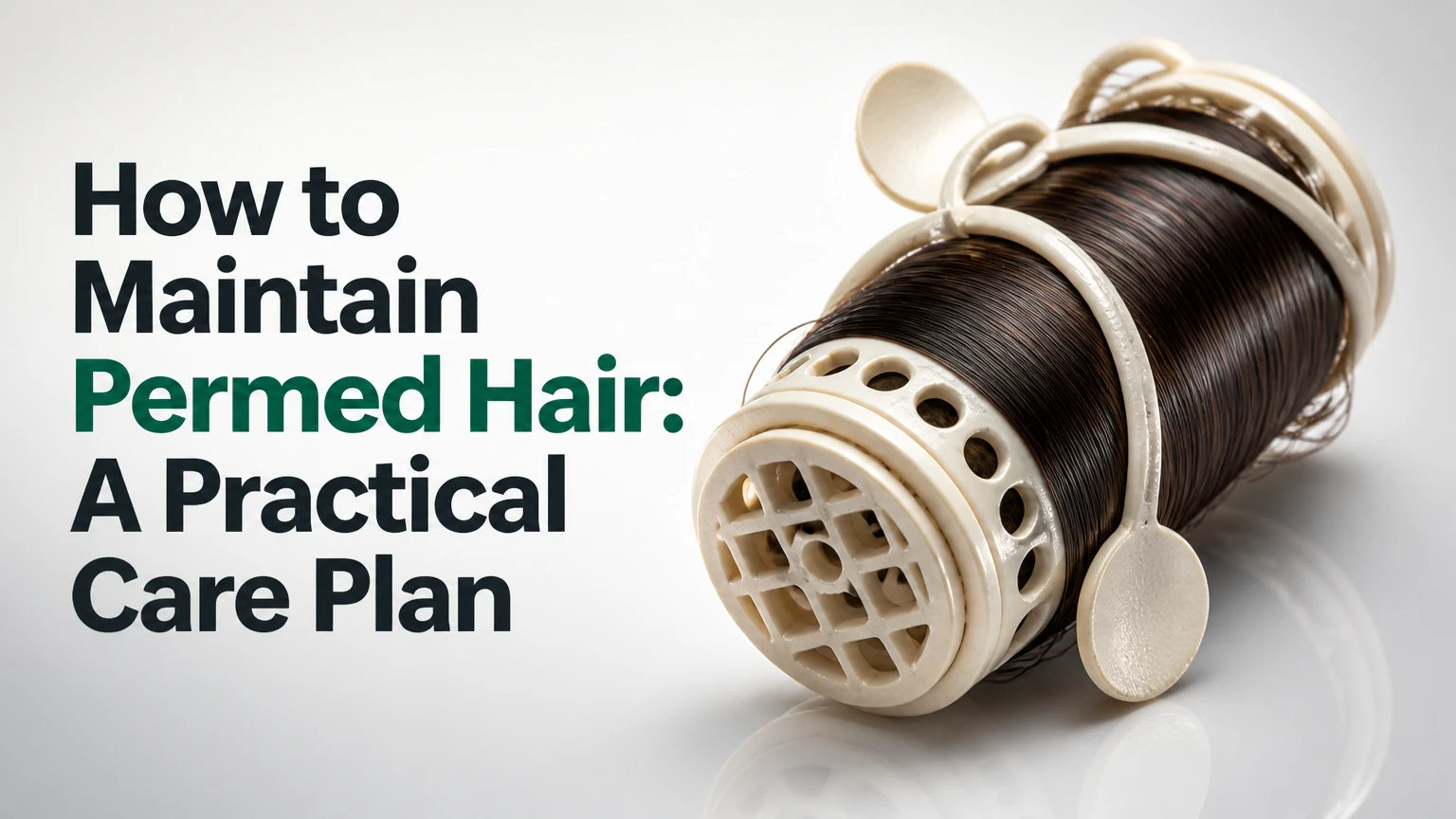
To maintain permed hair, protect the newly formed curl pattern for the first 48 hours, then wash less often with a gentle cleanser, condition regularly, detangle wet hair carefully, and limit heat and chemical overlap. The best routine also depends on the perm chemistry, hair porosity, curl size, scalp oiliness, and existing color damage.
Key Facts at a Glance
Keep newly permed hair dry, loose, and undisturbed for the period specified by your stylist, commonly 48 hours.
Most permed hair needs washing about 2-3 times weekly, with adjustments for oily scalps, workouts, and product buildup.
Chemical texture services alter disulfide bonds, so permed hair can become more porous, dry, and breakage-prone.
Apply conditioner and styling products to the lengths first, because the ends usually have the greatest chemical exposure.
Air-drying creates the least thermal stress; a diffuser should use low heat, low airflow, and continuous movement.
A perm changes existing lengths permanently, but new growth remains your natural texture and requires a stylist-planned touch-up.
What Does a Perm Change?
A permanent wave changes the internal shape of the hair fiber by reducing some disulfide bonds, molding the hair around rods, and reforming bonds with a neutralizer. The result is durable texture in the treated lengths, but the chemical service does not make hair stronger, repair existing porosity, or change future growth from the follicle.
Hair is composed largely of keratin, whose disulfide bonds help determine fiber shape. Perm lotion reduces enough of those bonds for the strand to conform to a rod, while the neutralizer oxidizes and reforms bonds in the new configuration. Ammonium thioglycolate is common in alkaline formulas; acid-balanced systems use different conditions and usually produce a softer result.
The process explains the aftercare rules. A treated strand has less structural resilience and often absorbs water, conditioner, and styling products differently from untreated hair. The American Academy of Dermatology Association states, “There is no way to repair damaged hair.” Treatments can reduce friction and improve feel, but only trimming removes severely split or degraded ends.
Which Perm Type Changes the Routine?
Perm chemistry and rod technique affect maintenance more than the salon label alone. A tight spiral perm usually needs more styling control and moisture, while a loose digital wave may need less daily manipulation but still contains chemically processed hair.
| Perm type | Typical result | Maintenance demand | Main caution |
|---|---|---|---|
| Alkaline or cold | Firm curls on resistant hair | Wash 2-3 times weekly | Can increase dryness on fine or porous hair |
| Acid or heat | Soft waves with flexible movement | Condition after every wash | Waves may relax sooner |
| Digital or hot | Dry-defined loose waves | Diffuse or air-dry with light products | Heat adds another stress source |
| Spiral | Vertical, springy curls | Daily moisture and careful separation | Friction can create severe tangling |
| Root perm | Volume in the first 2-3 inches | Low product near scalp | New growth becomes visible quickly |
| Stack perm | Curled mid-lengths and ends | Length-focused conditioning | Heavy creams can flatten the top |
| Multi-textured | Mixed rod sizes and irregular movement | Section-specific styling | One product weight may not suit every zone |
A stylist should evaluate previous bleach, highlights, permanent color, henna, relaxers, and heat damage before selecting a formula. Hair that stretches excessively when wet, snaps during combing, or feels gummy may be unsuitable for another chemical service.
How Should You Prepare Before the First Wash?
Prepare a gentle cleanser, rinse-out conditioner, leave-in conditioner, microfiber towel or cotton T-shirt, wide-tooth comb, and a diffuser before the first wash. Product labels matter less than the formula’s weight, cleansing strength, and compatibility with chemically treated hair.
Before You Start
| Item | Typical requirement | Why it matters |
|---|---|---|
| First-wash timing | Commonly 48 hours | Gives the salon-applied shape time to settle |
| Washing frequency | 2-3 times weekly | Limits repeated swelling and drying |
| Deep treatment | Every 7-10 days | Adds slip and softness to porous lengths |
| Cleanser amount | 1-2 teaspoons for shoulder-length hair | Removes scalp oil without overscrubbing |
| Conditioner amount | 1-2 tablespoons for shoulder-length hair | Coats and detangles the lengths |
| Diffuser setting | Low heat, low airflow | Reduces thermal and mechanical stress |
| Appointment duration | Typically 2-4 hours | Varies with density, length, and technique |
| Typical service price | About $80-$350 or more | Location, stylist, hair length, and perm type change cost |
Product quantities are starting points, not fixed prescriptions. Thick, waist-length hair may need twice as much conditioner, while a short root perm may need only a pea-sized leave-in application.
How to Maintain Permed Hair During the First 48 Hours
During the first 48 hours, keep permed hair dry, loose, and free from pressure, clips, ties, brushing, swimming, and heavy steam unless your stylist gives a different written instruction. The exact waiting period varies by product and technique, so the salon’s aftercare direction overrides a generic timetable.
Step 1: Protect the New Curl Pattern
- Keep the hair dry. Avoid showers without a secure cap, rain, swimming pools, hot tubs, saunas, and high-steam bathrooms.
- Leave the hair loose. Do not use elastic bands, claw clips, headbands, tight hats, or behind-the-ear tucking.
- Do not brush or comb it. Handling can stretch the developing pattern and create irregular bends.
- Sleep without compressing the hair. Use a loose position on a satin or silk surface, but do not tie the hair if the stylist has instructed you to leave it completely free.
- Follow the salon’s specific timing. Some modern systems may have different instructions, and the neutralizer chemistry determines the safe interval.
You will know the protection step succeeded when the hair remains dry, the rod pattern looks even, and no sharp bends appear where accessories pressed the strands. A common mistake is treating “48 hours” as permission to wet the hair at hour 47, even when the appointment ended late in the day.
How Often Should You Wash Permed Hair?
Wash permed hair approximately 2-3 times per week, then adjust according to scalp oil, exercise, climate, and product buildup. A dry scalp may need fewer washes, while an oily scalp or daily athlete may need more frequent cleansing with a mild formula rather than allowing sweat and residue to accumulate.
Step 2: Cleanse the Scalp, Not the Ends
- Saturate the hair with lukewarm water for 30-60 seconds.
- Apply about 1-2 teaspoons of shampoo to the scalp and massage with fingertips for 30 seconds.
- Let the suds pass through the lengths without scrubbing or piling the curls on top of the head.
- Rinse until the water runs clear, adding a second small cleanse only when oil or buildup remains.
- Apply conditioner from mid-lengths to ends and leave it for 2-5 minutes.
- Detangle with fingers or a wide-tooth comb while the conditioner is present.
- Rinse with cool or lukewarm water.
Sulfate-free shampoo can be a reasonable starting point, but “sulfate-free” does not automatically mean gentle, and a mild shampoo with sulfates is not automatically damaging. The practical test is whether the cleanser removes oil without leaving the scalp tight or the ends rough.
| Hair situation | Starting wash schedule | Cleansing adjustment | Conditioning adjustment |
|---|---|---|---|
| Fine, oily hair | Every 2 days | Use a lightweight shampoo | Apply conditioner below the ears |
| Thick, dry hair | 1-2 times weekly | Shampoo the scalp once | Use a richer mask every 7 days |
| Daily exercise | 3-5 times weekly | Rinse or cleanse sweat promptly | Use lightweight conditioner each wash |
| Bleached and permed hair | 1-2 times weekly | Avoid repeated clarifying washes | Alternate moisture and protein carefully |
| Product buildup | Every 3-4 days temporarily | Use one clarifying wash, then return to mild cleanser | Follow with a rich conditioning treatment |
| Short men’s perm | 2-4 times weekly | Concentrate shampoo at the scalp | Use a small amount on the ends |
How Do You Dry and Style a Perm Without Frizz?
Dry permed hair by squeezing out water, blotting with microfiber or cotton, applying a small amount of leave-in or curl cream, and air-drying or diffusing on low heat. Rubbing with a terry towel, using high airflow, or repeatedly touching wet curls separates the pattern and raises friction.
Step 3: Add Lightweight Moisture
Apply leave-in conditioner to damp hair, beginning with a nickel-sized amount for shoulder-length hair and adding more only if the ends remain rough. Follow with mousse or a light curl cream when definition is needed; thick oils, waxes, and dense butters can flatten loose waves.
Distribute product with praying-hands motion or gentle scrunching. Avoid combing through repeatedly after the curl groups form. A successful application leaves strands flexible and grouped, not sticky, coated, or visibly greasy.
Step 4: Air-Dry or Diffuse on Low
- Blot until the hair is damp rather than dripping.
- Divide dense hair into four to six sections.
- Place curls into the diffuser bowl without stretching them.
- Use low heat and low airflow for 30-60 seconds per section.
- Move the diffuser continuously and stop when the roots and mid-lengths are about 90% dry.
- Let the remaining moisture evaporate naturally.
- Break a firm styling cast with dry hands only after the hair is fully dry.
You will know drying worked when the curls feel dry at the roots, retain their clumps, and show little halo frizz. A practitioner rule is to solve excess frizz first by reducing handling, not by adding more product, because product layering often creates limp, coated curls.
How Should You Sleep With a Perm?
Sleep on a satin or silk pillowcase, or use a breathable satin bonnet that does not compress the curl pattern. Night protection reduces friction, but a tight bonnet, high ponytail, or damp bedtime routine can create dents, tangles, and mildew odor on the scalp.
Step 5: Refresh Without Rewashing
For next-day curls, mist the hair lightly with water or a curl refresher, add a fingertip amount of leave-in to dry ends, and scrunch only the flattened sections. Do not saturate the whole head unless you intend to dry it again.
A loose “pineapple” can work for long hair after the first 48 hours, but the elastic must be soft and positioned without tension. Short hair usually benefits more from a satin pillowcase than from forcing it into a tie.
Can You Exercise or Swim With Permed Hair?
You can exercise with permed hair, but rinse sweat from the scalp promptly and protect the lengths from repeated salt and chlorine exposure. Swimming requires a cap or pre-wetting with clean water, followed by a thorough rinse and conditioner after leaving the pool.
Chlorinated water can make porous hair feel rough and may interact poorly with some color treatments. Apply a small amount of conditioner to the lengths before swimming, braid only long hair loosely if needed, and avoid tight caps that crush the wave pattern.
| Activity | Before | After | Avoid |
|---|---|---|---|
| Gym workout | Secure with a satin scrunchie | Rinse scalp and air-dry | Tight elastics on wet hair |
| Pool swimming | Wet hair and apply conditioner | Shampoo or rinse, then condition | Leaving chlorine overnight |
| Ocean swimming | Wet hair with fresh water | Rinse salt thoroughly | Brushing dry, salt-stiff hair |
| Hot yoga or sauna | Cover loosely and limit steam | Cool scalp and rinse if sweaty | Extended heavy steam during first 48 hours |
| Rain exposure | Use a loose hood or umbrella | Blot, then reshape damp curls | Rough towel drying |
When Can You Color or Perm Hair Again?
Wait at least 2 weeks between a perm and color only when the hair remains strong and the stylist approves; bleached, highlighted, or fragile hair may require longer or may be unsuitable for another chemical service. Never overlap perm solution onto already processed lengths during a routine touch-up.
A new perm and permanent color both stress the cuticle and protein structure. Bleach creates a higher-risk combination than deposit-only color because lightening removes pigment and can increase porosity. A strand test, consultation, and accurate chemical history are safer than relying on a fixed calendar interval.
What Is the Best Perm for Low-Maintenance Hair?
A loose digital or acid-balanced wave is often easier to maintain than a tight spiral because the shape needs less daily separation and can be styled with lightweight mousse. However, digital perms use heated rods, so they are not automatically safer for fine, bleached, or heat-sensitive hair.
| User profile | More suitable option | Why | Poor fit when |
|---|---|---|---|
| Fine, fragile hair | Acid-balanced wave | Softer movement and lower structural demand | Hair is already gummy or breaking |
| Coarse, resistant hair | Alkaline cold perm | Stronger curl formation without heated rods | Ends are porous from bleach |
| Low daily styling | Loose digital wave | Dry-defined movement and fewer styling steps | Hair cannot tolerate added heat |
| Dramatic long curls | Spiral perm | Uniform vertical curl from roots downward | The wearer dislikes daily moisture care |
| Root volume only | Root perm | Adds lift to the first 2-3 inches | The scalp is irritated or inflamed |
| Mixed natural movement | Multi-textured perm | Varying rod sizes reduce uniformity | The hair has uneven chemical damage |
A perm is not a good shortcut for damaged hair, a substitute for a haircut, or a guaranteed solution for humidity-related frizz. The desired look, hair history, and maintenance tolerance must agree before the service is chosen.
How Long Does a Perm Last?
A traditional perm commonly remains visible for about 3-6 months, while some digital perms remain recognizable for roughly 6-8 months; the treated hair does not revert completely, but new growth and gradual relaxation change the appearance. Hair length, washing frequency, sun, heat, product weight, and curl size all affect perceived longevity.
| Variable | Typical effect | Practical response |
|---|---|---|
| Tight alkaline curl | Often remains defined 3-6 months | Condition ends and avoid overloading |
| Loose acid wave | May visibly relax sooner | Use lightweight mousse and diffuse gently |
| Digital wave | Often looks defined 6-8 months | Limit extra hot-tool styling |
| Fast-growing roots | Texture change appears sooner | Discuss a root-only service |
| Frequent swimming | Can increase dryness and fading | Rinse immediately and condition |
| Heavy product use | Can make curls look limp within days | Clarify occasionally, then moisturize |
Do not schedule a full-length perm simply because the calendar says six months have passed. A touch-up should generally address untreated growth while avoiding repeated solution on previously processed hair.
How Much Does Perm Maintenance Cost?
Routine home maintenance typically costs about $25-$100 for cleanser, conditioner, leave-in, and one styling product, while salon trims or treatments commonly add about $30-$150 per visit depending on location. The original perm often costs about $80-$350 or more, with digital techniques usually occupying the higher range.
| Maintenance item | Typical price range | Replacement interval | Cost-control choice |
|---|---|---|---|
| Gentle shampoo | $8-$30 | 2-4 months | Use 1-2 teaspoons per wash |
| Rinse-out conditioner | $8-$35 | 1-3 months | Apply mainly to processed lengths |
| Leave-in conditioner | $10-$35 | 2-4 months | Start with a nickel-sized amount |
| Mousse or curl cream | $8-$ thirty-five | 2-4 months | Choose one primary styler |
| Deep mask | $12-$40 | 2-6 months | Use weekly, not daily |
| Trim | $30-$100 | Every 6-8 weeks | Remove split ends before they travel |
| Bond-focused treatment | $25-$75 | According to label | Reserve for confirmed chemical damage |
The price range for bond-building products does not prove that a product can rebuild every broken bond. These products may improve manageability and reduce breakage in some chemically treated hair, but they cannot fuse a split end back together.
What Should You Do When Permed Hair Has Problems?
Match the response to the failure: add moisture for roughness, remove buildup for limpness, reduce manipulation for frizz, and stop chemical services when the hair breaks or feels elastic. Persistent scalp burning, sores, swelling, or rapid breakage requires medical or professional assessment rather than another home treatment.
| Problem | Likely cause | First response | Escalate when |
|---|---|---|---|
| Dry, rough ends | Porosity and overprocessing | Conditioner, leave-in, trim | Hair snaps during detangling |
| Frizz halo | Friction or repeated touching | Blot gently and reduce handling | Frizz follows visible breakage |
| Curls falling flat | Heavy products or buildup | Clarify once, use mousse | Pattern remains absent after cleansing |
| Tangling | Dryness, long hair, friction | Detangle with conditioner | Knots cause repeated snapping |
| Split ends | Mechanical or chemical damage | Micro-trim 6-8 weeks | Splits travel above the ends |
| Burning scalp | Chemical irritation | Rinse and contact salon or clinician | Blisters, swelling, or persistent pain |
Should You Use Protein or Moisture?
Use moisture when hair feels dry, stiff, or rough, and consider a protein-containing treatment when hair feels overly soft, stretchy, or weak when wet. Alternate cautiously because excessive protein can make some hair rigid, while repeated rich moisture can leave fine hair limp.
The most useful diagnosis comes from wet behavior and combing response, not from porosity quizzes alone. Start with one change for two washes, record the result, and avoid adding several new products at once.
What Are the Most Common Maintenance Mistakes?
The most damaging mistakes are wetting the hair too soon, brushing it dry, applying excessive heat, piling on heavy products, and overlapping chemical services. Each mistake has a different consequence, so recovery should target the cause instead of applying more curl cream to every problem.
- Washing before the stylist’s waiting period: The pattern may relax or develop unevenly. Contact the stylist rather than immediately repeating the service.
- Using a fine brush on dry curls: The brush separates curl groups and increases static. Detangle damp hair with conditioner and a wide-tooth comb.
- Clarifying every week: Repeated strong cleansing can worsen dryness. Use clarifying shampoo only when buildup is evident.
- Applying oil to replace conditioner: Oil can reduce friction but does not provide the same water-based conditioning and slip.
- Using a flat iron to “fix” frizz: High heat can permanently weaken porous strands. Diffuse gently or trim damaged ends.
- Perming over bleach without a test: Overlap can cause breakage during processing or later washing. Delay the service and seek an in-person evaluation.
A Simple Weekly Routine for Permed Hair
A practical weekly routine uses two or three wash days, one deeper conditioning session, daily low-friction handling, and a monthly review of curl shape and end condition. The schedule should change when scalp oil, exercise, climate, or chemical history changes.
| Day | Routine | Product focus | Handling limit |
|---|---|---|---|
| Monday | Cleanse, condition, diffuse low | Mild shampoo and conditioner | One detangling session |
| Tuesday | Refresh selected curls | Water mist and light leave-in | Scrunch flattened areas only |
| Wednesday | Rest or rinse after exercise | No heavy cream | Keep hair loose |
| Thursday | Cleanse and condition | Mild cleanser and mousse | Avoid dry brushing |
| Friday | Refresh or air-dry | Small leave-in amount | Minimal touching |
| Saturday | Deep condition if needed | Mask for 5-10 minutes | Detangle under conditioner |
| Sunday | Inspect ends and scalp | No new product unless needed | Plan next wash |
Frequently Asked Questions
Can I straighten permed hair occasionally?
Yes, but occasional straightening adds thermal stress to chemically altered hair and may make the curl pattern less springy over time. Use a heat protectant, the lowest effective temperature, completely dry hair, and one controlled pass rather than repeated passes. Do not straighten hair that is already snapping or unusually stretchy.
Can I use dry shampoo on permed hair?
You can use a small amount of dry shampoo at the roots between washes, but buildup may make curls look dull and can irritate a sensitive scalp. Apply it only to oily areas, allow the powder to absorb for several minutes, and remove it during the next proper cleanse instead of layering it for many days.
Why does my perm smell after washing?
A mild chemical odor can remain temporarily after processing, but a strong persistent odor with scalp discomfort may indicate irritation or residue. Rinse thoroughly, avoid perfume or essential oils on the scalp, and contact the salon if burning, redness, sores, or swelling develops.
Can I sleep with wet permed hair?
Sleeping with wet permed hair is best avoided because wet strands stretch more easily, while pillow friction can flatten curls and increase tangling. If washing at night is unavoidable, blot carefully, apply light product, dry the roots and most of the lengths on low heat, and use a satin surface.
Do perms damage hair permanently?
A perm permanently changes the treated hair’s internal structure and can increase porosity, dryness, and breakage risk, although the severity depends on formula, processing time, hair history, and aftercare. New growth is untreated. Damaged lengths can be managed cosmetically, but severely split or broken sections require trimming.
When should I ask a stylist to correct a perm?
Ask for a professional assessment when curls are uneven, the hair feels gummy, breakage appears, the scalp burns, or the result differs substantially from the agreed pattern. Do not apply a second perm or straightening treatment at home. A correction may require waiting, trimming, or treating only specific sections.
The Bottom Line
To maintain permed hair, protect the first 48 hours, wash about 2-3 times weekly according to scalp needs, condition the processed lengths, detangle with slip, and dry with low heat or air. Keep bleach, color, chlorine, friction, and heavy styling products under control, and treat breakage or scalp irritation as a reason to seek professional help rather than add more chemicals.