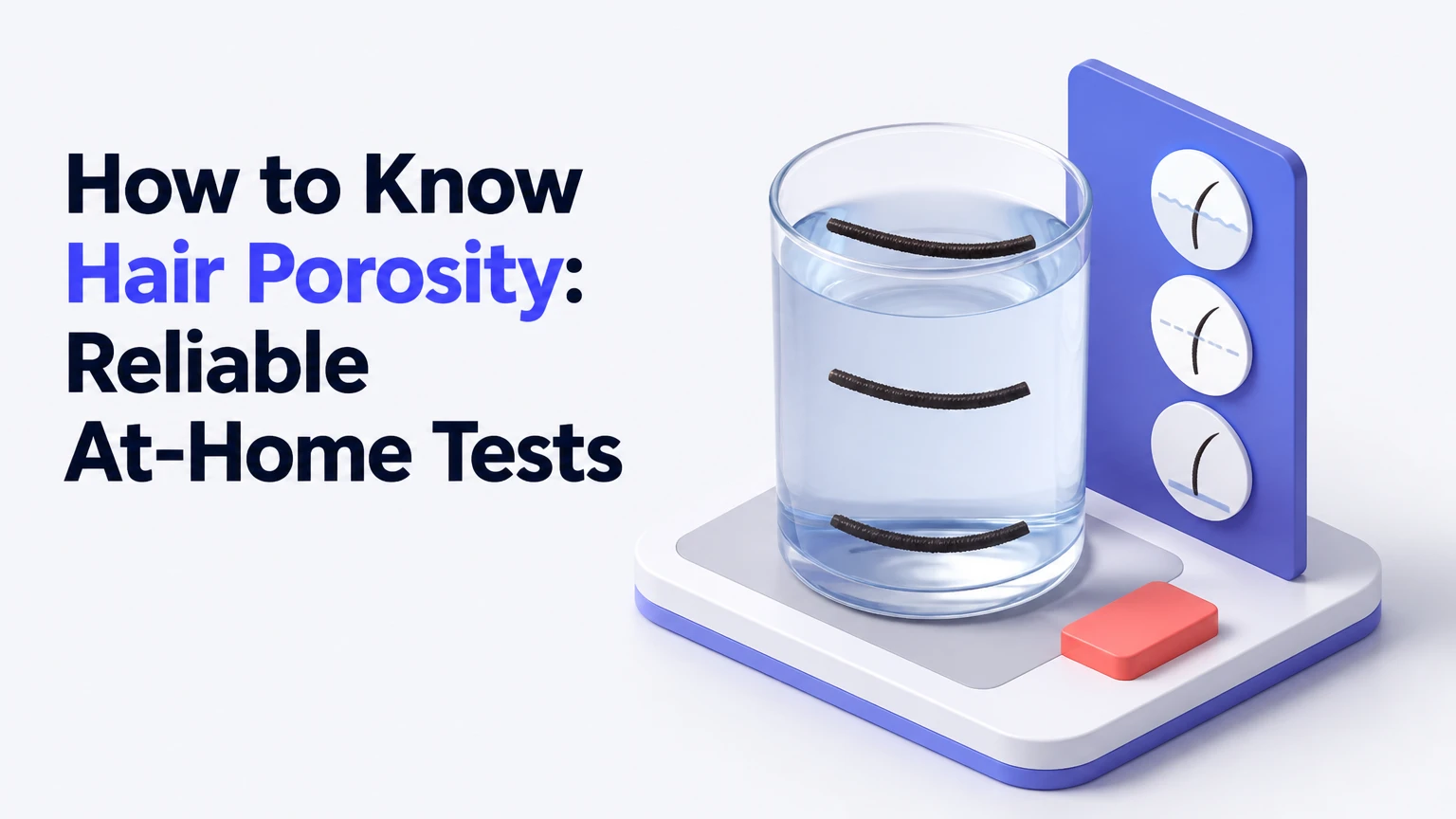
Hair porosity describes how readily a hair fiber takes in water and how well it retains moisture afterward. To know hair porosity, test clean, product-free hair with a controlled water-spray observation, then compare the result with drying time and product behavior across two or three wash cycles.
Key Facts at a Glance
- Hair porosity mainly reflects the condition and arrangement of the cuticle, the hair shaft’s outer layer.
- A water-spray test is more useful at home than the popular float test, but neither provides a laboratory diagnosis.
- Hair can have mixed porosity because roots, canopy hair, mid-lengths, and chemically treated ends experience different exposure.
- Hair texture, curl pattern, strand diameter, and density are separate characteristics from porosity.
- Bleaching, relaxing, permanent coloring, repeated heat, friction, and ultraviolet exposure can increase porosity over time.
- A practical porosity assessment requires clean hair, consistent water temperature, several strands or sections, and repeated observations.
What Hair Porosity Means
Hair porosity is the hair fiber’s tendency to absorb and release water, conditioners, and other aqueous ingredients. The property is governed primarily by the cuticle’s physical condition, including how closely its overlapping cells lie against the cortex and whether damage has created lifted or missing areas.
Porosity is not the same as dryness. Dryness describes a hair condition or sensation, while porosity describes a structural behavior that can contribute to moisture loss. Highly porous hair may feel dry because it loses water quickly, but low-porosity hair can also feel dry when water and conditioner remain on the surface instead of distributing through the fiber.
Porosity is also different from hair type. Straight, wavy, curly, and coily hair can occur at any porosity level. Hair density describes how many fibers grow in a scalp area, while diameter describes whether individual fibers are fine, medium, or coarse. Those traits affect drying and product weight, which is why they can confuse a home test.
How Hair Porosity Works
The hair shaft contains the medulla, cortex, and cuticle. The cortex provides most of the fiber’s mechanical strength and contains melanin, while the cuticle consists of overlapping cells that protect the cortex from water, chemicals, friction, and heat.
Water does not enter every hair fiber in the same way or at the same speed. Cuticle condition, fiber diameter, surface coatings, humidity, temperature, and chemical history all influence the observation. Hair science references, including Clarence Robbins’ Chemical and Physical Behavior of Human Hair, describe the cuticle as a protective barrier whose damage changes fiber interaction with water and cosmetic ingredients.
Natural curvature may create different stress points along a strand, particularly where tightly curved fibers bend. However, curl pattern alone cannot prove high porosity. Acquired damage is often more important: bleaching removes or alters pigment and can weaken the cuticle, while repeated heat, alkaline services, brushing, and ultraviolet exposure can increase surface irregularity.
Natural and Acquired Porosity
Natural porosity varies among people and among fibers on the same head. Hair history usually explains large differences between the roots and ends more reliably than a person’s curl category.
| Factor | Typical effect on the fiber | What you may observe | Practical implication |
|---|---|---|---|
| Virgin, lightly handled hair | More intact cuticle surface | Water spreads gradually | Moderate conditioning may be sufficient |
| Bleached lengths | Increased cuticle and cortex damage | Fast wetting and rapid moisture loss | Use conditioning films and reduce chemical exposure |
| Relaxed or permed hair | Altered internal and surface structure | Uneven absorption along treated sections | Treat processed lengths separately |
| Frequent flat-iron use | Heat-related surface damage | Rough ends and faster drying | Lower heat and use thermal protection |
| Sun and environmental exposure | Progressive surface weathering | Dry canopy and fragile ends | Compare protected roots with exposed hair |
| Repeated friction | Localized cuticle wear | Knots, roughness, split ends | Reduce tight styles, friction, and aggressive detangling |
What Are the Three Porosity Patterns?
Low porosity usually means water and conditioner spread slowly across the fiber, whereas high porosity usually means the fiber wets rapidly and loses moisture quickly. Medium porosity describes an intermediate response, but these are practical categories rather than standardized medical grades or universal numerical scores.
| Pattern | Water response | Retention pattern | Common product response | Frequent confounder |
|---|---|---|---|---|
| Low porosity | Droplets remain visible for several seconds | Moisture may remain once distributed | Heavy products sit on the surface | Silicone, oil, or hard-water film |
| Medium porosity | Water spreads at a moderate rate | Moisture balance is relatively stable | Many formulas feel manageable | Fine diameter can dry quickly |
| High porosity | Water spreads or disappears quickly | Moisture leaves the fiber rapidly | Hair absorbs product but soon feels rough | Bleached or weathered ends |
| Mixed porosity | Different sections react differently | Ends lose moisture before roots | One routine feels inconsistent | Canopy exposure or color placement |
Low porosity does not mean that a strand is impermeable. It means the fiber generally wets and accepts water more slowly under the same conditions. High porosity does not mean that every product penetrates beneficially; rapid wetting can coexist with weak retention because damaged surfaces allow water to escape.
A useful interpretation combines three observations: how quickly clean hair wets, how long it takes to dry, and whether conditioning remains effective between washes. One observation alone is too vulnerable to false results.
How to Test Hair Porosity at Home
The most useful home method takes about 10 minutes, costs nothing if you already own shampoo and a spray bottle, and requires clean hair without conditioner, oil, gel, or leave-in product. Test at least three sections, because a single shed strand cannot represent an entire head.
Before You Start
| Requirement | Recommended specification | Why it matters |
|---|---|---|
| Hair preparation | Wash once with a regular shampoo; clarify only when buildup is suspected | Excess residue can repel water |
| Product state | No conditioner, oil, leave-in, gel, or styling cream | Coatings change surface wetting |
| Water | Room-temperature or lukewarm tap water | Extreme temperature changes the observation |
| Tools | Clean spray bottle, towel, timer, comb | Consistent application improves comparison |
| Test locations | Crown, canopy, and ends | Exposure and processing differ by location |
| Cost and time | $0-$10; 10-15 minutes | Home screening needs no specialist equipment |
Clarifying shampoo is not mandatory for every person. It can remove heavy styling residue, but frequent clarification may increase roughness and does not make the result scientifically definitive. Wash normally first, and clarify only if hair feels coated, waxy, or unusually resistant to water.
Step 1: Wash and Isolate Clean Sections
Wash the hair thoroughly, rinse until the water runs clear, and skip conditioner for the test session. Allow the hair to dry completely, then separate a small section from the crown, canopy, and ends.
If the hair is curly or coily, avoid stretching it aggressively because tension changes how water contacts the fiber. If the hair is color-treated, test untreated roots and processed ends separately rather than averaging them.
You’ll know this step worked when: the dry hair has no oily film, styling slip, or fresh product scent.
Common mistake: testing immediately after a rich mask or oil treatment. Residue can make porous hair behave like low-porosity hair.
Step 2: Apply the Water-Spray Test
Hold the spray bottle about 15-20 centimeters from dry hair and apply a light, consistent mist to one section. Do not soak the hair. Start a timer and observe whether droplets remain on the surface, spread gradually, or disappear into the fiber.
Repeat the same number of sprays on each section. A typical controlled trial uses 3-5 fine mists per section, although bottle output varies. The goal is equal treatment, not a precise laboratory volume.
You’ll know this step worked when: each section receives the same distance, number of sprays, and observation time.
Common mistake: using a forceful stream that floods the hair. Excess water hides the difference between gradual wetting and immediate saturation.
Step 3: Record the Wetting Pattern
Record what happens during the first 10 seconds, not only the final appearance. Low-porosity hair commonly holds beads or shows delayed spreading; medium-porosity hair allows water to spread progressively; high-porosity hair often wets rapidly.
| Observation after a light mist | Likely interpretation | Confidence | Next check |
|---|---|---|---|
| Droplets remain intact for 5-10 seconds | Possible low porosity or surface coating | Moderate | Repeat after a clean wash |
| Droplets spread within 2-5 seconds | Possible medium porosity | Moderate | Compare drying and retention |
| Water disappears almost immediately | Possible high porosity or very fine hair | Moderate | Inspect processed ends separately |
| One area beads while another wets fast | Mixed porosity | High | Create separate routines by section |
| Water beads only on oily ends | Product or sebum residue | Low | Wash and retest |
| Hair wets quickly but retains softness | Not automatically high porosity | Low to moderate | Assess moisture retention over 24 hours |
The spray test is a screening tool, not a score. Fine hair can wet quickly because the fiber has a small diameter, while dense hair may appear slow to wet because water has difficulty reaching the inner layers of the style.
Step 4: Compare Drying and Product Response
Observe the tested hair through its next complete wash cycle. Note whether the section dries much faster than usual, feels rough after drying, or remains coated after a small amount of conditioner.
Typical air-drying times vary widely. A fine, short, low-density head may dry in 30-90 minutes, while dense, long hair can take 4-8 hours regardless of porosity. Drying time becomes useful only when you compare the same person, similar wash conditions, and similar amounts of water.
You’ll know the result is more credible when: the water response, drying behavior, and conditioner response point in the same direction across two or three washes.
Common mistake: labeling hair high porosity solely because it dries in 20 minutes. Short length, fine strands, low density, warm airflow, and low humidity can explain rapid drying.
Which Hair Porosity Test Is Most Reliable?
For home use, repeated water-spray observation is generally more informative than the float test because it evaluates hair in its normal surface environment. No home test can provide a universally validated porosity percentage, and a professional microscope can inspect damage without necessarily converting that inspection into a standardized score.
| Method | Typical time | Typical cost | Main useful signal | Main limitation |
|---|---|---|---|---|
| Water-spray test | 2-5 minutes | $0-$5 | Surface wetting speed | Sensitive to residue and fiber diameter |
| Float test | 5-10 minutes | $0-$2 | Rough buoyancy observation | Surface tension, oils, air, and strand shape distort results |
| Finger-slip test | 1 minute | $0 | Surface roughness | Texture and coarseness can mimic damage |
| Wash-cycle observation | 2-3 washes | $0 | Retention and product behavior | Requires more time and consistent conditions |
| Salon inspection | 20-60 minutes | Typically $20-$100 | Visual assessment and history | No universal grading standard |
| Mail-in analysis | 1-3 weeks | Typically $25-$100 or more | Sample-based cosmetic assessment | Results depend on method and interpretation |
The float test is popular because it is simple, but its low accuracy is a practical limitation rather than a precise published percentage. A shed strand can float because surface tension supports it, because oil coats it, or because air clings to its surface. Strand thickness and water chemistry also affect buoyancy.
The finger-slip test can identify a rough or irregular surface, especially on damaged ends. It cannot distinguish porosity from naturally coarse hair, tangling, scale direction, or mechanical wear with enough reliability to stand alone.
Professional assessment is worthwhile when a stylist needs to evaluate bleach damage, breakage, or uneven chemical processing. It is not necessary for most routine decisions, and “100% accurate porosity analysis” claims should be treated cautiously because porosity lacks one universally accepted consumer scoring system.
Can Different Sections Have Different Porosity?
Hair can have mixed porosity, and mixed porosity is common when the ends are older, the canopy receives more ultraviolet exposure, or only selected sections have been bleached. Treating the whole head as one porosity category can explain why roots become greasy while ends remain dry.
| Hair section | Typical exposure | Likely porosity risk | Testing advice |
|---|---|---|---|
| Roots near the scalp | Sebum and limited chemical exposure | Lower or moderate | Test after normal shampooing |
| Crown and canopy | Sun, wind, friction, heat | Moderate or higher | Mist separately from underside |
| Mid-lengths | Handling and styling | Variable | Compare with both roots and ends |
| Last 5-10 centimeters | Age, brushing, splitting, color | Higher | Test and condition separately |
| Highlighted panels | Bleach and toner | Higher | Do not average with virgin hair |
| Nape and underside | Less sun, more friction | Variable | Check for tangling-related roughness |
Use separate product amounts for separate zones. A lightweight conditioner may suit the roots, while a richer leave-in or film-forming cream may help the ends. Mixed porosity does not require buying multiple complete product lines; it often requires changing quantity and placement.
Why Porosity Results Can Be Misleading
Porosity results become misleading when a test measures a coating, fiber diameter, or environmental condition instead of cuticle behavior. Silicone, oil, mineral deposits, and heavy polymers can cause water to bead, while fine hair and low humidity can make hair seem more porous than its cuticle condition suggests.
Hard water is a frequent confounder. Calcium and magnesium deposits can leave hair dull, stiff, or resistant to wetting, which resembles low porosity. A chelating treatment used occasionally according to its label can remove mineral residue, but it should not replace diagnosis of scalp or fiber problems.
Porosity also changes along a strand. A bleached end may absorb water rapidly while a virgin root wets slowly. That difference is real, but it does not mean the entire head has one stable category.
Expert Rules That Prevent Misclassification
- Trust repeated patterns over viral tests. If the spray test says low porosity but conditioner disappears quickly and the ends remain rough, test for buildup and mixed porosity before changing every product.
- Do not use cold water as a diagnostic control. Water temperature changes comfort and swelling, but a cold rinse cannot close a cuticle in a way that creates a reliable porosity measurement.
- Treat hair history as evidence. Recent bleach, relaxer, perm, or frequent high-heat styling raises the probability of acquired damage more than curl pattern does.
- Use less product before using heavier product. Hair that feels dry may be coated, under-cleansed, protein-sensitive, mechanically damaged, or genuinely porous. More butter is not a universal solution.
- The ends usually need a different answer than the roots. A single porosity label often hides the most actionable information.
How Should You Adjust Your Routine?
Low-porosity hair usually benefits from thorough cleansing, small product quantities, water-based conditioners, and enough warmth to distribute conditioner without excessive heat. High-porosity hair usually benefits from consistent conditioning, film-forming ingredients, careful detangling, and reduced chemical and thermal damage.
| Porosity pattern | Cleansing approach | Conditioning approach | Useful ingredient examples | Main risk |
|---|---|---|---|---|
| Low | Regular shampoo; occasional buildup removal | Lightweight conditioner on wet hair; modest warmth | Aloe, glycerin, behenyl alcohol, light silicones | Surface buildup and limpness |
| Medium | Standard schedule based on scalp oil | Balanced rinse-out conditioner | Fatty alcohols, cationic conditioners, occasional hydrolyzed protein | Overprocessing |
| High | Gentle cleansing with periodic buildup control | Leave-in plus a film-forming cream or gel | Hydrolyzed wheat protein, polyquaterniums, silicones, plant oils | Fast moisture loss and breakage |
| Mixed | Adjust frequency by scalp and product load | Light at roots, richer at damaged ends | Zone-specific formulas | Applying one heavy routine everywhere |
Low-Porosity Routine
Apply conditioner to thoroughly wet hair and distribute it in small sections. Five to ten minutes under a shower cap or with gentle shower warmth may improve spreadability, but high heat is unnecessary and can worsen damage.
Avoid treating coconut oil, shea butter, or protein as universally harmful. Their effect depends on formula, dose, fiber diameter, and individual response. If hair becomes coated, dull, stiff, or difficult to wet, reduce heavy layers and cleanse appropriately rather than assuming the hair needs more oil.
Medium-Porosity Routine
Medium-porosity hair often needs fewer corrective steps. Use a regular shampoo and conditioner schedule, add a richer mask when the hair feels rough, and reserve protein treatments for a clear need such as chemical weakness or excessive stretch when wet.
Avoid changing several variables at once. A one-product trial for two wash cycles reveals more than adding oil, protein, cream, and a new cleanser simultaneously.
High-Porosity Routine
High-porosity hair usually needs moisture followed by a protective film. Apply leave-in conditioner to wet hair, then use a cream, gel, or another compatible film-forming product; the exact LOC or LCO order matters less than complete coverage, manageable weight, and reduced water loss.
Hydrolyzed proteins can temporarily improve feel by depositing along damaged areas, but they do not permanently rebuild a destroyed cuticle. Rich oils and butters can reduce friction and improve softness, yet they cannot reverse bleaching or split ends. Trim severely split ends and reduce the process that caused the damage.
How Long and How Much Does Testing Take?
A home porosity screening takes 10-15 minutes on wash day and requires no special equipment. A reliable personal conclusion usually takes two or three wash cycles, because one spray test can be distorted by product residue, humidity, water hardness, or inconsistent application.
| Testing option | Time commitment | Typical price | Best use | Decision value |
|---|---|---|---|---|
| One spray test | 10 minutes | $0-$5 | First screening | Low to moderate |
| Three-section test | 15 minutes | $0-$5 | Detecting mixed porosity | Moderate to high |
| Two-wash observation | 3-7 days | $0-$10 | Confirming retention | High |
| Stylist consultation | 20-60 minutes | $20-$100 | Reviewing damage history | Moderate to high |
| Laboratory-style mail-in test | 1-3 weeks | $25-$100+ | Additional cosmetic assessment | Variable |
The highest-value approach is usually the three-section test followed by routine observation. Spending money on a “perfect porosity score” is unnecessary unless a professional can explain the test method, limitations, and practical recommendations.
Common Mistakes and How to Fix Them
| Failure mode | Why it happens | Recovery action | Retest timing |
|---|---|---|---|
| Hair floats | Oil, silicone, surface tension, or trapped air | Wash thoroughly and use spray testing | Next wash |
| Hair sinks quickly | Very fine strand, wetting, or a small strand | Test several sections and observe retention | Same week |
| Hair feels rough | Coarse texture, tangles, or cuticle wear | Compare smoothness with wetting behavior | After detangling |
| Hair stays dry after conditioner | Product sits on the surface or damage loses water | Apply to wetter hair, reduce buildup, assess ends | 2 wash cycles |
| Hair dries too fast | Short length, low density, warm air, or fine fibers | Compare with same conditions and check retention | 1 week |
| Roots and ends disagree | Mixed porosity from age or chemical processing | Use zone-specific product amounts | Ongoing |
Do not diagnose a scalp disorder from porosity. Persistent shedding, sudden breakage, scalp pain, itching, scaling, bald patches, or a major texture change warrants assessment by a dermatologist or qualified medical professional.
What Is the Most Practical Decision Rule?
Classify hair as low, medium, or high porosity only when at least two independent observations agree. Water behavior gives the first signal, while drying and conditioner retention provide confirmation; conflicting results usually indicate residue, mixed porosity, fine strands, or damage rather than a failed test.
Use this decision sequence:
- Wash without conditioner, oil, or styling product.
- Mist three sections with the same number of sprays.
- Record whether water beads, spreads, or disappears.
- Observe drying under comparable conditions.
- Check whether hair retains softness for 24-48 hours.
- Repeat once or twice before changing the routine.
- Separate roots, canopy, and ends if their responses differ.
A likely low-porosity pattern is delayed wetting plus surface buildup and relatively strong retention after thorough conditioning. A likely high-porosity pattern is rapid wetting plus rapid moisture loss, roughness, or chemically damaged ends. Medium porosity is the intermediate pattern, not a promise that every product will work.
FAQ
Does Curly or Coily Hair Automatically Have High Porosity?
No. Curly and coily hair can be low, medium, high, or mixed porosity. Curvature may increase mechanical stress at bends, but chemical processing, heat, friction, strand diameter, and age often have a larger effect on porosity. Test the actual hair fiber rather than assigning a category from curl pattern alone.
Can Bleaching Change Hair Porosity?
Yes. Bleaching can increase porosity by altering the cuticle and cortex, especially in repeatedly lightened lengths. New growth may remain lower porosity while older highlighted ends become highly porous. Test virgin roots and processed ends separately, and reduce further chemical exposure when breakage or rapid moisture loss appears.
Should I Use the Hair Float Test?
The float test can provide a rough observation, but it should not determine your routine. Surface tension, oil, silicone, trapped air, strand thickness, and water chemistry can change whether a shed strand floats or sinks. A controlled spray test followed by repeated wash-cycle observations is more useful for most people.
Why Does My Hair Feel Dry if It Is Low Porosity?
Low-porosity hair can feel dry when water and conditioner remain on the surface, when buildup prevents wetting, or when the formula is too heavy for the fiber. Apply conditioner to saturated hair, use modest quantities, remove residue when needed, and evaluate softness after drying rather than judging only the first wet sensation.
Is Professional Hair Porosity Testing Necessary?
Professional testing is usually unnecessary for choosing a basic routine. A stylist can provide useful visual assessment when hair has bleach damage, uneven processing, severe breakage, or mixed behavior that home observations cannot explain. No provider can legitimately promise a universally standardized 100% accurate porosity percentage because consumer porosity grading lacks one accepted scale.
How Often Should Hair Porosity Be Tested?
Retest after major changes such as bleaching, relaxing, perming, a new color service, or prolonged heat styling. Otherwise, reassess when water behavior, drying, buildup, or moisture retention changes. Porosity is not a daily measurement, and repeated viral tests can encourage unnecessary product switching.
The Bottom Line
To know hair porosity, wash away product residue, mist clean hair consistently, and compare water absorption with drying time and moisture retention across two or three wash cycles. Use separate observations for roots, canopy, and ends because mixed porosity is common. The most useful result is a practical routine decision, not a precise numerical label: lighter and more controlled for low porosity, balanced for medium porosity, and more protective for high-porosity or damaged sections.