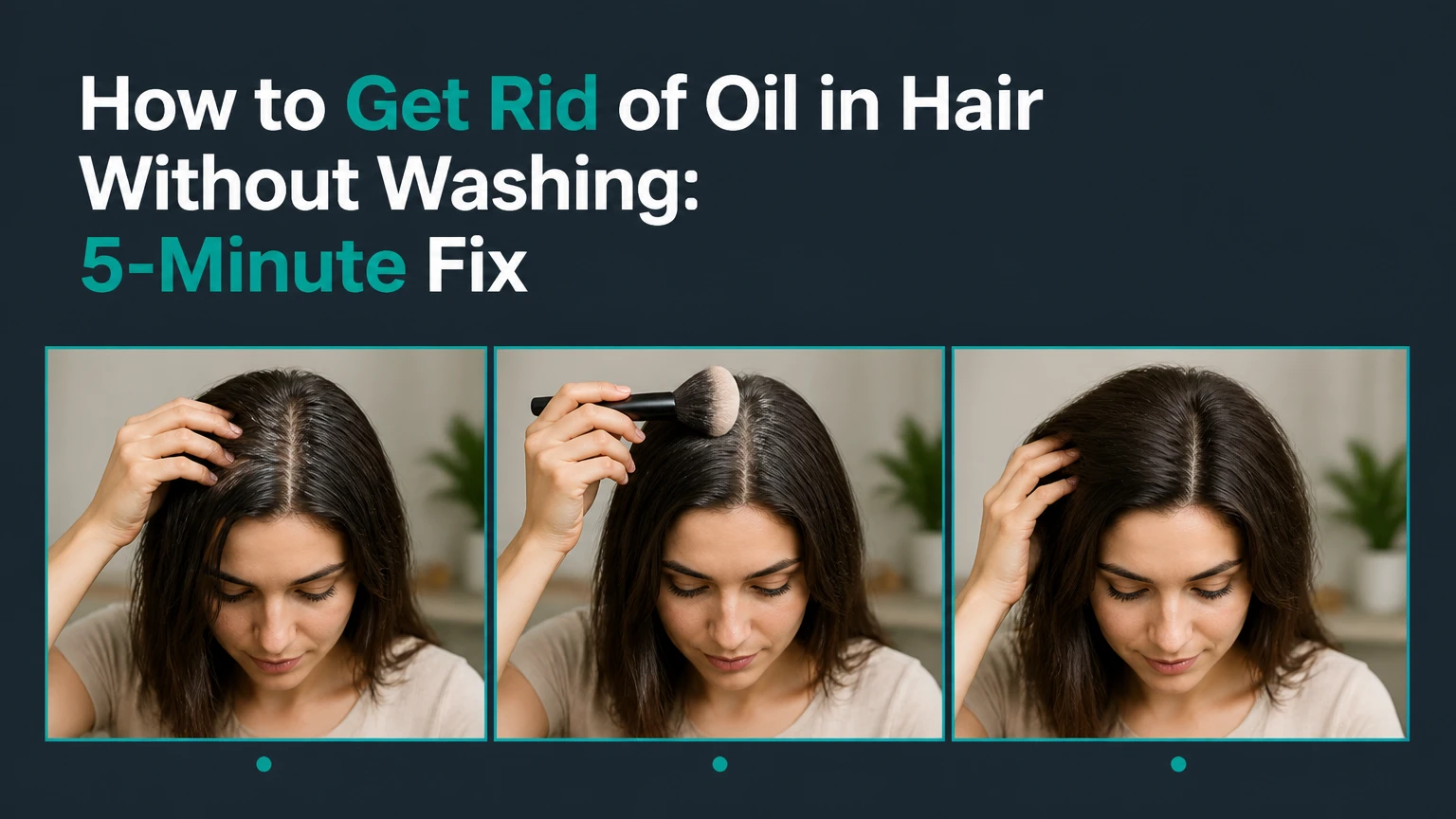
Dry shampoo, cornstarch, or blotting paper can reduce visible oil in hair without a full water wash. Apply an absorbent only to oily roots, wait 1-3 minutes, then massage and brush it out. These methods remove the appearance and feel of surface sebum temporarily, but they do not cleanse the scalp like shampoo and water.
Key Facts / At a Glance
- Dry shampoo absorbs or binds surface sebum; it does not remove all sweat, dead skin, microbes, or styling residue.
- A typical root refresh takes 3-5 minutes and uses approximately 2-6 short aerosol bursts or 1/8-1/4 teaspoon of loose powder.
- Waiting at least 1 minute before massaging gives the absorbent time to contact oily roots.
- Dry shampoo belongs on the scalp and roots, not repeatedly along dry mid-lengths and ends.
- Cornstarch or rice starch is a safer DIY absorbent than baking soda, lemon juice, or undiluted vinegar.
- Persistent greasy scale, itching, redness, odor, or sudden oiliness needs a water cleanse and possibly dermatological evaluation.
What Waterless Oil Removal Can and Cannot Do
Waterless oil removal makes hair look less greasy by sequestering surface sebum, rather than washing sebum away. Starches, clays, and silica powders have porous or high-surface-area particles that capture oil through absorption and physical adhesion; brushing then removes some of the oil-loaded particles.
The method works best when the problem is a light oily film at the part, hairline, or crown. It works poorly after heavy hair oiling, swimming, intense exercise, or several days of accumulated sweat and styling products. Those conditions require surfactants and water for meaningful removal.
Dry shampoo is therefore a cosmetic spacing tool, not a substitute for cleansing. The American Academy of Dermatology Association advises choosing washing frequency according to how oily or dirty the scalp becomes, rather than following a universal weekly schedule. The often-repeated claim that follicles lose oxygen and cause thinning when hair is not washed for one week is not an established rule.
Why does dry shampoo work?
Dry shampoo works because absorbent particles contact liquid sebum and reduce its spread across neighboring strands. Aerosol formulas commonly combine starches, clays, silica, or modified powders with propellant, while powder formulas deliver the absorbent without aerosol pressure.
Alcohol can create a quick-drying sensation and dissolve some surface oils, but alcohol does not replace surfactant cleansing. Frequent alcohol exposure may sting a sensitive scalp or increase dryness, especially when the formula also contains fragrance.
A useful practitioner distinction is simple: oil control is not scalp cleaning. A visibly matte root can still contain sweat, dead skin, bacteria, and product residue.
Before You Start
The five-minute method needs a dry towel, a comb or brush, and one absorbent product. Use a mirror and bright light so the application stays at the roots instead of coating the lengths.
| Item | Typical amount | Typical time | Typical cost |
|---|---|---|---|
| Aerosol dry shampoo | 2-6 bursts | 3-5 minutes | $8-$18 per can |
| Loose starch powder | 1/8-1/4 teaspoon | 4-7 minutes | $2-$8 per container |
| Blotting papers | 2-6 sheets | 1-3 minutes | $4-$12 per pack |
| Clean dry towel | 1 small towel | 1-2 minutes | Existing household item |
Do not apply powder over a wet, sweaty, or broken scalp. Let perspiration evaporate first, and postpone the method if the scalp has scratches, sunburn, active rash, or a known reaction to fragrance.
How to Get Rid of Oil in Hair Without Washing
A successful oil-free-looking finish usually takes five steps and less than 10 minutes. The factor that matters most is controlled application at the oily roots, because excess product creates dullness, clumps, and scalp residue.
Step 1: Blot and Section the Oily Roots
Press a clean, dry towel or oil-blotting paper against the part line, hairline, crown, and visibly shiny roots. Do not rub, because friction spreads sebum down the hair shaft and roughens the cuticle.
Create sections approximately 1-2 inches apart with a comb. Concentrate on the scalp zones that look shiny rather than treating the entire head.
You will know this step worked when the roots look less wet or reflective, but still lie naturally. A towel removes a small amount of surface oil without leaving powder behind.
The common mistake is dragging the towel from roots to ends. That transfers oil through otherwise clean hair and can flatten fine strands.
Step 2: Apply a Small Amount of Absorbent
Shake aerosol dry shampoo for 10-15 seconds, hold it 6-12 inches from the scalp, and use 1-second bursts along each section. For loose powder, tap approximately 1/8 teaspoon into your palm or a small makeup brush, then press it onto the roots.
| Hair situation | Starting amount | Placement | Adjustment |
|---|---|---|---|
| Fine, short hair | 2-3 aerosol bursts | Part and crown | Add 1 burst only after checking |
| Medium, straight hair | 3-5 aerosol bursts | Part, crown, temples | Use two passes instead of one heavy pass |
| Thick or long hair | 5-8 aerosol bursts | Four to six sections | Work in layers near the scalp |
| Dark hair using powder | 1/8 teaspoon per side | Part and hairline | Choose tinted powder or blend thoroughly |
Spray onto the roots, not directly into the face, and keep aerosol products away from flames, cigarettes, and heat tools. Apply in a ventilated room. The common mistake is coating the hair until it looks gray; adding more product rarely improves a saturated root.
Step 3: Let the Absorbent Work
Leave the product undisturbed for 1-3 minutes before massaging. The waiting period lets powder particles contact and bind surface oil instead of being immediately displaced by fingers or a brush.
Massage the roots gently with clean fingertips for 10-20 seconds. A cool hairdryer can help distribute visible powder, but high heat may increase dryness and can set styling products unevenly.
You will know the step worked when the roots feel less tacky and separate into individual strands. If the hair still looks wet, use a second light application after brushing rather than one large dose.
The common mistake is immediate brushing. Brushing too soon moves unabsorbed powder away from the most oily areas.
Step 4: Distribute the Product Without a White Cast
Tilt the head forward and shake the roots lightly, or use a clean brush to move from the scalp outward. Dark hair may need a tinted aerosol, a brown-toned powder, or a very small amount of cocoa mixed into starch.
A cautious DIY color mixture uses four parts cornstarch to one part unsweetened cocoa powder. Test the blend on a hidden section first, because cocoa can transfer to pillowcases and may irritate some scalps.
You will know the product is distributed when no concentrated pale patch remains at the part. The common mistake is adding cocoa directly to commercial dry shampoo, which can alter its texture and increase staining.
Step 5: Style the Hair and Inspect the Scalp
Brush or finger-style the hair only after the absorbent has been massaged through. Keep dry shampoo away from the ends unless the ends are oily from a specific product, because powder can make already dry strands feel rough.
Tie-back styles, loose braids, low buns, and a changed part often hide residual unevenness better than a sleek center part. Inspect the temples and behind the ears, where overspray commonly collects.
You will know the refresh is complete when the roots look matte, movement returns, and no powder transfers heavily to your fingers. The common mistake is using heat immediately after aerosol application; allow the formula to settle and follow the label’s flammability instructions.
Which Product Type Fits Your Hair?
Aerosol dry shampoo is the fastest choice for widespread light oil, while loose powder offers better control over a concentrated oily part. Foam and liquid formulas can reduce powdery residue on curls, but they are usually less effective against heavy sebum because many contain water and conditioning ingredients.
| Product type | Best use | Typical control | Main limitation |
|---|---|---|---|
| Aerosol spray | Fine to medium roots | Low to medium | Overspray and inhalation exposure |
| Loose powder | Thick hair or one oily part | High | White cast and clumping |
| Foam or liquid mist | Curls and textured hair | Medium | Lower absorption of heavy oil |
| Paste or balm | Hairline spot treatment | Very high | Uneven distribution through dense hair |
Fine or straight hair
Fine hair usually needs the smallest amount because sebum spreads quickly across a narrow shaft. Choose a lightweight aerosol, apply at the crown and part, and brush after the one-minute contact period.
Volume can increase because particles create friction between strands. Too much product reverses that benefit by making the roots stiff and dull.
Thick, coarse, or long hair
Thick hair benefits from multiple small applications rather than one broad spray. Divide the hair into four to six sections, apply near the scalp, and massage each section before moving on.
Loose powder can outperform aerosol for a heavy root because the applicator places more absorbent material exactly where needed. Powder may still fail after oil has soaked several centimeters down the shaft.
Curly, coily, or textured hair
Curly and coily hair often loses definition when brushed, so use fingertips or a cool diffuser instead of a conventional brush. Apply product to the scalp through separated sections and avoid disturbing the curl pattern.
Foam or liquid dry shampoo may leave less visible residue, but check whether the formula contains humectants, oils, or conditioners that could add weight. Refreshing the scalp is different from restoring curl definition.
Which DIY Absorbents Are Reasonable?
Cornstarch and rice starch are the most practical household absorbents for a small oily section, provided the powder is applied sparingly and kept out of the nose and eyes. A clean makeup brush gives more control than shaking powder directly onto the scalp.
Baby powder requires extra caution. Cornstarch-based products avoid talc exposure, but any loose powder can irritate the airways when inhaled. The U.S. Food and Drug Administration has investigated asbestos contamination in some talc products, so talc-based powder is a poor choice for improvised scalp use.
| DIY option | Oil absorption | Residue risk | Practical verdict |
|---|---|---|---|
| Cornstarch | Moderate | Medium | Use 1/8 teaspoon on a small area |
| Rice flour | Moderate | High if coarse | Sift before limited use |
| Cocoa-cornstarch blend | Moderate | Medium to high | Use 4:1 starch-to-cocoa ratio |
| Talc-based powder | Moderate | Medium | Avoid for routine use |
Do not share powder applicators, and discard a mixture that develops odor, moisture, or visible contamination. DIY powders extend a hairstyle for a short interval; they do not remove sweat or microbes.
Which DIY Ingredients Should You Avoid?
Baking soda, lemon juice, and apple cider vinegar are poor choices for dry oil removal. Baking soda is alkaline and abrasive, lemon juice is acidic and potentially photoreactive, and vinegar requires water for dilution and rinsing, so none provides a reliable waterless cleansing process.
Micellar water is also not truly waterless. Micelles suspend oil and dirt in a water-based solution, but dabbing the scalp with a wet cotton pad can leave surfactant, fragrance, or oil residue behind when the area is not rinsed.
| Ingredient | Claimed action | Main problem | Safer alternative |
|---|---|---|---|
| Baking soda | Absorbs odor and oil | Alkaline irritation and roughness | Cornstarch powder |
| Lemon juice | Breaks down buildup | Stinging and sun sensitivity | Proper shampoo wash |
| Apple cider vinegar | Changes scalp pH | Must be diluted and rinsed | Water-based scalp cleanser |
| Micellar water | Lifts surface oil | Water-based residue without rinsing | Blotting paper for emergencies |
A diluted acid rinse may have a place in a fully rinsed hair routine, but it cannot replace shampoo for oily buildup. Stop immediately if any ingredient causes burning, redness, or scaling.
What If the Hair Is Heavily Oiled?
Heavy oiling cannot be reliably removed with dry shampoo alone. If coconut, olive, castor, argan, or mineral oil has been applied deliberately, blotting and powder may reduce shine but will leave a substantial film on the hair.
Use a towel to remove excess oil first, then place the hair in a braid or bun if a water wash is unavailable. Avoid adding more dry shampoo to saturated hair, because the combined oil and powder can form a paste that is harder to remove later.
At the next wash, apply shampoo directly to the oily scalp before fully soaking the hair if the product label and hair type permit it, then rinse and repeat as needed. A clarifying shampoo may help occasional buildup, but frequent use can dry chemically treated or textured hair.
Common Mistakes and How to Fix Them
| Failure mode | Likely cause | Immediate fix | Prevention |
|---|---|---|---|
| Gray or white roots | Excess powder or close spraying | Massage, then use cool airflow | Hold aerosol 6-12 inches away |
| Greasy roots remain | Too little contact time | Wait 2 minutes, then add a light pass | Blot before applying |
| Hair feels gritty | Powder on lengths or overapplication | Brush thoroughly and stop adding product | Keep application at roots |
| Itchy scalp | Fragrance, alcohol, or buildup | Remove product at the next wash | Choose fragrance-free, low-alcohol formula |
| Clumped roots | Oil and powder formed paste | Loosen with fingers and wash soon | Do not powder heavily oiled hair |
| Flat, stiff style | Excess product on fine hair | Change the part and brush lightly | Start with half the recommended amount |
A counterintuitive rule matters here: visible whiteness often indicates too much product, not too little blending. Adding more powder makes the residue denser and can turn a cosmetic correction into a cleanup problem.
Another practitioner rule is to apply dry shampoo before the scalp becomes extremely greasy. Light sebum is easier to sequester than a thick oil-and-sweat film, so preventive evening application may work better for people who wake with oily roots.
How Often Can You Repeat the Method?
Most people should treat waterless oil removal as an occasional bridge, not a daily cleansing system. A reasonable practical limit is one or two consecutive refreshes before a normal scalp wash, although the correct interval depends on oil production, exercise, styling products, and scalp condition.
| Situation | Waterless refresh limit | Water-wash signal |
|---|---|---|
| Light oil, no scalp symptoms | 1-2 days | Shine returns across the scalp |
| Daily exercise or heavy sweating | Same day only | Sweat, odor, or salt residue |
| Sensitive or acne-prone scalp | Occasional use | Itching, bumps, or burning |
| Seborrheic dermatitis tendency | Short emergency use | Flaking, redness, or greasy scale |
Dry shampoo is not inherently unsafe, but repeated residue can irritate the scalp or worsen follicle blockage in susceptible users. The American Academy of Dermatology Association recommends washing when the scalp becomes oily or dirty, while people with textured or dry hair may need less frequent washing of the lengths.
When Should You Wash or See a Dermatologist?
Wash with water when the scalp feels coated, itchy, sweaty, odorous, or visibly flaky, or when two light applications of dry shampoo no longer improve the roots. Shampoo and water are necessary for removing accumulated sebum, sweat, dead skin, environmental particles, and styling residue.
Arrange a dermatology evaluation for persistent redness, painful bumps, thick greasy scale, intense itching, or sudden changes in oil production. Seborrheic dermatitis, psoriasis, folliculitis, contact dermatitis, and hormonal changes can all resemble ordinary greasy hair.
Hair loss should not be attributed automatically to skipping a weekly wash. Excess shedding, widening part lines, bald patches, or scalp pain deserve evaluation independent of how often the hair is washed.
Time and Cost Guide
A towel-and-blotting-paper refresh costs almost nothing when supplies are already available, while a commercial dry shampoo typically costs $8-$18 and lasts approximately 15-40 applications depending on can size and spray duration.
| Method | Typical completion time | Typical one-use cost | Best scenario |
|---|---|---|---|
| Towel blotting | 1-2 minutes | Under $0.10 | Mild shine at the hairline |
| Blotting papers | 1-3 minutes | $0.10-$0.40 | Part-line oil without style disruption |
| Aerosol dry shampoo | 3-5 minutes | $0.25-$1.20 | Fast, broad root refresh |
| Loose starch powder | 4-7 minutes | $0.05-$0.30 | Dark-root spot treatment with control |
These are typical retail and household ranges, not fixed prices. A full wash usually takes longer but produces a cleaner result because surfactants emulsify oil and water carries the mixture away.
FAQ
Can I remove hair oil without shampoo after an overnight oil treatment?
Not completely. Blotting paper and starch can reduce surface shine, but coconut, olive, castor, and similar oils often coat the shaft too heavily for dry absorption. Remove excess with a towel, avoid adding large amounts of powder, and shampoo the hair when water becomes available.
Is dry shampoo better as a spray or powder?
Spray is usually easier for fine or medium hair because it distributes a light layer quickly, while powder gives thicker hair and small oily areas more control. Powder has a higher white-cast risk, and aerosol products require ventilation and distance from flames.
Can I sleep with dry shampoo in my hair?
Occasional overnight use is unlikely to create an immediate problem for most people, but leaving repeated product layers on the scalp increases residue and irritation risk. Apply a small amount, wash when the scalp feels itchy or coated, and avoid sleeping with damp or heavily powdered roots.
Does dry shampoo cause hair loss?
Dry shampoo does not automatically cause hair loss, but buildup, scratching, inflammation, or an allergic reaction can worsen scalp health. Sudden shedding, bald patches, or a widening part require medical assessment rather than more frequent dry shampoo application.
How do I remove a white cast from dry shampoo?
Massage the roots for 10-20 seconds, shake the hair, and use a cool hairdryer or brush to distribute the powder. If the cast persists, the application was probably too heavy. A tinted formula is more reliable for dark hair than repeatedly adding cocoa or colored powder.
The Bottom Line
The fastest answer to how to get rid of oil in hair without washing is to blot the roots, apply a small amount of dry shampoo or cornstarch, wait 1-3 minutes, massage, and brush or shake out the residue. Use the method for appearance control, not scalp cleansing, and wash with water when oil, sweat, odor, itching, or buildup returns.