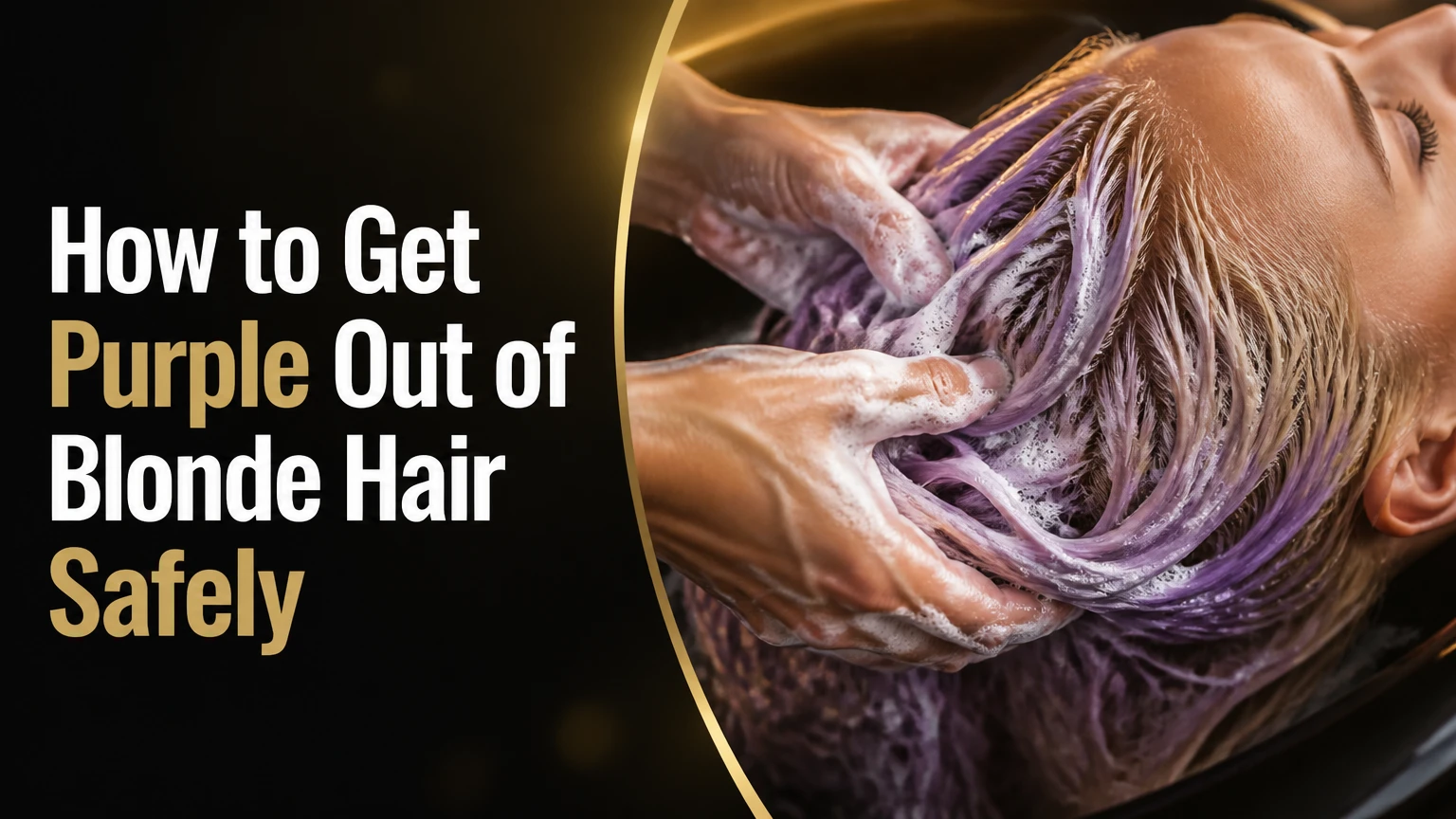
To get purple out of blonde hair, first identify whether the color came from purple shampoo, toner, or semi-permanent direct dye. For a light lavender cast, wash with a regular or clarifying shampoo once, condition deeply, and reassess after drying. Strong dye stains may require a professional direct-dye correction, not immediate bleach.
Key Facts / At a Glance
Purple shampoo staining usually fades through repeated washing because the product deposits violet pigment rather than permanently lightening hair.
Porous, bleached ends absorb more purple pigment and often need fewer treatments but longer recovery.
Clarifying shampoo is the safest first option for a mild lavender cast; dish soap and baking soda increase dryness.
Yellow or gold can visually neutralize violet, but neutralization does not remove the purple pigment.
Direct-dye removers may reduce semi-permanent purple, but a strand test is required because results vary by dye formula and hair porosity.
Bleach can damage blonde hair and should not be the first response to over-toning.
Why Blonde Hair Turns Purple
Purple blonde hair usually contains excess violet direct pigment on or within porous cuticle layers. Purple shampoos and many toning conditioners use pre-formed color molecules that sit on the hair instead of permanently changing its natural melanin.
Bleached hair is especially vulnerable to staining because lightening removes natural pigment and alters the cuticle. Highly porous sections have more irregular surfaces, so violet molecules can lodge unevenly in mid-lengths and ends. The result may look lilac, silver-grey, blue-purple, or dark violet depending on the product concentration and the starting blonde level.
The source matters more than the visible shade. A pale lavender cast from one purple shampoo application needs a different response from a saturated fashion color applied over platinum hair.
Purple shampoo, toner, or direct dye?
The product history often predicts the removal method more accurately than color intensity. Purple shampoo normally fades with cleansing, while a highly concentrated direct dye can remain after several washes.
| Color source | Typical appearance | Pigment behavior | First response |
|---|---|---|---|
| Purple shampoo | Pale lavender, silver, grey-violet | Surface deposit, usually temporary | Regular shampoo, then conditioner |
| Purple conditioner | Lavender patches on porous ends | Heavier surface deposit | Clarifying shampoo on stained areas |
| Demi-permanent toner | Even smoky violet or cool beige | Oxidative color, more persistent | Salon assessment or suitable remover |
| Semi-permanent direct dye | Strong purple, grape, plum, blue-violet | Direct pigment, often highly staining | Strand test with direct-dye remover |
| Mineral or pool-related cast | Dull green-violet or grey | Deposits from water or chemicals | Chelating treatment, not bleach |
L’Oréal Paris advises against using purple shampoo every day because overuse can create unwanted cool buildup. OpenTextBC’s professional hair-colour textbook also distinguishes direct dyes from oxidative color, a distinction that determines whether a remover can work.
How to Get Purple Out of Blonde Hair Without Damage
For a mild purple shampoo stain, use one normal wash followed by one careful clarifying wash if needed. Apply shampoo mainly to the purple sections, use lukewarm water, and stop after the color visibly softens because repeated cleansing can strip moisture faster than it removes deeply absorbed pigment.
The safest process is gradual. Wet the hair thoroughly, apply a sulfate-containing regular shampoo or clarifying shampoo, and massage gently for approximately 60 seconds. Rinse completely, then use a conditioner or mask for 5-10 minutes. Dry the hair fully before judging the shade because wet blonde hair can look darker, cooler, or more purple than it actually is.
Do not begin with bleach. Bleach removes natural and artificial pigment through oxidation, but it also raises the cuticle and can weaken already lightened fibers.
Before You Start
| Preparation factor | Typical requirement | Why it matters |
|---|---|---|
| Time | 20-35 minutes | Includes washing, conditioning, and drying assessment |
| Difficulty | Low for shampoo staining | Direct dye removal requires more control |
| Home cost | $8-$30 | Depends on shampoo, mask, and test products |
| Materials | Shampoo, conditioner, towel, gloves | Gloves prevent violet staining on hands |
| Test | Hidden 1-inch strand | Reveals uneven fading before full application |
| Hair condition | No severe snapping or gummy texture | Fragile hair needs professional handling |
Check elasticity before applying any stripping product. Stretch one wet strand gently; hair that stretches excessively, feels gummy, or breaks with light tension should not receive baking soda, vitamin C, color remover, or bleach.
Step 1: Wash With Regular Shampoo
Apply a regular shampoo to wet hair and concentrate the lather on lavender sections. Leave the lather in contact with the hair for approximately 60-90 seconds, then rinse with lukewarm water.
You will know the step worked when the purple looks lighter on both wet and dry strands. A common mistake is scrubbing aggressively, which roughens the cuticle without guaranteeing more pigment removal.
If the color came from a single use of purple shampoo, this step may be sufficient. Wait at least 24 hours before deciding whether another treatment is necessary.
Step 2: Use Clarifying Shampoo Selectively
Apply a clarifying shampoo to the stained mid-lengths and ends, not automatically to the entire head. Massage for 30-60 seconds, rinse thoroughly, and apply a moisturizing mask for 5-10 minutes.
You will know the step worked when the blonde appears less lavender but still feels flexible and smooth. The common mistake is repeating clarifying washes several times in one session, especially on bleached ends that already feel dry.
A chelating shampoo is more appropriate when hard water, copper, chlorine, or mineral buildup contributes to a dull cast. Chelation and color stripping are different processes, so a mineral treatment may improve clarity without removing a concentrated purple dye.
Step 3: Reassess After the Hair Dries
Dry the hair naturally or with a low-heat setting before choosing a stronger method. Wet hair can conceal uneven areas, and wet porous ends often appear more saturated than they will after drying.
You will know whether further action is justified when the hair is completely dry under neutral lighting. The common mistake is applying a second aggressive treatment because the wet hair still looks purple.
Wait 24-48 hours between cleansing attempts. During that interval, use conditioner and avoid purple, blue, silver, and ash-based products.
Which Purple Removal Method Should You Choose?
Clarifying shampoo is best for light purple shampoo staining, a commercial direct-dye remover is more suitable for persistent semi-permanent color, and salon correction is safest for dark pigment or fragile blonde hair. Vitamin C can be tried cautiously, but it is drying and less predictable than its online reputation suggests.
| Method | Best candidate | Typical time | Typical cost | Hair-risk level |
|---|---|---|---|---|
| Regular shampoo wash | One-use purple shampoo cast | 10-20 minutes | $5-$15 | Low |
| Clarifying shampoo | Light to moderate buildup | 20-35 minutes | $8-$25 | Low to moderate |
| Chelating shampoo | Mineral or chlorine contribution | 15-30 minutes | $10-$30 | Low to moderate |
| Vitamin C and shampoo | Fading direct pigment cautiously | 30-60 minutes | $5-$15 | Moderate dryness |
| Direct-dye remover | Saturated semi-permanent purple | 30-60 minutes | $15-$40 | Moderate |
| Salon color correction | Deep stain or damaged hair | 1-4 hours | $100-$350+ | Controlled but variable |
Prices are typical United States ranges, not fixed charges. A salon may charge more for a color correction because the service can include strand testing, multiple rinses, bond protection, a toner, and a haircut for compromised ends.
Does baking soda remove purple hair dye?
Baking soda may help loosen superficial pigment when mixed with shampoo, but it is alkaline and can increase roughness, dryness, and tangling. Baking soda is not a dependable substitute for a formulated color remover, particularly when purple dye has penetrated porous bleached hair.
If someone chooses to try it, a safer approach is a small hidden-strand test rather than a full-head application. Avoid heated caps and prolonged processing. Rinse promptly and condition thoroughly. Do not use baking soda on hair that is gummy, breaking, chemically overprocessed, or scalp-irritated.
Dish soap is a poor routine choice. Its detergency can remove surface oils rapidly while leaving the user with dry hair and no reliable control over dye reduction.
Does vitamin C remove purple from blonde hair?
Vitamin C mixed with shampoo may fade some temporary or semi-permanent pigment, but the result is inconsistent and the treatment can leave bleached hair dry. Ascorbic acid does not guarantee removal of direct dye, and it should not be treated as a harmless chemical reset.
Use a commercially prepared product according to its instructions whenever possible. If using a homemade mixture, patch test the skin and strand test first, avoid broken skin, and keep contact brief rather than assuming a 45-60 minute treatment is safe for every head of hair.
Stop if the hair becomes rough, stretchy, hot, or unusually tangled. A moisturizing mask afterward can improve feel, but conditioner cannot reverse structural damage caused by excessive chemical processing.
Do commercial color removers work on purple dye?
Direct-dye removers can reduce some semi-permanent purple formulas, but compatibility varies by brand, pigment chemistry, and the underlying blonde. A remover designed for permanent oxidative color may not work on a direct dye and can produce uneven results.
| Product category | Works primarily on | Purple-dye suitability | Main limitation |
|---|---|---|---|
| Direct-dye remover | Pre-formed fashion pigment | Possible, formula-dependent | Can leave residual blue or pink |
| Oxidative color remover | Permanent oxidative dye | Limited for direct dye | May not affect surface pigment |
| Color reducer | Oxidative artificial color | Product-specific | Requires accurate application |
| Bleach lightener | Natural and artificial pigment | Effective but damaging | Can over-lift blonde fibers |
| Chelating treatment | Minerals and metals | Indirect benefit | Does not dissolve most dye |
Always follow the manufacturer’s mixing, application, processing, and rinsing instructions. Test a hidden strand first, apply to the darkest stained area, and inspect the result before treating the rest of the head.
Can Yellow Cancel Purple Hair?
A sheer yellow-gold deposit can visually neutralize a pale violet cast because yellow and violet oppose each other on the traditional hair-color wheel. Neutralization changes the appearance of the color; it does not remove purple molecules from the hair.
This option suits a light lavender cast on a healthy, even pale blonde base. Choose a deposit-only warm beige or pale gold product close to the existing level, apply to a test strand, and check it every minute. A yellow product that is too dark or concentrated can create yellow bands, beige ends, or a muddy result.
| Purple appearance | Possible visual correction | Safer product type | Main risk |
|---|---|---|---|
| Pale lilac | Pale gold | Diluted deposit conditioner | Yellow cast |
| Silver-violet | Warm beige | Sheer non-oxidative toner | Beige or muddy blonde |
| Blue-violet | Gold with slight warmth | Professional gloss | Uneven orange warmth |
| Dark grape | No reliable home neutralization | Professional correction | Patchy brown or khaki |
| Purple with green areas | Avoid yellow alone | Colorist diagnosis | More muddiness |
A professional colorist may formulate a warm gloss after removing excess pigment, but adding warmth over a saturated stain can trap an uneven visual result. Removal and neutralization are separate decisions.
What If the Purple Is Uneven, Blue, or Green?
Uneven purple usually reflects uneven porosity, product distribution, or previous lightening rather than a need for stronger chemicals. Apply cleansing treatments only to the darkest patches and protect pale sections with conditioner during the process.
Blue or green after purple removal often means the formula contained blue pigment or that the underlying hair has cool and warm areas reacting differently. Do not automatically apply orange, copper, pink, or more purple; first identify the unwanted residual tone on a dry strand.
| New unwanted tone | Likely cause | First response | Avoid |
|---|---|---|---|
| Blue | Blue-violet residue | Stop purple products, wash gradually | Blue shampoo |
| Green | Blue over yellow underlying hair | Professional warm correction | Strong red dye blindly |
| Yellow | Warm deposit or overcorrection | Pause and reassess level | More gold immediately |
| Grey | Heavy cool buildup | One gentle clarifying wash | Repeated bleach |
| Patchy lavender | Uneven porosity | Localized treatment | Full-head processing |
A tiny test section is more informative than a full-head experiment. Colorists use strand tests because the same product can produce different results on roots, mids, and porous ends.
When Should You Stop Home Treatments?
Stop home color removal when hair snaps, stretches like elastic, feels gummy, develops severe tangling, or shows scalp burning. A salon assessment is also appropriate when purple remains dark after two gentle washes, when multiple dyes overlap, or when the underlying blonde must remain even.
Bleach baths are not a harmless diluted shampoo. The mixture can still oxidize hair, lift the natural base, create hot roots, and worsen breakage on porous ends. Professional color correction allows controlled application, timed inspection, thorough rinsing, and a new toner matched to the exposed level.
| Warning sign | Recommended action | Do not do |
|---|---|---|
| Gummy wet hair | Stop chemical services | Do not bleach |
| Snapping ends | Trim and condition | Do not brush forcefully |
| Scalp burning | Rinse and seek medical advice if persistent | Do not reapply product |
| Dark purple after two washes | Book a color consultation | Do not layer random colors |
| Patchy result | Request strand-tested correction | Do not process the whole head |
| Severe dryness | Pause clarifiers for 1-2 weeks | Do not use heat repeatedly |
Bond-building products may improve the feel and resilience of damaged hair, but they do not restore every broken bond or make repeated bleaching safe. Hair-care products support recovery; they do not cancel chemical history.
How Long Does Purple Take to Fade?
Light purple shampoo staining commonly softens after one to three washes, while concentrated semi-permanent purple may require several sessions or professional removal. The timeline depends on pigment concentration, wash frequency, water temperature, hair porosity, and whether the hair was previously bleached.
| Starting condition | Expected fading pattern | Reassessment point | Likely next action |
|---|---|---|---|
| Pale lavender after one wash | Noticeable change in 1 wash | After dry hair assessment | Condition and wait |
| Moderate purple buildup | Gradual change in 2-4 washes | After 48 hours | Local clarifying wash |
| Saturated direct dye | Partial fading over several washes | After strand test | Direct-dye remover |
| Porous platinum ends | Uneven, persistent staining | After each section | Colorist correction |
| Mineral-related dullness | Clarity improves after chelation | After one treatment | Reevaluate pigment source |
Wash frequency should not be increased aggressively just to chase a color change. Blonde hair often loses moisture and surface lipids before stubborn direct pigment disappears.
How Do You Care for Blonde Hair After Purple Removal?
After purple removal, use a moisturizing conditioner every wash, limit hot tools, and pause all cool-toned products until the blonde looks even. A gentle shampoo, low-heat drying, and a weekly mask are usually more useful than repeated stripping.
For the first week, wash with lukewarm water and detangle from the ends upward. Use a heat protectant when styling, and avoid purple shampoo until the unwanted cast has fully disappeared. If the hair feels rough, alternate hydration and a light protein treatment rather than applying several heavy treatments simultaneously.
Can electrolysis remove purple from hair?
Electrolysis cannot remove purple pigment from blonde hair because electrolysis destroys individual hair follicles beneath the skin, while cosmetic color sits on or inside the existing hair shaft. Hair electrolysis is a permanent hair-removal procedure for unwanted growth, not a hair-color correction service.
Cutting, washing, chelating, color reduction, and professional lightening are the relevant categories for purple hair. Electrolysis has no useful role in removing violet dye from scalp hair.
Common Mistakes and How to Fix Them
Reapplying purple shampoo
Purple shampoo adds more violet pigment to hair that is already over-toned. Stop all purple, blue, silver, and ash products until the cast fades.
Using blue shampoo
Blue pigment does not neutralize violet pigment. Blue shampoo can make a purple result look darker or push an already cool blonde toward blue-green.
Bleaching immediately
Bleach can lift the underlying blonde while leaving direct dye unevenly distributed. Wait after mild cleansing, then obtain a professional assessment if the color persists.
Leaving treatments on longer
Longer processing does not guarantee cleaner removal. Porous ends can become dry or patchy while the deepest pigment remains.
Ignoring the strand test
A full-head application hides regional differences in porosity. Test the darkest and most porous sections separately before committing.
Conditioning too lightly
A quick rinse-out conditioner may not compensate for clarifying or acidic treatments. Use a substantial mask for 5-10 minutes and reduce heat styling during recovery.
Frequently Asked Questions
Will purple shampoo eventually wash out of blonde hair?
Purple shampoo usually fades with ordinary washing because its violet pigments are deposited rather than permanently oxidized into the hair. One to three washes may noticeably reduce a light cast, but porous bleached ends can retain lavender longer and may need a localized clarifying wash.
Can I use hydrogen peroxide to remove purple hair?
Hydrogen peroxide is an oxidizing developer that can lighten hair and alter its structure, but it is not a controlled universal remover for purple direct dye. Unsupervised peroxide can create uneven lift, dryness, and breakage, especially on bleached hair. Use a professional color correction service for persistent pigment.
Should I use hot water to remove purple?
Lukewarm water is sufficient for cleansing and is less drying than prolonged hot water. Hot water may increase swelling and speed some fading, but the extra dryness can worsen tangling and breakage. Use a normal wash, rinse thoroughly, and condition instead of relying on heat.
Can purple hair turn blonde again without bleaching?
Purple shampoo staining often can fade back toward the existing blonde without bleaching. A concentrated direct dye may leave a residual lavender, blue, pink, or grey stain that needs a compatible remover or professional correction. The original blonde level cannot be restored if the hair was previously lightened unevenly.
How can I remove purple from only the ends?
Apply shampoo or a compatible remover only to the stained ends while keeping unaffected lengths coated with conditioner. Work in small sections and inspect the hair dry after each attempt. Localized treatment prevents already pale roots or mids from becoming over-cleansed.
Should I tone my hair after removing purple?
Tone blonde hair only after excess purple has been removed and the underlying level is visible. A colorist can select a neutral, beige, or warm formula based on the remaining yellow or orange undertone. Toning too soon can layer more pigment over the original stain.
The Bottom Line
To get purple out of blonde hair, start with the least aggressive method that matches the pigment source: one regular shampoo wash for a mild cast, selective clarifying for buildup, and a strand-tested direct-dye remover for persistent semi-permanent color. Avoid bleach, blue shampoo, dish soap, and repeated baking soda treatments, especially on porous hair. When blonde hair is brittle, gummy, unevenly stained, or still dark purple after gentle washing, professional correction is the safer answer.