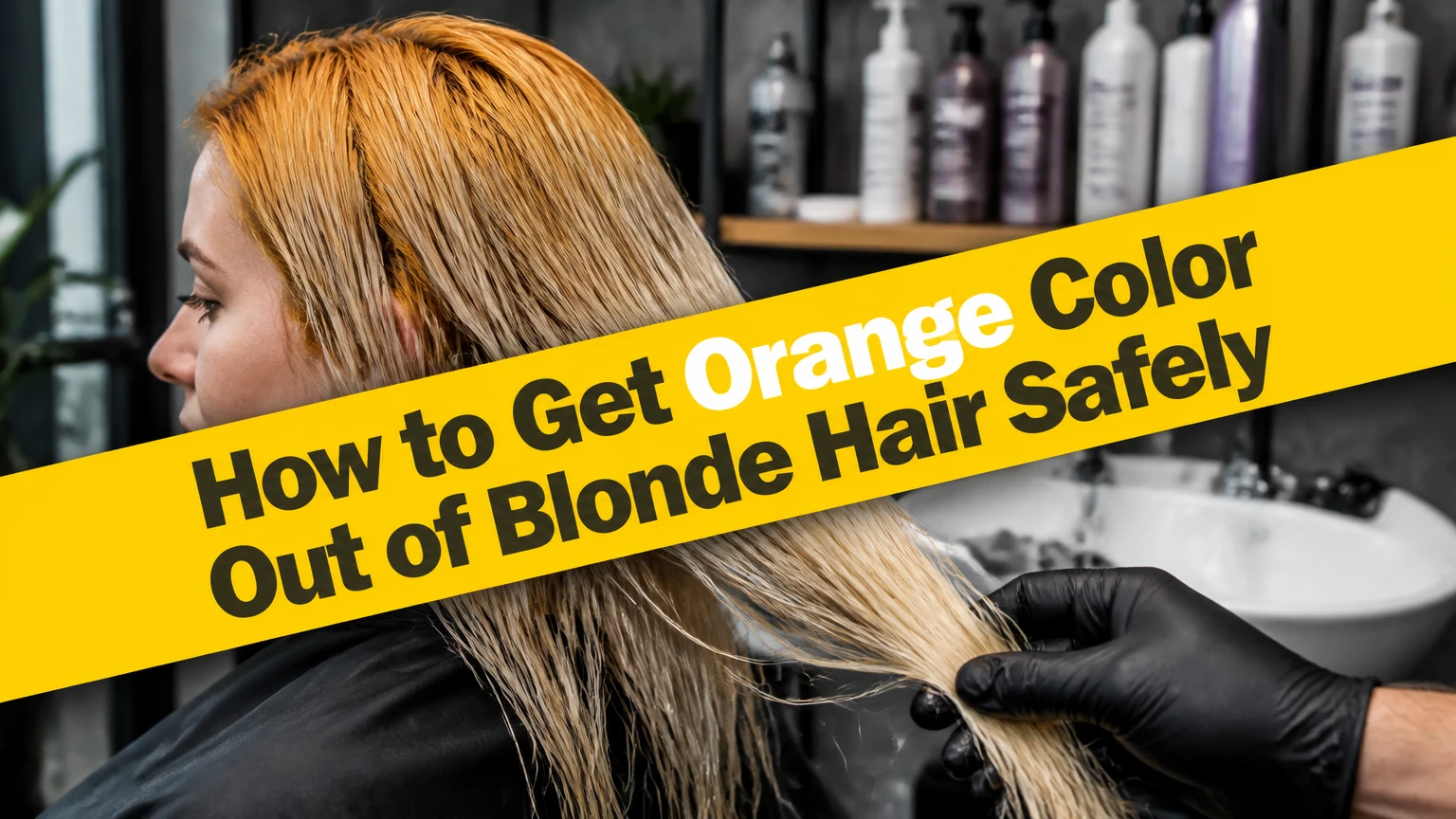
To get orange color out of blonde hair, first identify whether the warmth is copper-orange, yellow-orange, or pale yellow. Blue pigment neutralizes true orange, while violet works on yellow; a toner or gloss can mute the warmth, but hair that is too dark must be lightened rather than toned. Hair condition determines whether correction is safe.
Key Facts
True orange hair needs a blue-based product, not a violet-only product.
Toner deposits color but does not make hair lighter.
Blue shampoo usually lasts one to three washes and cannot reliably correct deep copper.
A strand test is necessary because porous blonde hair can absorb ash pigment faster than healthy hair.
Re-bleaching creates the greatest breakage risk and should not overlap previously lightened hair.
A professional colorist is the safest choice for stretchy, gummy, breaking, or severely uneven hair.
How Do You Identify the Orange Tone?
Orange color in blonde hair usually means the hair stopped lifting around a dark-blonde or light-brown stage, where warm red and orange pigments remain visible. Yellow-orange hair is lighter and needs a different formula from copper-orange hair, so product color alone cannot determine the correct treatment.
Use daylight or a white bathroom light to inspect clean, dry hair. Artificial warm lighting can make ordinary blonde look more orange. Compare the hair with these descriptions:
| Visible tone | Approximate level | Correcting pigment | Typical target |
|---|---|---|---|
| Red-orange or auburn | Level 5-6 | Blue-green or professional corrective formula | Neutral medium brown or dark blonde |
| Copper orange | Level 6-7 | Blue or blue-ash | Neutral dark blonde |
| Tangerine or amber | Level 7 | Strong blue-ash | Cool or neutral medium blonde |
| Yellow-orange | Level 7-8 | Blue-violet | Beige or neutral blonde |
| Pale yellow | Level 9-10 | Violet | Light blonde or platinum |
Hair-level numbers are approximate because professional color brands use different charts. A strand that looks orange beside a pale-blonde reference may actually be yellow-orange, and that difference affects whether blue, violet, or a blend is appropriate.
Why Does Blonde Hair Turn Orange?
Bleach removes natural melanin in stages, exposing warm undertones before the hair reaches pale yellow. Darker hair commonly passes through red, red-orange, orange, and yellow-orange phases, while a cool toner can later fade and reveal the remaining warmth.
The American Academy of Dermatology Association advises that chemical services can damage hair and recommends following product directions, avoiding unnecessary overlapping treatments, and seeking professional help when hair becomes brittle or breaks. UV exposure, frequent hot washing, mineral deposits, and repeated shampooing can also make a cool overlay fade sooner.
Hard-water minerals deserve separate attention. Copper, iron, and calcium can accumulate on porous hair, creating dull orange, rusty, or sometimes greenish casts that pigment alone may not correct. A chelating treatment is more suitable than repeatedly applying blue toner when the problem began after swimming, well-water exposure, or a change in household plumbing.
What Color Cancels Orange in Blonde Hair?
Blue cancels orange because blue and orange sit opposite each other on the traditional color wheel. Violet cancels yellow, so a violet product is appropriate for pale-yellow blonde but may leave strong orange hair visibly warm.
Color correction is optical, not a permanent erasure of the underlying pigment. Blue molecules overlay the warm visual field and produce a more neutral appearance, but the result depends on the hair’s starting level, porosity, existing color, and the amount of pigment deposited.
| Hair appearance | First product category | Why it fits | Risk if mismatched |
|---|---|---|---|
| Copper-orange level 6-7 | Blue-ash demi-permanent toner | Deposits stronger cool pigment | Hair can look smoky or dark |
| Light orange level 7-8 | Blue shampoo or blue-violet gloss | Provides moderate surface correction | Orange may remain after one use |
| Yellow-orange level 8 | Blue-violet toner or conditioner | Addresses both warm families | Uneven greenish areas if overapplied |
| Pale yellow level 9-10 | Violet shampoo or toner | Violet counteracts yellow | Blue can create a dull gray cast |
| Rust from minerals | Chelating treatment first | Removes mineral film before toning | Toner may not bond evenly |
A practical colorist rule is to correct the least amount necessary. If only the roots are orange, apply correction to the roots rather than coating pale mids and ends with a strong ash formula. Blonde ends are often more porous, so they can become gray, blue, or muddy before the orange root has neutralized.
Which Method Should You Use?
The best method depends on tone intensity and hair condition. Use a blue shampoo for mild, recurring warmth; choose a gloss for gentle conditioning and shine; use a demi-permanent toner for stronger, more even orange; and consider lightening only when the hair is too dark for the desired blonde.
| Method | Typical cost in the USA | Processing time | Approximate duration | Best starting condition |
|---|---|---|---|---|
| Blue shampoo | $12-$45 | 3-10 minutes | 1-3 washes | Healthy to mildly dry hair |
| Blue conditioner | $15-$40 | 5-15 minutes | 1-3 washes | Dry hair needing deposit |
| At-home gloss | $15-$35 | 10-20 minutes | 2-4 weeks | Mild warmth and porous ends |
| Salon glaze | $50-$120 | 15-30 minutes | 2-5 weeks | Dry or uneven blonde |
| Demi-permanent toner | $10-$30 DIY, $60-$150 salon | 15-30 minutes | 4-6 weeks | Even orange at a workable level |
| Corrective lightening | $150-$400+ salon | 2-5 hours over sessions | Until regrowth | Hair too dark for the target |
These are typical US consumer and salon ranges, not universal prices. Product size, location, stylist expertise, color history, and the need for a haircut or bond-repair service can change the total substantially.
Is Blue Shampoo Enough?
Blue shampoo is enough when orange is mild, the hair is already close to the desired level, and the user accepts a temporary result. Blue shampoo cannot make dark copper hair pale blonde because shampoo deposits pigment without lifting natural or artificial color.
Use the product once on a small hidden section first. Apply it to wet hair, distribute it evenly with gloved hands, leave it for the manufacturer’s stated time, and rinse thoroughly. Begin with three minutes rather than ten when the hair is highly porous. Repeat after several washes only if the tone improves without dullness.
Blue shampoo is a maintenance product, not a rescue bleach. Daily use can make hair feel dry and can build an uneven blue-gray film on porous ends.
When Is a Toner or Gloss Better?
A toner is better for all-over orange that needs a more noticeable, longer-lasting correction. A gloss is better for mild warmth, faded color, dull texture, or fragile hair that should not receive a stronger alkaline service.
Demi-permanent toners typically use an acidic or mildly alkaline color system with a low-volume activator, depending on the manufacturer. Do not assume a universal 1:2 mixing ratio. Wella, Redken, Schwarzkopf, Matrix, and independent color lines specify different developer types, ratios, and processing times, and substituting products can alter the result.
Color glosses generally deposit translucent pigment while adding shine. Glosses are not suitable when the hair is several levels too dark, when intense orange needs full neutralization, or when a permanent cool blonde result is required.
How Do You Get Orange Color Out of Blonde Hair at Home?
To get orange color out of blonde hair at home, assess the level, perform a strand test, select a blue or blue-violet deposit product, apply it evenly to the warm areas, monitor the result, and condition after rinsing. The safest first attempt takes about 30-45 minutes, including preparation.
Before You Start
| Requirement | Typical specification | Safety checkpoint |
|---|---|---|
| Time | 30-45 minutes for deposit-only correction | Reserve extra time for a strand test |
| Cost | $15-$45 for shampoo, gloss, or conditioner | Professional correction costs more |
| Tools | Gloves, clips, bowl, tint brush, timer | Use nonmetal tools where directions require |
| Hair state | Clean, towel-dried hair for most toners | Follow the product label over general advice |
| Test | 1 hidden strand and skin patch test | Stop if burning, swelling, or severe irritation occurs |
Do not tone hair that feels gummy when wet, stretches excessively, snaps during combing, or has visible chemical burns. Do not apply bleach over a scalp with sores, and do not repeat a failed chemical service immediately.
Step 1: Wash and Assess the Hair
Wash away oils and styling residue, then dry or towel-dry according to the product instructions. Inspect the roots, mids, and ends separately because uneven lift requires uneven application.
You will know the assessment is useful when the hair shows a consistent tone under neutral light. A common mistake is choosing a toner from the desired result, such as “ash blonde,” instead of matching the current orange level.
Step 2: Perform a Strand and Patch Test
Mix or apply the product exactly as directed to a hidden strand, then process for the shortest recommended time. A patch test should follow the manufacturer’s timing, usually 48 hours before a color service when the instructions require it.
You will know the strand test is acceptable when the strand looks neutral rather than green, excessively gray, or darker than intended and still feels resilient. A common mistake is testing on the healthiest front section instead of the most porous area.
Step 3: Choose the Product and Activator
Select blue for orange, blue-violet for yellow-orange, and violet for pale yellow. If using a demi-permanent toner, use only the activator named by that brand, commonly a low-volume developer, and follow its mixing ratio.
You will know the formula is plausible when the product instructions support the hair level and target shade. A common mistake is using 20, 30, or 40 volume developer with a deposit-only toner, which can add avoidable damage without improving neutralization.
Step 4: Section and Apply to Warm Areas
Divide the hair into four sections and apply the product first to the darkest, most orange areas. Saturate each strand without repeatedly dragging strong pigment over already-cool ends.
You will know application is even when every orange section is visibly coated and no dry patches remain. A common mistake is starting at the front for convenience, then leaving the back under-saturated or processing it for less time.
Step 5: Monitor the Processing Time
Set a timer and inspect a test strand every five minutes after the minimum development point. Stop when the orange has visually softened, even if the maximum time has not elapsed.
You will know the process is complete when the strand appears neutral or softly beige under daylight. A common mistake is extending the service beyond the label because the hair still looks warm while wet, when wet hair often hides the final tone.
Step 6: Rinse, Condition, and Reassess
Rinse with cool or lukewarm water until the water runs clear, then apply the recommended conditioner or mask. Avoid aggressive shampooing immediately after a toner unless the product instructions say otherwise.
You will know the result is stable after the hair is completely dry. A common mistake is adding another toner while the hair is wet and temporarily darker, which can create excessive ash pigment.
What Should You Avoid When Correcting Orange Hair?
Avoid bleaching immediately after a failed toner, using purple shampoo on unmistakable copper hair, applying high-volume developer for deposit-only color, and covering the entire head when only the roots need correction. Each choice can worsen unevenness, dryness, or color buildup.
| Mistake | Likely result | Safer correction |
|---|---|---|
| Violet on deep orange | Warmth remains | Use blue or blue-violet after a strand test |
| Blue on pale yellow | Green, gray, or dull blonde | Clarify gently, then use violet |
| Toner on level 5-6 hair | Little visible change | Reassess target or seek controlled lightening |
| 30 or 40 volume activator | Extra cuticle stress | Use the brand’s low-volume activator |
| Repeated bleach overlap | Breakage and short pieces | Stop chemical services and consult a colorist |
| Unmeasured home mixtures | Uneven or unpredictable tone | Follow one complete product system |
One counterintuitive fact matters here: a darker ash toner can make orange hair look less orange without making it genuinely blonder. The apparent improvement comes from added cool and dark pigment, so the result may be useful for a dark ash-blonde goal but disappointing for someone seeking platinum.
Can Bleach Fix Orange Hair?
Bleach can fix orange hair only when the hair is structurally strong enough for more lifting and the desired result requires a lighter level. Bleach removes or breaks down additional pigment, while toner only changes reflected color; neither process can safely guarantee platinum in one session.
A professional should evaluate elasticity, porosity, previous bleach overlap, permanent dye history, and scalp condition before lightening. A stylist may use a lower-strength lightener, isolated application, or multiple sessions rather than applying one strong formula over the entire head.
Do not bleach over permanent black, box dye, metallic dye, or unknown color history without professional assessment. Do not apply lightener to all hair when the orange is limited to new growth. Overlapping lightener on already blonde mids and ends creates the highest breakage risk.
How Do You Fix Specific Orange-Hair Problems?
Specific correction problems need different recovery steps. Green hair requires removing excess blue before adding violet, unaffected hair may be too dark for toner, and brittle or gummy hair requires a complete pause in chemical services.
Green After Blue Toner
Green usually means blue pigment met yellow hair or a mineral cast. Stop depositing blue, wash gently according to the product’s removal guidance, and consult a colorist if the green persists after a few washes.
Do not immediately apply red dye as a home correction. Red can overcorrect and create muddy brown or uneven warm patches, particularly on porous ends.
Toner Did Nothing
An unchanged result usually means the hair was too dark, the product was too sheer, the tone was mismatched, or mineral buildup blocked even deposition. Toner cannot lift hair, and a light ash shade cannot turn level 6 copper into level 9 platinum.
Clarify or chelate only when buildup is plausible, then reassess under daylight. If the hair remains too dark, controlled lightening is the next technical option, not a stronger toner.
Hair Feels Dry or Gummy
Dryness indicates reduced moisture and lipid balance, while gummy stretch and snapping indicate serious structural damage. Stop bleach, permanent color, strong toners, and high heat; use gentle cleansing, conditioning, and professional assessment.
Bond-building products may improve manageability, but they cannot fuse severed hair back together or make unsafe hair ready for immediate bleaching. The damaged portion may need gradual trimming.
Orange Roots but Blonde Ends
Orange roots after lightening often indicate insufficient lift, heat-related unevenness, or a “hot root” effect from applying lightener too close to the scalp. Use a root-specific professional formula rather than coating cool blonde ends with a dark ash product.
The scalp’s warmth can accelerate processing near the root. Experienced colorists therefore adjust placement and timing instead of assuming every section needs identical chemistry.
How Long Does the Correction Last?
A blue shampoo may last one to three washes, a gloss commonly lasts two to five weeks, and a demi-permanent toner often lasts four to six weeks. Longevity depends on porosity, shampoo frequency, water minerals, heat, UV exposure, and the original color system.
| Service or product | Typical refresh interval | Main fading factor | Maintenance action |
|---|---|---|---|
| Blue shampoo | Every 1-2 weeks | Frequent cleansing | Use only when warmth returns |
| Blue conditioner | Every 1-2 weeks | Porous ends | Apply more briefly to ends |
| Acidic gloss | 3-5 weeks | Heat and shampoo | Use color-safe cleanser |
| Demi-permanent toner | 4-6 weeks | Porosity and regrowth | Refresh only faded zones |
| Mineral chelation | As needed, often monthly | Hard or well water | Follow with conditioning |
| Professional retone | 4-8 weeks | Desired coolness | Reassess level before service |
Use a shower filter for sediment and chlorine, but do not assume every filter removes iron or copper. A chelating product designed for mineral removal may be necessary in hard-water homes, especially when blonde hair develops a rusty cast soon after washing.
How Much Does Orange-Hair Correction Cost?
Typical US costs range from $12 for a blue shampoo to more than $400 for complex salon lightening. A simple at-home deposit service generally costs $15-$45, while a salon toner or glaze commonly costs $60-$150 before a larger corrective color service.
Salon pricing rises when the service includes color removal, multiple lightening sessions, bond repair, a haircut, or extensive section-by-section application. A consultation is worthwhile when the hair has several previous color layers or the target is platinum.
When Should You See a Professional?
See a professional when hair is gummy, breaking, severely uneven, darker than level 7 but intended to become platinum, or affected by unknown permanent or metallic color. Professional correction is also safer when orange appears in bands, because banding requires controlled formula placement rather than all-over toner.
A salon appointment cannot eliminate the laws of hair chemistry. A responsible colorist may recommend a darker beige or caramel result, several appointments, or a haircut when the requested blonde would exceed the hair’s structural limit.
Frequently Asked Questions
Can I use purple shampoo to remove orange hair?
Purple shampoo works best on yellow or pale-yellow blonde, not strong copper-orange hair. Blue is the complementary color for orange, while violet is the complementary color for yellow. Yellow-orange hair may need a blue-violet product, but a strand test prevents a green or overly gray result.
Can baking soda or lemon juice remove orange tones?
Baking soda and lemon juice are unreliable color-correction methods and can increase dryness or scalp irritation. Acidic lemon juice may also produce uneven lightening under sunlight. A formulated blue conditioner, gloss, toner, or professional chelating service provides more predictable pigment and exposure control.
Can I tone orange hair the same day I bleach it?
A same-day toner may be appropriate when the hair remains elastic, the lightener has been fully rinsed, and the toner system is designed for that service. Do not tone immediately when the hair feels stretchy, gummy, hot, or fragile. Follow the product directions and stop if the scalp is irritated.
Why does my blonde turn orange after a few weeks?
Blonde can turn orange when a cool toner fades and exposes the underlying warm pigment. Hard-water minerals, UV exposure, hot water, frequent shampooing, and heat styling can accelerate the change. Blue maintenance products and periodic glosses can reduce visible warmth, but they cannot replace missing lift.
Can hair electrolysis remove orange color?
Hair electrolysis cannot remove orange color from blonde hair. Electrolysis targets individual hair follicles for permanent hair-removal purposes, while brassiness exists in the hair shaft’s pigment. Orange color requires pigment balancing, mineral removal, or controlled lightening, not an electrolysis treatment.
Should I recolor orange hair darker instead of bleaching it?
Recoloring orange hair darker can be the safest choice when the hair is damaged or the desired result is dark blonde, beige, caramel, or light brown. A neutral or cool demi-permanent shade can mute warmth, but it will not create a pale blonde result and may complicate future lightening.
The Bottom Line
The safest answer to how to get orange color out of blonde hair is to match the correction to the visible undertone and hair level. Use blue for true orange, blue-violet for yellow-orange, violet for pale yellow, and a gloss or conditioner when the hair is fragile. If the hair is too dark for the intended blonde, toner cannot solve the problem, and further lightening should follow a strand test or professional assessment.