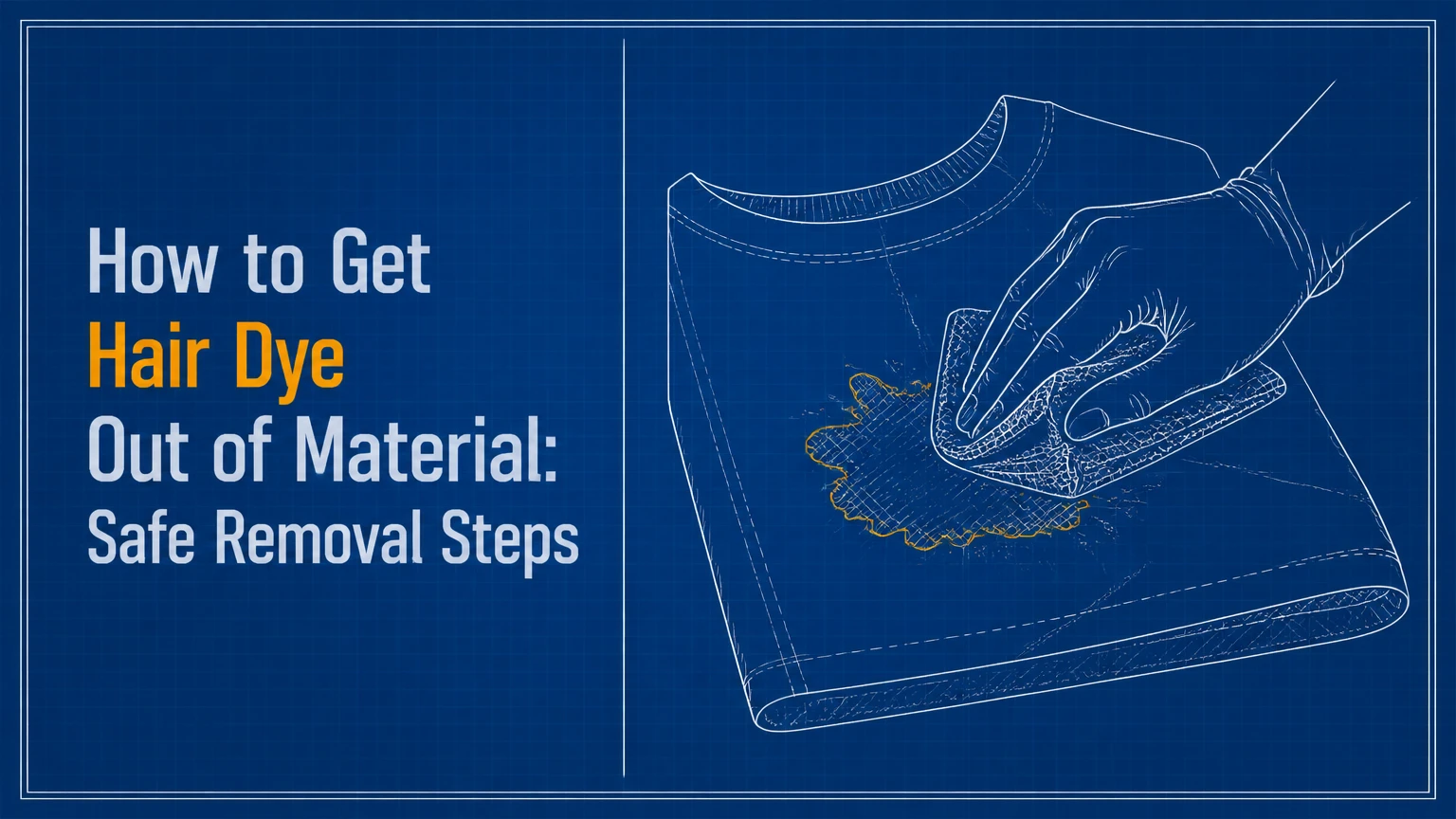
To get hair dye out of material, remove excess dye, rinse the stain from the back with cold water, apply liquid laundry detergent, then wash without heat drying. For washable cotton, linen, polyester, or nylon, an oxygen-based color-safe bleach soak can treat persistent residue. Always check the care label and patch-test chemicals first.
Key Facts at a Glance
Cold water and quick action reduce the amount of hair dye that penetrates fabric fibers.
Liquid laundry detergent is the safest first treatment for most washable textiles.
Oxygen bleach is generally preferable to chlorine bleach for colored, washable fabric.
Rubbing alcohol can lift some direct dyes, but it may also dissolve the fabric’s original color.
Heat from a dryer can make a remaining stain harder to remove.
Wool, silk, leather, rayon, and dry-clean-only garments need a different treatment pathway.
What Determines the Best Hair Dye Removal Method?
The material, dye type, stain age, and original fabric color determine the safest removal method. A fresh stain on white cotton can tolerate more treatment than a dried stain on dyed polyester, while silk, wool, leather, and upholstery can suffer permanent damage from home solvents or prolonged soaking.
Hair color products do not all stain in the same way. Permanent and many demi-permanent formulas use small dye precursors that react with an oxidizer, commonly hydrogen peroxide, and form larger colored molecules inside the hair shaft. Direct and semi-permanent colors contain pre-formed pigments that remain closer to a material’s surface, although porous fibers can still absorb them. Compound Chem describes these broad categories in its explanation of hair-dye chemistry.
Removal therefore means either carrying loose pigment out with water and detergent, dissolving surface color with a compatible solvent, or chemically fading the pigment. No household treatment reliably reverses every permanent dye stain. The goal is controlled lifting without stripping the textile’s original color or weakening its fibers.
Quick Decision Table
| Stain situation | First choice | Typical contact time | Main risk |
|---|---|---|---|
| Fresh dye on white cotton | Liquid detergent, then oxygen bleach | 10 minutes, then 1-6 hours | Whitening unevenly |
| Fresh dye on colored polyester | Detergent, then careful alcohol test | 5-10 minutes | Background color transfer |
| Dried dye on washable linen | Detergent and oxygen bleach | 6-8 hours | Fiber or finish damage |
| Dye on wool or silk | Blot and professional cleaner | Same day | Permanent fiber damage |
| Dye on ceramic tile | Mild detergent, then baking soda paste | 5-15 minutes | Surface scratching |
| Dye on laminate | Detergent or approved surface cleaner | 5 minutes | Dull or dissolved finish |
Before You Start
Set aside 15-30 minutes for the first treatment, with a further 1-6 hours for an oxygen-bleach soak if the care label permits it. Typical household cost is approximately $3-$12 when detergent and oxygen bleach are already available; professional cleaning commonly costs $10-$40 for a small garment treatment, depending on the local market and garment type.
Materials and Safety Checklist
| Item | Suggested amount | Suitable use | Important limitation |
|---|---|---|---|
| White paper towels | 6-12 sheets | Blotting wet dye | Colored towels can transfer dye |
| Liquid laundry detergent | 1-2 teaspoons | Washable fabric pretreatment | Avoid strong rubbing |
| Oxygen bleach powder | Label-directed dose | White and colorfast washable fabric | Patch-test colored items |
| Soft toothbrush | 1 | Working detergent into weave | Do not use on silk or loose knits |
| Isopropyl alcohol | 70-91%, 1-2 teaspoons for testing | Some synthetic or hard surfaces | Flammable and color-stripping |
| Nitrile gloves | 1 pair | Chemical handling | Replace if contaminated |
Read the care label before applying anything. Check whether the material is cotton, linen, polyester, nylon, rayon, wool, silk, leather, coated fabric, upholstery, or a blend. Test every chemical on a hidden seam or underside, wait until the test area dries, and compare both color and texture.
Never mix chlorine bleach with ammonia, vinegar, alcohol, or other cleaners. Chlorine bleach and ammonia can generate toxic chloramine gases. Ventilate the work area, keep chemicals away from children and pets, and follow the product label rather than combining homemade formulas.
How Do You Remove Fresh Hair Dye From Washable Fabric?
Remove fresh hair dye from washable fabric in four controlled stages: scrape, flush, pretreat, and wash. Use cold water first, keep the stain wet until treatment begins, and inspect the fabric before drying. Fresh surface residue usually responds better than dye that has oxidized or been heat-set inside the fibers.
Step 1: Scrape Off Excess Dye
Use a dull spoon, plastic card, or the edge of a blunt table knife to lift thick dye paste. Work from the outside of the stain toward the center so the residue does not spread across clean fabric.
Do not press the scraper into the weave. Place a folded white towel beneath the stained section, particularly when treating a shirt, pillowcase, or towel, because the backing towel catches loosened dye.
You will know it worked when: no raised paste remains and the stain is a flat wet mark.
Common mistake: wiping the stain with a dry cloth. Dry wiping spreads pigment and pushes it across adjacent threads.
Step 2: Flush From the Reverse Side
Hold the fabric with the stained side facing down and run cool water through the back of the material. A faucet with moderate pressure is preferable to a forceful jet that stretches knit fabric. Continue for 2-5 minutes, or until the runoff becomes visibly lighter.
Reverse-side rinsing helps move loose surface dye away from the face of the fabric instead of driving it further into the material. Tide and Maytag both recommend prompt treatment and avoiding dryer heat until the stain has gone.
You will know it worked when: the water no longer carries obvious dark, red, blue, or purple color.
Common mistake: starting with hot water. Heat can accelerate setting and may also spread a water-soluble dye through a larger area.
Step 3: Apply Liquid Laundry Detergent
Put 1-2 teaspoons of liquid laundry detergent directly on the damp stain. Choose a detergent intended for the fabric and, where available, one containing stain-lifting enzymes. Gently press the detergent into the weave with clean fingers or a soft toothbrush.
Let the detergent sit for 5-10 minutes. Do not allow it to dry on the fabric. Rinse from the reverse side again, then check whether the stain has faded.
You will know it worked when: the residue looks lighter and the fabric feels free of thick product buildup.
Common mistake: scrubbing rapidly from side to side. Lateral friction spreads color and can roughen cotton, fleece, or synthetic fibers.
Step 4: Wash, Inspect, and Air-Dry
Wash the item according to its care label using the warmest permitted setting, not an automatically hot setting. Use the normal amount of detergent, keep the stained item separate from pale clothing, and select a full rinse if the machine offers that option.
Remove the item immediately after washing. Inspect it under bright light while damp, then air-dry it if any discoloration remains. The Spruce, Whirlpool, Ariel, and Persil all emphasize checking the stain before dryer use.
You will know it worked when: no colored halo appears after the fabric is fully dry.
Common mistake: putting the item in a tumble dryer because the stain looks almost gone. Dryer heat can make the remaining pigment much more difficult to remove.
When Should You Use Oxygen Bleach?
Use oxygen bleach after detergent treatment when the washable material remains discolored and the care label permits it. Oxygen bleach is usually safer than chlorine bleach for colorfast fabrics because it fades many stains without the same rapid fiber damage risk, but it can still lighten unstable dyes and damage some finishes.
Dissolve the label-directed quantity in cool or lukewarm water before adding the item. A typical household treatment uses a basin containing 4-8 liters of water and an oxygen-bleach dose specified on the package. Submerge the affected section for 1-6 hours, checking a colored item every hour. Some products allow longer soaking, but the product label controls the maximum time.
| Fabric condition | Oxygen-bleach approach | Check interval | Stop if |
|---|---|---|---|
| White cotton towel | Full label-strength soak | 2 hours | Fabric weakens or yellows |
| Colorfast cotton shirt | Reduced or label strength | 60 minutes | Original color lightens |
| Polyester sportswear | Short soak after patch test | 30-60 minutes | Finish becomes tacky |
| Linen tablecloth | Label-strength soak | 60-120 minutes | Fibers feel brittle |
| Wool or silk | Do not use at home | Not applicable | Professional treatment required |
Rinse thoroughly after soaking, then launder according to the care label. Do not add chlorine bleach to the same basin, even after oxygen bleach has been used, unless the basin and item have been fully rinsed and the product directions explicitly permit the next treatment.
Can Ammonia Remove Red Hair Dye?
Ammonia can damage or strip textile color and create a dangerous gas if it contacts chlorine bleach, so ammonia is not a preferred general-purpose hair-dye treatment. For red dye on washable material, use detergent followed by a color-safe oxygen-bleach treatment first; reserve stronger chemistry for a professional cleaner.
Some stain guides recommend a dilute ammonia and dish-soap mixture for particular red stains. That recommendation is not universally safe because fabric dyes, finishes, and cleaning products vary. Ammonia is especially unsuitable for wool, silk, spandex-containing garments, rubber-backed items, and poorly ventilated rooms.
If a professional or product label specifically directs ammonia use, wear gloves, ventilate strongly, use only the stated dilution, and confirm that no chlorine product has touched the fabric. Never improvise a stronger concentration.
Which Materials Need Different Treatment?
Washable cellulose and synthetic fabrics can usually receive detergent-based treatment, but delicate fibers, coated surfaces, and upholstery require less moisture and less aggressive chemistry. Material identification should come before stain selection because the same solvent can lift hair dye from polyester while damaging acetate, leather, or a printed finish.
| Material | Preferred first treatment | Avoid | Realistic result |
|---|---|---|---|
| Cotton | Cold rinse, detergent, oxygen bleach | Immediate dryer heat | Often substantial fading |
| Linen | Cold rinse, mild detergent, short soak | Aggressive brushing | Good on fresh stains |
| Polyester | Detergent, patch-tested alcohol if needed | Acetone on blends | Variable, depends on finish |
| Nylon | Detergent, cautious spot treatment | Strong oxidizers | Often improved if fresh |
| Rayon or viscose | Blot, minimal water, cleaner | Soaking and scrubbing | Professional help often needed |
| Wool | Blot with clean water, dry cleaner | Enzymes, bleach, ammonia | Home removal is risky |
| Silk | Blot, isolate, dry cleaner | Alcohol, peroxide, soaking | Requires specialist handling |
Cotton, Linen, and Denim
Cotton and linen tolerate water-based cleaning better than protein fibers. Place a towel behind the stain, rinse from the reverse, apply detergent, and use oxygen bleach only after confirming colorfastness. Denim may lose indigo when treated with bleach, so a faint lighter patch can remain even after the hair dye has faded.
Polyester, Nylon, and Blends
Synthetic fibers can hold hydrophobic components of direct dye, especially when the stain dries. After detergent treatment, test 70% isopropyl alcohol on an inside seam using a cotton swab. If the background color transfers to the swab, stop and rinse with cool water.
Dab alcohol onto the dye from the outside inward rather than pouring it over a large area. Work over a white towel, replace the towel as it absorbs color, and limit each application to 30-60 seconds before rinsing.
Wool, Silk, Rayon, and Dry-Clean-Only Items
Do not soak, brush, bleach, or apply household solvents to silk, wool, rayon, velvet, leather, or a dry-clean-only item. Blot wet residue with white paper towels, avoid compressing the stain deeper, and take the item to a cleaner as soon as possible.
Tell the cleaner whether the product was permanent, demi-permanent, semi-permanent, or a fashion color. Product packaging or a photograph can help the cleaner choose a solvent system.
How Do You Remove Hair Dye From Upholstery and Carpet?
Remove hair dye from upholstery and carpet by blotting, limiting moisture, and treating from the outside toward the center. Do not saturate the backing, because dissolved dye can migrate into foam, carpet underlay, or a larger section of upholstery where it becomes harder to extract.
First scrape dried surface residue with a dull card. For a fresh mark, blot with a white towel rather than rubbing. Mix a small amount of liquid dish soap with cool water, apply the foam to the towel, and dab the stain in 30-second intervals. Transfer loosened color to a clean towel section each time.
| Surface | Safe starting mixture | Application limit | Follow-up |
|---|---|---|---|
| Synthetic upholstery | 1 teaspoon dish soap in 250 ml water | 2-3 teaspoons per area | Blot with plain water |
| Cotton upholstery | Same mixture after patch test | 1-2 teaspoons | Dry rapidly with towels |
| Nylon carpet | Detergent solution | 5-10 minutes total | Extract moisture |
| Wool carpet | Plain water blot only | Minimal moisture | Professional cleaner |
| Mattress cover | Laundry detergent on removable cover | 5-10 minutes | Wash by label |
| Car seat fabric | Dilute upholstery cleaner | Small sections | Ventilate before use |
Finish by blotting with a separate towel dampened with plain water, then press dry towels over the area. Do not use a hair dryer or steam cleaner until you know the dye has not spread.
Which Solvent Works Best on Hard Surfaces?
The safest hard-surface treatment begins with dish soap or an all-purpose cleaner approved for that surface; alcohol is a second-line option for some sealed, nonporous surfaces, while acetone is a high-risk choice. Hair dye can stain grout and unsealed stone permanently because pigment enters pores rather than remaining on top.
| Surface | First option | Possible second option | Do not use |
|---|---|---|---|
| Glazed ceramic tile | Dish soap and water | Baking soda paste | Steel wool |
| Porcelain sink | Mild detergent | Small alcohol test | Abrasive scouring powder |
| Laminate counter | Manufacturer-approved cleaner | Brief alcohol test | Acetone or nail-polish remover |
| Quartz or engineered stone | Stone-safe cleaner | Manufacturer-approved stain remover | Unapproved solvents |
| Sealed granite | pH-neutral stone cleaner | Professional advice | Vinegar or harsh bleach |
| Unsealed grout | Detergent and soft brush | Oxygen bleach test | Heavy solvent saturation |
For ceramic or porcelain, apply a paste made from baking soda and a little water, leave it for 5 minutes, and wipe with a soft cloth. Baking soda provides mild abrasion, but repeated scrubbing can dull glossy finishes.
Acetone can soften plastics, remove laminate coatings, damage sealants, and strip decorative prints. It is not a universal hair-dye remover. If a surface manufacturer permits it, use a tiny amount in a ventilated area and wipe it off immediately.
Is Rubbing Alcohol Safe for Hair Dye Stains?
Rubbing alcohol is safe only when the material passes a hidden-area test and the treatment is brief. Alcohol can dissolve some surface dyes, but the same action may remove the garment’s original dye, soften coatings, or create a pale ring around the stain.
Use 70% isopropyl alcohol for a cautious first test rather than assuming 91% is better. Put a white towel under the material, dampen a cotton swab, and dab one small section. Wait for the area to dry completely before judging color change.
Alcohol is more reasonable for a small stain on white or colorfast polyester than for cotton prints, acetate, leather, painted furniture, or upholstery. Keep the container away from flames, heaters, cigarettes, and electrical sparks. Never pour alcohol into a washing machine or mix it with bleach.
Can Hair Electrolysis Remove Hair Dye From Material?
Hair electrolysis cannot remove hair dye from material. Electrolysis uses a fine probe and electrical current to destroy individual hair follicles in a person’s skin; it does not dissolve textile pigment, clean upholstery, or remove stains from clothing.
The distinction matters because “hair removal” and “hair dye removal” describe unrelated processes. Electrolysis is a permanent hair-removal service regulated differently across jurisdictions, while fabric stain removal uses rinsing, detergent, solvents, or bleaching chemistry. Electrolysis has no useful role in treating a dye mark on cotton, polyester, carpet, or a bathroom surface.
What Should You Do if the Stain Has Dried?
Treat a dried stain by removing the hardened surface layer, rehydrating it with detergent, and repeating a controlled wash before considering a stronger product. Dried hair dye is less predictable because pigment may have oxidized and bonded within the fiber or surface pores.
For washable fabric, soak the stained area in cool water for 10 minutes, apply liquid detergent for another 10 minutes, and rinse from the reverse. If the material remains colorfast, use an oxygen-bleach soak for 1-6 hours according to the package directions. Wash and air-dry.
For a stain that has already passed through a dryer, expect partial improvement rather than guaranteed removal. Repeated treatment can lighten the original fabric, weaken fibers, or enlarge a halo. Stop after two carefully performed cycles if the mark does not improve, then consult a textile cleaner.
Why Did the Cleaning Treatment Make the Stain Worse?
A treatment can make a hair dye stain worse when it spreads dissolved pigment, removes the original fabric color, or leaves a chemical ring. Stop immediately if the test area lightens, the material becomes sticky, the texture changes, or the stain expands.
Flush a washable item with cool water from the reverse side to remove the active product. Do not try to neutralize one household chemical with another, because vinegar, ammonia, bleach, and alcohol can create hazardous combinations or additional discoloration.
| Failure mode | Likely cause | Immediate correction | Next step |
|---|---|---|---|
| Dark halo around stain | Excess liquid migration | Blot edges with white towel | Use less solution |
| White patch on colored fabric | Original dye stripped | Rinse and stop chemicals | Professional color repair |
| Sticky synthetic surface | Solvent attacked coating | Remove solvent with water if compatible | Surface specialist |
| Persistent odor | Product trapped in fibers | Rinse thoroughly and air out | Cleaner if odor remains |
| Stain spread during brushing | Lateral scrubbing | Stop and blot outward-to-inward | Re-treat smaller area |
| No improvement after two cycles | Heat-set or deeply bonded dye | Stop escalation | Professional assessment |
How Much Time and Money Does Removal Take?
A fresh washable-fabric treatment usually takes 15-30 minutes of active work and one wash cycle; a stubborn stain may require a further 1-6 hour oxygen-bleach soak. Typical costs range from $0 if existing supplies are available to $15 for new detergent, oxygen bleach, gloves, towels, and a small stain remover.
| Treatment route | Active time | Waiting time | Typical household cost |
|---|---|---|---|
| Detergent-only treatment | 10-15 minutes | 0 minutes | $0.25-$1 |
| Detergent plus wash | 15-25 minutes | 45-120 minutes | $0.50-$2 |
| Oxygen-bleach treatment | 15-25 minutes | 1-6 hours | $1-$4 |
| Alcohol spot test | 5-15 minutes | 15 minutes drying | $0.25-$2 |
| Upholstery spot treatment | 20-40 minutes | 2-8 hours drying | $1-$8 |
| Professional dry cleaning | 5 minutes drop-off | 1-3 days | $10-$40 typical |
Prices vary substantially by country, fabric value, stain size, and local labor rates. A $10 treatment is usually reasonable for a washable shirt, but a specialist is more economical than repeated experimentation on a silk scarf, tailored jacket, or expensive carpet.
Common Mistakes and How to Fix Them
- Using heat too early: Rewash the item without heat drying and inspect it while damp.
- Rubbing aggressively: Stop friction, rinse from the reverse, and switch to blotting.
- Skipping the patch test: Flush the chemical, let the fabric dry, and assess background color loss before continuing.
- Using chlorine bleach on colored fabric: Rinse thoroughly and do not attempt to recolor the item immediately.
- Mixing ammonia and bleach: Leave the area, ventilate it safely, and contact local poison-control or emergency services if fumes cause coughing, breathing difficulty, or eye irritation.
- Over-wetting upholstery: Press dry towels into the area, improve airflow, and watch for a spreading tide mark.
A practitioner’s rule is to escalate one variable at a time. Change the product, contact time, or mechanical action separately, because simultaneous changes make fabric damage difficult to diagnose.
Another useful rule is to treat the surrounding fabric as carefully as the visible spot. Many failed stain removals produce a larger pale ring even when the original dye becomes less noticeable.
How Can You Prevent Hair Dye From Staining Material?
Prevent hair dye stains by covering nearby textiles, using a washable cape, and wiping spills before the product oxidizes. In a salon, use silicone or disposable workstation protection, keep white towels away from active color, and place a labeled waste container beside the shampoo station.
| Prevention measure | Practical specification | Best location | Main benefit |
|---|---|---|---|
| Protective cape | Waterproof, washable surface | Home or salon chair | Blocks clothing contact |
| Silicone mat | Covers 60-90 cm workstation area | Salon counter | Protects sealed surfaces |
| Dark reusable towels | Separate color-service set | Shampoo basin | Reduces visible staining |
| Petroleum jelly barrier | Thin layer around hairline | Skin and collar edge | Limits runoff |
| Immediate wipe kit | Towels, detergent, gloves | Color station | Cuts response time |
| Removable cover | Machine-washable fabric | Sofa or chair | Protects upholstery |
Keep the dye bowl on a nonporous tray, not directly on a countertop or towel. Label cleaning bottles clearly, because a mislabeled spray bottle is a greater safety risk than a slow stain-removal method.
FAQ
Does hairspray remove hair dye from clothing?
Hairspray is not a dependable hair-dye remover because modern formulas vary and may leave resins, fragrance, or alcohol behind. A liquid laundry detergent treatment is more controllable for washable clothing. If alcohol is considered for polyester, patch-test the fabric first and rinse the area after brief dabbing.
Can white vinegar remove hair dye from fabric?
White vinegar may alter cleaning conditions but does not reliably dissolve or destroy every hair-dye pigment. Vinegar should not be mixed with chlorine bleach, and it can damage some stone surfaces. Use detergent first, then a labeled oxygen-bleach product when the textile-care instructions allow it.
Will baking soda remove hair dye from clothes?
Baking soda can provide mild abrasion on hard, glazed surfaces, but it is weak as a stand-alone treatment for dye embedded in textile fibers. On clothing, detergent and careful rinsing are more useful. On ceramic, use a soft cloth and stop if the glossy finish begins to dull.
Can hydrogen peroxide remove a hair dye stain?
Hydrogen peroxide can bleach some pigments, but household concentrations may also lighten the fabric’s original dye and create an uneven mark. Oxygen-bleach products provide labeled directions and are generally easier to control. Never combine peroxide products with other cleaners unless the label specifically permits it.
Should you take a hair-dye-stained garment to a dry cleaner?
Take the garment to a dry cleaner when it is labeled dry clean only, made from silk or wool, expensive, tailored, leather-trimmed, or already damaged by a home chemical. Provide the dye box or product name, because permanent and direct dyes may respond differently to professional solvent treatment.
The Bottom Line
To get hair dye out of material, start with cold reverse-side rinsing, apply liquid laundry detergent, wash according to the care label, and air-dry until the stain is confirmed gone. Use oxygen bleach for a colorfast washable textile that remains marked, but avoid improvised ammonia formulas, acetone, and heat. For silk, wool, rayon, leather, upholstery, or heat-set stains, professional cleaning is the safer decision.