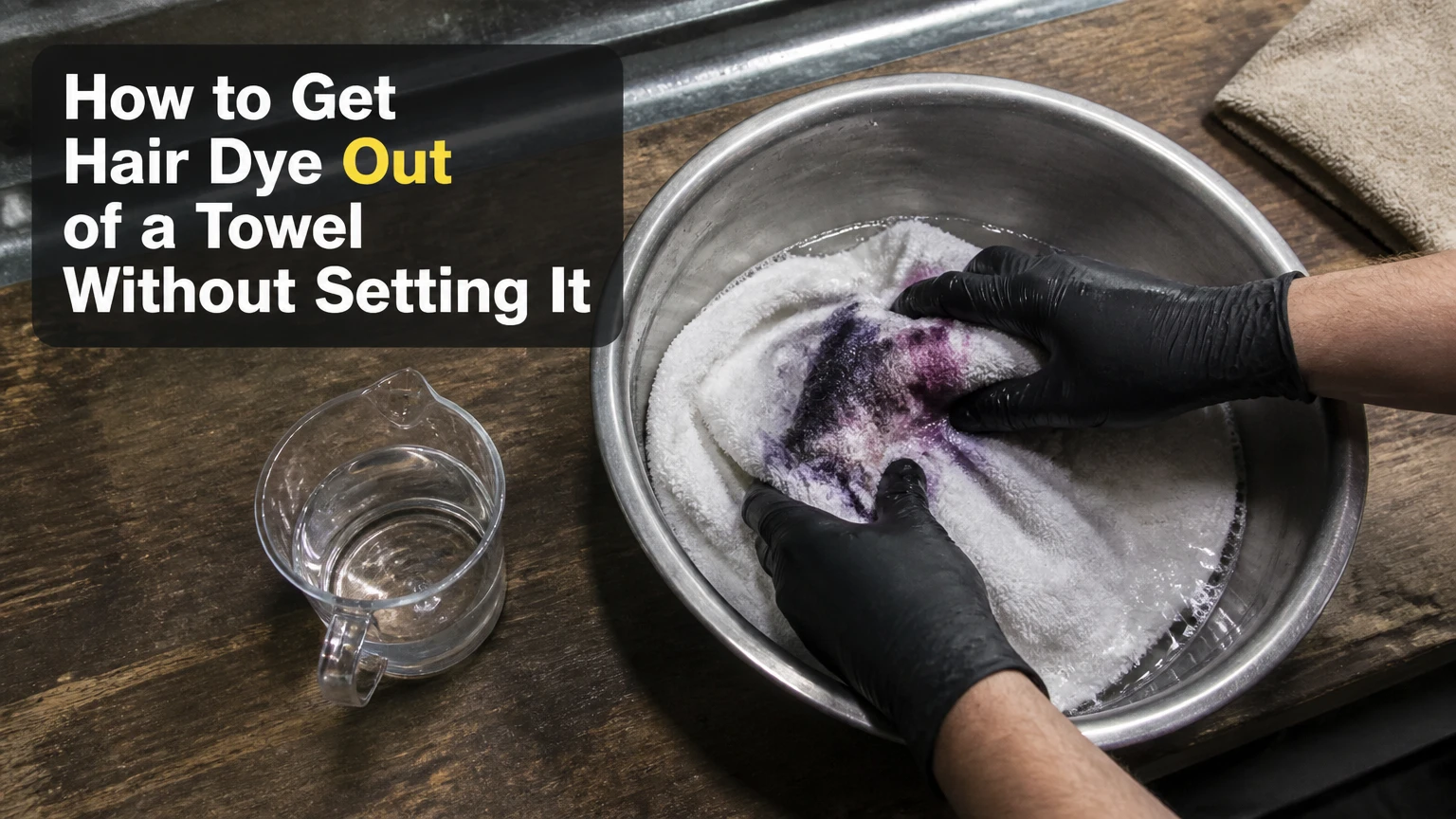
To get hair dye out of a towel, rinse the stain from the reverse side with cold water, pretreat it with liquid laundry detergent, then use oxygen bleach if the care label permits. Wash at the hottest fabric-safe setting, inspect before drying, and repeat treatment if pigment remains.
Key Facts at a Glance
Cold water should flow through the back of a fresh hair-dye stain for about 30 seconds.
Heavy-duty liquid laundry detergent is the safest first treatment for most cotton towels.
Oxygen bleach typically needs 1-8 hours to work, depending on stain age and dye concentration.
A dryer can make remaining pigment substantially harder to remove, so inspect the towel while damp.
Rubbing alcohol can help with some semi-permanent dyes, but it requires ventilation, a patch test, and careful rinsing.
Chlorine bleach is restricted to suitable white towels and can weaken cotton fibers or damage colored fabric.
What You Need Before Starting
Hair dye removal requires a washable work surface, running water, detergent, and one compatible stain treatment. Gather the supplies before wetting the towel because prompt treatment prevents pigment from drying inside the cotton loops.
Before You Start
| Item | Typical quantity | Typical cost | Purpose |
|---|---|---|---|
| Cold running water | 30 seconds | $0.01-$0.10 | Flush loose pigment |
| Liquid laundry detergent | 1-2 teaspoons per stain | $0.10-$0.40 | Suspend loosened dye |
| Oxygen bleach powder | Label dose, often 1 scoop per 4 L | $5-$15 | Oxidize residual color |
| Rubbing alcohol, 70% or 91% | 1-2 tablespoons for testing | $2-$5 | Dissolve some cosmetic pigments |
| White cloth or paper towel | 2-4 pieces | $0.05-$1 | Check color transfer |
| Old soft toothbrush | 1 | $1-$4 | Gentle localized agitation |
| Plastic basin | 4-8 L capacity | $5-$15 | Controlled soaking |
Typical time: 15 minutes for initial treatment, plus 1-8 hours for an oxygen-bleach soak.
Difficulty: Easy, provided the towel is not silk, wool, leather, or dry-clean-only material.
Cost: About $0.25-$15, depending on which products are already available.
Check the care label first. Cotton terry towels tolerate more agitation than microfiber, bamboo blends, or towels with decorative edging. Test every chemical on an inside hem for five minutes, rinse it, and compare the test area with the original color.
Why Does Hair Dye Stain a Towel?
Hair dye stains a towel because pigment, dye intermediates, oils, alkalizing agents, and conditioning polymers enter the spaces between cotton fibers. Permanent color is especially difficult because oxidation develops color inside the hair, while direct dyes in semi-permanent products can remain strongly attached to wet textile fibers.
Cotton terry fabric contains thousands of raised loops. Those loops increase absorbency, but they also trap pigment below the visible surface. A towel that looks clean after one rinse can release color during a later wash.
Three cleaning mechanisms matter:
| Mechanism | Chemical action | Best target | Main limitation |
|---|---|---|---|
| Surfactant suspension | Detergent surrounds loosened pigment | Fresh surface residue | Weak against dried permanent dye |
| Solvent dissolution | Alcohol loosens some binders and cosmetic residues | Small, fresh semi-permanent marks | Flammability and color-transfer risk |
| Oxidation | Oxygen bleach breaks down color-producing compounds | Residual dye on washable fabric | Requires soaking and label compatibility |
| Mechanical extraction | Water and gentle brushing move pigment outward | Loose surface dye | Aggressive scrubbing damages terry loops |
Oxygen bleach is usually preferable to chlorine bleach for colored towels because oxygen-based products can reduce staining without deliberately stripping the towel’s base color. The product label remains the authority because formulas and concentrations differ.
Hair electrolysis does not remove textile dye. Electrolysis is a hair-removal procedure that uses electrical energy at the follicle, whereas towel stain treatment relies on rinsing, surfactants, solvents, or oxidation.
How to Get Hair Dye Out of a Towel
The most reliable sequence is back-rinse, detergent pretreatment, compatible soaking, and washing without heat drying. The first treatment should begin before the stain dries, because wet pigment is easier to move than pigment fixed by a dryer.
Step 1: Flush the Stain From Behind
Turn the towel so the stained side faces downward, then run cold water through the reverse side for approximately 30 seconds. Back-rinsing pushes loose dye out of the towel instead of driving it farther into the terry loops.
Hold only the stained section under the tap when possible. A controlled stream reduces the risk of spreading dye across a larger area.
You will know it worked when the runoff becomes noticeably lighter and no loose color transfers to a white cloth after blotting.
Common mistake: Do not start by pouring hot water over the mark. Warm or hot water is not automatically a permanent setting agent, but heat can accelerate drying, spread some dyes, and make later correction harder. Cold water is the lowest-risk first rinse.
Step 2: Apply Liquid Detergent
Place the damp towel on a clean, colorfast surface. Apply 1-2 teaspoons of heavy-duty liquid laundry detergent to a stain approximately 5 centimeters across, then gently work from the outer edge toward the center with a soft toothbrush or fingertips.
Leave the detergent for 10-15 minutes. Do not let the product dry on the towel. Rinse from the reverse side again before choosing a stronger treatment.
Laundry detergent works because surfactants lift oily residues and keep loosened pigment suspended in the rinse water. Tide and Persil both recommend prompt pretreatment for dye-related clothing stains, although their exact product directions vary by formulation.
You will know it worked when the mark lightens and the damp towel stops releasing visible color during the rinse.
Common mistake: Vigorous brushing can fray terry loops and enlarge the stained area. Use short, light strokes instead of scrubbing until the fabric feels rough.
Step 3: Choose a Solvent or Oxygen Bleach
Select one treatment based on towel color, fiber, and dye age. Never combine rubbing alcohol with bleach, and never pour different stain products together.
For a colored cotton towel, dissolve the label-directed amount of oxygen bleach in warm water, commonly about one scoop in 4 liters. Submerge the towel for 1-8 hours, checking the stain and towel color every hour during the first treatment.
For a small, fresh stain from a temporary or semi-permanent product, place a white cloth beneath the mark and dab a small amount of 70% or 91% rubbing alcohol onto the stain. Blot from the outside inward, replace the backing cloth as it absorbs dye, and rinse thoroughly after 5-10 minutes.
| Towel and stain condition | First choice | Typical treatment time | Stop condition |
|---|---|---|---|
| Colored cotton, fresh stain | Liquid detergent | 10-15 minutes | Dye runoff decreases |
| Colored cotton, persistent stain | Oxygen bleach | 1-8 hours | Towel color begins changing |
| White cotton, dried stain | Oxygen bleach | 2-8 hours | Stain visibly lightens |
| Small semi-permanent mark | Rubbing alcohol test | 5-10 minutes | Backing cloth stops collecting dye |
| Microfiber towel | Detergent only initially | 10-15 minutes | Dye release slows |
| Silk or wool towel | Professional cleaner | Varies by cleaner | Do not soak at home |
Alcohol is not a universal hair-dye remover. It may loosen some direct dyes and binders, but it can also move color laterally, remove printed designs, or damage finishes. Ventilate the room, keep alcohol away from flames and heat, and do not put an alcohol-wet towel into a dryer.
You will know it worked when the stain becomes lighter without a pale halo or loss of the towel’s original color.
Common mistake: A long oxygen-bleach soak is not automatically safer. Excessive exposure can fade some dyes, weaken fibers over repeated use, or leave detergent residue if the towel is not rinsed well.
Step 4: Wash, Inspect, and Repeat
Wash the treated towel separately using the hottest cycle allowed by the care label. Use the normal detergent dose, select an extra rinse if available, and keep the towel out of the dryer until the mark has disappeared.
The washing machine removes suspended pigment after pretreatment has loosened it. The extra rinse matters because trapped dye and oxygen-bleach residue can remain between thick terry loops.
You will know it worked when the towel looks clean both wet and dry under bright light, with no gray, blue, red, or brown shadow around the original mark.
Common mistake: Do not judge success immediately after a warm wash. Some damp fabrics hide a faint stain, so inspect the towel under daylight after it has air-dried.
If pigment remains, repeat detergent treatment and an oxygen-bleach soak once. Two controlled treatments are preferable to one highly concentrated chemical application.
Which Hair Dye Stain Remover Should You Use?
Oxygen bleach is the best general-purpose choice for washable colored cotton towels, while detergent is the safest first step and rubbing alcohol is a targeted option for small fresh marks. Chlorine bleach works fastest on compatible white cotton, but its damage and discoloration risks make it a specialist option.
| Method | Suitable towel | Typical cost | Typical time | Main risk |
|---|---|---|---|---|
| Liquid laundry detergent | White or colored cotton | $0.10-$0.40 | 10-15 minutes | Incomplete removal |
| Oxygen bleach soak | Most colorfast cotton | $5-$15 per container | 1-8 hours | Fading or residue |
| Rubbing alcohol | Small testable mark | $2-$5 per bottle | 5-15 minutes | Spreading or flammability |
| Chlorine bleach | Label-approved white cotton | $3-$8 | 5-15 minutes | Fiber weakening or yellowing |
| Commercial color remover | Selected washable fabrics | $7-$12 | 30-60 minutes | Base-color removal |
When Should You Use Oxygen Bleach?
Use oxygen bleach when detergent has reduced but not removed the stain, especially on a colorfast cotton towel. Oxygen-based powder is generally more suitable than chlorine bleach for colored towels because it targets residual organic color without relying on aggressive decolorization.
Use the manufacturer’s dilution, not a stronger homemade concentration. The American Cleaning Institute advises following product labels and avoiding chemical combinations, because household cleaning products can react unpredictably.
Can Rubbing Alcohol Remove Hair Dye?
Rubbing alcohol can remove some fresh, small hair-dye marks, particularly when the stain contains direct pigment and cosmetic binders. Alcohol is less useful for a large dried permanent-dye stain, and it can spread dissolved color unless a clean absorbent cloth is placed beneath the towel.
Apply alcohol by dabbing, not pouring. Stop if the backing cloth shows the towel’s original color or if the stained area expands.
Should You Use Chlorine Bleach?
Use chlorine bleach only when the towel’s label permits it and the towel is genuinely white. Follow the bleach label exactly, dilute it in water before contact with fabric, limit exposure to the stated time, and rinse thoroughly.
Chlorine bleach can remove the towel’s own color, weaken cotton with repeated exposure, and create yellowing on some fabrics. Never mix chlorine bleach with ammonia, vinegar, acids, alcohol, or other cleaners.
What Changes for Different Dye and Towel Types?
Permanent, demi-permanent, semi-permanent, temporary, and bleach products do not stain towels in the same way. Permanent and demi-permanent color often needs oxidation or repeated treatment, while temporary color may release during prompt detergent rinsing.
| Product type | Typical pigment behavior | Best first treatment | Realistic expectation |
|---|---|---|---|
| Temporary spray or chalk | Surface pigment, low binder load | Cold rinse and detergent | Often improves within 15 minutes |
| Semi-permanent direct dye | Strong surface fiber adsorption | Detergent, then alcohol test | One to two treatments may work |
| Demi-permanent dye | Oxidative color and direct pigment | Detergent plus oxygen bleach | Partial fading is common |
| Permanent box dye | Oxidized dye compounds and oils | Detergent plus oxygen bleach | Dried marks may remain |
| Hair bleach or lightener | Removes textile color rather than adding pigment | No dye-removal method restores color | Discoloration may be permanent |
A white cotton towel gives you more options, but white does not guarantee complete restoration. A black salon towel may hide the mark better than it removes it, while a light-colored towel can show a faint altered patch after successful pigment reduction.
Microfiber needs a gentler approach. Use liquid detergent, cool water, and low mechanical force; avoid fabric softener because it coats microfiber and can reduce absorbency. Bamboo and rayon blends may require cooler water and shorter soaking periods than cotton.
How Do You Remove Dried or Heat-Set Hair Dye?
Dried hair dye should be loosened with detergent before an oxygen-bleach soak, but a dryer-set stain may only fade rather than disappear. Heat can drive oils, polymers, and pigment deeper into the textile structure, so repeated controlled treatment is safer than concentrated bleach.
Dried Stain Procedure
- Scrape away any surface residue with a blunt card.
- Wet the stain with cool water.
- Apply liquid detergent for 15 minutes.
- Rinse from the back.
- Patch-test oxygen bleach.
- Soak for 2-8 hours according to the label.
- Wash, air-dry, and inspect.
- Repeat once if the stain is lighter.
Do not use a dryer between attempts. If the towel has already been tumble-dried, record that limitation and assess whether a faint shadow is acceptable before escalating to a commercial color remover.
Commercial color removers can strip the towel’s own dye as well as the hair dye. They are therefore unsuitable for many colored towels, printed towels, and fabrics with mixed fibers.
What If Hair Dye Spread to Other Clothes?
Remove dye-transferred clothing from the dryer and rewash every affected item before drying. Separate white and colored fabrics, pretreat visible marks with liquid detergent, and use an oxygen-bleach product only on items whose labels permit it.
A color-catcher sheet may help during a subsequent wash, but it cannot reverse dye that has already bonded to fabric. Run a normal wash with the correct detergent dose and inspect each garment individually.
For a mixed load, do not add chlorine bleach simply because one item is white. Chlorine can damage elastane, colored trim, printed graphics, and neighboring garments.
Why Did the Towel Turn Purple, Green, or Gray?
Purple or green discoloration usually means two pigments remain together or the towel’s original color has been altered; it does not prove that a pH change alone caused a new stain. Gray residue often indicates diluted pigment spread through the loops, detergent buildup, or partial removal from a colored towel.
Vinegar is not a dependable universal treatment for hair dye. Acidic rinses may affect some residues, but vinegar will not reliably dissolve every dye and must never be combined with chlorine bleach.
Use this recovery sequence:
| Symptom | Likely cause | Corrective action | Avoid |
|---|---|---|---|
| Purple halo | Red and blue pigment overlap | Detergent rinse, then oxygen bleach test | Immediate chlorine bleach |
| Green patch | Blue pigment plus yellow towel color | Oxygen bleach test on hidden area | Assuming vinegar will reverse it |
| Gray shadow | Diluted pigment in terry loops | Repeat oxygen soak and wash alone | Dryer exposure |
| Pale ring | Treatment removed towel color | Stop chemical treatment | Stronger bleach |
| Sticky feel | Product residue or conditioner | Warm label-safe rinse | More detergent |
A white towel with a gray stain can sometimes improve with oxygen bleach. Hydrogen peroxide may also oxidize some pigments, but mixing peroxide with other cleaners is unsafe, and a peroxide paste is not automatically better than a correctly diluted commercial oxygen product.
What Are the Common Removal Mistakes?
The most damaging mistakes are drying too soon, mixing chemicals, scrubbing terry loops aggressively, and using a stronger product before testing a milder one. Each mistake either fixes pigment, enlarges the affected area, damages the base fabric, or creates a chemical hazard.
- Tumble-drying before inspection: Air-dry instead and repeat treatment while the stain remains visible.
- Scrubbing with a stiff brush: Switch to a soft toothbrush and use short strokes.
- Using alcohol on a large area: Test a hidden hem first and dab through an absorbent backing cloth.
- Soaking without checking colorfastness: Test the oxygen bleach solution for five minutes.
- Mixing vinegar with chlorine bleach: Rinse the towel completely, ventilate the room, and use one product at a time.
- Overloading the washer: Wash the stained towel alone or with similarly dark, washable items so loosened pigment has fewer surfaces to recolor.
A practitioner rule of thumb is to escalate one variable at a time. If detergent, alcohol, and bleach are all applied together, you cannot identify which product caused fading or determine which residue remains.
How Can Salons Prevent Repeated Towel Stains?
Salons reduce hair-dye towel losses by using dedicated dark cotton towels, separating chemical-service laundry, and rinsing stained items before they enter a full wash. Prevention costs less than repeatedly treating permanent black, blue, and red stains.
| Salon practice | Operating detail | Typical benefit | Trade-off |
|---|---|---|---|
| Dedicated dark towels | Black or charcoal cotton | Hides residual pigment | Stains remain chemically present |
| Immediate rinse station | 30-60 seconds per towel | Removes loose dye | Adds handling time |
| Separate stain load | 4-8 kg per wash | Limits transfer | More wash cycles |
| Oxygen bleach rotation | Label dose, monthly or as needed | Reduces accumulated residue | Can fade towels |
| Replacement threshold | Replace after persistent visible staining | Maintains presentation | Ongoing textile cost |
Dark towels do not make dye harmless. Residual color can transfer to light capes, client clothing, or cleaning cloths during later laundering.
Commercial salon stain removers may help with stubborn marks, but professional products still require label checks, ventilation, gloves, and a compatibility test. A dedicated laundry workflow is more reliable than relying on a single aggressive chemical.
How Much Time and Money Does Removal Take?
Most fresh towel stains cost less than $1 to treat and require 15-30 minutes of active work. Stubborn or dried stains commonly require a $5-$15 oxygen-bleach product and a 1-8-hour soak, while professional cleaning or replacement may be more economical for delicate towels.
| Situation | Active labor | Total elapsed time | Typical treatment cost | Likely result |
|---|---|---|---|---|
| Fresh cotton stain | 10-15 minutes | 30-90 minutes | $0.25-$1 | Good improvement |
| Fresh semi-permanent stain | 15-25 minutes | 1-2 hours | $2-$5 | Often substantial removal |
| Dried colored-towel stain | 20-30 minutes | 2-9 hours | $5-$15 | Fading or removal |
| Dryer-set permanent dye | 30-45 minutes | 3-12 hours | $5-$15 | Partial removal likely |
| Delicate or specialty towel | 5 minutes sorting | Cleaner-dependent | Local service price | Professional assessment |
| Repeated salon staining | 10-20 minutes per load | One wash cycle | Replacement varies | Prevention is usually better |
The most valuable variable is response time, not product price. A $0.20 detergent pretreatment applied immediately can outperform a $12 stain stripper used after several hot dryer cycles.
When Should You Stop Treating the Towel?
Stop chemical treatment when the towel’s original color begins to fade, a pale ring appears, the fabric becomes rough, or two complete treatment cycles produce no further improvement. At that point, additional bleach is more likely to damage the towel than remove the remaining pigment.
Use the towel for cleaning, designate it as a salon color-service towel, or replace it if appearance matters. No household method can guarantee removal of every permanent hair-dye formulation, especially after heat setting.
Frequently Asked Questions
Does hairspray remove hair dye from towels?
Hairspray is not a preferred modern stain treatment because many formulas contain little alcohol and add resins, fragrance, or oils. Liquid laundry detergent followed by a color-safe oxygen bleach soak gives a more predictable process for washable cotton towels.
Can baking soda remove hair dye from fabric?
Baking soda can provide mild alkalinity and gentle abrasion, but it does not reliably dissolve or oxidize permanent hair dye. Use detergent first and oxygen bleach when the care label permits; avoid abrasive baking-soda scrubbing on terry loops.
Can I use hydrogen peroxide on a white towel?
Hydrogen peroxide may lighten some dye on white cotton, but concentrated or prolonged exposure can damage fibers and should not be mixed with vinegar, chlorine bleach, or other cleaners. A labeled oxygen-bleach product provides clearer dilution and contact instructions.
How do I remove hair bleach from a towel?
Hair bleach usually creates a pale or orange discoloration by removing the towel’s original dye, so stain removers cannot restore the lost color. Rinse the towel thoroughly, wash it separately, and consider textile dye or replacement if the color change is permanent.
Should I use hot water or cold water?
Use cold water for the initial back-rinse, then use warm or hot water only when the towel’s care label and treatment product permit it. The hottest safe wash setting can improve detergent performance, but heat should never be used before stain inspection.
Can a professional cleaner remove permanent hair dye?
A professional cleaner may improve a heat-set or delicate-fabric stain, but permanent restoration is not guaranteed. Tell the cleaner the exact dye product, treatment history, and whether chlorine bleach, alcohol, or a dryer has already been used.
The Bottom Line
The safest answer to how to get hair dye out of a towel is to act quickly: flush the stain from the back with cold water, apply liquid detergent, use a tested oxygen-bleach soak when appropriate, then wash and inspect before drying. Detergent is the starting point, oxygen bleach is the strongest broadly useful option, and chlorine bleach belongs only on compatible white cotton towels.