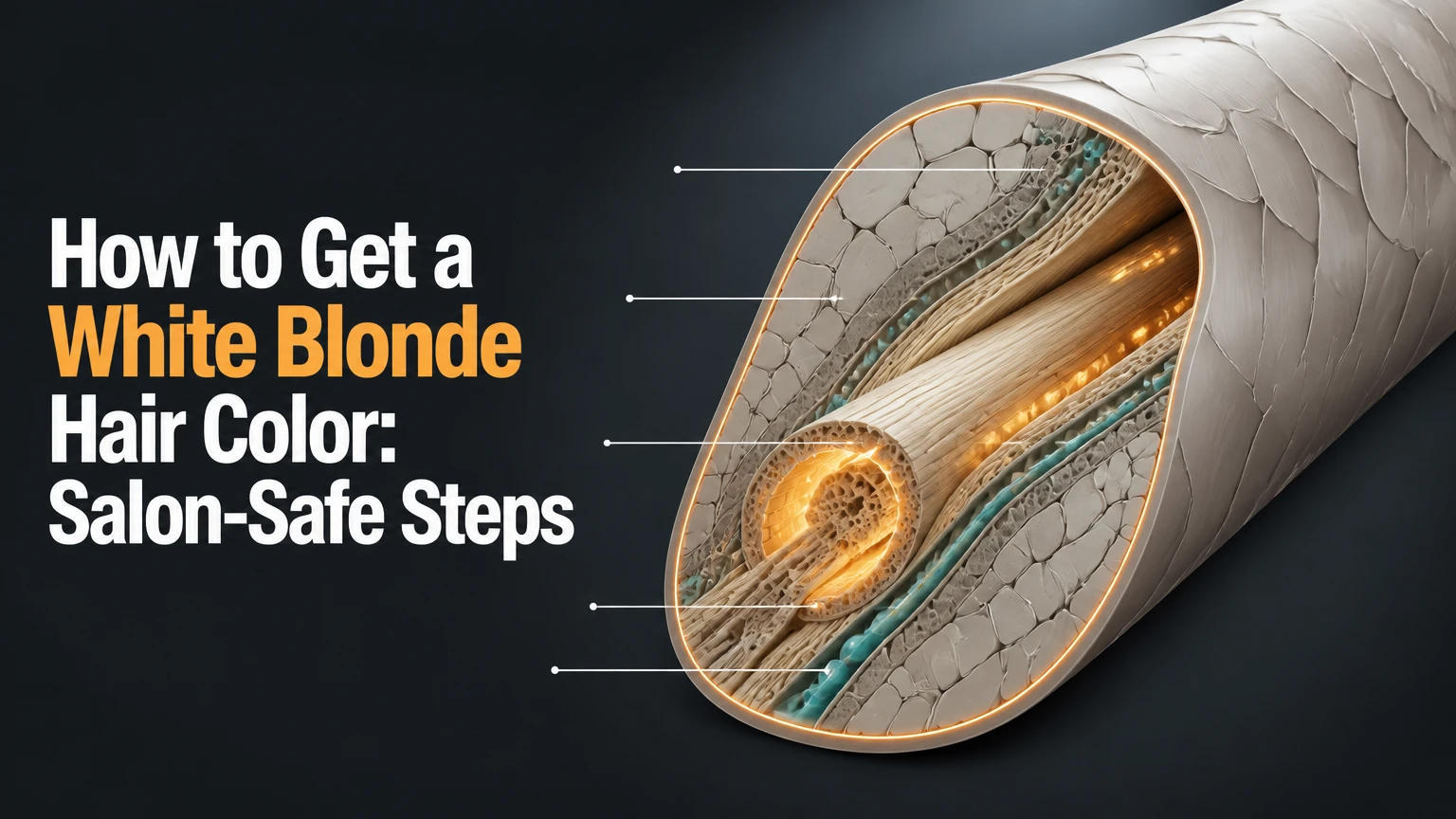
White blonde hair color requires lifting the hair to a very pale Level 10 yellow and then applying a carefully selected violet or violet-blue toner. The safest route is usually a licensed colorist, especially for dark, previously dyed, porous, or chemically treated hair, because white blonde requires substantial pigment removal and leaves little margin for overlapping bleach.
Key Facts at a Glance
- White blonde is usually a Level 10 or lighter result with minimal visible yellow pigment.
- Bleach creates lightness; toner adjusts the remaining undertone but cannot make dark orange hair white.
- A first salon appointment commonly takes 3-7 hours and may cost approximately $200-$600 or more in the United States.
- Dark hair, artificial black dye, henna, and fragile ends often require multiple appointments.
- Root maintenance commonly occurs every 4-6 weeks, before a long regrowth band develops.
- Hair that feels gummy, stretches excessively, or snaps when wet should not receive more bleach.
What Does White Blonde Mean?
White blonde is the palest practical blonde category, usually built on a Level 10 canvas rather than a naturally white pigment. The underlying hair should resemble the inside of a pale banana peel before toning, with no strong orange, gold, or deep yellow remaining.
Platinum blonde can look icy, silvery, pearl-toned, or nearly white. White blonde generally has less visible warmth than a conventional platinum shade, but the final appearance also depends on lighting, toner dilution, hair porosity, and the natural reflect of the formula.
Hair color levels describe depth, not the exact tone. A Level 8 may be medium blonde with strong yellow-orange pigment, while a Level 10 is much lighter and usually carries pale yellow. Toner works within that lightness range.
White Blonde Versus Platinum Blonde
| Color description | Typical level | Visible undertone | Maintenance pattern |
|---|---|---|---|
| Dark blonde | 7 | Yellow-orange | Gloss every 6-10 weeks |
| Light blonde | 8-9 | Yellow to pale yellow | Toner every 6-8 weeks |
| Platinum blonde | 9-10 | Pale yellow, pearl, or cool beige | Root service every 4-6 weeks |
| White blonde | 10+ | Very pale yellow, violet-neutralized | Root service every 4-6 weeks |
White blonde is not the same as gray hair, and it is not achieved by applying white dye over a darker base. Permanent color can shift natural pigment in limited circumstances, but artificial color cannot reliably replace the controlled lightening required for a clean Level 10 result.
How Does Bleaching Create White Blonde Hair?
Bleach and hydrogen peroxide developer oxidize natural melanin and some artificial color molecules inside the hair fiber. The process raises the cuticle, allows the lightening mixture to penetrate, and changes the pigment through successive red, orange, gold, and yellow stages.
Hair does not jump directly from brown to white. Dark hair normally exposes red and orange first, then gold and yellow as it becomes lighter. A colorist must control saturation, section size, timing, and product placement so the hair reaches the required level without unnecessary exposure on already-lightened areas.
The colorist also considers scalp heat. Fresh regrowth near the scalp often processes faster than mid-lengths because body heat accelerates the chemical reaction. Applying lightener over previously bleached lengths creates a different risk: the old hair may be too porous to tolerate another full application.
What Starting Level Do You Need?
Your natural starting level strongly predicts appointment length, cost, and the likelihood of multiple sessions. Artificial color history can matter more than natural level because color remover and bleach behave differently on previously colored hair.
| Starting hair level | Common appearance | Typical white-blonde route | Main risk |
|---|---|---|---|
| 1-2 | Black to dark brown | 2-3 salon sessions, often 4 weeks apart | Uneven orange bands and breakage |
| 3-4 | Medium to dark brown | 1-3 sessions after history assessment | Persistent red-orange pigment |
| 5-6 | Light brown to dark blonde | 1-2 sessions, depending on density | Gold, banding, and resistant roots |
| 7-8 | Blonde | Often one controlled session | Over-toning or porous ends |
| 9-10 | Very light blonde | Toner or gentle lift only | Fragility and violet absorption |
A practitioner rule of thumb is that a healthy Level 7 natural blonde has a materially easier route than a Level 3 client with years of black box dye, even if both clients describe their hair as “brown.” The colorist needs the strand test and chemical history, not a verbal shade name alone.
Can Every Hair Type Reach White Blonde?
Most healthy, untreated hair can potentially reach white blonde, but potential does not mean that the result is safe in one appointment. Fine hair may lift quickly yet lose strength quickly, while coarse hair can resist lightening and still become fragile after repeated processing.
Hair with permanent dye, henna, relaxer, perming solution, keratin treatment, or frequent high-heat styling needs a separate risk assessment. Henna may contain metallic salts or mixed ingredients that react unpredictably with lightener, so a strand test is mandatory before any full service.
What Should You Check Before Lightening?
Perform a professional consultation and strand test before committing to a global bleach service. The test should assess lift, elasticity, porosity, color history, scalp condition, and the behavior of the intended toner.
Use these pre-service checkpoints:
- Record the chemical history. Include box dye, permanent color, semi-permanent color, henna, relaxers, perms, and smoothing treatments from the previous two years.
- Inspect the ends. Split, translucent, rough, or thinning ends may need trimming before lightening.
- Test elasticity when wet. Healthy hair stretches slightly and returns toward its original length; overly stretchy hair indicates structural weakness.
- Test a hidden section. The colorist can measure the lift and observe whether the strand becomes brittle, rubbery, or uneven.
- Check the scalp. Cuts, sunburn, eczema flare-ups, and recent scratching increase discomfort and chemical injury risk.
- Review allergies and product instructions. A patch test may be required for certain color products, and manufacturer directions override generic timing advice.
Do not rely on skipping shampoo as a complete safety strategy. Natural oils may improve comfort for some people, but they do not prevent chemical damage, and a clean scalp may be necessary for accurate sectioning and product placement.
Which Lightening Method Fits Your Hair?
A platinum card or carefully controlled foil service is generally the most predictable option for creating an even white blonde result. Scalp bleach may suit experienced professionals and short regrowth, while DIY bleaching carries the highest risk of patchiness, scalp injury, and overlap damage.
| Method | Typical appointment | Best use | Main limitation |
|---|---|---|---|
| Platinum card foils | 4-7 hours | Full, even lift on dark or resistant hair | High labor cost and long sitting time |
| Global scalp lightener | 3-6 hours | Short, untreated regrowth | Scalp sensitivity and fast root lift |
| Highlights or babylights | 3-5 hours | Lower-maintenance blonde effect | Does not create solid white coverage |
| At-home open-air bleaching | 2-4 hours | Only limited, experienced applications | High risk of missed sections and overlap |
The phrase “safest” does not mean that one method eliminates damage. Foils can retain heat and increase lift, scalp application can irritate skin, and highlights leave some natural hair dark. The correct method depends on the target pattern, existing lightness, density, and condition.
DIY bleaching is particularly unsuitable for dark hair, long hair, layered color, or any hair with unknown history. A mirror cannot reliably show the back of the head, and a small missed section can produce a visible band after toning.
How to Get a White Blonde Hair Color Professionally
A professional white-blonde service usually follows seven controlled stages: consultation, sectioning, lightener application, monitoring, rinse assessment, toning, and conditioning. The decisive checkpoint is the post-rinse level, because a toner cannot transform Level 7 orange or Level 8 gold into a true white blonde.
Step 1: Prepare the Hair and Scalp
Bring photographs taken in natural light and identify whether the goal is pearl white, icy white, silver white, or neutral platinum. Avoid applying oils, color, or intensive protein treatments immediately before the appointment unless the colorist instructs you to do so.
The colorist sections the hair into manageable quadrants or smaller working zones. Fine sections and complete saturation matter more than using a stronger developer.
You will know preparation worked when: the hair history is documented, the scalp is intact, and the strand test gives a predictable lift.
Common mistake: hiding old black dye or henna because the color appears faded. Residual pigment still affects the chemical result.
Step 2: Apply Lightener to the Correct Areas
The colorist applies lightener to virgin hair or regrowth while avoiding unnecessary overlap onto pale lengths. Product choice, developer strength, and placement follow the brand’s professional instructions and the hair’s condition.
Many colorists begin slightly away from the scalp on virgin lengths, then address the root area later because scalp heat speeds processing. This is a technique decision, not a universal rule for every formula.
You will know application worked when: every section is fully saturated, the product remains moist, and no previously lightened band is coated without a specific reason.
Common mistake: using a stronger developer to compensate for thick sections. Poor saturation produces patchy lift even when the chemical strength increases.
Step 3: Monitor Lift and Elasticity
Check the hair at regular intervals according to the product instructions, usually at least every 5-10 minutes. A colorist monitors the exposed level, scalp comfort, product moisture, and wet or dry elasticity rather than allowing the mixture to process by timer alone.
A fixed 45-50 minute limit is not universal because professional lighteners have different maximum development times. Exceeding the manufacturer’s instructions is unsafe, and adding heat can accelerate damage without producing an even result.
You will know monitoring worked when: the hair reaches a pale yellow level while retaining enough strength for rinsing and toning.
Common mistake: leaving lightener on because one darker strand remains. The correct response may be selective reapplication, a later session, or a darker result, not unlimited processing.
Step 4: Rinse and Evaluate the Canvas
Rinse thoroughly with lukewarm water when the hair reaches the planned level or the maximum permitted time. Evaluate the hair before choosing a toner, because wet hair can look lighter and cooler than it will appear after drying.
| Rinsed result | Underlying pigment | Correct next decision |
|---|---|---|
| Level 7 orange | Orange and yellow | Do not use a white toner; reassess later lifting |
| Level 8 gold | Gold and yellow | Use a gold-neutralizing plan only if the target allows warmth |
| Level 9 yellow | Yellow | Select a violet or violet-blue toner for a cooler blonde |
| Level 10 pale yellow | Very pale yellow | Tone toward pearl, icy, or white blonde |
| Uneven levels | Multiple pigments | Correct selectively or postpone the final tone |
You will know evaluation worked when: the lightest and darkest zones are identified separately, and the hair passes an elasticity check.
Common mistake: toning the whole head to disguise uneven lift. Toner can temporarily reduce visual contrast but cannot correct a dark band.
Step 5: Select and Apply the Toner
Toner deposits or adjusts color; it does not significantly lighten a dark base. Violet counters yellow, blue counters orange, and violet-blue may address a mixture of pale yellow and residual gold, but the formula must match the actual undertone.
Porous ends can absorb cool pigment faster than healthier roots. A colorist may use different formulas, timing, or dilution on different zones, then rinse when the target is reached rather than waiting for a single maximum time.
You will know toning worked when: the hair appears even in neutral daylight, with no strong yellow cast and no blue or purple saturation.
Common mistake: choosing an intensely violet toner for hair that is too dark. The result can look gray, muddy, or lavender while the underlying warmth remains.
Step 6: Condition Without Masking Damage
After toning, use the color line’s recommended cleanser and a conditioning treatment suited to bleached hair. Bond-building products may support the feel and manageability of compromised hair, but they cannot restore hair that has already broken.
Ask the colorist whether the hair needs moisture, protein, or a balanced rotation. Excess protein can make some hair stiff, while excessive moisture can leave weak hair overly soft and difficult to style.
You will know conditioning worked when: the hair detangles with limited force and does not feel gummy when wet.
Common mistake: treating a damaged strand with repeated protein masks while continuing to bleach the roots over the same fragile lengths.
Step 7: Photograph the Result in Neutral Light
Check the final color near a window rather than under a strong salon lamp. White blonde can appear blue under cool LEDs and warmer under incandescent bulbs.
Photographs help identify whether the desired result is truly white, pearl, silver, or simply very light blonde. That distinction improves the next toner consultation.
How Much Time and Money Does White Blonde Require?
A first professional white-blonde service commonly takes 3-7 hours and costs approximately $200-$600 or more in the United States, while a root retouch often costs $150-$300. Dense hair, corrective color, metropolitan pricing, extra-long lengths, and multiple sessions increase both figures.
| Service situation | Typical time | Typical US price | Likely schedule |
|---|---|---|---|
| Natural Level 8 to white blonde | 3-4 hours | $200-$400 | One session, toner refresh |
| Natural Level 5-7 to white blonde | 4-6 hours | $300-$600 | One or two sessions |
| Natural Level 1-4 to white blonde | 5-7 hours per session | $400-$800+ | Two or three sessions |
| Existing dark dye correction | 5-8 hours | $500-$1,000+ | Consultation-led, staged lifting |
| Root retouch under 1.25 cm | 2-4 hours | $150-$300 | Every 4-6 weeks |
| Toner or gloss refresh | 30-90 minutes | $60-$180 | Every 4-8 weeks |
These are typical planning ranges, not universal prices. Ask whether the quote includes toner, bond treatment, blow-dry, haircut, corrective work, and a second lightening appointment.
How Should You Maintain White Blonde Hair?
White blonde hair usually needs a root appointment every 4-6 weeks, with toning or glossing as needed between services. Waiting until regrowth becomes long increases the chance of a visible hot-root band because the hair nearest the scalp processes differently from hair farther away.
Use a maintenance plan based on actual fading and condition:
| Maintenance action | Typical frequency | Product or behavior | Purpose |
|---|---|---|---|
| Gentle color-safe shampoo | 1-3 washes weekly | Sulfate-conscious cleanser if suitable | Reduce dryness and fading |
| Purple shampoo | Every 1-2 weeks | Short contact time, visual check | Reduce yellow cast |
| Deep conditioning | Weekly | Moisture-focused mask | Improve slip and manageability |
| Heat protection | Every heat session | Product rated for thermal styling | Limit additional stress |
| Professional toner | 4-8 weeks | Demi-permanent gloss or toner | Refresh tone |
| Root lightening | 4-6 weeks | Professional regrowth service | Prevent difficult banding |
Purple shampoo is not a substitute for lightening. Frequent use on porous hair may create violet patches, while shampoo cannot remove orange pigment from hair that never reached a pale enough level.
Wash with lukewarm rather than very hot water, detangle from ends upward, and avoid tight styles when the hair is wet. Bleached hair has reduced tensile strength, so mechanical friction can compound chemical damage.
What Are the Most Common White-Blonde Mistakes?
The most damaging mistake is overlapping lightener onto already-lightened hair. The overlap can weaken the same section twice, causing snapping or a short breakage line that some stylists call a chemical haircut.
Other common failures include:
- Using 40-volume developer as a shortcut. Higher developer is not automatically faster or safer. Scalp discomfort, swelling, and fiber damage can increase without producing even lift.
- Applying toner before sufficient lift. Purple toner can neutralize pale yellow, but it cannot remove the orange pigment in Level 7 hair.
- Working in thick sections. A thin, saturated section lifts more evenly than a thick section with dry interior strands.
- Ignoring artificial color history. Faded black dye remains chemically relevant even when the visible surface looks brown.
- Waiting too long between root services. Longer regrowth creates a hot-root zone beside a cooler mid-length zone.
- Using clarifying shampoo aggressively after toning. Clarifying can fade excess toner, but repeated washing may worsen dryness and does not repair structural damage.
A counterintuitive professional rule is that the lowest workable developer is often preferable to the strongest available developer. Controlled saturation and correct timing usually provide more predictable results than chemical force.
How Do You Fix Yellow, Orange, Purple, or Gummy Hair?
Color correction begins by identifying the underlying level and hair condition, not by immediately applying another toner. Yellow hair may need a different violet formula, orange hair may need more lift, and gummy hair needs a complete pause in chemical processing.
| Problem | Likely cause | Immediate action | Do not do |
|---|---|---|---|
| Bright yellow | Level 9-10 hair with warm residue | Use a measured violet toner or consult a colorist | Rebleach healthy and fragile areas together |
| Orange hair | Insufficient lift at Level 7-8 | Wait and reassess condition before another service | Add purple shampoo repeatedly |
| Purple or blue hair | Porous hair absorbed excess cool pigment | Wash gently once or twice and condition | Use bleach to remove toner |
| Gummy, stretchy hair | Severe structural weakening | Stop bleach and heat, seek professional assessment | Brush hard or apply permanent color |
| Dark root band | Regrowth processed unevenly | Book a corrective consultation | Paint lightener over the whole head |
| Uneven blonde | Missed saturation or color history | Map zones and correct selectively | Cover everything with one dark shade |
Hair that stretches dramatically when wet, feels elastic like chewing gum, or breaks during gentle detangling should not receive another bleaching service. A bond-building treatment may improve handling, but no product can make severely compromised hair safe for immediate re-lightening.
Is DIY White Blonde Hair Safe?
DIY white blonde bleaching is safest only in narrow circumstances, such as short, untreated, already-light blonde hair where the application can avoid overlap. Home bleaching is a poor choice for dark hair, long hair, previously dyed hair, henna-treated hair, or hair with visible breakage.
At-home users commonly cannot control back-section saturation, scalp placement, processing intervals, or formula differences between root and length. Box kits also provide limited flexibility when one area lifts faster than another.
If a salon is inaccessible, reduce the target rather than increasing chemical strength. A soft platinum, pale beige blonde, highlights, or a temporary wig can provide the visual effect with less risk than attempting a solid white result in one session.
What Alternatives Create a White-Blonde Look?
Highlights, extensions, wigs, and temporary sprays can create a white-blonde appearance without lightening every strand. These alternatives are useful when the hair is too fragile, the budget is limited, or the wearer wants to test the color before committing to permanent bleaching.
| Alternative | Typical longevity | Approximate cost | Best situation |
|---|---|---|---|
| High-impact highlights | 8-16 weeks before refresh | $150-$500 | Dimension with less full-head bleach |
| White-blonde human-hair extensions | 6-12 months with care | $300-$1,500+ | Immediate length and color change |
| Synthetic white-blonde wig | 1-6 months of regular wear | $30-$500 | Testing the look without chemical exposure |
| Temporary color spray or wax | 1-3 washes | $10-$30 | Short-term event or photograph |
| Halo or clip-in pieces | 6-18 months with care | $50-$400 | Occasional wear and low commitment |
Hair electrolysis does not create blonde hair and cannot replace bleaching or toning. Electrolysis uses an electrical current to disable individual hair follicles for permanent hair removal, so it belongs to facial or body hair-removal services, not scalp color services. It should never be used as a hair-lightening technique.
Which Route Fits Your Situation?
Your current level, chemical history, hair strength, and desired coverage determine the appropriate route. A natural Level 8 with strong hair may need one salon visit, while a Level 2 client with black dye should plan for staged correction or choose an alternative.
Natural Blonde Hair
Natural Level 7-9 hair often reaches white blonde in one appointment if the fiber is healthy. The main challenge is evenness, because fine baby hairs, resistant areas, and porous ends may need separate toner handling.
Dark or Coarse Hair
Dark or coarse hair commonly needs two or three sessions spaced about four weeks apart. The safest interim result may be copper, orange-gold, or warm blonde, because forcing a pale canvas too quickly increases breakage risk.
Fine or Previously Damaged Hair
Fine or damaged hair may reach Level 10 quickly but fail the elasticity test afterward. The better strategy is lower exposure, smaller services, frequent conditioning, and a less aggressive target such as pale beige or highlighted platinum.
Box Dye or Black Dye
Box dye can create bands because different areas contain different amounts of artificial pigment. A colorist may use a strand-tested color remover, selective lightener, or a darker transitional shade, but no universal product safely removes every dye history.
Henna or Metallic-Salt History
Tell the colorist about henna even if it was used months or years ago. A strand test can reveal heat, discoloration, smoking, or breakage that would make a full bleach service unsuitable.
Frequently Asked Questions
Can permanent blonde dye make hair white?
Permanent blonde dye can lighten some natural hair, particularly at lighter starting levels, but it cannot reliably create a white Level 10 result over dark or previously colored hair. White blonde usually requires controlled lightening followed by a toner, and artificial color generally cannot lift artificial color evenly.
How often should white blonde hair be toned?
Most white-blonde clients refresh the tone about every 4-8 weeks, depending on washing frequency, porosity, water quality, and the desired coolness. Purple shampoo may extend the visual result, but excessive use can stain porous ends violet and make the color look dull.
Can hard water make white blonde hair yellow?
Hard water can leave mineral deposits that make pale hair look dull, yellow, orange, or greenish. A salon mineral-removal treatment may help, but frequent chelating can dry bleached hair, so use it according to the product schedule and follow with conditioning.
Should you bleach hair that has split ends?
Bleaching hair with extensive split ends increases the chance of fraying and breakage. Trim compromised ends where possible, complete a strand test, and consider highlights or a wig if the remaining fiber cannot tolerate a full lightening service.
Why did white blonde hair turn beige after one wash?
A beige shift may result from toner fading, porous hair releasing cool pigment, mineral deposits, or warm lighting. Compare the hair in daylight, use a gentle cleanser, and ask a colorist to identify whether the problem is tone loss or insufficient initial lift.
Can white blonde hair become healthy again?
Bleached hair cannot biologically return to its unprocessed state because the removed pigment and altered keratin structure do not regenerate inside the existing fiber. New growth can be healthy, while trims, conditioning, reduced heat, and careful handling improve the feel of the treated lengths.
The Bottom Line
To get a white blonde hair color, lift the hair evenly to a pale Level 10 yellow, assess elasticity, and use a tailored violet or violet-blue toner only after sufficient lightness is present. Start with a strand test and complete color history, choose a professional service for dark or processed hair, schedule roots every 4-6 weeks, and stop immediately if the hair becomes gummy or snaps.