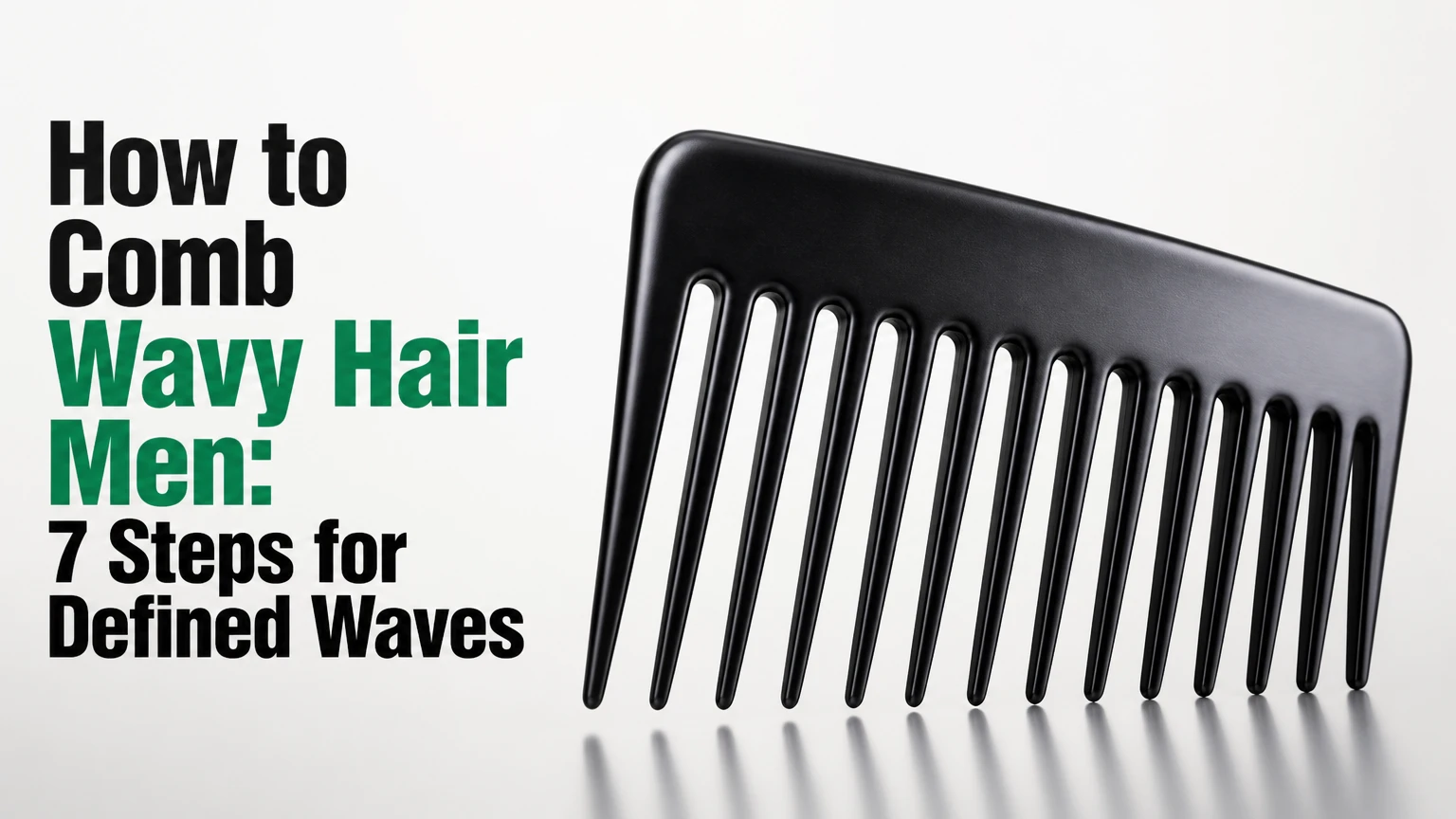
To comb wavy hair men should work from damp or soaking-wet hair, use conditioner for slip, start at the ends with a wide-tooth comb, and finish with minimal directional styling. The method takes about 3-5 minutes, while drying usually takes 30-90 minutes. The main success factor is reducing friction before the hair begins to dry.
Key Facts at a Glance
Damp, conditioned hair is the safest state for detangling medium and long waves.
A wide-tooth comb with roughly 4-8 mm spacing separates knots without aggressively breaking wave clumps.
Start at the ends and move upward in short sections; beginning at the roots pushes knots downward.
Fine 2A hair usually needs less product than coarse 2C hair, even when both have similar length.
Touching or repeatedly combing waves while they dry commonly increases frizz.
Electrolysis removes individual hair follicles through a professional process; it does not define, straighten, or improve scalp waves.
Before Combing Wavy Hair, Identify the Hair’s Needs
Men’s wavy hair falls broadly into Type 2A, 2B, or 2C, but wave classification alone does not determine the routine. Strand thickness, density, porosity, haircut length, scalp oil production, and chemical damage often matter more than the label.
Type 2A hair forms loose bends and can lose volume under heavy creams. Type 2B hair develops clearer S-shaped waves and often needs moderate conditioning. Type 2C hair has tighter bends, greater shrinkage, and a higher chance of tangling, so it benefits from more slip and smaller sections.
| Hair profile | Typical pattern | Main combing risk | Useful adjustment |
|---|---|---|---|
| Fine 2A, short | Loose bends under 5 cm | Flattened roots | Use fingers or a 4-6 mm comb |
| Medium 2B, medium length | Visible S-waves from 5-12 cm | Frizz and broken clumps | Detangle with conditioner, then scrunch |
| Coarse 2C, medium length | Tight S-waves with volume | Snagging and breakage | Use smaller sections and more conditioner |
| Dense, collar-length waves | Multiple overlapping wave groups | Hidden knots near the nape | Detangle from ends upward in 2-4 cm sections |
| Damaged or bleached waves | Uneven, porous strands | Stretching and snapping | Use lower tension and a richer rinse-out conditioner |
Hair length changes the mechanical problem. Short hair rarely needs full detangling because the strands cannot form long knots; longer hair needs controlled sectioning because one knot can catch surrounding wave groups.
Should Men Comb Wavy Hair Wet or Dry?
Men should comb wavy hair wet or damp when the goal is definition and low-frizz detangling. Dry combing is acceptable for a very short cut, a precise part, or a small isolated knot, but a full dry pass usually separates wave clumps and increases volume.
Water temporarily changes the hydrogen-bond pattern that helps hair retain its current shape. Conditioner adds slip, which lowers the pulling force needed to move strands past one another. The result is less mechanical stress and a better chance of preserving grouped waves.
The American Academy of Dermatology Association advises gentle hair care and warns that excessive brushing can damage hair; its consumer guidance states, “There is no need to brush your hair 100 strokes a day.” The practical lesson for wavy hair is simple: use the fewest passes that achieve the desired result.
Dry combing is not automatically destructive. A man with 3 cm of fine 2A hair may use a clean comb briefly without creating significant tangling. The problem appears when a wide wave pattern is pulled apart repeatedly, especially after sea salt spray or when the hair is already dry and rough.
How to Comb Wavy Hair Men: The 7-Step Method
The following routine works for most short-to-medium men’s wavy hairstyles and takes approximately 3-5 minutes before drying. Use a wide-tooth comb during detangling, then switch to fingers for final placement when possible.
Step 1: Wet the Hair Thoroughly
Rinse the hair until every section is evenly wet, including the crown and area behind the ears. Water should reach the scalp, but the hair does not need to drip continuously before conditioner is added.
For a normal wash, apply shampoo mainly to the scalp and massage with fingertips rather than scratching with nails. Rinse, then spread conditioner through the mid-lengths and ends. Keep heavy conditioner away from an oily scalp unless the hair is very coarse or dry.
You’ll know it worked when: the hair feels evenly slippery and no dry, resistant patch remains.
Common mistake: applying shampoo to the ends and scrubbing the lengths, which can increase roughness and tangling.
Step 2: Apply Enough Conditioner for Slip
Use a typical starting amount of 5-10 ml for short-to-medium hair and 10-15 ml for dense or collar-length hair. The correct quantity depends on density and strand thickness, not gender.
Press the conditioner through the hair with flat hands. Do not twist or rake aggressively while the hair is still tangled. Let the conditioner sit for about 1-3 minutes, following the product label.
You’ll know it worked when: a wide-tooth comb can pass through the ends with light resistance rather than catching immediately.
Common mistake: using a small coin-sized amount on thick hair, then compensating with force. Add slip before adding tension.
Step 3: Divide Long or Dense Hair Into Sections
Men with hair longer than approximately 8-10 cm, dense 2C hair, or a heavily layered cut should divide the hair into two to four sections. Use fingers to separate sections without creating tight ponytail tension.
Start with the least tangled area, usually the front or sides, before moving to the nape. Sectioning prevents a comb from dragging a knot through an entire side of the head.
You’ll know it worked when: each section is narrow enough to see the ends clearly.
Common mistake: trying to detangle the whole head as one mass. This increases snagging and makes it difficult to locate the original knot.
Step 4: Detangle From the Ends Upward
Place the wide-tooth comb approximately 2-3 cm from the ends and make short, gentle strokes. Once that area moves freely, work 2-3 cm higher and repeat until the comb reaches the roots.
Hold the hair above the area being combed when practical. This reduces force transferred to the scalp and limits unnecessary stretching. If the comb stops, remove it, add water or conditioner, and separate the knot with fingers.
You’ll know it worked when: the comb travels from roots to ends in one smooth pass without snagging.
Common mistake: starting at the roots. Root-first combing pushes the entire knot toward the ends, where it becomes tighter and harder to remove.
Step 5: Rinse Without Destroying the Wave Groups
Rinse most of the conditioner with lukewarm or cool water while keeping the hair pointed downward. A cool rinse does not permanently “seal” the cuticle, but it can feel more comfortable and may reduce the temptation to use very hot water.
Leave a small amount of rinse-out conditioner only if the product label supports leave-in use. Otherwise, rinse thoroughly and apply a separate leave-in conditioner after washing.
You’ll know it worked when: the hair feels smooth but not coated, greasy, or waxy.
Common mistake: leaving heavy rinse-out conditioner in fine hair. The roots may appear flat within a few hours.
Step 6: Style While the Hair Is Damp
Blot with a microfiber towel or smooth cotton T-shirt. Press and squeeze; do not rub the hair sideways. Apply one product at a time so you can identify what improves or harms the result.
Use praying hands to smooth a cream or leave-in over the surface. Use fingers to rake lightly through separated sections. Scrunch upward once or twice to encourage the natural bend, then use the comb only for the part or directional shape.
Typical starting amounts are 1-2 ml of leave-in cream for short hair, 2-4 ml for medium hair, or 1-2 pumps of mousse. Sea-salt spray often begins at 3-6 sprays, but salt can make dry or chemically treated hair feel rough.
You’ll know it worked when: wave groups look organized while wet, with no white residue or greasy film.
Common mistake: layering salt spray, cream, pomade, and oil in one routine. Product buildup can mimic dryness and make the comb drag.
Step 7: Set the Hair While It Dries
Air-dry without repeatedly touching, rearranging, or combing the hair. For faster drying, use a diffuser on low airflow and low-to-medium heat, keeping the attachment moving rather than concentrating heat on one area.
Diffuse from underneath for volume or from above for a smoother finish. Stop when the roots and interior feel dry, not merely when the surface appears set.
You’ll know it worked when: the hair feels dry at the roots and the wave pattern remains grouped.
Common mistake: high-speed airflow. Strong air separates clumps before the styling product has formed a stable hold.
Which Comb or Brush Is Best for Men’s Wavy Hair?
A wide-tooth comb is the best default for wet detangling, while fingers are usually better for dry touch-ups. A vent brush can help with controlled blow-drying, but a dense brush or fine-tooth comb is more likely to flatten or separate medium and long waves.
Choose a tool with smooth, rounded teeth or pins. Inspect the comb under bright light; rough seams, sharp edges, cracked teeth, and melted areas can catch the cuticle regardless of material.
| Tool | Typical specification | Best use | Main limitation |
|---|---|---|---|
| Wide-tooth comb | 4-8 mm tooth spacing | Wet detangling and loose direction | Limited precision for tight parts |
| Finger styling | 5 fingers, no fixed spacing | Dry refresh and natural finish | Less consistent parting |
| Vent brush | Open vents, flexible pins | Root drying with a blow dryer | Airflow can increase frizz |
| Styling brush | 7-9 rows, smooth nylon pins | Damp definition and neat shaping | Can pull if knots remain |
| Fine-tooth comb | 1-3 mm spacing | Short hair and precise edges | Poor choice for tangled medium hair |
Material matters less than finish and technique. Cellulose acetate, wood, carbon-fiber plastic, and polished hard plastic can all work when the teeth are smooth; a premium material cannot compensate for pulling through a knot.
How Much Do Tools and Products Usually Cost?
Typical retail prices vary by country and brand, but a functional routine does not require expensive equipment. A wide-tooth comb, regular conditioner, and one lightweight styler cover most men’s wavy-hair needs.
| Item | Typical price range | Replacement or use interval | Best reason to buy |
|---|---|---|---|
| Wide-tooth comb | $5-$25 | Replace when teeth roughen or crack | Wet detangling |
| Microfiber towel | $8-$25 | Replace when fabric becomes abrasive | Lower-friction blotting |
| Leave-in conditioner | $8-$25 | 2-4 months with regular use | Slip and moisture |
| Mousse or light cream | $8-$30 | 2-4 months with regular use | Definition without heavy wax |
| Sea-salt spray | $8-$25 | 2-4 months with regular use | Matte texture and grit |
| Diffuser attachment | $15-$50 | Several years if undamaged | Lower-disturbance drying |
Prices are typical consumer ranges, not fixed market prices. Local availability, salon brands, and imported products can change the total substantially.
Which Products Match 2A, 2B, and 2C Hair?
Fine 2A waves usually need the lightest formula, while coarse 2C waves generally tolerate more conditioning and hold. Product weight should follow strand thickness and density, not the assumption that all wavy hair is dry.
| Hair situation | First product to test | Starting amount | Avoid first |
|---|---|---|---|
| Fine 2A, oily scalp | Lightweight mousse | 1 pump | Heavy butter or oil |
| Medium 2B, normal scalp | Light cream or mousse | 1-2 pumps | Thick petroleum pomade |
| Coarse 2C, dry ends | Leave-in cream plus gel | 2-4 ml plus 1-2 ml | Repeated salt spray |
| Formal side part | Water-based light pomade | 1-2 ml | Greasy oil-based wax |
| Matte textured crop | Sea-salt spray or dry-texture spray | 3-6 sprays | Multiple layers of clay |
Sea-salt spray adds texture by increasing grip, but frequent use can leave some hair feeling dry or stiff. A leave-in conditioner improves slip, while mousse or gel supplies hold with less weight than a dense wax.
Pomade is useful for a defined side part or controlled sweep, but it is not ideal for maximum wave volume. Apply it mainly to the surface and ends after the hair has been shaped, rather than pressing a large amount into the roots.
How Should You Comb Short, Long, Thick, or Fine Wavy Hair?
Short wavy hair can usually be shaped with fingers after washing, while long or dense wavy hair requires sectioning and deliberate ends-first detangling. Fine hair needs less product and lower tension; coarse hair needs more slip but not necessarily more combing.
Short Wavy Hair
For hair under approximately 5 cm, apply a small amount of mousse or cream to damp hair and use fingers to establish the part. A comb is useful for a clean line or controlled fringe, but repeated passes can remove root lift.
Medium-Length Wavy Hair
For hair between approximately 5 and 12 cm, detangle with conditioner, then comb once toward the desired part. Scrunch the ends and leave the hair alone during drying.
Long or Coarse Wavy Hair
For hair beyond 12 cm, use two to four sections and detangle in 2-3 cm increments. Apply leave-in conditioner to the lengths, but keep the scalp area light unless the scalp is dry.
Fine or Flat Wavy Hair
Use less cream, lift the roots with fingers, and diffuse from underneath. Avoid brushing the roots repeatedly because tension can create temporary smoothness while sacrificing overall wave volume.
Chemically Treated or Damaged Hair
Use lukewarm water, generous conditioner, and minimal tension. The American Academy of Dermatology Association recommends gentle handling because wet hair can be more vulnerable to breakage in certain circumstances, especially when hair is already damaged.
What Causes Frizz, Flat Roots, and Crunchy Waves?
Frizz usually comes from friction, broken wave groups, product incompatibility, or humidity entering unevenly porous hair. Flat roots usually result from excess product, downward drying, or a haircut that places too much weight at the crown.
| Visible problem | Likely cause | Immediate fix | Next-wash adjustment |
|---|---|---|---|
| Puffy, undefined hair | Dry full-head combing | Mist with water and finger-coil large sections | Detangle under conditioner |
| Flat crown | Heavy cream or downward drying | Lift roots and diffuse underneath | Reduce product at roots |
| Crunchy finish | Excess gel or mousse | Scrunch only after fully dry | Use 25-50% less product |
| Greasy appearance | Oil or pomade overload | Blot surface and avoid adding water | Apply styler to lengths only |
| Snagging comb | Rough teeth or hidden knot | Add conditioner and finger-separate | Replace damaged tool |
| Uneven waves | Hair dried in different directions | Re-wet the inconsistent area | Style in smaller sections |
A crunchy cast is not necessarily a failure. Once hair is completely dry, gently squeeze the wave groups with clean, dry hands. If the hair remains sticky or hard after scrunching, the product quantity was excessive or the formula does not suit the hair.
Hard water can also contribute to rough-feeling hair through mineral deposits. If hair suddenly feels coated after washing in a new location, use a chelating or clarifying product according to its label rather than increasing conditioner indefinitely.
How Often Should Men Comb Wavy Hair?
Most men need one complete detangling session on wash day and, at most, one additional damp styling session. Daily dry brushing is unnecessary for definition-focused wavy hair, particularly when the hair is longer than 5 cm.
Comb when the hair has a real need: knots, a wash-day reset, a formal part, or a controlled restyle. Do not use a fixed stroke count. The American Academy of Dermatology Association’s guidance supports minimizing unnecessary brushing and handling.
Clean the comb about weekly if you use leave-in products daily, or sooner when residue is visible. Wash it with warm water and mild soap, rinse completely, and dry it before storing. Do not share combs when scalp irritation, lice, or infection is present.
How Do You Refresh Wavy Hair the Next Day?
Mist the hair lightly with water until the surface is damp, then reshape only the flattened or frizzy sections with fingers. Add a pea-sized amount of leave-in or curl cream to the ends if water alone does not restore the pattern.
Avoid soaking the entire head when the roots are oily or when the product is already heavy. For a flattened crown, lift the roots while diffusing for 2-4 minutes on low airflow. For a messy fringe, dampen the fringe alone and guide it with fingers or a wide-tooth comb.
| Refresh situation | Water amount | Product amount | Tool |
|---|---|---|---|
| Slight overnight frizz | 2-4 sprays | None | Fingers |
| Dry ends | Damp hands | 0.5-1 ml cream | Fingers |
| Flattened front | 6-10 sprays | 0.5 ml mousse | Fingers or comb |
| Formal restyle | Damp surface | 1 ml water-based pomade | Fine comb for short hair |
| Heavy buildup | Full rinse or wash | Normal wash amount | Wide-tooth comb in conditioner |
The next-day routine should be smaller than wash-day styling. Adding a full new layer of product can create residue and make the hair increasingly difficult to comb.
Expert Rules for Better Wave Definition
Three practitioner rules produce more reliable results than buying additional products.
- Detangle only as far as necessary. A comb is a separation tool, not a wave-making tool. Once knots are removed, use fingers to preserve the groups that naturally formed.
- Apply hold after slip. Leave-in conditioner or water reduces friction; mousse, gel, or pomade controls shape. Reversing that order often creates drag and uneven distribution.
- Judge the result when dry. Wet hair can look perfectly organized while drying in the wrong direction. Check the roots, interior, and ends after the hair is fully dry before changing the routine.
A fourth rule matters for haircuts: a heavy, one-length cut can pull waves downward even when the combing method is correct. Subtle internal layering may restore movement, but excessive thinning can create short, frizzy pieces.
When Should You Avoid Combing or See a Dermatologist?
Stop forcing the comb if the scalp is painful, bleeding, intensely itchy, or covered with persistent scale. A dermatologist can assess conditions such as seborrheic dermatitis, psoriasis, contact dermatitis, or abnormal shedding, which grooming technique alone cannot resolve.
Seek professional advice for sudden hair loss, widening part lines, broken patches, or scalp symptoms lasting more than a few weeks. The American Academy of Dermatology Association recommends dermatology evaluation for unexplained hair loss because different causes require different treatment.
Electrolysis belongs to a separate category. Licensed electrologists use a probe to treat individual follicles for permanent hair removal; the procedure is not a method for detangling, defining, straightening, or repairing wavy scalp hair. Do not attempt electrolysis on scalp hair as a styling substitute.
The Bottom Line
To comb wavy hair men should detangle under conditioner, begin at the ends, use a smooth wide-tooth comb, and stop once the knots are gone. Apply lightweight styling product to damp hair, shape the part with fingers or a limited comb pass, then air-dry or diffuse on low settings. The routine works best when you reduce friction and stop touching the hair while it sets.
For fine 2A hair, use less product and protect root volume. For dense 2B or coarse 2C hair, use sections and more slip rather than more force. If frizz persists, change one variable at a time: comb condition, water level, product amount, drying airflow, or haircut weight.
Frequently Asked Questions
Can I comb wavy hair every morning?
You can comb wavy hair every morning if the hair is damp and the process removes a specific problem, such as overnight tangling. A full dry pass every morning is more likely to separate wave groups and create puffiness. For routine maintenance, mist the hair and use fingers first, reserving the comb for isolated knots or precise short-hair styling.
Is a wooden comb better than a plastic comb for wavy hair?
A wooden comb is not automatically better than a plastic comb. Smooth, rounded, well-finished teeth matter more than the material. A wooden comb with splinters can damage hair, while a polished plastic or cellulose-acetate comb can glide effectively. Replace any tool with rough seams, sharp edges, cracked teeth, or residue that cannot be removed.
Should I comb wavy hair before or after showering?
Comb wavy hair during the shower after applying conditioner when the hair is medium-length, dense, or prone to knots. Before-shower combing is reasonable for short hair or for removing loose product from a dry scalp, but it can create frizz in longer waves. After showering, use the comb only for directional placement.
How do I comb wavy hair without losing volume?
Detangle the lengths first, then lift the roots with fingers rather than repeatedly brushing them downward. Apply product mainly from mid-lengths to ends, use low airflow when diffusing, and dry the roots from underneath. Fine 2A hair usually retains more volume with mousse than with a heavy cream or pomade.
Can a comb make straight hair wavy?
A comb cannot permanently make straight hair wavy. A comb can guide damp hair into a temporary shape while water evaporates and styling product adds hold, but the result depends on the hair’s natural structure, haircut, and product. Heat tools, braiding, or chemical treatments create different temporary or lasting effects and carry separate damage risks.
How long should men’s wavy hair take to dry?
Short, fine waves may air-dry in 20-45 minutes, while dense or collar-length hair commonly takes 45-90 minutes. Diffusing can reduce the process to roughly 8-20 minutes, depending on density and moisture. Hair is fully dry when the roots and interior no longer feel cool or damp, not merely when the surface looks formed.