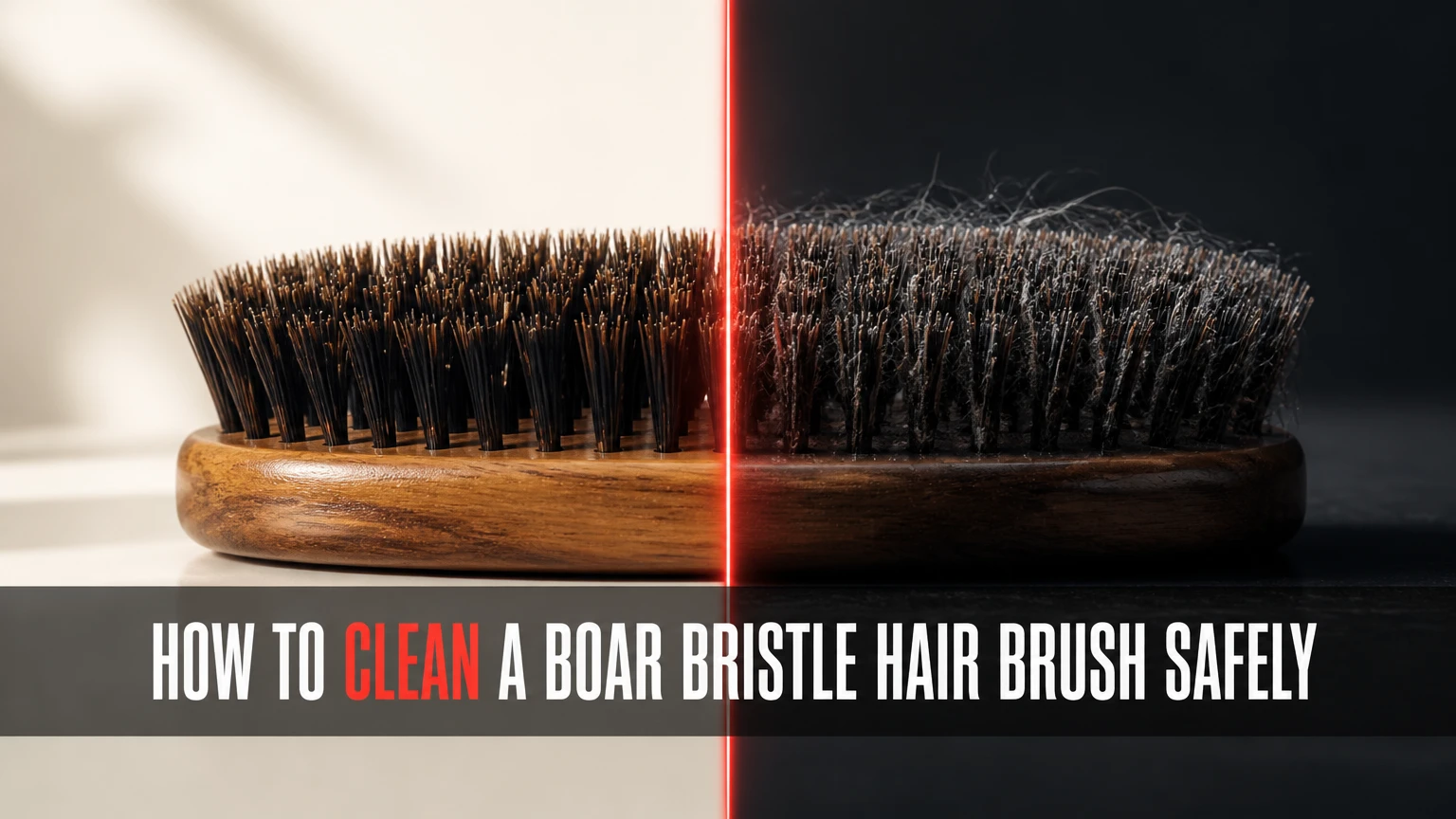
To clean a boar bristle hair brush, remove trapped hair while dry, wash only the bristles in lukewarm water with a small amount of gentle shampoo, rinse without soaking the handle or cushion, and dry the brush bristles-down for 12-24 hours. The safest method uses minimal water because wood, glue, and rubber cushions can retain moisture.
Key Facts at a Glance
A boar bristle hair brush usually needs dry hair removal after every few uses and washing every 2-4 weeks.
Lukewarm water, approximately 30-38°C or 86-100°F, is safer than hot water for natural bristles and glued components.
Never immerse a wooden handle, wooden pad, or rubber cushion in a bowl of water.
Typical active cleaning time is 5-10 minutes, but complete drying takes 12-24 hours.
Gentle shampoo is the default cleaner; clarifying shampoo is reserved for heavy styling-product residue.
A brush with mold, cracked wood, loose bristle tufts, or persistent odor may need replacement rather than repeated washing.
What You Need Before Cleaning
A boar bristle hair brush can be cleaned with a narrow comb, lukewarm water, gentle shampoo, a soft toothbrush, two towels, and a shallow bowl. A dedicated brush rake is optional, while bleach, concentrated alcohol, boiling water, and undiluted essential oils are unnecessary for routine home cleaning.
Materials and Typical Cost
| Item | Quantity | Typical cost | Purpose |
|---|---|---|---|
| Fine-tooth comb or brush rake | 1 | $0-$15 | Removes hair and lint |
| Gentle or sulfate-free shampoo | 1 teaspoon | $0.10-$0.50 per use | Loosens sebum and light residue |
| Lukewarm water | 250-500 milliliters | Usually household supply | Cleans bristles without soaking the body |
| Soft toothbrush | 1 | $1-$5 | Cleans gaps between bristle rows |
| Clean microfiber towels | 2 | $2-$10 | Blots the brush and supports drying |
| Shallow bowl | 1 | $0-$8 | Holds a limited cleaning bath |
Use the brush maker’s care instructions first if they differ from general guidance. Kent, Bass Brushes, Mason Pearson care guidance, and other manufacturer instructions can vary because a “boar bristle brush” may have a wood pad, plastic pad, rubber cushion, nylon pins, or a glued mixed-material construction.
How Long Does Cleaning Take?
Active cleaning usually takes 5-10 minutes, followed by 12-24 hours of air-drying. A brush with dense rows, long hair, wax, pomade, or dry shampoo may require 15 minutes of preparation because residue has to be loosened gradually rather than scraped aggressively.
| Cleaning situation | Active time | Drying time | Typical frequency |
|---|---|---|---|
| Light daily hair removal | 30-60 seconds | None | After each use or every few uses |
| Light surface wipe | 2-5 minutes | 30-60 minutes | Weekly |
| Standard deep clean | 5-10 minutes | 12-24 hours | Every 2-4 weeks |
| Heavy styling-product buildup | 10-20 minutes | 24 hours | Every 1-2 weeks |
| Odor or trapped cushion water | 5-10 minutes | 24-36 hours | Only when required |
The most important success factor is not the shampoo brand. It is preventing water from entering wood, glue joints, or a rubber cushion.
How to Clean a Boar Bristle Hair Brush
The safest process has six stages: remove dry debris, prepare a shallow wash, clean the bristles, clean the spaces between rows, rinse with controlled water, and dry bristles-down. The sequence protects the keratin-rich natural fibers while limiting swelling, splitting, glue failure, and moisture retention.
Step 1: Remove Hair and Lint While Dry
Use a fine-tooth comb, brush rake, or the pointed end of another comb to lift hair from the base of the bristles. Start at one edge, work across the brush in sections, and pull upward instead of dragging sideways through the bristle roots.
Remove lint with clean tweezers or your fingers after the larger hair mat has been lifted. Do not use scissors against the pad because a blade can cut bristles, nick rubber, or damage the stitching that holds a cushion in place.
You will know this step worked when no continuous hair layer remains across the pad and you can see the gaps between most bristle rows.
Common mistake: washing before removing hair. Wet hair tightens around bristle roots and makes product residue harder to extract.
Step 2: Prepare a Small Lukewarm Cleaning Bath
Pour 250-500 milliliters of lukewarm water into a shallow bowl and mix in approximately 1 teaspoon of gentle shampoo. The water should feel comfortably warm, not hot; a practical range is 30-38°C or 86-100°F.
Sulfate-free shampoo is a conservative default because it cleans sebum without the stronger degreasing action of detergent. A normal personal shampoo can also work for light residue, provided the formula does not contain large amounts of oils, waxes, or conditioning polymers that may leave a new film.
You will know this step worked when the shampoo is dispersed and the bath contains no thick, concentrated pool of cleanser.
Common mistake: adding a tablespoon of shampoo to a small bowl. Excess cleanser takes longer to rinse and can leave bristles tacky.
Step 3: Wash the Bristles, Not the Brush Body
Hold the brush with its bristles facing downward and dip only the bristle tips and shafts into the bath. Keep the wooden handle, wooden pad, rubber cushion, air hole, and glued edges above the waterline.
Gently swirl the bristles for 30-60 seconds, lift the brush, and inspect the base. Repeat in short cycles until the sebum film softens. Dense natural bristles may need 2-3 minutes of total contact, but prolonged soaking is not safer or more effective.
For a flat brush, press the bristles lightly against your palm while moving the brush in small circles. For a round brush, rotate the barrel through the bath without allowing the core or end caps to become wet.
You will know this step worked when the bristles separate more easily and the water carries away visible oil or styling residue.
Common mistake: fully submerging the brush. Water can swell wood, soften adhesive, and remain inside a pneumatic cushion.
Step 4: Clean Between the Bristle Rows
Dip a soft toothbrush into the cleaning bath, squeeze out excess water, and brush between the bristle rows from the base toward the tips. Work around the perimeter first, then clean the center where scalp oil and powder commonly accumulate.
Use light pressure on pure boar bristles. Nylon-and-boar blends tolerate more mechanical brushing because the nylon pins are firmer, but force can still loosen a tuft or bend a pin.
You will know this step worked when lint and gray or waxy residue no longer collect on the toothbrush after a pass through the same row.
Common mistake: using a stiff nail brush. Hard plastic or metal can abrade natural bristles and scratch a polished wooden pad.
Step 5: Rinse With the Base Above the Water
Rinse the bristles under a narrow stream of lukewarm water or dip the bristles briefly into a second bowl of clean water. Keep the brush angled downward so water flows away from the pad, cushion, handle, and ventilation hole.
Rinse until the water no longer feels slippery on the bristles. Avoid twisting the bristle bundle, because rotational force can loosen glued or stitched tufts.
Blot the bristles with a towel without rubbing them sideways. Wipe the handle and exposed pad immediately if they received a few drops.
You will know this step worked when the bristles feel clean rather than coated, and no foam remains near the roots.
Common mistake: holding the brush flat under a running tap. That position directs water into the base and increases the chance of trapped moisture.
Step 6: Air-Dry the Brush Bristles-Down
Place the brush bristles-down on a clean, dry towel in a ventilated room. Leave space around the brush so air reaches the pad and bristle roots, and wait at least 12 hours before use, extending the period to 24 hours for dense brushes or humid rooms.
Do not use a hair dryer, radiator, heated towel rail, or direct high-heat sunlight. Heat can dry natural bristles unevenly, soften adhesive, warp nylon, and accelerate cracking in wood.
You will know this step worked when the bristle roots, pad, and cushion feel completely dry and the brush has no cool, damp areas or odor.
Common mistake: drying bristles-up. Water can drain toward the cushion or wooden pad instead of away from it. Manufacturer care instructions commonly emphasize controlled rinsing and complete drying for brush longevity.
Which Cleaner Should You Use?
Gentle shampoo is the best first cleaner for ordinary sebum and light residue. Clarifying shampoo is more suitable for silicone, wax, pomade, or hairspray buildup, while dish soap may work in an emergency but is more aggressive and should not become the routine treatment.
| Cleaner | Best use | Amount | Main risk | Recommended frequency |
|---|---|---|---|---|
| Gentle sulfate-free shampoo | Sebum and light dust | 1 teaspoon per 250-500 mL | May struggle with wax | Every 2-4 weeks |
| Regular personal shampoo | Light routine cleaning | 1 teaspoon per 250-500 mL | Conditioning film | Every 2-4 weeks |
| Clarifying shampoo | Silicone, gel, pomade | 1/2-1 teaspoon | Can leave bristles dry | Every 4-8 weeks |
| Mild dish soap | Exceptional greasy residue | 1-2 drops | Strips oils aggressively | Rarely |
| 70% isopropyl alcohol | Spot treatment on plastic only | Small dampened cloth | Can affect finish and adhesives | Avoid on natural-bristle bodies |
| Bleach solution | Not recommended for this brush type | None | Damages fibers and finishes | Never for routine care |
Tea tree oil is not a substitute for cleaning or a validated home disinfectant for a porous brush. Undiluted essential oil can irritate skin and may affect rubber, coatings, or adhesives. If odor persists after thorough drying, replacement is safer than repeatedly adding antimicrobial ingredients.
How Do You Remove Heavy Product Buildup?
Remove heavy product buildup by repeating a short shampoo wash, then using a small amount of clarifying shampoo only on the bristles. A second controlled wash is safer than increasing detergent concentration or soaking a wooden brush for an extended period.
Use clarifier when the bristles remain sticky, glossy, clumped, or visibly coated after the first wash. Apply approximately 1/2 teaspoon to the wet bristles, work it through for 30-60 seconds, and rinse promptly while keeping the base dry.
Hair-product buildup affects brush performance because a coated bristle cannot contact the hair shaft evenly. Bass Brushes specifically discusses product buildup as a maintenance issue that can change how a brush performs. Heavy users may need cleaning every 7-14 days instead of monthly.
How Often Should You Clean a Boar Bristle Brush?
Clean a boar bristle brush every 2-4 weeks for ordinary use, remove loose hair after each use or every few uses, and shorten the interval to 7-14 days when styling products, scalp oil, dry shampoo, or multiple users add residue. Frequency should follow contamination level rather than a fixed calendar date.
| User pattern | Hair removal | Surface care | Deep cleaning |
|---|---|---|---|
| Dry hair, no styling product | Every 2-3 uses | Weekly | Every 3-4 weeks |
| Oily scalp | After every use | Every 3-4 days | Every 1-2 weeks |
| Pomade, wax, or hairspray | After every use | Twice weekly | Every 7-14 days |
| Dry shampoo or texturizing powder | After every use | Weekly | Every 1-2 weeks |
| Curly or shedding hair | After every use | Weekly | Every 2-3 weeks |
| Shared household brush | After every use | Every 2-3 days | Weekly, with separate users preferred |
A brush used on an active scalp condition should not be shared. Cleaning removes residue, but it does not replace medical treatment or guarantee removal of every microorganism from porous wood, damaged rubber, or cracked adhesive.
How Do Brush Materials Change the Method?
Brush material determines how much water and friction the brush can tolerate. Plastic-bodied brushes are generally more water-resistant, while wood, leather details, natural rubber, stitched cushions, and glued components require short contact with water and immediate drying.
| Brush construction | Water tolerance | Safe method | Main failure mode |
|---|---|---|---|
| Plastic pad and handle | Moderate to high | Brief bristle wash and careful rinse | Water trapped behind pad |
| Wooden handle, plastic pad | Low on handle | Bristle-only washing | Swelling or finish damage |
| Wooden pad and handle | Low | Damp cloth plus minimal bristle contact | Splitting, staining, glue failure |
| Rubber cushion with air hole | Low to moderate | Bristles-down rinsing | Water retained inside cushion |
| Pure boar bristle | Low friction tolerance | Gentle shampoo and soft brush | Fraying or stiffness |
| Nylon-and-boar blend | Moderate friction tolerance | Gentle wash and row brushing | Bent nylon pins or loosened tufts |
Pure boar bristles have a scaly keratin surface and can hold scalp oils and styling residue. That structure helps distribute sebum along hair, but it also means aggressive degreasing can leave the fibers feeling rough. Nylon-and-boar blends are more useful for detangling because nylon pins provide greater stiffness, although their mixed construction creates additional joints where residue can collect.
Common Mistakes and How to Fix Them
Most damaged boar bristle brushes fail because of excess water, excess heat, or excessive force. Correcting the method early is easier than repairing a split wooden pad or permanently loosened bristle tuft.
| Mistake | What happens | Recovery action | Replace when |
|---|---|---|---|
| Full submersion | Wood swells and cushion retains water | Wipe, compress cushion downward, air-dry 24-36 hours | Wood remains swollen or moldy |
| Hot water | Bristles and nylon can deform | Stop heat exposure and reshape gently while damp | Bristles stay kinked |
| Hair dryer use | Adhesive and rubber may weaken | Allow slow room-temperature drying | Tufts loosen or cushion warps |
| Dish soap every wash | Natural oils strip from bristles | Wash once with gentle shampoo and rinse well | Bristles remain brittle |
| Metal scraping | Pad and bristle roots get scratched | Stop scraping and use a comb | Roots are cut or exposed |
| Drying bristles-up | Water moves into the base | Turn bristles-down and extend drying | Odor or mold remains |
| Essential-oil addition | Skin and material irritation may occur | Rinse thoroughly and dry completely | Persistent odor or surface damage |
What If Water Gets Inside a Rubber Cushion?
If water enters a rubber cushion, hold the brush with the cushion’s air hole facing downward and press the cushion gently several times over a towel. Do not seal the hole, inject cleaner, or apply heat; leave the brush in a dry, ventilated room for another 12-24 hours.
A slight temporary change in cushion feel can occur while moisture moves out. Persistent sloshing, bubbling, sour odor, discoloration, or a cushion that stays depressed indicates internal deterioration. Replace the brush if the interior cannot dry fully.
What If the Bristles Feel Stiff After Washing?
Stiff bristles usually indicate leftover cleanser, excessive degreasing, product film, or incomplete drying. Rinse the bristles briefly with clean lukewarm water, blot them, and allow a full 24-hour dry before deciding that the fibers are damaged.
If the bristles are clean but unusually dry, place one or two drops of jojoba or argan oil between your palms and lightly smooth the palms over the dry bristles. Do not pour oil onto the brush, because excess oil recreates the buildup that required cleaning.
What If the Brush Smells After Drying?
A smell after 24 hours usually indicates trapped moisture, product residue, or material deterioration rather than a need for stronger fragrance. Repeat a short gentle wash, rinse carefully, and dry bristles-down for 24-36 hours in low humidity.
Do not mask the odor with perfume. If the smell returns after complete drying, inspect the pad, air hole, stitching, and wooden joints for mold or rot. A porous brush with persistent microbial odor is not a reliable candidate for home sanitation.
Can You Sanitize a Boar Bristle Brush?
You can reduce surface residue, but you cannot guarantee complete sterilization of a porous boar bristle brush at home. Cleaning and drying are appropriate for normal personal use, whereas salon tools, blood exposure, suspected fungal infection, or shared use require the manufacturer’s material-compatible disinfection protocol or replacement.
The American Academy of Dermatology recommends regular cleaning for reusable beauty tools, but hairbrush construction differs from washable makeup brushes because natural fibers, wood, rubber, and adhesive can retain liquid. Never use bleach on natural bristles or an unverified disinfectant on a wooden or rubber body.
If a brush contacts blood, a contagious scalp condition, or a heavily infected area, discard it unless the manufacturer provides a validated disinfection method for that exact model. Hair-electrolysis equipment is a separate category: electrolysis probes and reusable metal instruments require professional sterilization procedures, not shampoo washing or hairbrush-care methods.
When Should You Replace the Brush?
Replace a boar bristle hair brush when it has visible mold, persistent odor after complete drying, cracked or splintering wood, loose tufts, exposed sharp wire, a permanently deformed cushion, or bristles that scratch the scalp. A well-maintained brush may last several years, but lifespan depends on construction, use, and moisture exposure.
| Condition | Cleaning response | Use decision |
|---|---|---|
| Loose hair and lint | Remove with comb or rake | Continue using |
| Light sebum film | Gentle shampoo wash | Continue after drying |
| Sticky product film | Controlled clarifying wash | Continue if bristles recover |
| One or two bent nylon pins | Trim or remove carefully | Continue if no sharp edge remains |
| Cracked wooden pad | Do not soak | Replace soon |
| Mold spots or rot | Do not reuse | Replace immediately |
| Persistent sour odor | Drying and inspection | Replace if odor returns |
| Multiple loose bristle tufts | Avoid aggressive repair | Replace when grooming performance declines |
A premium price does not make a damaged brush safer. The practical value of a high-quality brush comes from preserving its materials, not from extending use after the pad or cushion has become unsound.
How Do You Maintain a Clean Brush Between Washes?
Maintain a clean brush by removing shed hair promptly, storing it bristles-up only after it is dry, keeping it away from a wet bathroom counter, and avoiding use on heavily product-coated hair when a comb is more appropriate. These habits reduce the amount of water and detergent needed during deep cleaning.
Keep the brush in a dry drawer or ventilated container rather than a sealed plastic bag. Do not share it during scalp infections, and do not return it to storage while the cushion or bristle roots still feel cool or damp.
Maintenance Checklist
- Remove hair and lint after use or every few uses.
- Wipe the handle and outer pad with a barely damp cloth.
- Deep-clean every 2-4 weeks under ordinary conditions.
- Use clarifying shampoo only for stubborn product film.
- Dry bristles-down for at least 12 hours.
- Inspect wood, glue, cushion, stitching, and bristle roots monthly.
- Replace the brush if odor, mold, splitting, or sharp damage persists.
Frequently Asked Questions
Can I wash a boar bristle brush with regular shampoo?
Yes, regular shampoo is suitable for light sebum and dust when used in a small amount with lukewarm water. Use approximately 1 teaspoon in 250-500 milliliters of water, wash only the bristles, rinse promptly, and dry the brush bristles-down. Clarifying shampoo is better for wax, silicone, or hairspray residue.
Can I use vinegar to clean a natural-bristle brush?
Vinegar is not necessary for routine cleaning and can expose wood, rubber, adhesives, and natural fibers to an acidic liquid without solving trapped moisture. Use gentle shampoo for ordinary residue, then focus on controlled rinsing and complete drying. Replace the brush if persistent odor suggests internal mold or rot.
How do I clean a boar bristle brush without water?
Remove hair with a fine-tooth comb or brush rake, lift lint with tweezers, and wipe the handle and pad with a barely damp cloth. Waterless cleaning removes loose debris but may not dissolve sebum, wax, or silicone. Perform a controlled bristle wash when the brush feels sticky or coated.
Why does my boar bristle brush make my hair greasy?
A boar bristle brush can make hair appear greasy when the brush contains accumulated sebum, oil-based products, or dry shampoo residue. Clean the brush, wash the hair as appropriate for the scalp, and avoid repeatedly brushing heavy product through clean lengths. Excess oil on the brush can redeposit along the hair shaft.
Can I clean a boar bristle brush every week?
You can clean it weekly if you use pomade, hairspray, oils, dry shampoo, or share the brush, provided you use minimal water and gentle shampoo. For low-product use, weekly deep washing may be unnecessary. Frequent wetting increases material stress, so daily dry removal is preferable to unnecessary washing.
How should I store a boar bristle brush after cleaning?
Store a fully dry boar bristle brush in a ventilated, dry location with the bristles protected from dust and crushing. During drying, place the brush bristles-down; after drying, store it in its normal orientation if the manufacturer permits. Avoid sealed containers, wet counters, radiators, and direct high heat.
The Bottom Line
The safest answer to how to clean a boar bristle hair brush is simple: remove debris dry, use a small amount of gentle shampoo in lukewarm water, wash only the bristles, rinse with the base above the water, and air-dry bristles-down for 12-24 hours. Clean more often when styling products or scalp oil create visible buildup, but replace any brush with mold, rot, persistent odor, or structural damage.