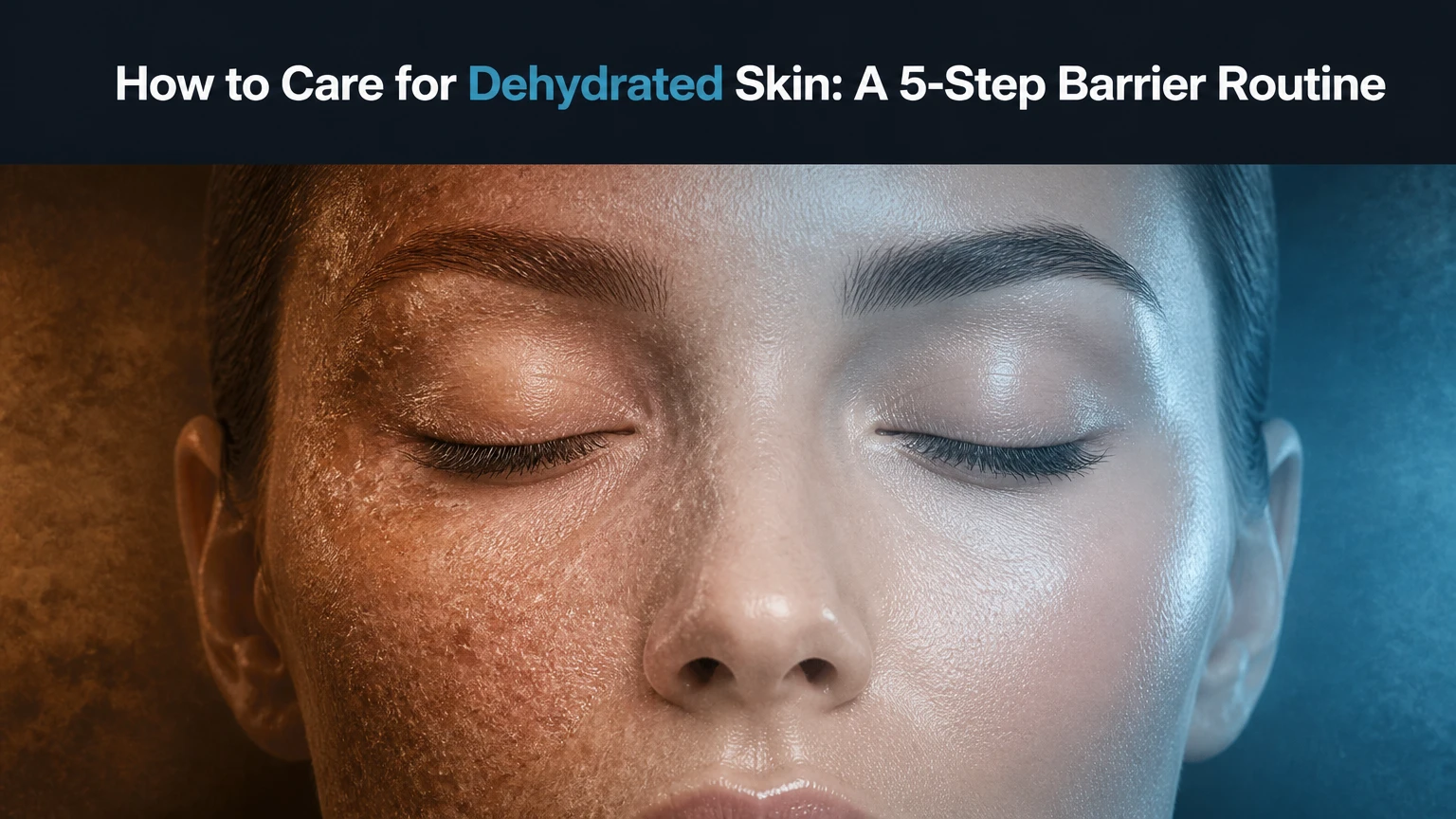
To care for dehydrated skin, cleanse gently, apply humectants to damp skin, layer a barrier moisturizer, then use sunscreen or petrolatum; this five-step routine takes about 10 minutes, requires beginner-level skill, and succeeds when you reduce water loss without irritating the barrier.
Before You Start
Dehydration means the outer skin layer has insufficient water. Dry skin, by contrast, usually describes a skin type with less oil. Your skin can be oily and dehydrated at the same time, especially after harsh cleansing, cold weather, low humidity, sun exposure, or irritating active ingredients.
The routine costs approximately $35-$150, depending on whether you choose drugstore or prestige products. You do not need every product listed. A cleanser, moisturizer, and sunscreen form the minimum effective daytime routine; add a hydrating serum only if the basic routine is comfortable.
| Item | Quantity or specification | Typical cost | Purpose |
|---|---|---|---|
| Gentle cleanser | 2-3 mL per wash; fragrance-free, low-foam or non-foaming | $8-$25 | Removes sunscreen, makeup, and dirt without excessive lipid removal |
| Hydrating toner or essence | 4-5 drops; glycerin, beta-glucan, or hyaluronic acid | $10-$35 | Adds a light water-binding layer |
| Humectant serum | 2-3 drops or one pea-sized pump | $10-$45 | Holds water near the outer skin layer |
| Barrier moisturizer | About 1-2 mL for face and neck; ceramides, cholesterol, fatty acids, or petrolatum | $12-$40 | Reduces water loss and supports the barrier |
| Broad-spectrum sunscreen | SPF 30 or higher; enough for face, ears, and neck | $10-$35 | Reduces ultraviolet irritation and barrier stress |
| Petrolatum ointment | Pea-sized amount for selected dry patches | $4-$15 | Adds a strong occlusive layer at night |
| Soft towel | Clean microfiber or bamboo cloth | $3-$12 | Blots without vigorous rubbing |
| Lukewarm water | Comfortable, not hot; approximately 36-38°C is a practical target | No extra cost | Limits heat-related irritation |
Prerequisites and safety checks
- Stop or reduce any product that causes persistent burning, swelling, hives, or a rash.
- Patch-test a new product on the jawline or behind the ear once daily for two days before applying it widely.
- Use clean hands and a clean towel.
- Keep the routine stable for at least seven days before judging it, unless irritation develops sooner.
- Do not start several exfoliants, retinoids, fragrances, or essential oils during barrier recovery.
The American Academy of Dermatology recommends applying moisturizer after washing while skin still retains water, because this helps trap moisture at the surface. The order below applies that principle without requiring a complicated product collection.
Five-Step Routine
| Step | Action | Time | Most common mistake |
|---|---|---|---|
| 1 | Cleanse gently | 1 minute | Using hot water or scrubbing |
| 2 | Apply a hydrating toner or essence | 30 seconds | Applying it to completely dry skin |
| 3 | Add a humectant serum | 1 minute | Using too much and allowing it to dry tight |
| 4 | Seal with barrier moisturizer | 30 seconds | Applying too little moisturizer |
| 5 | Protect or occlude | 1 minute | Skipping sunscreen or slugging the entire face unnecessarily |
Step 1: Cleanse Without Stripping the Barrier
Cleanse your face with a mild, fragrance-free cleanser and lukewarm water, then blot without drying the skin completely.
In the evening, wet your hands and face, dispense approximately 2-3 mL, or a nickel-sized amount, and massage it over the face with your fingertips for about 30-60 seconds. Use light pressure around the nose, mouth, and cheeks. Rinse for approximately 30 seconds with lukewarm water. Remove makeup and sunscreen thoroughly, but do not use a brush, cleansing device, facial sponge, or washcloth to create extra friction.
Blot with a clean, soft towel and leave the skin slightly damp. It should feel cool and moist, not wet enough to drip. In the morning, rinse with water only if your skin feels comfortable and clean. Use cleanser in the morning if you have oily residue, sweat, overnight occlusive products, or acne medication that requires removal.
You’ll know it worked when your skin feels clean but flexible, with no squeaking, tightness, or immediate urge to moisturize.
Common mistake: Washing twice daily with a foaming cleanser because the face feels oily. Reduce morning cleansing first rather than aggressively adding richer products at night.
Step 2: Add a Water-Binding Toner or Essence
Press a fragrance-free hydrating toner or essence into damp skin using your palms.
Apply 4-5 drops to your palms, then press the product over your face and neck while the skin remains damp from cleansing. Choose a formula containing glycerin, hyaluronic acid, beta-glucan, panthenol, or another clearly labeled humectant. Avoid toners dominated by alcohol, fragrance, menthol, or exfoliating acids while the skin feels sensitive.
Do not rub repeatedly, and do not rely on a cotton pad for this step. Cotton pads are not automatically harmful, but pressing with clean hands uses less product and reduces avoidable friction. Apply the toner within about one minute of blotting so the skin does not become fully dry first.
If the toner pills, use fewer drops and wait 15-30 seconds before the next layer. If it stings, rinse it off and skip directly to moisturizer.
You’ll know it worked when the skin feels lightly damp and comfortable, not sticky, hot, or tight.
Common mistake: Applying several watery layers until the face feels soaked. One layer is usually enough; excess product can increase pilling and irritation without improving hydration.
Step 3: Apply Humectant Serum to Damp Skin
Smooth a small amount of humectant serum over the still-damp face and neck, then cover it promptly with moisturizer.
Use 2-3 drops, or one pea-sized pump, of a serum containing glycerin, hyaluronic acid, polyglutamic acid, or panthenol. Spread it between your fingertips first, then gently smooth it over the face. Keep the layer thin, especially around the eyelids and corners of the nose. Do not apply concentrated hyaluronic acid directly to completely dry skin.
Wait approximately 30 seconds, or until the surface feels slightly tacky rather than wet. Do not wait until the serum feels tight or completely dry. Follow with moisturizer immediately if you are in a dry, heated, or air-conditioned environment. Humectants bind water, but they do not replace the lipids and occlusives that slow evaporation.
The “damp skin” rule is a practical application method, not a guarantee that every hyaluronic acid product will work for everyone. Formula composition, humidity, and your moisturizer matter.
You’ll know it worked when the serum spreads evenly and leaves a comfortable, lightly tacky finish without pilling.
Common mistake: Applying a large amount because the serum feels weightless. Excess humectant can pill under moisturizer or sunscreen, so increase coverage only by adding one drop at a time.
Step 4: Seal the Layers With Barrier Moisturizer
Apply a lipid-supporting moisturizer while the humectant layer remains slightly tacky.
Use approximately 1-2 mL, or a nickel-sized amount, for the face and neck. If you are treating only the face, start with a smaller amount and add more to visibly flaky areas. Look for ceramides, cholesterol, fatty acids, glycerin, dimethicone, squalane, or petrolatum. A moisturizer does not need a precise ceramide-to-cholesterol-to-fatty-acid ratio to be useful; the finished formula and your tolerance matter more than recreating a laboratory ratio at home.
Warm the cream between your fingertips for several seconds. Press it onto the cheeks, forehead, chin, and neck, then smooth outward with minimal passes. Apply a second thin layer to the sides of the nose or other cracked areas instead of rubbing one thick layer repeatedly.
You’ll know it worked when the face feels supple for several hours and the moisturizer does not sting, crack, or leave a rapidly tightening film.
Common mistake: Using a lightweight lotion but applying only a tiny amount. First increase the amount or switch to a richer cream before adding facial oil.
Step 5: Protect in the Day or Occlude at Night
Finish with broad-spectrum sunscreen in the morning or a thin petrolatum layer at night.
During the day, apply a broad-spectrum SPF 30 or higher after moisturizer. A practical facial amount is approximately two finger-lengths of sunscreen for the face and neck, with extra attention to the ears and hairline. Apply it in two thin passes if a single layer pills. Reapply after swimming, heavy sweating, towel drying, or prolonged outdoor exposure.
At night, use petrolatum only where it helps. Apply a pea-sized amount over the driest patches, or spread a very thin film over the face if you tolerate occlusion and do not break out easily. Keep it away from infected-looking areas, actively oozing rashes, and eyelid margins. Occlusion reduces transepidermal water loss, but it does not add water by itself, so apply it over moisturizer rather than directly to dry, flaky skin.
You’ll know it worked when morning tightness and surface flaking gradually decrease without new clogged pores or heat rash.
Common mistake: Slugging the entire face every night from the first day. Start with one cheek or a few flakes for two nights, then expand only if your skin remains comfortable.
Common Mistakes and How to Fix Them
| Problem | Likely cause | Recovery action |
|---|---|---|
| Moisturizer burns or stings | Barrier irritation, dermatitis, or a fragranced formula | Stop new products, rinse gently, and use a bland fragrance-free cream or petrolatum. Seek medical advice if burning persists |
| Skin feels tighter after the routine | Too much humectant, insufficient moisturizer, dry air, or product alcohol | Use less serum, apply it to damp skin, and cover it within 30 seconds with a richer cream |
| Greasy shine with small bumps | Excess occlusion or a comedogenic formula for your skin | Stop full-face slugging, use petrolatum only on flakes, and choose a lighter gel-cream |
| Flaking continues after one week | Ongoing irritant, dermatitis, sun damage, or insufficient time | Remove active ingredients and fragrance, simplify the routine, and arrange assessment if redness or scale continues |
| Product pills under sunscreen | Too many layers, excess product, or insufficient setting time | Use thinner amounts, wait 30-60 seconds between layers, and pat sunscreen rather than rubbing |
| Face feels oily but still tight | Dehydration combined with excess sebum or over-cleansing | Reduce foaming cleanser use, keep the humectant layer light, and use a non-comedogenic moisturizer |
If moisturizer burns
Do not automatically assume burning means the product is “working.” Burning may indicate irritant contact dermatitis, allergic contact dermatitis, fissures, or another condition that needs diagnosis. Stop the suspected product and use only products that have previously caused no reaction. Plain petrolatum can protect the surface, but seek medical care for swelling, hives, blisters, pus, severe pain, or eye involvement.
If tightness returns immediately
Check the environment before buying more products. Central heating, air conditioning, wind, and low indoor humidity can increase surface water loss. Run a clean humidifier if appropriate, keep showers short, and apply moisturizer within one minute of rinsing. If tightness continues, replace a gel lotion with a cream containing ceramides, dimethicone, or petrolatum.
If flaking persists
Do not use an acid or scrub to force flakes off. The American Academy of Dermatology advises people with dry skin to avoid irritating ingredients and use gentle skin care while the skin recovers. Persistent scale can also reflect seborrheic dermatitis, eczema, psoriasis, rosacea, or a reaction to a product. Arrange a dermatology evaluation when flaking lasts more than two weeks despite a simplified routine.
Variations for Different Skin Situations
| Situation | Change to the routine | Avoid |
|---|---|---|
| Oily or acne-prone skin | Use water or a gentle cleanser in the morning, a gel-cream moisturizer, and petrolatum only on flakes | Full-face nightly slugging and heavy fragrance oils |
| Very dry or mature skin | Use cream cleanser, two thin moisturizer layers, and petrolatum on fissured areas | Hot showers and frequent foaming cleansers |
| Sensitive or reactive skin | Start with cleanser, moisturizer, and sunscreen; add one hydrating product after 3-4 comfortable days | Fragrance, essential oils, acids, retinoids, and frequent product changes |
| Humid climate | Use one humectant layer and a light moisturizer; reduce occlusive quantity | Multiple sticky layers that trap heat |
| Dry or cold climate | Apply serum and cream promptly, use a richer cream, and consider targeted petrolatum | Letting humectants dry before sealing |
| After facial electrolysis | Keep the treated area product-light for the period recommended by the electrologist, then use bland moisturizer and sunscreen | Acids, retinoids, scrubs, fragrance, and petrolatum over hot or freshly irritated follicles |
| After body electrolysis | Wear loose clothing, cleanse gently, and moisturize once the area is calm | Friction, sweating, fragranced body products, and occlusion over inflamed follicles |
Facial electrolysis and body electrolysis create localized irritation that can temporarily increase sensitivity. Follow the electrologist’s aftercare instructions first, particularly if they differ from a general skincare routine. Do not perform electrolysis over open, infected, blistered, or severely inflamed skin.
The simplified three-product version
If five steps feel excessive, use this sequence:
- Rinse with water or cleanse gently.
- Apply a fragrance-free moisturizer to damp skin.
- Apply broad-spectrum SPF 30+ during the day.
Add a hydrating serum only after this basic routine feels comfortable for several days. This approach often works better for reactive skin because it reduces the number of possible irritants and makes the cause of a reaction easier to identify.
How Long Does It Take and What Does It Cost?
| Goal | Typical timeframe | What affects the range |
|---|---|---|
| Immediate comfort | Within minutes to one day | Product compatibility and whether moisturizer is applied promptly |
| Reduced tightness | 3-7 days | Severity of barrier disruption, climate, and continued exposure to irritants |
| Less visible flaking | 1-2 weeks | Whether dermatitis, sunburn, or an active ingredient remains involved |
| More stable barrier comfort | 2-4 weeks | Consistency, moisturizer formula, cleansing habits, and environmental dryness |
These are typical practitioner ranges, not guarantees. Mild dehydration may improve within several days after removing the trigger. A persistent rash, fissures, swelling, pain, or intense itch requires assessment rather than increasingly complicated skincare.
A basic routine usually costs $25-$70 for cleanser, moisturizer, and sunscreen. Adding a toner and serum commonly raises the total to $45-$150. Product price does not prove efficacy. Spend first on a tolerable moisturizer and sunscreen, then add a serum if needed.
FAQ
Can oily skin still be dehydrated?
Yes. Oil describes sebum production, while dehydration describes insufficient water in the outer skin layer. Oily dehydrated skin often feels tight after cleansing, looks shiny but flaky, or produces more visible oil while the cheeks feel uncomfortable. Use gentle cleansing, a light humectant layer, and a non-comedogenic moisturizer rather than skipping moisturizer.
Should I exfoliate dehydrated skin to remove flakes?
Avoid exfoliation while the skin burns, stings, feels tight, or has visible barrier irritation. AHAs, BHAs, retinoids, scrubs, brushes, and peeling products can prolong the problem. Once the skin has been comfortable for at least one week, ask a dermatologist whether a specific exfoliant is appropriate for your condition and skin history.
Is facial oil enough for dehydrated skin?
Usually not. Facial oils are emollient or occlusive, so they soften the surface and slow water loss, but they do not supply water like a damp moisturizer layer or humectant formula. Apply a small amount of squalane or another tolerated oil over moisturizer if needed, rather than replacing the water-binding and barrier-supporting steps.
Do I need a toner and serum?
No. They are optional layers. A gentle cleanser, moisturizer, and sunscreen can support recovery without toner or serum. Add one product at a time when you want more hydration, and patch-test it first. If your face is sensitive, reducing the routine is often more useful than adding multiple humectants.
Can drinking more water cure dehydrated facial skin?
Adequate fluid intake supports general health, but drinking extra water does not directly replace a damaged skin barrier. The AAD recommends topical moisturizer and gentle bathing practices for dry skin, while the NHS recommends drinking fluids according to thirst and health needs rather than forcing excessive amounts. Address both general hydration and topical water loss.
When should I see a dermatologist?
Seek medical advice for facial swelling, hives, blistering, pus, severe pain, bleeding cracks, eye-area involvement, or a rapidly spreading rash. Make an appointment when redness, itching, scaling, or burning lasts more than two weeks, repeatedly returns, or fails to improve after removing irritating products. The issue may be eczema, rosacea, dermatitis, infection, or another condition rather than simple dehydration.
Conclusion
Start by cleansing less aggressively, keep the skin slightly damp, apply humectants, seal them with a compatible moisturizer, and finish with sunscreen or targeted petrolatum. Follow the five steps consistently for one to two weeks, adjust the texture for your climate and skin type, and stop any product that burns. That is how to care for dehydrated skin without confusing temporary water loss with a permanent dry-skin type.