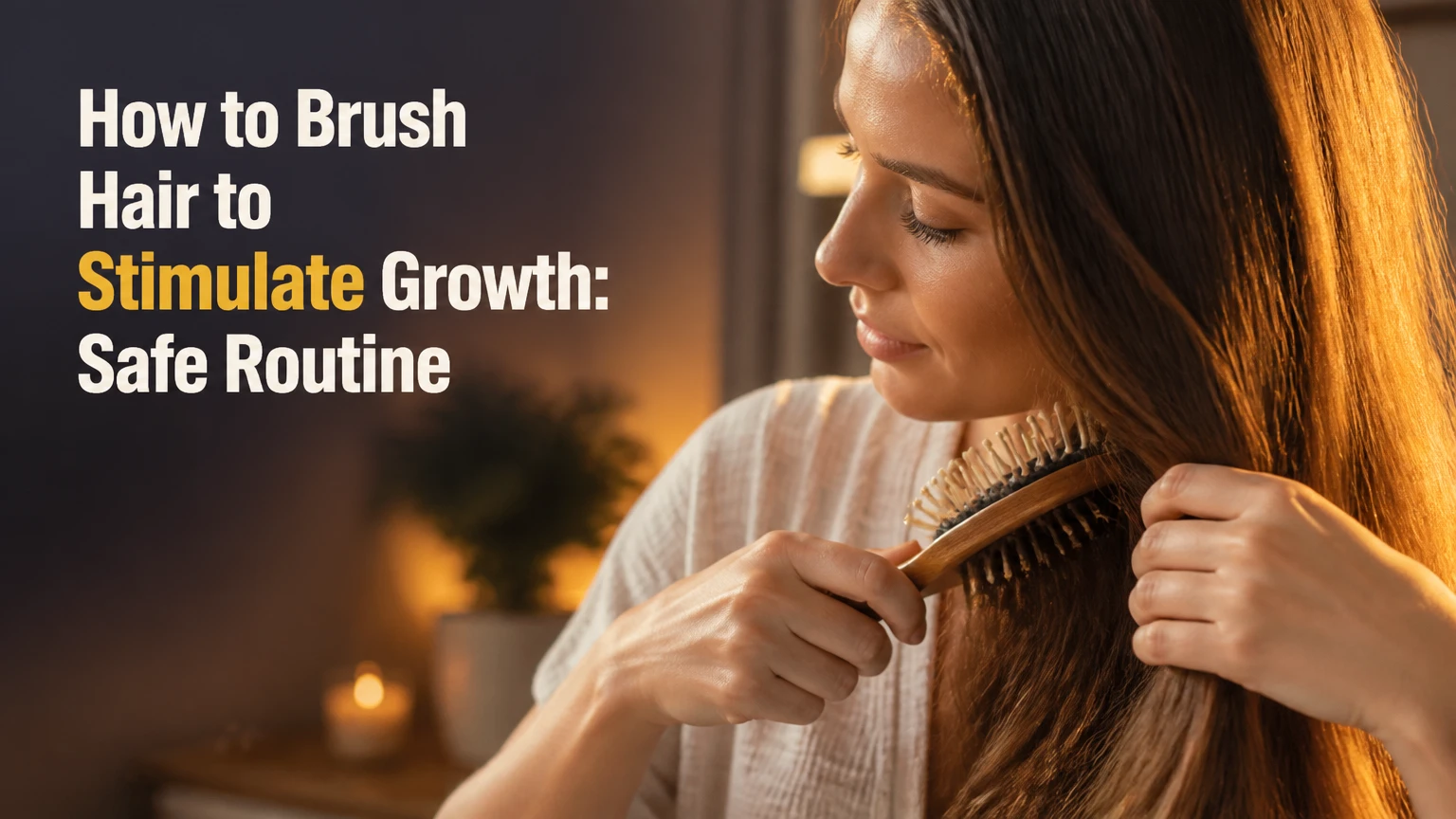
To brush hair to stimulate growth safely, use a soft tool to massage the scalp for about 2-3 minutes, while detangling from the ends upward and avoiding painful tension. Brushing can distribute sebum, remove loose debris, and reduce breakage, but it cannot create new follicles or treat genetic, inflammatory, nutritional, or medication-related hair loss.
Key Facts at a Glance
- Hair brushing has no established ability to override genetic hair-loss patterns or permanently increase follicle density.
- Gentle scalp massage may temporarily increase local blood flow and improve comfort, but circulation is not the same as proven regrowth.
- Detangling from the ends upward reduces pulling force on the hair shaft and minimizes traction-related breakage.
- A brushing session should stop when the scalp feels sore, hot, scratched, or unusually tender.
- Curly and coily hair usually needs sectioned detangling with conditioner rather than repeated dry brushing.
- Sudden shedding, bald patches, scalp pain, or scarring requires assessment by a dermatologist.
Can Brushing Hair Stimulate Growth?
Brushing can support the conditions around existing hair, but evidence does not show that ordinary brushing reliably makes scalp hair grow faster or thicker. The practical benefits are improved detangling, sebum distribution, removal of loose flakes, and less visible breakage when the technique is gentle.
A small 2016 study in ePlasty reported increased hair thickness after standardized scalp massage in nine men over 24 weeks, but the intervention used sustained massage rather than ordinary brush strokes, and the sample was too small to establish a general treatment. The study supports cautious interest in massage, not a claim that a brush treats baldness.
The American Academy of Dermatology Association states that “it’s normal to lose between 50 and 100 hairs per day.” Brushing may make those already-shed hairs more noticeable because they collect in the brush. That observation does not prove that brushing caused the shedding.
What brushing can and cannot do
| Potential effect | What it involves | Evidence or practical limit |
|---|---|---|
| Sebum distribution | Moves scalp oil along the shaft | Helps dry lengths; can worsen oiliness |
| Loose-debris removal | Lifts loose flakes and product residue | Does not treat psoriasis or fungal dandruff |
| Scalp comfort | Provides mild pressure and sensory relaxation | Benefit depends on pressure and sensitivity |
| Follicle regrowth | Creates new or thicker terminal hairs | Not established for routine brushing |
| Breakage reduction | Detangles with less pulling | Depends on tool, texture, and wetness |
Why scalp massage is not the same as hair growth
Hair follicles receive blood through the scalp’s vascular network, but increasing blood flow for a short period does not automatically activate dormant follicles. Hair cycling also depends on hormones, genetics, inflammation, nutrition, medications, and the condition of the follicle itself.
The British Association of Dermatologists identifies several causes of hair loss, including androgenetic alopecia, alopecia areata, telogen effluvium, and scarring disorders. A brush cannot address those causes. Its realistic role is supportive hair care.
How to Brush Hair to Stimulate Growth
A safe routine takes 2-3 minutes and uses light pressure, loose sections, and an ends-first sequence. The most important variable is not the number of strokes; it is avoiding repeated tension on knots and avoiding abrasion of the scalp.
Before you start
| Requirement | Typical specification | Why it matters |
|---|---|---|
| Session length | 2-3 minutes | Limits friction and scalp irritation |
| Tool | Padded brush, wide-tooth comb, or silicone massager | Matches the technique to texture |
| Hair condition | Dry or mostly dry for brushing | Wet strands stretch and break more easily |
| Pressure | Light, comfortable contact | Prevents scratching and traction |
| Frequency | 1 session daily or every other day | Adjusts to tolerance, oiliness, and texture |
Step 1: Inspect the scalp and brush
Check for open sores, crusts, pustules, bleeding, or a painful rash before brushing. Clean loose hair and residue from the brush, then test the bristles against the inside of your forearm; sharp tips, cracked plastic, or exposed metal should not touch the scalp.
You will know the tool is suitable when it moves over the skin without scratching and through the hair without snagging. A common mistake is choosing a stiff brush because stronger pressure feels more stimulating. Pain signals irritation, not superior follicle activation.
Step 2: Detangle the ends first
Divide long or dense hair into sections about 2-5 centimeters wide. Hold each section above the knot, detangle the bottom 5 centimeters first, then gradually move toward the roots with a wide-tooth comb or flexible detangler.
The hand holding the section acts as a tension buffer, so force is not transmitted directly to the scalp. You will know this step worked when the comb passes through the ends without a sudden tug. Starting at the roots is the fastest way to tighten knots farther down the shaft.
Step 3: Massage the scalp in short sections
Place the brush or silicone massager against the scalp at the nape, then work across the sides, temples, crown, and frontal hairline. Use small circles or short strokes for 15-20 seconds per region, keeping the pressure similar to a gentle shampoo massage.
Do not scrape back and forth rapidly. Lift the tool and reposition it if hair tangles. The success checkpoint is a warm or relaxed sensation without redness, tenderness, or increased shedding during the session.
Step 4: Brush from roots toward the ends
After the scalp is detangled, use slow strokes through each section from near the roots toward the tips. Do not force the brush through resistance; stop, separate the knot with your fingers, and return to the ends-first method.
This step distributes some natural oil and aligns the hair surface, which can improve shine and reduce the appearance of dryness. The common mistake is trying to complete every stroke in one pass. Hair that requires force needs smaller sections or a different tool.
Step 5: Finish without inversion
Keep your head upright unless bending forward is comfortable and medically appropriate. Gravity-based inversion is not required for scalp stimulation, and it can cause dizziness, worsen reflux, or be unsuitable for people with certain eye, blood-pressure, or balance conditions.
Finish with one or two gentle passes over the lengths. You will know the routine is complete when the scalp feels normal and the hair is detangled without a sore or tight sensation.
Which Brush Should You Choose?
The best brush depends on hair texture, scalp sensitivity, wetness, and the job being performed. A flexible detangler or wide-tooth comb is usually safer for knots, while a soft silicone tool is better for shampoo massage than for pulling through long hair.
| Tool | Typical cost | Best use | Main limitation |
|---|---|---|---|
| Wide-tooth comb | $5-$20 | Wet or curly-hair detangling | Provides little scalp massage |
| Flexible nylon brush | $10-$35 | Fine to medium, dry hair | Can snag dense curls |
| Boar or mixed bristle brush | $15-$150 | Sebum distribution on straight hair | May not reach thick roots |
| Wooden pin brush | $15-$60 | Dense, straight, or wavy hair | Hard pins irritate sensitive skin |
| Silicone scalp massager | $5-$20 | Shampooing and localized massage | Should not be dragged through lengths |
Boar bristle, nylon, or silicone?
A boar or mixed-bristle brush suits straight or lightly wavy hair when the goal is to spread oil down the shaft. Nylon pins are more versatile for medium-density hair, but rounded tips and flexible spacing matter more than the material name.
A silicone scalp massager works by contacting the skin rather than combing the entire length. Use it with shampoo, place it on one area for several seconds, lift it, and move to the next area. Dragging the massager through long hair can create tangles and mechanical damage.
How Should Different Hair Types Be Brushed?
Hair texture changes the safest method more than the desired growth goal. Straight and wavy hair often tolerates dry sectioned brushing, whereas curly and coily hair generally needs conditioner, fingers, or a wide-tooth comb to preserve the curl pattern.
| Hair profile | Preferred tool | Typical timing | Technique |
|---|---|---|---|
| Fine, straight hair | Soft flexible nylon or mixed bristle | Dry, once daily | Light pressure, small sections |
| Thick, straight hair | Wooden pin or flexible nylon | Dry, 3-7 times weekly | Section into four quadrants |
| Wavy hair | Flexible detangler or mixed bristle | Dry or damp, as needed | Detangle ends first |
| Curly hair, type 3 | Wide-tooth comb or fingers | Wet with conditioner | Work in curl-sized sections |
| Coily hair, type 4 | Wide-tooth comb or fingers | Wet with conditioner | Start at ends, use minimal passes |
How should curly and coily hair be handled?
Curly and coily hair should usually be detangled while wet and conditioned, but scalp massage can be performed separately with a silicone tool. Avoid dry brushing the lengths because it can disrupt curl clumps, increase frizz, and break fragile strands without providing a proven growth advantage.
For dense texture, part the hair into four to eight sections. Apply conditioner, finger-separate large knots, then use a wide-tooth comb from the ends upward. Massage the scalp with the fingertips or a stationary silicone tool, rather than dragging it through the hair.
Brush or Scalp Massager?
A scalp massager is preferable for shampoo-stage skin contact, while a brush or comb is preferable for detangling and distributing oil. Neither tool has strong evidence as a stand-alone treatment for pattern hair loss, so selection should prioritize low tension and a healthy scalp barrier.
| Feature | Hairbrush | Silicone massager | Fingertip massage |
|---|---|---|---|
| Detangles lengths | Yes, tool dependent | No | No |
| Works in shower | Usually no | Yes | Yes |
| Oil distribution | Yes | No | Limited |
| Tangle risk | Low to high | Moderate if dragged | Minimal |
| Cleaning | Weekly or after buildup | After each use | Wash hands first |
A practitioner rule is to separate the tasks. Use a comb to remove knots, a brush to smooth dry lengths, and fingertips or silicone to massage the scalp. One tool rarely performs all three jobs safely across every texture.
How Often Should You Brush?
For most people, one gentle scalp-focused session daily or every other day is sufficient, and brushing more often has no established growth advantage. Stop or reduce frequency if the scalp becomes tender, flaky, oily, or red, or if the lengths develop more split ends.
| Situation | Starting frequency | Session limit | Adjustment |
|---|---|---|---|
| Healthy straight hair | Once daily | 2-3 minutes | Reduce if ends become dry |
| Fine or thinning hair | 3-5 times weekly | 1-2 minutes | Avoid force and inversion |
| Curly or coily hair | Massage 2-3 times weekly | 1-3 minutes | Detangle only when needed |
| Oily or acne-prone scalp | Every other day | 1-2 minutes | Clean tool more often |
| Sensitive or inflamed scalp | Pause brushing | None | Treat the scalp condition first |
The traditional “100 strokes” rule is unnecessary. Repeated passes increase friction and can weather the cuticle, especially when hair is dry, chemically processed, or already fragile.
Can you brush wet hair?
Wet hair can be detangled safely with a wide-tooth comb or flexible brush when conditioner provides slip, but soaking-wet hair should not be aggressively brushed with a rigid bristle brush. Hair fibers become more extensible when wet, so force can cause stretching and breakage.
Blot rather than rub with a towel, separate the hair, and begin at the ends. A silicone massager may contact the scalp during shampooing, but it should not be used as a substitute for careful length detangling.
What If Your Scalp Is Flaky, Oily, or Sensitive?
Brushing does not cure dandruff, seborrheic dermatitis, psoriasis, folliculitis, or contact dermatitis. Gentle cleansing and appropriate treatment are more useful than extra friction, while aggressive scraping can worsen inflammation and increase discomfort.
The American Academy of Dermatology Association recommends dandruff shampoos containing active ingredients such as ketoconazole, zinc pyrithione, selenium sulfide, salicylic acid, or coal tar, depending on the product and condition. Follow the product directions and seek clinical advice if symptoms persist.
| Scalp sign | Avoid | More appropriate response |
|---|---|---|
| Greasy yellow flakes | Heavy oiling and vigorous brushing | Medicated dandruff shampoo |
| Thick silvery plaques | Scraping with pins | Dermatology assessment |
| Pustules or tenderness | Sharing tools or brushing hard | Medical evaluation |
| Burning after a product | Reapplying oil or fragrance | Stop product and rinse |
| Diffuse itch with redness | Daily abrasive massage | Identify irritant or scalp disease |
Clean a frequently used brush about weekly, or sooner if it accumulates visible oil and residue. Remove loose hair, wash a washable tool with mild shampoo, rinse thoroughly, and dry it completely before reuse.
What If You Are Losing Hair?
Brushing is not an adequate treatment for progressive thinning, a widening part, a receding hairline, bald patches, or sudden shedding. Those patterns can indicate androgenetic alopecia, alopecia areata, telogen effluvium, thyroid or iron-related problems, medication effects, infection, or scarring disease.
A dermatologist can examine the scalp, review the timeline, and order targeted tests when appropriate. The AAD notes that treatment depends on the cause, and common medical options may include minoxidil for selected forms of hair loss under proper guidance.
Brushing with minoxidil or rosemary oil
Apply minoxidil exactly as the product label or clinician directs, and allow the scalp and product to settle before brushing. Brushing immediately through a wet topical can spread it onto the face, remove product from the target area, or increase irritation.
Rosemary oil is not equivalent to minoxidil. A 2015 randomized comparative trial in SKINmed Journal found similar hair-count improvement between rosemary oil lotion and 2% minoxidil at six months in men with androgenetic alopecia, but the study was limited in size and design, and essential oils can cause allergic contact dermatitis. Never apply undiluted essential oil to the scalp.
Does electrolysis stimulate scalp hair growth?
Electrolysis does not stimulate scalp hair growth. The FDA recognizes electrolysis as a method intended for permanent hair removal because a probe delivers electrical energy into individual follicles to destroy their ability to produce hair.
Electrolysis may be relevant for unwanted facial or body hair, but it is the opposite of a regrowth procedure. A hairbrush cannot replace medical treatment for scalp loss, and electrolysis should never be marketed as a way to increase scalp density.
Common Mistakes and How to Fix Them
| Mistake | Likely consequence | Correction |
|---|---|---|
| Starting at the roots | Knots tighten and pull the scalp | Begin at the bottom 5 centimeters |
| Pressing until the scalp hurts | Redness, irritation, or tenderness | Reduce pressure immediately |
| Dry-brushing tight curls | Frizz, broken strands, disrupted pattern | Detangle wet with conditioner |
| Using a dirty brush | Oil and residue return to the scalp | Wash weekly and dry fully |
| Brushing over sores | Delayed healing and more pain | Pause until healed |
| Chasing 100 strokes | Excess friction and split ends | Stop after one gentle pass |
One counterintuitive truth is that seeing more hair in a brush does not necessarily mean brushing caused hair loss. Brushing gathers loose hairs that would otherwise fall onto clothing or bedding; the stronger warning sign is a sustained change in density, part width, or scalp visibility.
Another practitioner rule is to measure hair health by breakage, not by shine alone. A heavily oiled shaft may look smoother while the scalp becomes congested or irritated, and a glossy finish says nothing about follicle activity.
What Results and Costs Are Realistic?
A brushing routine may produce immediate smoothness and a cleaner-feeling scalp, while reduced breakage can take several weeks to become noticeable. New growth from medical treatment generally requires several months, and brushing alone has no validated result schedule.
| Outcome | Typical timeframe | What to monitor | Interpretation |
|---|---|---|---|
| Smoother appearance | Same session | Shine and alignment | Cosmetic effect |
| Less tangling | 1-3 weeks | Fewer snapped ends | Technique benefit |
| Scalp comfort | Same day to 2 weeks | Relaxation without soreness | Individual response |
| Reduced visible breakage | 4-8 weeks | Short broken hairs and split ends | Hair-care benefit |
| Regrowth from treatment | 3-6 months or longer | Density photographs | Requires cause-specific care |
| Routine component | Typical cost | Replacement or review interval | Main value |
|---|---|---|---|
| Wide-tooth comb | $5-$20 | Replace when teeth warp | Low-tension detangling |
| Flexible brush | $10-$35 | Replace when tips crack | Dry-length smoothing |
| Silicone massager | $5-$20 | Replace when silicone splits | Shower scalp contact |
| Dandruff shampoo | $8-$25 | Review after label course | Condition-specific scalp care |
| Dermatology visit | Varies by location and insurance | Based on symptoms | Diagnosis and treatment plan |
Take monthly photographs under the same lighting if you are monitoring density. Do not judge growth from one wash or one brushing session because shedding varies with wash frequency, hairstyle, and the length of time loose hairs remain trapped.
When Should You Stop Brushing and Seek Care?
Stop scalp brushing and arrange medical advice when brushing causes bleeding, persistent pain, pustules, thick plaques, or a rapidly worsening rash. Seek prompt evaluation for sudden bald patches, eyebrow loss, scalp scarring, or marked shedding that begins after illness, childbirth, major stress, or a medication change.
The American Academy of Dermatology Association advises early evaluation because identifying the cause improves the chance of effective treatment. A brush is a maintenance tool, not a diagnostic or regenerative device.
FAQ
Can brushing reverse a receding hairline?
Brushing cannot reverse a receding hairline because a receding pattern commonly involves androgen-sensitive follicle miniaturization. Gentle brushing can make existing hair look orderly and may reduce breakage, but progressive recession warrants a dermatologist’s assessment for cause-specific options.
Should you brush your hair before or after washing?
Detangle before washing if the hair is heavily knotted, then use conditioner and a wide-tooth comb during or after washing. Brush dry hair after washing only when it is mostly dry and the tool moves without snagging. Avoid rigid-bristle brushing through soaking-wet hair.
Can brushing remove dandruff?
Brushing can lift loose flakes temporarily, but it cannot treat the underlying cause of dandruff. Medicated shampoo, correct contact time, and professional evaluation for persistent redness or thick plaques are more appropriate than increased brushing pressure.
Is scalp massage better than brushing for growth?
Scalp massage gives more direct skin contact and less length friction, so it is often preferable for a sensitive scalp or tightly curled hair. Evidence remains limited, however, and a 2016 small study on standardized massage does not establish massage or brushing as a treatment for genetic hair loss.
How can you tell whether brushing is causing breakage?
Short uneven hairs, split ends, white friction points, and increased tangling suggest shaft breakage rather than shedding from the follicle. Reduce passes, use smaller sections, add conditioner for wet detangling, and compare the hair’s ends over four to eight weeks.
Can hair extensions change the brushing routine?
Hair extensions require sectioned brushing from the ends upward while supporting the attachment points. Avoid brushing directly across bonds, tapes, or tightly attached braids, because repeated traction can damage the natural hair and contribute to traction alopecia.
The Bottom Line
The safest way to brush hair to stimulate growth is to use gentle scalp contact for 2-3 minutes, detangle from the ends upward, and select a tool that matches the hair texture. Brushing may improve scalp comfort, oil distribution, and breakage control, but it cannot treat follicle miniaturization or other medical causes of hair loss. Evaluate persistent shedding or thinning rather than increasing brush pressure.