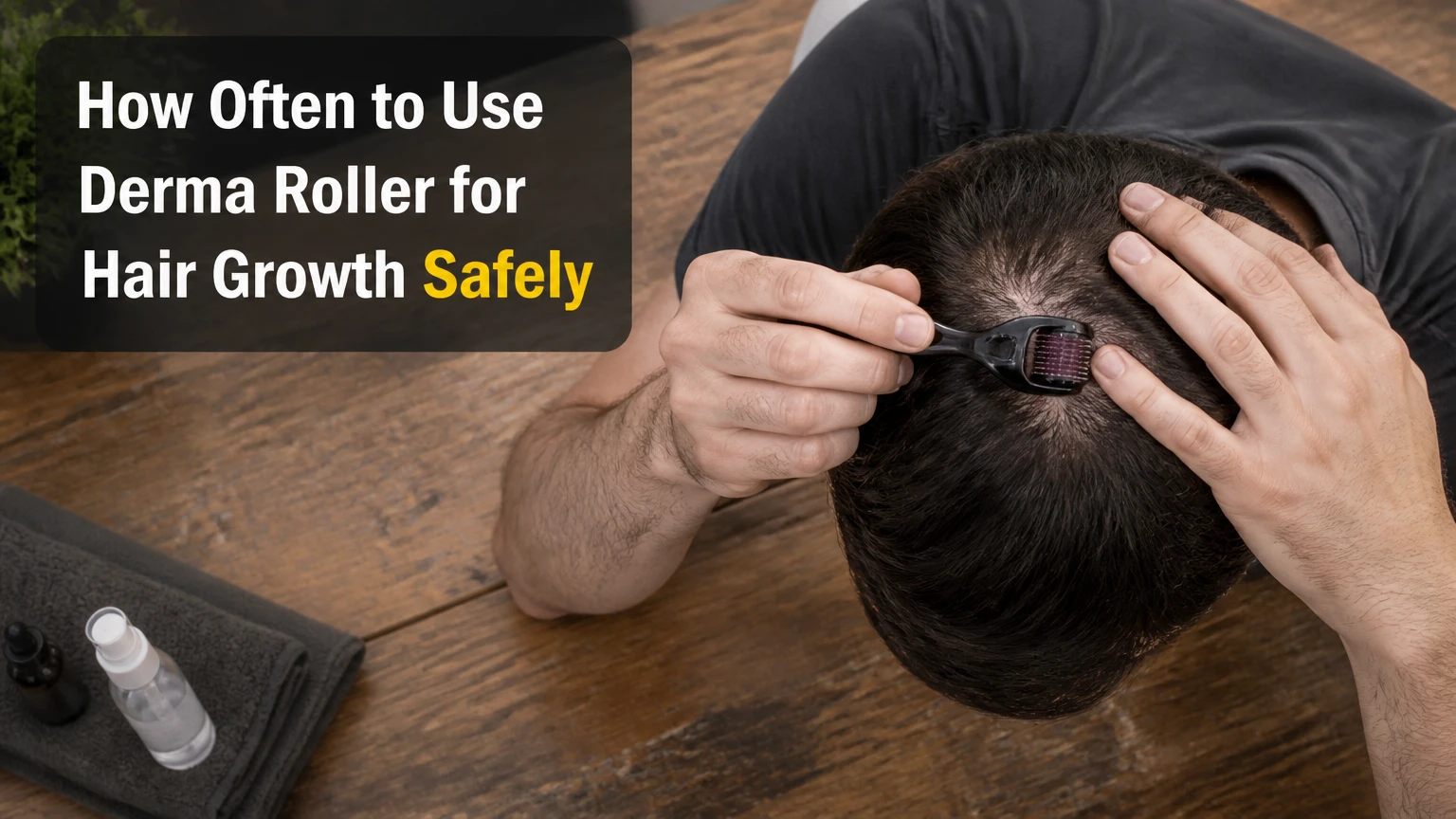
A derma roller for hair growth is usually used once weekly at 0.5 mm, while deeper 1.0-1.5 mm microneedling requires roughly 2-4 weeks between sessions and is better supervised medically. A 0.25 mm roller may be used more often, but it primarily improves topical penetration rather than reliably stimulating new hair.
Key Facts at a Glance
- A 0.5 mm scalp derma roller is typically limited to one session every 7-14 days.
- A 1.0 mm device usually requires a 14-21 day recovery interval.
- A 1.5 mm treatment is generally a clinical procedure, not a routine home treatment.
- Daily rolling can prolong inflammation, increase infection risk, and cause scalp injury.
- Microneedling has the strongest evidence as an adjunct to minoxidil for some forms of androgenetic alopecia, not as a universal cure.
- Electrolysis removes individual hairs permanently. Electrolysis does not stimulate scalp hair growth.
What Does a Derma Roller Do for Hair Growth?
A derma roller creates controlled punctures in the scalp with multiple fine needles. The injury response may release wound-healing signals, increase local remodeling, and improve delivery of a topical medication, but the evidence does not establish that every claimed growth factor produces meaningful regrowth in every user.
Microneedling is not the same as increasing blood flow through vigorous massage. The relevant action is mechanical injury followed by repair. Platelet-derived growth factor, vascular signals, collagen remodeling, and inflammatory mediators may participate, but biological plausibility is not proof of a predictable cosmetic result.
The best-known clinical evidence concerns androgenetic alopecia, also called pattern hair loss. In a randomized controlled study published in International Journal of Trichology in 2013, Dhurat and colleagues reported greater hair-count improvement when weekly microneedling was combined with 5% minoxidil than with minoxidil alone over 12 weeks. The study was small, and it does not prove that a home roller alone will reproduce the result.
Does microneedling work for every type of hair loss?
Microneedling is most plausibly useful for selected cases of pattern hair loss. It is not a substitute for diagnosis because sudden shedding, smooth bald patches, scarring, infection, thyroid disease, iron deficiency, and medication-related loss require different treatment.
A dermatologist should assess hair loss that begins abruptly, causes pain or scaling, produces shiny scar-like skin, or affects eyebrows and body hair. Microneedling an inflamed or scarred scalp can worsen the problem and delay appropriate care.
How Often Should You Use a Derma Roller for Hair Growth?
The practical schedule depends on needle length, skin response, diagnosis, and whether treatment occurs at home or in a clinic. For most beginners, 0.5 mm once every 7-14 days is the conservative starting interval; longer needles require more healing time and should not be selected merely to obtain faster results.
Needle length is not a simple measure of effectiveness. A longer needle creates more tissue disruption, more pain, and more opportunity for bleeding, contamination, and prolonged inflammation. The correct interval is the shortest interval that allows the scalp to return to its normal appearance and comfort.
| Needle length | Typical purpose | Home-use interval | Typical recovery signal |
|---|---|---|---|
| 0.25 mm | Topical delivery, superficial stimulation | 2-3 times weekly | Redness usually resolves within 24 hours |
| 0.5 mm | Common beginner depth for thinning | Every 7-14 days | Tenderness and redness settle within 24-48 hours |
| 1.0 mm | Deeper clinical-style stimulation | Every 14-21 days | Tenderness may last 2-3 days |
| 1.5 mm | Professional microneedling | Every 21-28 days | Bleeding and redness require medical monitoring |
These are typical practitioner intervals, not universal prescriptions. The evidence base uses different devices, pressures, treatment counts, and diagnoses, so a study schedule should not automatically become a home protocol.
Should you roll every day?
No. Daily scalp rolling does not give follicles extra time to benefit from repair. Repeated puncturing can maintain inflammation, damage the skin barrier, increase microbial contamination, and cause the user to mistake irritation for treatment progress.
A useful practitioner rule is to wait until redness, burning, crusting, and tenderness have completely resolved before repeating a session. If symptoms remain after 48 hours, extend the interval and reduce the needle length or seek clinical advice.
Which Needle Size and Device Should You Choose?
A 0.5 mm derma stamp is often the most manageable home option for a beginner with short hair and localized thinning. A stamp enters vertically and reduces the pulling and hair entanglement that can occur with a rolling drum, whereas a motorized pen offers more consistent penetration but creates greater safety demands.
Needle counts and materials do not determine medical quality by themselves. Sterile, single-use cartridges used by a qualified clinician offer a different contamination profile from a reusable consumer roller, even when both products list the same nominal depth.
| Device | Entry pattern | Typical depth range | Best-fit situation | Main limitation |
|---|---|---|---|---|
| Derma roller | Angled rolling entry | 0.25-1.0 mm home models | Short hair and broad thinning | Can snag hair and create dragging |
| Derma stamp | Press-and-lift entry | 0.25-1.5 mm listed models | Hairlines and small target areas | Requires consistent spacing and pressure |
| Microneedling pen | Motorized vertical pulses | 0.5-2.5 mm professional range | Clinic-controlled depth | Deep settings are unsafe for casual home use |
| Cosmetic stamp | Very superficial puncture | Under 0.25 mm | Limited topical application | Usually too shallow for meaningful follicle stimulation |
Stainless steel and titanium both appear in consumer devices. Stainless steel is common in medical instruments and can be easier to inspect, while titanium is hard and corrosion resistant. Material alone cannot prove sterility, sharpness, or accurate needle length.
How Should You Apply a Scalp Derma Roller?
Safe application requires a clean, fully dry scalp, a disinfected device, light pressure, limited passes, and enough recovery time. A complete home session generally takes 10-20 minutes, excluding drying and cleaning, and should target thinning skin rather than the entire scalp.
Before You Start
| Requirement | Typical specification |
|---|---|
| Device | 0.5 mm roller or stamp from a traceable manufacturer |
| Cleaning agent | 70% isopropyl alcohol for compatible reusable equipment |
| Scalp condition | Clean, dry, free from sores, pus, active rash, or open scratches |
| Session time | 10-20 minutes |
| Replacement | Follow manufacturer instructions; replace bent, dull, rusty, or contaminated devices immediately |
Do not share a roller. Do not use a device with bent needles, a loose head, visible residue, or an uncertain cleaning history.
Step 1: Clean and Inspect the Device
Clean the device according to its manufacturer’s instructions. Many reusable devices can be disinfected with 70% isopropyl alcohol, but alcohol does not transform a contaminated consumer roller into a sterile medical instrument.
Inspect the needle head under bright light. You should see straight, intact tips and a clean handle. The checkpoint is simple: no residue, rust, looseness, or damaged needles. A common mistake is wiping the head with a used towel, which can recontaminate it.
Step 2: Wash and Dry the Scalp
Wash away oil, styling products, sweat, and loose scale, then allow the scalp to dry fully. Wet hair increases snagging, and wet skin can make pressure harder to judge.
Avoid rolling immediately after harsh chemical treatments, hair dye, bleaching, or vigorous scratching. The scalp should feel calm before treatment begins.
Step 3: Section the Thinning Areas
Use clips or a clean comb to expose the crown, part line, or hairline. Treat only the areas relevant to the treatment plan.
A focused treatment reduces unnecessary trauma. Rolling over dense unaffected scalp adds injury without demonstrating an added regrowth benefit.
Step 4: Use Light, Lifted Passes
Place the device on the target skin, apply light pressure, roll or stamp in one direction, lift it fully, and change direction. Four directions are commonly used: vertical, horizontal, and two diagonals, with approximately 4-5 passes per direction on each small section.
The scalp may become pink and feel warm. Pinpoint bleeding can occur with deeper professional treatment, but heavy bleeding means the pressure or depth is excessive. Never drag the roller sideways while it remains in contact with the skin.
Step 5: Clean, Dry, and Store
Rinse away visible debris only if the manufacturer permits it, disinfect as directed, air-dry completely, and store the device in a clean protective case. The case should itself remain dry and clean.
A frequent error is sealing a wet roller in a closed container. Moisture supports contamination and can corrode or damage the needle assembly.
Can You Apply Minoxidil After Microneedling?
Minoxidil should not be applied immediately after a deeper microneedling session because disrupted skin can increase irritation and medication absorption. Many clinicians advise waiting about 24 hours after 0.5-1.5 mm treatment, but the correct timing depends on skin closure, product formulation, and medical guidance.
The commonly discussed combination is microneedling plus topical minoxidil, not microneedling plus every scalp oil. Alcohol, propylene glycol, fragrance, essential oils, and other ingredients can sting intensely on freshly punctured skin.
| Product or treatment | Immediate post-session use | Safer practical approach |
|---|---|---|
| 5% topical minoxidil | Avoid after deeper puncturing | Resume after about 24 hours if skin is closed and calm |
| Fragranced scalp serum | Avoid | Wait until burning and redness disappear |
| Rosemary essential oil | Avoid undiluted use | Do not place on freshly injured skin |
| Plain gentle cleanser | Usually acceptable before treatment | Use only as directed and avoid scrubbing |
| Prescribed scalp medication | Depends on prescription | Ask the prescribing clinician before pausing or applying |
Topical minoxidil can cause irritation, unwanted facial hair, dizziness, or palpitations in some users. Stop and seek medical advice for chest pain, faintness, rapid heartbeat, or severe swelling.
Who Should Avoid Home Scalp Microneedling?
People with active infection, folliculitis, uncontrolled seborrheic dermatitis, psoriasis plaques, open wounds, bleeding disorders, poor wound healing, or a tendency toward keloid scarring should avoid unsupervised scalp microneedling. Pregnancy, immune suppression, anticoagulant use, and recent scalp surgery also warrant clinician review.
| Situation | Why home treatment is risky | Appropriate next action |
|---|---|---|
| Pus, crusting, or painful bumps | Can spread infection | Treat the scalp condition first |
| Alopecia areata | Autoimmune hair loss needs diagnosis | See a dermatologist |
| Scarring alopecia signs | Injury may accelerate permanent loss | Obtain prompt specialist assessment |
| Blood thinners or bleeding disorder | Bleeding may be prolonged | Obtain medical clearance |
| Recent transplant or surgery | Healing tissue is vulnerable | Follow the surgical team’s schedule |
| Severe dandruff or psoriasis | Needling can worsen inflammation | Control the disease before treatment |
The American Academy of Dermatology Association recommends diagnosis before treating hair loss because different causes require different therapies. A roller cannot identify whether follicles are miniaturizing, inflamed, scarred, or temporarily shedding.
How Long Does Hair Regrowth Take?
Visible change usually requires at least 3-6 months, and some users see no meaningful improvement. Hair grows through cycles, so early redness, scalp texture changes, or temporary shedding cannot confirm that follicles are producing durable new strands.
| Period | What may occur | What it does not prove |
|---|---|---|
| First 24-48 hours | Redness, warmth, tenderness | Successful follicle stimulation |
| Weeks 1-4 | Healing and possible irritation | New terminal hair growth |
| Weeks 8-12 | Fine hairs may become noticeable in responders | Permanent density increase |
| Months 4-6 | Thickness and coverage can be assessed | Guaranteed treatment success |
| After 6 months | Progress can be compared with baseline photos | Freedom from ongoing hair-loss treatment |
Take standardized photographs monthly using the same lighting, camera distance, hairstyle, and parting. Daily mirror checks are unreliable because hair angle and hydration change the apparent density.
Microneedling does not permanently cure androgenetic alopecia. If an effective maintenance medication is stopped, the underlying miniaturization process can continue.
How Does Microneedling Compare With Other Options?
Microneedling is an adjunct, not a universal replacement for evidence-based hair-loss treatment. Minoxidil has a larger treatment history for pattern hair loss, finasteride is prescription-based for appropriate men, and clinic procedures provide greater depth control but cost more.
| Option | Main use | Typical frequency | Typical cost range | Key limitation |
|---|---|---|---|---|
| Home 0.5 mm device | Adjunct for selected thinning | Every 7-14 days | $15-$60 device | Technique and hygiene vary |
| Topical minoxidil | Pattern hair-loss treatment | Daily, product dependent | $10-$40 monthly | Irritation and continued use required |
| Clinic microneedling | Controlled adjunctive procedure | Every 3-4 weeks | $200-$700 per session | Cost and medical availability |
| PRP injections | Physician-delivered adjunct | Often 3 initial sessions | $500-$2,000 per session, typical US range | Variable evidence and expense |
| Hair transplant | Redistribution of donor follicles | Usually one surgical course | $4,000-$15,000, typical US range | Requires suitable donor hair |
| Electrolysis | Permanent removal of individual hairs | Repeated appointments | Often $50-$150 per hour | Removes hair; does not regrow it |
Electrolysis deserves a clear distinction. A licensed electrologist inserts a probe into individual follicles to destroy their growth capacity, making electrolysis useful for unwanted facial or body hair, not receding hairlines or scalp-density restoration.
Is professional microneedling safer?
Professional microneedling offers controlled depth, sterile single-use cartridges, appropriate skin preparation, and medical assessment. It is generally safer for deeper treatment, unusual hair loss, darker skin prone to post-inflammatory pigment changes, and people using medications that affect healing.
The U.S. Food and Drug Administration states that it has not authorized microneedling medical devices for over-the-counter sale or for treatment of hair loss. That warning does not mean every home product causes harm, but it does mean marketing claims should not be treated as regulatory proof.
What Are the Most Common Mistakes?
The most damaging mistake is treating frequency as the main success factor. Diagnosis, consistent evidence-based treatment, clean technique, and adequate healing matter more than increasing sessions.
- Rolling daily: Stop and allow the scalp to recover fully. Resume at a longer interval, or stop if burning and crusting persist.
- Using excessive pressure: Reduce pressure until the device glides without force. Bleeding beyond occasional pinpoint spots requires medical advice.
- Rolling over dermatitis: Pause treatment and control the rash, scale, or folliculitis first.
- Applying minoxidil immediately: Wait about 24 hours after deeper treatment unless a clinician gives different instructions.
- Using a blunt roller: Replace a device that snags hair, drags, bends, or shows rust.
- Expecting treatment to reverse scarring: Seek prompt dermatology assessment when the scalp looks shiny or follicular openings disappear.
What if redness lasts longer than 48 hours?
Stop microneedling until the scalp returns to baseline. Persistent redness, swelling, increasing pain, pus, fever, spreading warmth, or thick crusting can indicate infection or excessive injury and warrants medical evaluation.
Do not apply alcohol repeatedly to an irritated scalp to “sterilize” it. Alcohol can further damage the skin barrier and intensify burning.
Which Schedule Fits Your Situation?
A beginner with mild pattern thinning can usually start with 0.5 mm every 10-14 days, document baseline photographs, and review progress after 12 weeks. A person with significant loss should obtain a diagnosis before choosing needle depth.
| User situation | Conservative starting plan | Avoid |
|---|---|---|
| Mild, stable thinning | 0.5 mm every 10-14 days | Daily rolling |
| Sensitive scalp | 0.25-0.5 mm every 14 days | Fragranced post-treatment products |
| Long or dense hair | Consider a stamp rather than roller | Dragging through hair |
| Minoxidil user | Pause after treatment for about 24 hours | Immediate application |
| Patchy bald spots | Dermatology evaluation first | Self-treating suspected alopecia areata |
| Scalp disease | Treat inflammation before needling | Rolling over scale, sores, or pus |
Women and men can develop pattern hair loss, but the cause and medication choices differ. A clinician should assess menstrual changes, postpartum shedding, hormonal symptoms, nutritional deficiency risk, and medication history where relevant.
FAQ
Can a derma roller regrow a receding hairline?
A derma roller may support treatment of early pattern hair loss in some people, particularly when combined with an established therapy such as minoxidil, but it cannot reliably restore a fully smooth or scarred hairline. Receding temples should be photographed and medically assessed before home needling begins.
Is a derma stamp better than a derma roller?
A derma stamp can be easier to control on a hairline or small thinning patch because it enters vertically and does not need to roll through surrounding hair. A roller may cover a broad area faster, but dragging, hair snagging, and uneven pressure are greater practical risks.
Can microneedling cause permanent hair loss?
Improper microneedling can cause infection, prolonged inflammation, pigment changes, or scarring, and scarring can permanently damage follicles. Correct depth, clean equipment, adequate healing intervals, and avoiding active scalp disease reduce risk, but no home device eliminates it.
Should you microneedle before or after washing your hair?
Wash the scalp first and treat it only after the skin and hair are completely dry. Washing afterward can irritate freshly punctured skin, while rolling over product buildup increases contamination and makes the device less predictable.
What happens if you stop scalp microneedling?
Stopping microneedling removes its possible adjunctive effect, but it does not create withdrawal shedding in the way some ongoing hair-loss treatments can. Any continued pattern hair loss reflects the underlying condition, so effective medical treatments may still need ongoing use.
Does electrolysis help hair grow on a bald scalp?
Electrolysis does not help scalp hair grow. Electrolysis permanently destroys individual follicles to remove unwanted hair, whereas scalp microneedling and hair-loss medications aim to preserve or stimulate existing follicles. The two procedures have opposite goals.
The Bottom Line
For most people asking how often to use derma roller for hair growth, the safest practical starting point is 0.5 mm once every 7-14 days, with no session until the scalp has completely recovered. Deeper 1.0-1.5 mm treatment belongs under professional supervision, and microneedling should not replace diagnosis, minoxidil when appropriate, or treatment for scalp disease.
A derma roller is not a cure, and daily use is not an accelerated protocol. Clean equipment, conservative pressure, correct minoxidil timing, monthly photographs, and a confirmed diagnosis provide a safer basis for judging whether the routine is helping.