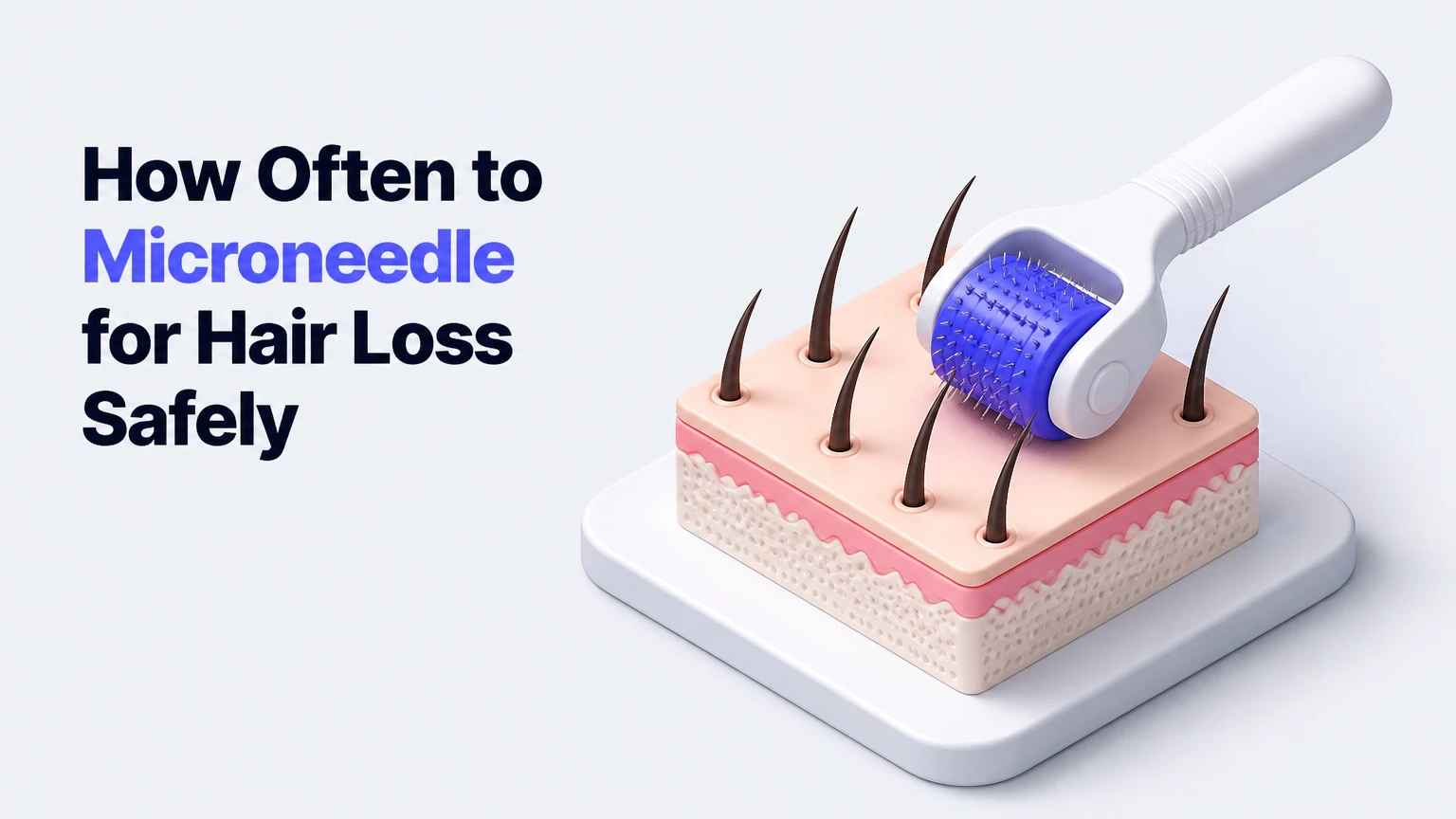
For hair loss, scalp microneedling is typically performed every 1-4 weeks, depending mainly on needle depth and skin recovery. A 0.25-0.5 mm device is generally used no more than weekly, while 1.0-1.5 mm treatment usually requires a 2-4 week interval and is better supervised by a dermatologist.
Key Facts at a Glance
- Scalp microneedling should not be performed daily because repeated injury can prolong inflammation and impair barrier recovery.
- A 0.5 mm session is commonly spaced about 7 days apart, but persistent redness requires a longer interval.
- A 1.0-1.5 mm session is commonly spaced 14-28 days apart, especially when pinpoint bleeding occurs.
- Clinical studies support microneedling mainly as an adjunct to minoxidil for androgenetic alopecia, not as a universal treatment for every cause of shedding.
- Minoxidil should generally be withheld for at least 24 hours after deeper needling unless a prescribing clinician gives different instructions.
- Sudden shedding, smooth bald patches, scalp pain, pustules, or shiny scar-like skin should be evaluated before using a needle device.
How Often to Microneedle for Hair Loss?
The safest practical schedule is once weekly for shallow 0.25-0.5 mm needling and once every 2-4 weeks for 1.0-1.5 mm treatment. The correct interval is the shortest period that allows the scalp to return to its normal color, texture, and comfort; a fixed calendar schedule is inappropriate when redness, crusting, tenderness, or folliculitis persists.
Microneedling frequency depends on four linked variables: needle depth, pressure, number of passes, and the scalp’s medical condition. A lightly applied 0.5 mm stamp creates a different wound burden from a forcefully pressed 1.0 mm roller used repeatedly across the same area.
Published trials do not establish one universally superior interval for every device and patient. In a randomized controlled study, Dhurat and colleagues compared weekly microneedling plus minoxidil with minoxidil alone and reported better hair-count outcomes at 12 weeks in the combination group. That result supports microneedling as an adjunct, but it does not prove that weekly deep needling is safe for everyone.
Which Needle Depth Changes the Schedule?
Needle depth changes the schedule because deeper penetration creates more tissue disruption and usually needs more recovery time. The following ranges are practical starting points, not prescriptions for self-treatment.
| Needle depth | Common purpose | Typical interval | Expected endpoint |
|---|---|---|---|
| 0.25 mm | Cosmetic topical delivery | 7-14 days | Mild temporary pinkness |
| 0.5 mm | Shallow scalp stimulation | About 7 days | Uniform redness lasting less than 24 hours |
| 1.0 mm | Clinical-style adjunct treatment | 14-21 days | Redness and tenderness for 24-48 hours |
| 1.5 mm | Deeper professional treatment | 21-28 days | Longer recovery, sometimes pinpoint bleeding |
The 0.25 mm and 0.5 mm ranges are often marketed for product penetration, but deeper penetration does not automatically produce better hair growth. A 2022 systematic review by Gupta and colleagues found potential benefit from microneedling in androgenetic alopecia, while also noting differences in device type, depth, protocol, and outcome measurement across studies.
What Does Scalp Microneedling Do?
Scalp microneedling creates controlled punctures that activate wound-healing signals, alter local inflammatory activity, and may improve delivery of a topical treatment. The proposed hair-growth pathways include platelet-derived signals, vascular endothelial growth factor activity, and Wnt-related signaling, but the clinical importance of each pathway remains uncertain.
The strongest human evidence concerns androgenetic alopecia, also called male-pattern or female-pattern hair loss. In that condition, follicles gradually miniaturize under androgen-sensitive signaling, and microneedling may provide a supportive mechanical stimulus while minoxidil addresses a separate part of the growth process.
The treatment is not a follicle transplant. It cannot reliably restore a follicle destroyed by scarring, and it does not correct iron deficiency, thyroid disease, medication-related shedding, or active scalp infection. A dermatologist should identify the hair-loss diagnosis before a person commits to a repeated injury-based routine.
Does Microneedling Regrow Every Type of Hair Loss?
Microneedling has the most relevant evidence for androgenetic alopecia and far less evidence for telogen effluvium, alopecia areata, traction alopecia, and scarring alopecias. Needling an undiagnosed scalp can delay treatment for an inflammatory or autoimmune disorder.
| Hair-loss condition | Microneedling role | Main concern | Better first action |
|---|---|---|---|
| Androgenetic alopecia | Possible adjunct to minoxidil | Ongoing follicle miniaturization | Confirm diagnosis and discuss established treatments |
| Telogen effluvium | Not a primary treatment | Needling does not correct the trigger | Investigate illness, nutrition, hormones, or medication |
| Alopecia areata | Specialist decision only | Trauma may aggravate active inflammation | Dermatologic examination and appropriate therapy |
| Traction alopecia | Remove mechanical tension first | Repeated trauma can worsen damage | Change hairstyle and assess follicle viability |
| Scarring alopecia | Generally inappropriate without specialist approval | Needling may worsen inflammation or scarring | Prompt scalp examination and biopsy when indicated |
Which Device Is Appropriate?
A vertical stamp or professionally operated pen offers better control than a manual roller, while a roller remains inexpensive but can create uneven pressure and more dragging. Device choice affects wound shape, sterility, coverage speed, and the chance of using excessive passes.
| Device | Typical adjustable depth | Typical price | Main control feature | Main limitation |
|---|---|---|---|---|
| Manual roller | 0.25-1.5 mm | $10-$30 | Fast coverage | Angled needles can drag or tear skin |
| Manual stamp | 0.25-2.0 mm | $15-$50 | Vertical application | Slower on large areas |
| Electric pen | 0.25-2.5 mm | $80-$300 | Adjustable speed and depth | Requires single-use cartridges |
| Professional session | Clinician-selected | $200-$700 per session | Sterile technique and assessment | Higher cost and appointment time |
Home device depth labels are not always equivalent to actual penetration. Hair, scalp curvature, device angle, pressure, and needle sharpness can change the delivered injury, so a 1.0 mm consumer roller should not be treated as interchangeable with a 1.0 mm clinical pen.
How Do You Perform a Session?
A conservative scalp microneedling session involves diagnosis, clean preparation, controlled vertical application, and a recovery period without irritating actives. The active treatment usually takes 5-15 minutes for a limited thinning area, but cleaning and preparation add another 10-20 minutes.
Before You Start
| Requirement | Typical specification |
|---|---|
| Time | 20-35 minutes including preparation |
| Device | Clean stamp, roller, or pen with intact needles |
| Scalp state | Washed, dry, and free of pustules or open lesions |
| Cleaning product | Manufacturer-approved disinfectant or 70% isopropyl alcohol where appropriate |
| Replacement part | New pen cartridge for each session |
| Topical plan | Minoxidil paused after deeper treatment |
| Cost | $10-$300 for equipment, $200-$700 for a professional session |
Step 1: Confirm That the Scalp Is Suitable
Do not needle over infection, active eczema, psoriasis plaques, sunburn, open wounds, unexplained scabbing, or painful inflamed follicles. Delay treatment if the scalp is unusually tender or if shedding began suddenly without a diagnosis.
You will know the scalp is ready when the skin is intact, calm, and free from discharge. The common mistake at this stage is treating a symptom before identifying the cause of loss.
Step 2: Wash and Dry the Scalp
Wash the scalp with a gentle shampoo, rinse thoroughly, and allow the skin to dry completely. Avoid applying oils, styling products, fragrance, acids, or exfoliants before needling because these substances can increase irritation or contaminate the puncture sites.
A clean scalp reduces surface contamination, but washing does not make home treatment sterile. That distinction matters.
Step 3: Disinfect the Device
Follow the device manufacturer’s cleaning instructions. For compatible reusable tools, 70% isopropyl alcohol is commonly used for surface disinfection, but soaking a device does not guarantee sterilization, and some plastics or adhesives can deteriorate in alcohol.
Use a new disposable cartridge for each electric pen session. Never share a roller or stamp, and discard a device when needles become bent, dull, or visibly contaminated.
Step 4: Apply Controlled Passes
Part the hair to expose the thinning scalp and use a stamp or pen vertically, with light and consistent pressure. If using a roller, lift it between directional passes rather than dragging it across the skin, and stop when the scalp shows even pinkness.
Do not chase bleeding as proof of effectiveness. Pinpoint bleeding can occur with deeper treatment, but heavy bleeding, tearing, or intense pain indicates excessive pressure or an unsuitable technique.
Step 5: Protect the Recovery Window
Leave the scalp alone after treatment except for a clinician-approved bland product. Avoid sweating, swimming, hair dye, fragrance, exfoliating acids, and vigorous scratching for at least 24 hours, or longer if irritation remains.
You will know recovery is progressing when tenderness decreases and redness fades within 24-48 hours. Persistent inflammation means the next session should be postponed.
When Can You Apply Minoxidil?
Minoxidil should generally be withheld for at least 24 hours after 1.0 mm or deeper scalp microneedling because freshly punctured skin may increase absorption and irritation. A dermatologist may recommend a different interval based on the device, formulation, scalp condition, and cardiovascular history.
The concern is not that minoxidil becomes chemically dangerous after needling. The concern is that damaged skin can allow more product to enter than intended, increasing burning, dizziness, headache, rapid heartbeat, or unwanted systemic exposure.
A 0.25 mm cosmetic pass may have a shorter pause in some protocols, but product labels and clinician instructions take priority. Do not use numbing cream, minoxidil, retinoids, essential oils, or compounded growth serums on freshly punctured skin without professional guidance.
Why Is Daily Microneedling Unsafe?
Daily microneedling is unsafe because the scalp may not complete barrier repair before the next injury. Repeated puncturing can produce prolonged redness, dermatitis, folliculitis, pigment changes, pain, and infection without providing evidence of faster follicle growth.
Skin repair is not a race. An experienced practitioner adjusts the next session to the patient’s recovery rather than increasing frequency when results appear slow. Hair follicles also operate on a long biological cycle, so more frequent trauma cannot force visible regrowth within a few days.
How Long Should the Scalp Recover?
Most shallow sessions should have at least seven days between treatments, while deeper sessions usually need 14-28 days. Recovery takes longer when the user applies strong pressure, repeats passes, treats a large area, has eczema or seborrheic dermatitis, or develops crusting.
| Recovery sign | Typical meaning | Next action |
|---|---|---|
| Pinkness under 24 hours | Mild expected response | Resume only after normal skin returns |
| Tenderness for 24-48 hours | Moderate treatment response | Extend the interval if repeated |
| Redness beyond 48 hours | Excessive injury or irritation | Stop and seek advice if persistent |
| Yellow pustules | Possible folliculitis or infection | Stop treatment and contact a clinician |
| Crusting or open erosions | Barrier injury | Do not resume until fully healed |
| Worsening hair loss with pain | Possible inflammatory disease | Arrange prompt dermatologic assessment |
What Problems Require a Pause?
Painful pustules, spreading redness, warmth, drainage, fever, thick crusts, or worsening swelling require immediate cessation and medical assessment. Mild pinkness and short-lived tenderness can occur, but infection and inflammatory scalp disease should not be managed by adding more needling.
Common failure modes have practical corrections:
- Using the device over dirty or product-coated hair: Wash and dry the scalp first.
- Applying excessive pressure: Reduce pressure and stop at uniform pinkness rather than chasing bleeding.
- Repeating sessions before redness resolves: Extend the interval to 14 or 28 days.
- Applying minoxidil immediately after deep needling: Wait at least 24 hours unless a clinician directs otherwise.
- Using dull or shared needles: Replace disposable cartridges and discard damaged reusable tools.
- Needling active dandruff or dermatitis: Treat the scalp condition before mechanical stimulation.
An important practitioner rule is that the recovery endpoint outranks the planned calendar. A person who needs 10 days to recover from a nominal weekly session should not continue every seven days.
What Results Can You Expect?
Early visible changes usually take at least 3-6 months because scalp hair grows slowly and studies commonly assess hair density after several months. Temporary shedding, short vellus hairs, or reduced scalp visibility can occur before a stable result, but none proves that follicles are recovering.
| Time after starting | What may occur | What the result cannot prove |
|---|---|---|
| 0-4 weeks | Redness, tenderness, no visible growth | Treatment effectiveness |
| 6-12 weeks | Early texture or shedding changes | Permanent density improvement |
| 3-6 months | Possible density change with combination therapy | A cure for the underlying diagnosis |
| 6-12 months | More reliable assessment period | That continued needling is still necessary |
| After stopping | Benefit may plateau or decline | The exact maintenance interval |
Microneedling is not a substitute for treatments with stronger evidence for androgenetic alopecia, such as minoxidil and, where appropriate, prescription therapies. In the Dhurat trial, the combination group had greater mean hair-count improvement than the minoxidil-only group at 12 weeks, but the study was small and does not establish lifelong benefit.
Dr. Antonella Tosti, a dermatologist and hair-disorders researcher, has emphasized that hair loss requires identifying the specific diagnosis before treatment selection. That principle applies here: a needling protocol cannot compensate for an incorrect diagnosis.
What Are Typical Costs?
Home treatment commonly costs $10-$50 for a manual device or $80-$300 for an electric pen, while professional scalp microneedling commonly costs about $200-$700 per session in the United States. Actual prices vary by city, clinician credentials, treatment area, cartridge type, and whether platelet-rich plasma is included.
| Treatment route | Typical upfront cost | Typical recurring cost | Appointment or use time |
|---|---|---|---|
| Manual roller | $10-$30 | $5-$30 replacement | 10-20 minutes |
| Manual stamp | $15-$50 | $10-$50 replacement | 10-25 minutes |
| Electric pen | $80-$300 | $5-$30 cartridge | 5-15 minutes |
| Professional treatment | $200-$700 | $200-$700 per session | 30-60 minutes |
A lower equipment price does not equal lower medical risk. Professional treatment may be more economical when the diagnosis is uncertain, the scalp is reactive, or deeper penetration is being considered.
How Does Hair Electrolysis Compare?
Hair electrolysis does not treat scalp hair loss because electrolysis permanently destroys individual unwanted hair follicles rather than stimulating miniaturized scalp follicles. Licensed electrologists use a fine probe and electrical current for cosmetic removal, typically on the face, neck, or small body areas.
Electrolysis may be relevant to a person who wants to remove stray facial hairs caused by hormonal changes, but it is not an alternative to microneedling, minoxidil, platelet-rich plasma, or hair transplantation for thinning scalp hair. Using electrolysis on a thinning scalp would remove follicles, which conflicts with a hair-restoration goal.
| Feature | Microneedling | Hair electrolysis | Minoxidil | Hair transplant |
|---|---|---|---|---|
| Primary purpose | Mechanical adjunct for thinning | Permanent removal of selected hairs | Medication-based growth support | Relocation of donor follicles |
| Target | Scalp skin and miniaturized follicles | Individual unwanted follicles | Susceptible scalp follicles | Bald or thinning recipient zones |
| Session pattern | Every 1-4 weeks | Repeated visits per target area | Usually daily topical use | Usually one or more procedures |
| Typical cost | $10-$700 | Often $50-$150 per hour | About $10-$50 monthly | Commonly several thousand dollars |
| Main risk | Infection, irritation, scarring | Pain, irritation, pigment change | Irritation and systemic effects | Scarring, graft loss, poor growth |
Which Hair-Loss Conditions Need Diagnosis First?
A dermatologist should assess sudden diffuse shedding, sharply defined patches, eyebrow loss, scalp pain, itching, pustules, scale, or shiny areas before microneedling begins. These findings can indicate alopecia areata, infection, psoriasis, lupus, lichen planopilaris, folliculitis, nutritional deficiency, or medication-related loss.
A useful evaluation may include scalp dermoscopy, a medication review, and targeted blood tests when the history suggests thyroid disease, iron deficiency, hormonal disruption, or systemic illness. A biopsy is sometimes necessary for suspected scarring alopecia.
Microneedling is especially unsuitable as a self-treatment when the scalp is inflamed. Mechanical injury can obscure clinical signs and delay anti-inflammatory or antimicrobial treatment.
The Bottom Line
For the question “how often to microneedle for hair loss,” use a conservative depth-based schedule: shallow 0.25-0.5 mm treatment no more than about weekly, and 1.0-1.5 mm treatment every 2-4 weeks. Do not needle daily, pause minoxidil after deeper treatment, and obtain a diagnosis before treating sudden, patchy, painful, or scar-like hair loss.
The most defensible use is microneedling as a carefully controlled adjunct for diagnosed androgenetic alopecia. Stop when recovery is incomplete, because persistent inflammation is a warning that the treatment burden exceeds the scalp’s ability to repair.
Frequently Asked Questions
Can microneedling make hair loss worse?
Microneedling can worsen scalp problems when the user applies excessive pressure, treats infected or inflamed skin, uses contaminated equipment, or repeats sessions before healing. Temporary shedding after irritation does not necessarily mean permanent follicle damage, but pain, pustules, scarring, or persistent redness require treatment cessation and clinical assessment.
Should you microneedle a receding hairline?
A receding hairline can be treated only after confirming the cause, since androgenetic alopecia, traction alopecia, and frontal fibrosing alopecia can look different but require different management. Avoid needling a painful, scaly, inflamed, or shiny hairline until a dermatologist has examined it.
Can you use rosemary oil after scalp microneedling?
Rosemary oil should not be applied immediately after scalp microneedling because essential oils can irritate punctured skin and may cause allergic contact dermatitis. Wait until the barrier has fully recovered, and discuss topical alternatives with a clinician, particularly when minoxidil is already part of the treatment plan.
Is a derma roller or derma stamp better for hair growth?
A derma stamp generally offers better control because its needles enter vertically and target small areas without dragging across the scalp. A roller can cover larger areas more quickly, but uneven pressure, hair entanglement, and angled entry increase the chance of superficial tearing.
Can microneedling replace minoxidil?
Microneedling should not be assumed to replace minoxidil because the best-known clinical evidence evaluates the procedures as combination therapy, particularly for androgenetic alopecia. People who cannot use minoxidil need a clinician to discuss alternatives rather than treating microneedling as an equivalent replacement.
How long should you continue scalp microneedling?
Continue only while the diagnosis, response, and recovery remain acceptable, with a formal assessment after about 3-6 months. If density is unchanged after a consistent, safe protocol, reassess the diagnosis and treatment plan instead of increasing needle depth or shortening the interval.