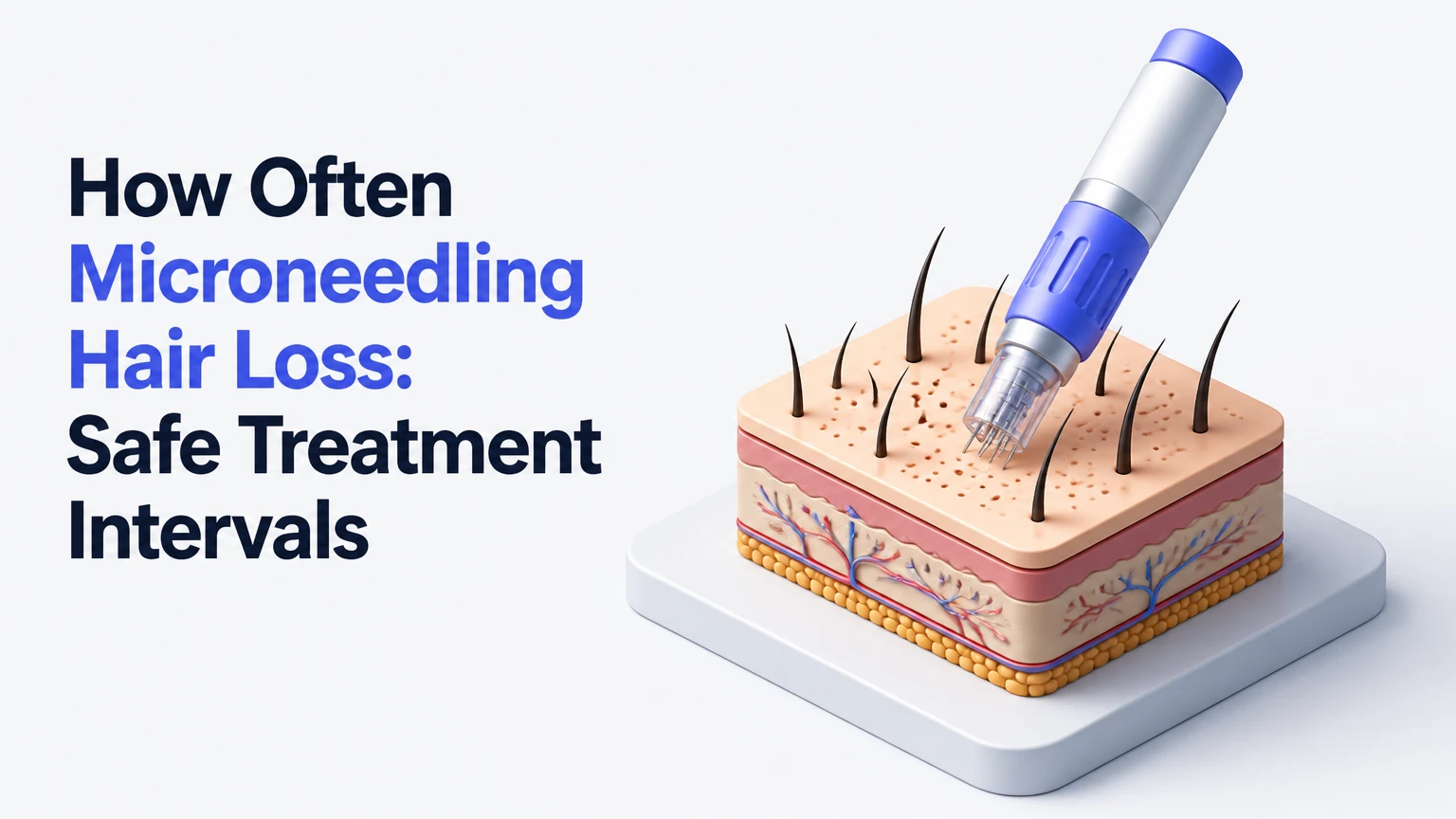
For scalp microneedling and hair loss, a common clinical schedule is every 4 weeks for deeper treatments around 1.0-1.5 mm, while shallow 0.5 mm treatments may be performed every 1-2 weeks under professional guidance. There is no universally proven home schedule. The correct interval depends on needle depth, skin healing, diagnosis, device quality, and concurrent treatments.
Key Facts at a Glance
- Scalp microneedling should not be repeated while redness, tenderness, swelling, crusting, or broken skin remains.
- Published hair-loss studies have used different protocols, including weekly and monthly sessions, so no single frequency applies to every device.
- Deeper professional needling generally requires longer recovery than shallow cosmetic needling.
- Minoxidil should not be applied to freshly punctured skin unless a clinician specifically instructs you to do so.
- Microneedling has the best evidence as an adjunct to treatment for androgenetic alopecia, not as a universal cure for every type of hair loss.
- Electrolysis removes individual hairs permanently and does not stimulate scalp follicles or treat pattern hair loss.
What Is Scalp Microneedling?
Scalp microneedling is a procedure that creates controlled punctures in the scalp with fine needles, usually to support a hair-loss treatment plan. The mechanical injury may activate wound-healing signals, alter local inflammation, and improve topical penetration, but the procedure does not reliably reverse every cause of alopecia.
Microneedling is used most often for androgenetic alopecia, also called male-pattern or female-pattern hair loss. That condition involves follicle miniaturization influenced by androgen sensitivity, especially sensitivity to dihydrotestosterone. A needle device cannot remove that underlying hormonal influence.
A dermatologist should diagnose sudden shedding, patchy bald spots, scalp pain, scaling, pustules, or scarring before treatment begins. Telogen effluvium, alopecia areata, traction alopecia, tinea capitis, psoriasis, and cicatricial alopecia require different decisions. Needling an inflamed or scarred scalp can worsen irritation and delay diagnosis.
How Does Microneedling Potentially Support Hair Growth?
Microneedling may support hair growth through mechanical wound-healing signals and improved delivery of selected topical medicines. Proposed mechanisms include release of platelet-derived growth factors, stimulation of dermal papilla signaling, and temporary changes in vascular and inflammatory pathways.
A 2022 review in Journal of Clinical Medicine described microneedling as a promising adjunct for androgenetic alopecia, but it also noted substantial variation in needle depth, frequency, outcome measures, and study quality. Biological mechanisms therefore support further research, not a guarantee that more punctures produce more hair.
The often-repeated claim that microneedling increases absorption by three to six times is not a dependable clinical rule for the scalp. Absorption changes with needle length, pressure, formulation, skin condition, and timing. Increased absorption can also increase irritation and systemic exposure to medication.
What Does the Research Actually Show?
The strongest frequently cited clinical evidence comes from a 2013 randomized study by Dhurat and colleagues, which compared weekly microneedling plus 5% minoxidil with minoxidil alone in men with androgenetic alopecia. The combination group achieved a greater change in hair count after 12 weeks, but the study was small, short, and used a specific protocol that should not be treated as a universal home prescription.
A 2023 systematic review and meta-analysis by Abdi and colleagues found that microneedling combined with topical minoxidil generally performed better than minoxidil alone for hair-count outcomes. The review also emphasized heterogeneity across trials. Evidence supports adjunctive use, while the ideal depth and interval remain unsettled.
How Often Should You Microneedle Your Scalp?
The most defensible schedule is to wait until the scalp has completely recovered, then space sessions according to depth: typically 1-2 weeks for shallow 0.25-0.5 mm professional or cosmetic procedures, about 2-4 weeks for approximately 0.75-1.0 mm treatment, and 4-6 weeks for deeper 1.5 mm clinical treatment. Home users should not copy a clinic protocol without assessment.
The table gives typical practice ranges, not a guaranteed prescription. A shorter interval may be inappropriate when the scalp remains sore or when minoxidil, retinoids, acids, or another irritating product is being used.
| Needle depth or setting | Typical setting | Common interval | Recovery checkpoint |
|---|---|---|---|
| 0.25 mm | Cosmetic topical-delivery use | 1-2 weeks | No tenderness or persistent redness |
| 0.5 mm | Shallow professional or cautious home protocol | 2-4 weeks | Intact skin, no scaling or crusting |
| 0.75-1.0 mm | Clinical hair-loss protocol | 3-4 weeks | Normal texture and comfortable washing |
| 1.5 mm | Professional medical treatment | 4-6 weeks | Complete healing and clinician approval |
Published studies do not establish that weekly treatment is superior to monthly treatment for every patient. The 2013 Dhurat trial used weekly sessions, whereas many clinical practices space deeper procedures farther apart. Depth, pressure, passes, and endpoint matter as much as the calendar.
Can You Microneedle Every Day?
Daily scalp microneedling is not an evidence-based hair-regrowth schedule. Repeated puncturing can maintain inflammation, damage the barrier, cause folliculitis, and increase the chance of post-inflammatory pigment changes or scarring.
A scalp that stays red, tender, swollen, crusted, or itchy beyond 48 hours needs a longer break and possibly medical review. Continued shedding after treatment does not prove that more frequent needling will solve the problem. It may indicate untreated androgenetic alopecia, telogen effluvium, dermatitis, infection, or procedural irritation.
Which Device Is Safest for Scalp Treatment?
A professional microneedling pen offers the most consistent vertical needle movement, while a stamp provides controlled perpendicular application for small areas. Rollers are harder to control because their needles enter and leave at changing angles, and dragging can catch long hair and create superficial tears.
No home device is sterile simply because it is sold for cosmetic use. Single-use cartridges reduce contamination risk, but the pen body still requires cleaning according to the manufacturer’s instructions.
| Device | Needle movement | Best practical use | Main limitation |
|---|---|---|---|
| Roller | Angled entry and exit | Small, short-haired areas at shallow depth | Hair tangling and skin dragging |
| Stamp | Perpendicular pressing | Hairline or isolated thinning zones | Uneven coverage if pressure varies |
| Automated pen | Rapid vertical punctures | Professional treatment across larger areas | Cartridge disposal and calibration |
| Manual cosmetic tool | Variable pressure and depth | Limited superficial cosmetic use | Stated depth may not equal penetration |
The device’s printed depth is not the same as the needle’s effective depth in tissue. Pressure, scalp curvature, hair density, needle sharpness, and movement alter the result. That is one reason consumer instructions cannot be safely converted into a universal frequency chart.
Should You Microneedle at Home or Use a Clinic?
Professional treatment is the safer choice for needle lengths near 1.0 mm or greater, active hair loss of unknown cause, darker skin prone to pigment changes, a history of keloids, or use of medicines that affect healing. Home treatment has lower cost but also greater uncertainty around sterility, depth, pressure, and diagnosis.
At-home microneedling should never be performed over pustules, open sores, sunburn, active eczema, psoriasis plaques, or a painful scalp. A clinician should also review anticoagulant use, immune suppression, diabetes control, and prior abnormal scars.
| Factor | Home cosmetic treatment | Professional clinical treatment |
|---|---|---|
| Typical purchase or session cost | $20-$150 for a device | $200-$700 per US session |
| Common effective depth range | 0.25-0.5 mm | 0.75-1.5 mm, clinician selected |
| Sterility control | User-dependent | Clinic protocol and disposable parts |
| Diagnosis | Usually absent | Scalp examination and differential diagnosis |
| Typical course | 8-16 weeks before assessment | 3-6 sessions over 3-6 months |
| Main risk | Inconsistent depth or contamination | Cost, irritation, infection, pigment change |
Prices vary by city, provider credentials, device, and whether platelet-rich plasma is added. A package price does not prove superior efficacy. Ask which needle depth is used, whether cartridges are disposable, what diagnosis is being treated, and who manages complications.
How Should You Combine Microneedling and Minoxidil?
Microneedling and minoxidil can be combined for androgenetic alopecia, and clinical trials generally report better hair-count outcomes for the combination than for minoxidil alone. Minoxidil should usually be withheld from freshly needled skin until the surface has closed and irritation has settled, often at least 24 hours after shallow treatment and longer after deeper treatment.
The Dhurat trial used minoxidil in a controlled research protocol, but it does not prove that applying minoxidil immediately after every home session is safe. Open microchannels can increase burning, dermatitis, dizziness, rapid heartbeat, or unwanted systemic exposure.
| Treatment combination | Potential benefit | Main timing issue | Suitable decision point |
|---|---|---|---|
| Microneedling alone | Mechanical stimulation without drug exposure | Requires complete healing | Mild, diagnosed cases with clinician guidance |
| Minoxidil alone | Established topical option for pattern loss | Daily adherence required | First-line discussion for many adults |
| Microneedling plus minoxidil | Higher hair-count outcomes in several studies | Delay minoxidil after needling | Adjunct plan supervised by a clinician |
| Microneedling plus PRP | Combined procedural approach | Higher cost and variable protocols | Selected patients seeking clinic treatment |
Do not compensate for a missed minoxidil dose by applying extra product after microneedling. Stop and seek medical advice for chest pain, faintness, marked dizziness, swelling, or sustained palpitations. Minoxidil is not appropriate for every diagnosis or medical history.
What Is a Safe Scalp Microneedling Procedure?
A safe procedure begins with diagnosis, clean equipment, short hair control, and conservative pressure. Home users should follow the device manufacturer’s cleaning instructions rather than soaking an electrical pen or assuming that ten minutes in alcohol sterilizes a reusable roller.
Before Treatment
Prepare a clean device, fresh disposable cartridge if applicable, mild shampoo, clean towel, and a written medication list. Wash hands and scalp, allow the scalp to dry fully, and avoid treatment after heavy sun exposure, chemical hair processing, or vigorous scratching.
Do not share devices. Do not use a cartridge that is bent, visibly contaminated, or past its stated single-use period. Alcohol disinfection is not the same as medical sterilization, and it does not reliably remove every pathogen from a damaged roller.
During Treatment
Part the hair into small rows and treat only the thinning scalp. A stamp or pen should contact the scalp perpendicularly with controlled, even placement; a roller should be lifted before changing direction rather than dragged across the skin.
Use the least pressure that achieves consistent contact. Home users should not chase pinpoint bleeding. Bleeding, tearing, severe pain, or repeated passes over one spot indicates that treatment has exceeded a conservative cosmetic approach.
After Treatment
Keep the scalp clean and avoid minoxidil, fragranced products, acids, retinoids, hair dye, swimming pools, and intense heat until the skin has recovered. A clinician may recommend a different aftercare plan based on depth and medical history.
Discard single-use cartridges immediately. Clean reusable equipment exactly as directed, store it dry, and replace it when needles become dull or distorted. Persistent pustules, spreading redness, pus, fever, or increasing pain require prompt medical assessment.
What Results and Costs Should You Expect?
Early assessment is usually more useful at 12 weeks, while a fair cosmetic judgment often requires 6 months of consistent treatment. Hair follicles cycle slowly, and a reduction in visible shedding can occur before measurable density improves.
Microneedling does not create new follicles. It may help miniaturized follicles function better when the follicles remain viable, but it cannot reliably restore a long-standing shiny bald area or reverse scarring alopecia.
| Outcome | Typical observation window | How to measure it | Interpretation |
|---|---|---|---|
| Irritation or tenderness | 1-3 days | Scalp symptoms | Longer duration suggests excess trauma |
| Shedding change | 6-12 weeks | Standardized wash or photo log | Not diagnostic by itself |
| Density change | 3-6 months | Same-angle photographs | Compare under matching lighting |
| Peak visible response | 6-12 months | Clinical examination and images | Maintenance may be necessary |
Take baseline photographs with the same camera distance, lighting, hairstyle, and hair part. Counting hairs from casual mirror checks is unreliable. A dermatologist can use dermoscopy or standardized photography to distinguish terminal hairs, vellus hairs, miniaturization, and scarring.
Which Hair-Loss Treatments Compare With Microneedling?
For diagnosed androgenetic alopecia, minoxidil and prescribed antiandrogen treatment usually address the disease more directly than microneedling alone. Microneedling is best viewed as an adjunct, while PRP, low-level light therapy, and transplantation occupy different roles with different evidence, costs, and maintenance demands.
| Option | Main target | Typical time to assess | Typical US cost |
|---|---|---|---|
| Topical minoxidil | Follicle growth support | 3-6 months | $10-$40 monthly |
| Oral finasteride, prescribed | DHT reduction in eligible men | 3-6 months | $10-$80 monthly |
| Microneedling | Mechanical adjunct | 3-6 months | $20-$700 per device or session |
| PRP | Injectable platelet concentrate | 3-6 months | $500-$2,000 per session |
| Low-level light therapy | Photobiomodulation | 4-6 months | $300-$3,000 device |
| Hair transplant | Redistribution of donor follicles | 6-12 months | $4,000-$15,000 procedure |
Finasteride requires a clinician because contraindications, reproductive considerations, adverse effects, and prescribing rules matter. Women who are pregnant or may become pregnant should not handle crushed finasteride tablets, and treatment choices require individualized medical advice.
Hair transplantation relocates follicles; it does not stop ongoing miniaturization in untreated native hair. PRP protocols vary substantially in platelet concentration, preparation, injection pattern, and session interval. Low-level light devices require repeated use and do not replace diagnosis.
Is Electrolysis an Alternative for Hair Loss?
Electrolysis is not a treatment for scalp hair regrowth. A licensed electrologist inserts a probe into an individual follicle to destroy its growth capacity, making electrolysis appropriate for unwanted facial or body hair, not for reversing androgenetic alopecia or increasing scalp density.
The distinction matters because “hair removal” and “hair restoration” have opposite objectives. Electrolysis can permanently remove selected hairs, while microneedling attempts to support existing follicles. Using electrolysis on a thinning scalp would reduce hair count rather than restore it.
Who Should Avoid Microneedling or Seek Medical Review?
People with active scalp infection, unexplained scarring, open wounds, uncontrolled inflammatory skin disease, a strong keloid history, or impaired wound healing should avoid self-treatment. A dermatologist should also review treatment for people taking anticoagulants, immunosuppressants, or medicines that increase photosensitivity.
Seek evaluation before needling when hair loss is sudden, patchy, painful, associated with scale or pus, accompanied by eyebrow loss, or associated with fatigue, weight change, menstrual disruption, or a new medication. Those features can point away from routine pattern hair loss.
Three practitioner rules reduce avoidable harm:
- Treat the diagnosis, not the visible thinning alone.
- Increase the interval when healing is slower, rather than reducing needle depth while keeping the same aggressive technique.
- Judge efficacy only after consistent photographs and at least one complete assessment period, commonly 3-6 months.
A counterintuitive point is that deeper needling is not automatically better. Greater depth can increase inflammation and downtime without producing proportional follicle stimulation, especially when the device is used by an untrained person.
What Problems Can Microneedling Cause?
The common short-term effects are redness, tenderness, mild swelling, and temporary sensitivity. Infection, folliculitis, prolonged inflammation, pigment alteration, and scarring are less common but more consequential, particularly when equipment is reused or the scalp is treated too frequently.
| Problem | Likely warning sign | Immediate response | When to obtain care |
|---|---|---|---|
| Excess trauma | Bleeding, tearing, severe pain | Stop treatment and cleanse gently | Same day if bleeding persists |
| Folliculitis | Pustules or painful bumps | Stop needling and avoid occlusive products | Prompt review for spreading lesions |
| Contact dermatitis | Burning, itch, diffuse rash | Stop new products | Review if symptoms persist beyond 48 hours |
| Infection | Pus, fever, worsening redness | Do not restart treatment | Urgent medical assessment |
| Scarring or pigment change | Firm texture or darkened patches | Stop all needling | Dermatology assessment |
Do not use chlorhexidine, topical antibiotics, steroid creams, or essential oils on a damaged scalp without medical advice. Each can irritate skin, mask infection, or create a separate allergic reaction. Persistent inflammation is a reason to stop, not a sign that the treatment is working.
How Should You Adjust the Schedule for Different Situations?
A beginner should start with professional advice or a conservative shallow protocol, then wait for complete healing before repeating. Someone with diagnosed androgenetic alopecia may use microneedling alongside minoxidil, while someone with active dandruff, alopecia areata, or a recent transplant needs a condition-specific plan.
| Situation | Safer starting decision | Interval principle | Medical checkpoint |
|---|---|---|---|
| First home session | Superficial device only | Wait 2 weeks initially | Review persistent irritation |
| Long, curly, or dense hair | Prefer stamp or clinic pen | Avoid dragging between rows | Stop if hair catches |
| Active dandruff or psoriasis | Defer treatment | Treat inflammation first | Dermatology review |
| Recent hair transplant | Follow transplant surgeon | Often delayed for healing | Surgeon sets restart date |
| Pattern loss with minoxidil | Coordinate both treatments | Delay topical after needling | Review cardiovascular symptoms |
| Darker skin with pigment tendency | Consider clinical treatment | Extend interval if pigment changes | Dermatologist guidance |
Hair length changes handling, not the biological healing requirement. Long hair increases the chance of roller entanglement, so a stamp or professional pen may provide better control. Curly hair should be sectioned without pulling follicles or abrading the scalp.
Frequently Asked Questions
Can Microneedling Make Hair Loss Worse?
Microneedling can worsen scalp irritation and possibly hair loss indirectly when excessive pressure, frequent sessions, contamination, or an untreated inflammatory condition causes sustained inflammation. Temporary shedding after a procedure is not proof of permanent follicle damage, but ongoing shedding, pustules, pain, or scarring requires treatment cessation and medical assessment.
Should You Wash Your Hair Before Microneedling?
Wash the scalp before treatment with a gentle shampoo and let it dry completely. Clean hair reduces oil and styling residue, but harsh clarifying shampoo, scratching, or chemical processing immediately before needling can increase irritation. Avoid treating a scalp with open lesions, active rash, or significant flaking.
Does Microneedling Work Without Minoxidil?
Microneedling may produce some benefit without minoxidil, but evidence is stronger for its use as an adjunct in androgenetic alopecia. Monotherapy cannot reduce dihydrotestosterone exposure or correct nutritional, inflammatory, autoimmune, or scarring causes of hair loss. Diagnosis should determine whether microneedling belongs in the plan.
How Long Should You Wait Before Applying Minoxidil?
A common conservative approach is to wait at least 24 hours after shallow needling and longer if the scalp remains red, tender, or broken. Deeper procedures may require several days based on clinician instructions. Applying minoxidil to freshly punctured skin can increase burning, dermatitis, and systemic absorption.
Can You Microneedle After a Hair Transplant?
Do not microneedle a transplanted scalp until the transplant surgeon confirms that grafts and donor skin have healed. The restart date varies with graft placement, crusting, complications, and the surgeon’s protocol. Self-treatment during early healing can disturb grafts, increase infection risk, and complicate evaluation of poor growth.
When Should You Stop Microneedling?
Stop when the scalp develops persistent redness, pain, swelling, crusting, pustules, pus, fever, unusual bleeding, or a firm scar-like texture. Stop also when no objective improvement appears after a properly documented 6-month plan, because continuing indefinitely can expose the scalp to risk without addressing the actual cause of hair loss.
The Bottom Line
“How often microneedling hair loss” cannot be answered safely with one weekly rule. Shallow procedures may be spaced 1-2 weeks apart, while approximately 1.0-1.5 mm professional treatment commonly requires 3-6 weeks, and the scalp must be fully healed before another session. Diagnosis, device control, and treatment compatibility matter more than frequency alone.
Microneedling is most reasonable as a supervised adjunct for diagnosed androgenetic alopecia. It is not a replacement for minoxidil or indicated antiandrogen treatment, and electrolysis is not a scalp-regrowth alternative. Stop for complications and obtain a dermatologic diagnosis when loss is sudden, patchy, painful, scaly, or scarring.