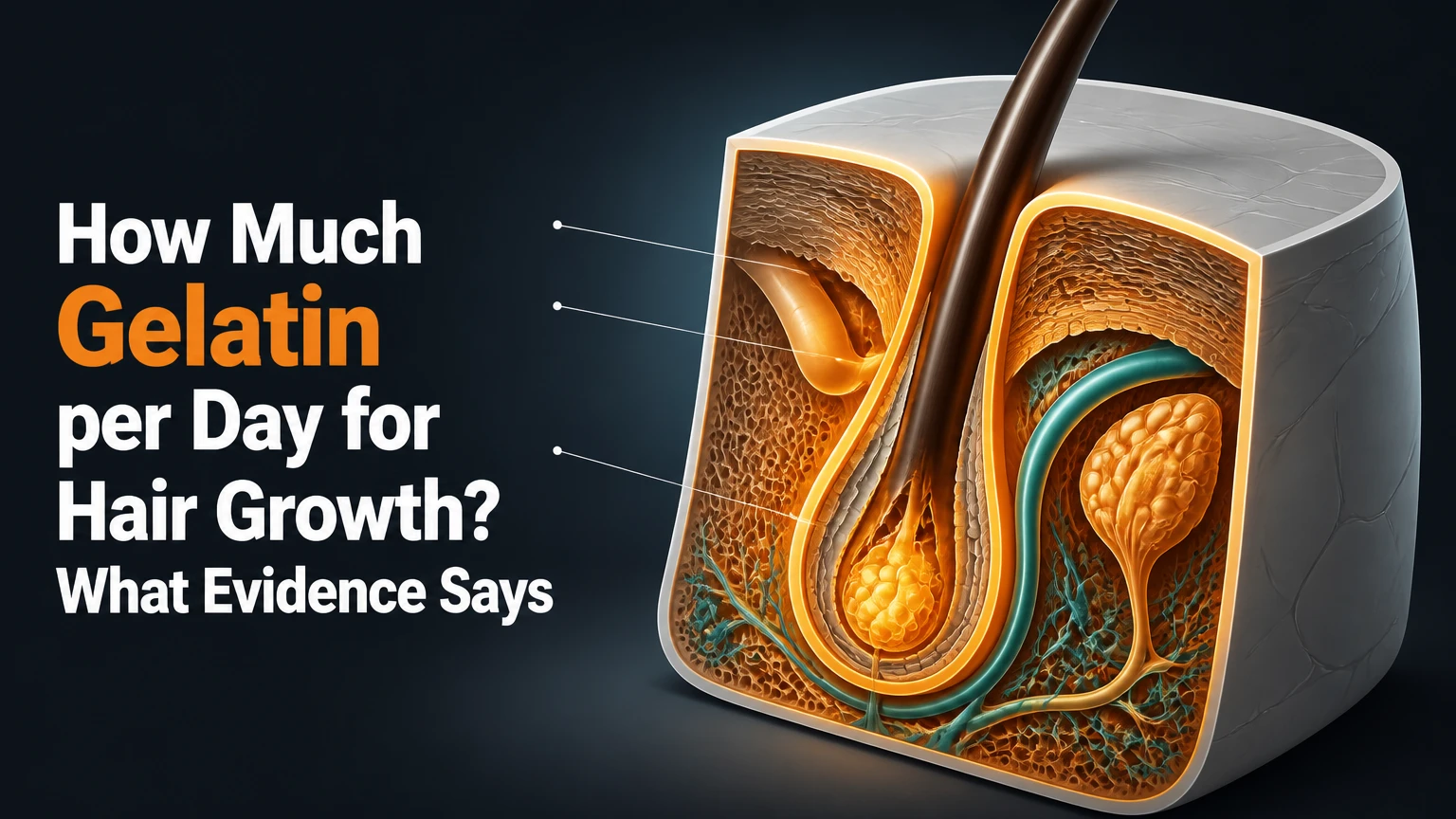
For hair growth, no clinically established gelatin dose exists. A cautious adult trial is 5 g of unflavored gelatin daily, increasing to 10 g if tolerated, but evidence does not prove that 10-14 g regrows hair or increases growth by 50%. Gelatin can add protein, yet it cannot replace diagnosis or treatment for pattern hair loss, thyroid disease, or scalp inflammation.
Key Facts at a Glance
- 5 g daily is a reasonable starting amount for adults testing digestive tolerance, not a proven minimum hair-growth dose.
- 10 g daily is a commonly used supplement quantity, but no major medical organization recommends it specifically for hair growth.
- 15 g gelatin with vitamin C has research support for collagen synthesis around exercise, not for scalp-hair regrowth.
- Gelatin contains glycine and proline, but hair follicles require broader nutritional and hormonal support than those two amino acids.
- A topical gelatin mask changes hair feel temporarily; it does not stimulate follicle growth beneath the scalp.
- Electrolysis removes unwanted hair permanently and has no role in increasing scalp-hair growth.
How Much Gelatin per Day for Hair Growth?
A practical oral range is 5-10 g of plain gelatin powder daily, with 10 g representing a conservative upper routine dose for self-experimentation. The evidence does not establish 10 g, 14 g, or any other quantity as an effective hair-growth treatment, so users should treat gelatin as a protein supplement rather than a regrowth medication.
A typical tablespoon varies by product density, making grams more reliable than kitchen volume. Many packets contain approximately 7 g, but labels differ. Weighing gelatin with a small digital kitchen scale avoids turning a package estimate into a false precision.
Start with 5 g for one week. Increase to 10 g only if digestion remains comfortable and the product fits the person’s dietary restrictions. A 15 g serving has been studied with vitamin C before exercise for collagen production, but that protocol should not be presented as a hair-growth prescription.
| Daily amount | Practical use | Evidence interpretation | Typical cost |
|---|---|---|---|
| 2.5 g | Tolerance test | No established hair outcome | $0.10-$0.40 |
| 5 g | Starting serving | Conservative trial quantity | $0.20-$0.80 |
| 10 g | Common routine serving | Not a proven follicle dose | $0.40-$1.50 |
| 14 g | Approximate two-packet serving | Common online recommendation, weak hair evidence | $0.60-$2.00 |
| 15 g | Exercise collagen protocol | Collagen-synthesis research, not hair-regrowth proof | $0.70-$2.20 |
Is 10 Grams of Gelatin Safe?
Ten grams of edible gelatin is generally tolerated by many healthy adults, but the NIH has not established a universal “safe limit” for gelatin supplementation that guarantees hair benefits. Safety depends on the complete product, allergies, kidney or liver health, gastrointestinal sensitivity, and total daily protein intake.
Gelatin is not a nutritionally complete protein because it lacks adequate amounts of some essential amino acids, especially tryptophan. It should not displace eggs, dairy, fish, meat, soy, legumes, or other complete protein sources.
Reduce or stop supplementation if gelatin causes persistent nausea, reflux, bloating, constipation, diarrhea, rash, wheezing, or throat swelling. Throat swelling or breathing difficulty requires urgent medical attention.
People who are pregnant, breastfeeding, managing kidney disease, following a medically prescribed protein restriction, or receiving cancer treatment should ask a clinician before using concentrated supplements. Product quality also matters because gelatin is an animal-derived ingredient and may carry allergen or sourcing implications.
Does Gelatin Actually Grow Hair?
Gelatin may provide amino acids used in collagen and other proteins, but human evidence does not establish gelatin as a reliable treatment for hair loss. The frequently repeated claim that gelatin increases hair growth by 50% is not a dependable clinical conclusion from high-quality, independently replicated hair-growth trials.
Hair shafts consist largely of keratin, while follicles are living mini-organs influenced by androgen signaling, thyroid status, inflammation, iron availability, genetics, medications, and overall nutrition. Eating proline or glycine does not direct those amino acids specifically to scalp follicles.
The 2017 study by Shaw and colleagues found that 15 g of vitamin C-enriched gelatin consumed before exercise increased a marker of collagen synthesis in connective tissue. That finding supports a narrow collagen-related mechanism. It does not demonstrate thicker hair, faster anagen growth, reduced shedding, or reversal of androgenetic alopecia.
The American Academy of Dermatology Association states that hair loss has many possible causes and recommends medical evaluation when shedding is sudden, patchy, or accompanied by scalp symptoms. That diagnostic principle is more important than selecting a particular gelatin source.
What Does Gelatin Contain?
Gelatin is denatured collagen obtained by processing animal connective tissue. Its amino-acid profile is rich in glycine, proline, and hydroxyproline, but gelatin does not contain the complete amino-acid balance required for normal tissue maintenance.
| Attribute | Gelatin | Hair relevance |
|---|---|---|
| Main source | Bovine, porcine, or fish collagen | Determines dietary compatibility |
| Common amino acids | Glycine, proline, hydroxyproline | Used in structural protein metabolism |
| Complete protein status | No | Cannot replace varied dietary protein |
| Typical form | Powder or packet granules | Mixes into warm liquid |
| Hair-follicle targeting | None established | Does not act like minoxidil or finasteride |
Which Type of Gelatin Is Best for Hair?
No gelatin type has demonstrated superior scalp-hair regrowth in reliable comparative trials. Choose bovine, porcine, or marine gelatin according to allergy status, religious requirements, sustainability preferences, availability, and price rather than claims about a special hair-growth effect.
Marine gelatin can suit people avoiding mammalian ingredients, but fish allergy remains relevant. Bovine gelatin may be easier to find and often costs less. Porcine gelatin is unsuitable for people avoiding pork for religious, cultural, or dietary reasons.
“Marine” does not mean automatically more absorbable or more effective for hair. Particle size, hydrolysis, dose, and the person’s total diet influence digestion, while marketing claims about prolonging the anagen phase require stronger human evidence than is currently available.
| Type | Source | Dietary considerations | Typical retail cost per 10 g |
|---|---|---|---|
| Bovine | Cow hide or bone | Halal or kosher only with certification | $0.40-$1.20 |
| Porcine | Pig skin or bone | Not halal or kosher | $0.20-$0.80 |
| Marine | Fish skin or scales | Pescatarian-compatible, fish allergy risk | $0.80-$2.50 |
| Vegan alternative | Agar, pectin, carrageenan | No animal collagen | $0.20-$1.00 |
Is Vegan Gelatin the Same as Gelatin?
Vegan gelatin does not exist in the biochemical sense because true gelatin comes from animal collagen. Agar, pectin, and carrageenan can create a gel texture, but they do not provide gelatin’s glycine-rich collagen peptides.
Plant-based alternatives can still support hair health when they improve the overall diet. Soy, beans, lentils, nuts, seeds, iron-rich foods, vitamin C sources, and adequate calories matter more than reproducing gelatin’s texture.
How Should You Take Gelatin for Hair?
Mix the measured powder into a warm liquid or a food with enough moisture, then consume it with a normal meal or snack. A simple protocol uses 5 g daily for seven days, followed by 10 g daily if tolerated, while tracking digestive symptoms and hair shedding for at least three months.
- Check the label. Select plain, edible gelatin without added sugar, artificial stimulants, or unnecessary herbal blends.
- Measure the serving. Weigh 5 g initially because packet and tablespoon sizes vary.
- Bloom the powder. Stir gelatin into 30-60 milliliters of cool liquid and wait 2-5 minutes.
- Dissolve it. Add 120-240 milliliters of warm liquid, staying below a boiling temperature to reduce clumping.
- Consume the mixture. Add it to soup, coffee, yogurt, oatmeal, or a smoothie after dissolving.
- Assess tolerance. Continue only if reflux, constipation, nausea, and bloating remain absent or mild.
The preparation is successful when the powder fully disperses and the person can maintain the serving without gastrointestinal discomfort. The most common mistake is measuring by tablespoon and assuming every product contains the same mass.
| Preparation option | Gelatin amount | Liquid or food amount | Practical result |
|---|---|---|---|
| Warm drink | 5-10 g | 150-240 mL | Fastest daily method |
| Yogurt | 5 g | 170 g yogurt | Thicker texture |
| Soup | 5-10 g | 250 mL soup | Savory option |
| Smoothie | 5 g | 300 mL smoothie | Requires prior dissolving |
| Dessert | 7-14 g | 250-500 mL liquid | Adds calories or sweetener if prepared traditionally |
Should You Add Vitamin C?
Vitamin C supports normal collagen formation, and the Shaw et al. exercise study used vitamin C-enriched gelatin. Most adults can obtain vitamin C from foods such as citrus, peppers, kiwi, broccoli, and strawberries, so a high-dose supplement is not automatically necessary.
The exercise protocol involved consuming 15 g of gelatin with vitamin C approximately one hour before activity. That timing was designed around connective-tissue collagen synthesis, not hair follicles. Applying the protocol to hair growth would be an extrapolation, not a proven treatment.
Avoid megadosing vitamin C to compensate for an unproven gelatin effect. High supplemental amounts can cause gastrointestinal symptoms and may increase kidney-stone risk in susceptible people.
Can a Gelatin Hair Mask Grow New Hair?
A gelatin hair mask can temporarily coat the hair shaft and make damaged strands feel stiffer or thicker, but it cannot create new follicles or reliably extend the anagen phase. Topical gelatin is a cosmetic conditioning experiment, not a treatment for shedding from the root.
A cautious mask uses approximately 5-7 g gelatin, 30 milliliters warm water, and 30-60 milliliters conditioner. Apply it to lengths rather than an irritated scalp, leave it for 10-20 minutes, rinse thoroughly, and follow with a moisturizing conditioner.
Use the mask no more than every one to two weeks at first. Hair that becomes rough, rigid, tangled, or prone to snapping may be receiving too much protein relative to moisture. Stop the mask and return to a moisturizing routine.
| Topical variable | Conservative specification | Why it matters |
|---|---|---|
| Gelatin | 5-7 g | Limits stiffness and residue |
| Warm water | 30 mL | Helps dissolve powder |
| Conditioner | 30-60 mL | Adds slip and moisture |
| Contact time | 10-20 minutes | Reduces drying risk |
| Frequency | Every 7-14 days | Limits protein buildup |
How Long Does Gelatin Take to Affect Hair?
Gelatin cannot be assigned a proven hair-growth timeframe because clinical evidence does not confirm that gelatin changes follicle growth. Human scalp hair grows roughly about 1 centimeter per month on average, so visible changes from any effective intervention usually require several months rather than 14 days.
Shedding often reflects events that occurred weeks or months earlier. A fever, surgery, major weight loss, childbirth, severe stress, or medication change can trigger telogen effluvium, with noticeable shedding delayed after the original event.
Photograph the same scalp areas every four weeks under consistent lighting. Record shower shedding, part width, scalp symptoms, dietary changes, and menstrual or medication changes. Do not judge a supplement after a single week.
| Observation period | What can reasonably be assessed | What cannot be concluded |
|---|---|---|
| 1-2 weeks | Digestion, rash, product tolerance | New follicle growth |
| 4-8 weeks | Breakage, texture, scalp irritation | Reliable density change |
| 3 months | Shedding trend and part photographs | Cause of hair loss alone |
| 6 months | Response to a diagnosed treatment plan | Gelatin as the sole explanation |
Gelatin or Collagen Peptides for Hair?
Collagen peptides are usually more convenient than gelatin because hydrolysis makes them dissolve in cold liquids, while neither option has strong evidence as a standalone hair-regrowth treatment. Select collagen peptides for convenience, gelatin for culinary use, and a complete dietary protein source when nutrition is the main concern.
Both products originate from collagen, but the manufacturing process changes texture and solubility. Collagen peptides are hydrolyzed into smaller peptide chains. Gelatin forms a gel when cooled and may be harder to mix into cold drinks.
Collagen supplements also vary in labeling, third-party testing, serving size, and source. “Type I collagen” describes a collagen classification, not proof of superior hair outcomes.
| Decision factor | Gelatin | Collagen peptides | Complete protein food |
|---|---|---|---|
| Cold-water solubility | Low to moderate | High | Food-dependent |
| Gelling ability | Yes | Usually no | No |
| Typical serving | 5-10 g | 5-15 g | 20-30 g protein |
| Amino-acid completeness | Incomplete | Incomplete | Often complete |
| Hair-regrowth evidence | Insufficient | Insufficient | Supports adequacy, not a cure |
Can Gelatin Stop Hair Loss?
Gelatin cannot reliably stop androgenetic alopecia, alopecia areata, scarring alopecia, thyroid-related shedding, iron-deficiency shedding, or scalp infection. A person with progressive thinning needs a cause-based evaluation rather than escalating gelatin from 10 g to 20 g.
Pattern hair loss commonly presents as a widening part, reduced crown density, or a receding hairline. Evidence-based options may include topical minoxidil, prescription therapies, or other treatments selected by a dermatologist after considering sex, pregnancy potential, age, medical history, and diagnosis.
Patchy loss, eyebrow loss, pain, pustules, scale, redness, scarring, or rapid shedding warrants prompt medical assessment. Scarring alopecia can permanently destroy follicles, and delaying care for a supplement trial creates a preventable risk.
What Nutrients Matter More Than Gelatin?
Adequate calories and total protein provide the foundation for normal hair production, while iron, zinc, vitamin D, thyroid hormones, and other factors matter when a deficiency or disease is present. Supplementing a nutrient without a documented need can fail to address the actual cause.
| Possible factor | Common clue | Appropriate next action |
|---|---|---|
| Low protein intake | Restrictive diet, muscle loss | Review meals with a clinician or dietitian |
| Iron deficiency | Fatigue, heavy periods, diffuse shedding | Request clinician-directed blood testing |
| Thyroid disorder | Temperature intolerance, weight change | Discuss thyroid evaluation |
| Androgenetic alopecia | Gradual patterned thinning | See a dermatologist |
| Alopecia areata | Smooth round patches | Seek prompt dermatology assessment |
| Scalp inflammation | Itch, scale, pain, pustules | Obtain scalp diagnosis |
Who Should Avoid or Modify Gelatin?
People with gelatin or source-animal allergies, significant gastrointestinal reactions, medically restricted protein intake, or uncertain product sourcing should avoid self-prescribing gelatin. Individuals receiving chemotherapy should never use gelatin as a substitute for oncology guidance, because treatment-related hair changes depend on the drug regimen and overall health.
Halal and kosher consumers should verify certification rather than infer compliance from “bovine” alone. Pescatarians may choose marine gelatin, but fish allergy and sustainability documentation still require attention.
Athletes can use the 15 g vitamin C protocol if a sports clinician considers it appropriate for connective-tissue goals. The protocol does not become a hair-growth treatment merely because collagen and hair both contain structural proteins.
Does Electrolysis Help Scalp Hair Growth?
Electrolysis does not stimulate scalp-hair growth. The U.S. Food and Drug Administration recognizes electrolysis as a method of permanent hair removal because an electrical current damages the targeted hair follicle, making it appropriate for unwanted facial or body hair rather than thinning scalp hair.
Electrolysis can be useful when a person wants to remove stray hairs around a hairline or treat unwanted hair caused by hormonal changes. It cannot reverse miniaturized follicles, increase anagen duration, or restore density. A licensed electrologist should not insert a probe into areas where the goal is regrowth.
| Goal | Appropriate approach | Electrolysis role |
|---|---|---|
| Increase scalp density | Dermatologic diagnosis and treatment | None |
| Remove chin hair | Licensed electrolysis | Primary option |
| Reduce unwanted facial hair | Electrolysis or laser assessment | Possible option |
| Treat pattern thinning | Evidence-based hair-loss care | None |
| Remove transplanted stray hairs | Professional consultation | Possible limited use |
What Are the Biggest Gelatin Mistakes?
The biggest errors are treating an online dose as a clinical prescription, expecting a topical mask to affect follicles, and ignoring a worsening pattern of hair loss. Correcting those errors improves safety more than increasing the serving.
- Mistake: using dessert gelatin. Sugary mixes add calories and flavoring without creating stronger hair evidence. Use plain edible gelatin if choosing to supplement.
- Mistake: escalating rapidly. Moving from zero to 15-20 g can worsen bloating or constipation. Start with 5 g.
- Mistake: replacing complete protein. Gelatin lacks a balanced essential-amino-acid profile. Keep varied protein foods in the diet.
- Mistake: judging results in 14 days. Hair cycles are too slow for that conclusion. Use monthly photographs for at least three months.
- Mistake: blaming nutrition for patterned loss. A widening part or receding hairline often needs diagnosis and treatment beyond supplements.
- Mistake: using a stiff mask repeatedly. Protein-heavy treatments can increase brittleness, particularly on highly processed or low-moisture hair.
Frequently Asked Questions
Can I take gelatin every day indefinitely?
Long-term daily use lacks a well-defined hair-specific safety evidence base. Healthy adults who tolerate 5-10 g may choose to continue, but periodic review is sensible, especially with kidney disease, digestive symptoms, pregnancy, restricted diets, or multiple supplements. Gelatin should remain optional, not a replacement for medical care or complete protein.
Is one packet of gelatin enough for hair growth?
One packet often contains about 7 g, but packet weights vary by manufacturer. That quantity is within a cautious supplemental range, yet no evidence proves that one packet regrows hair. Check the label, begin with half a packet if digestion is sensitive, and evaluate the underlying cause of shedding.
Can gelatin thicken hair strands?
Oral gelatin has not been reliably shown to increase human hair-shaft diameter. A topical gelatin treatment may leave a temporary coating that changes texture or body, but the effect washes out and can make hair stiff. Persistent diameter changes require addressing follicle health, breakage, or a diagnosed hair disorder.
Should I take gelatin in the morning or at night?
No hair-growth evidence supports a preferred time of day. Take gelatin with a meal or beverage that fits the person’s routine and minimizes reflux or nausea. The one-hour pre-exercise timing belongs to a collagen-synthesis research protocol, not an established scalp-hair schedule.
Does gelatin help hair grow after chemotherapy?
Chemotherapy-related hair changes require oncology guidance, and gelatin has no established ability to accelerate safe regrowth after chemotherapy. Hair may regrow differently after treatment, depending on the medication and dose. Report persistent, patchy, painful, or delayed regrowth to the oncology team or a dermatologist.
When should I see a dermatologist instead of trying gelatin?
Arrange an evaluation for sudden shedding, bald patches, scalp pain, redness, scale, pustules, scarring, eyebrow loss, or rapidly widening part lines. Medical assessment also makes sense when shedding persists beyond three months or follows a medication, illness, major weight change, or hormonal event.
The Bottom Line
For how much gelatin per day for hair growth, start with 5 g daily and increase to 10 g only if tolerated, while recognizing that neither amount is a proven hair-regrowth dose. Gelatin supplies collagen-associated amino acids, but it does not treat most causes of hair loss. Track changes for months, maintain complete dietary protein, and obtain a dermatologic diagnosis for persistent or patterned shedding.