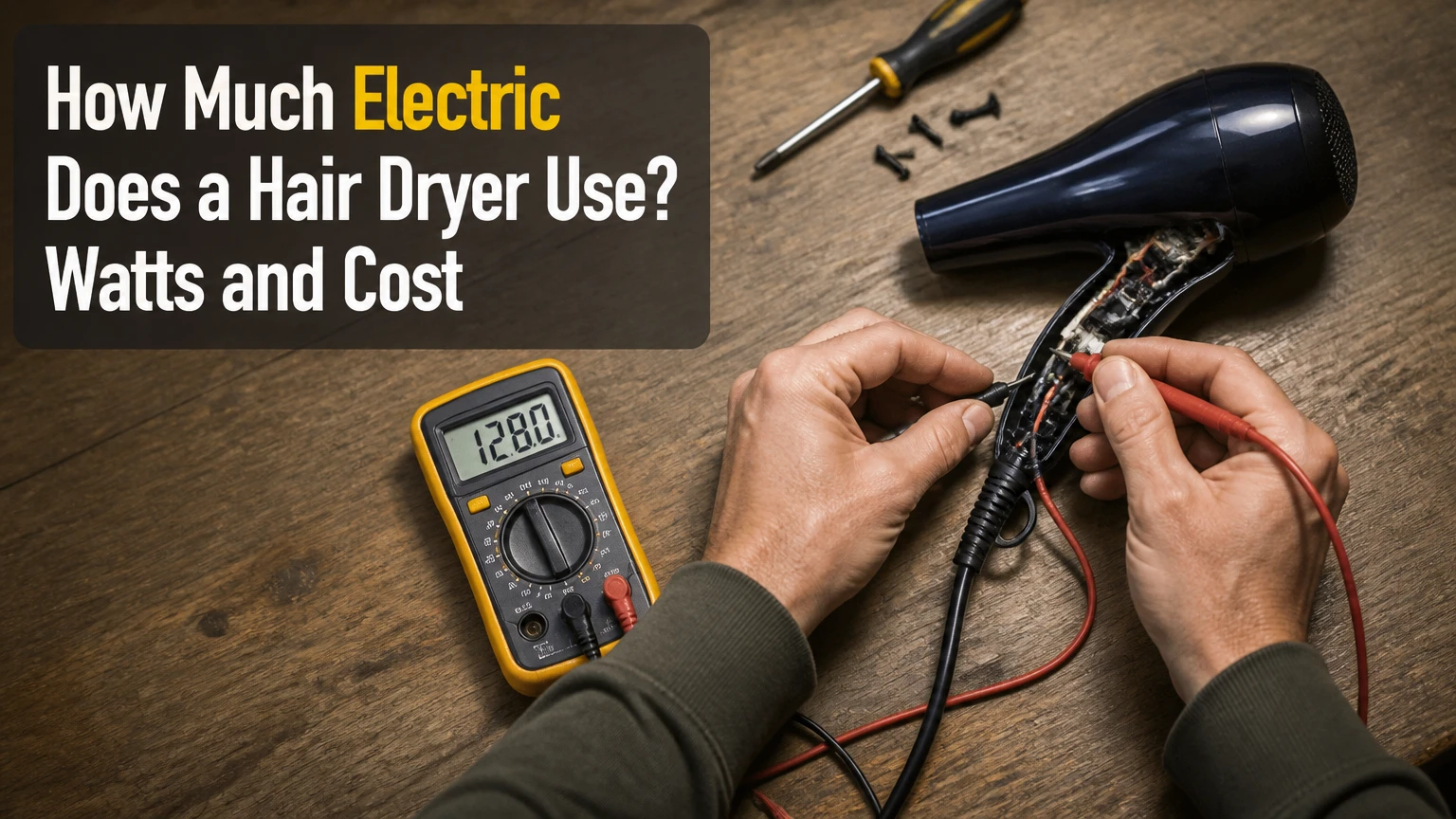
A hair dryer typically uses 1,500-2,200 watts while operating on high heat, with 1,800 watts common for a full-size household model. A 1,800W dryer running for 20 minutes consumes 0.6 kilowatt-hours, costing about $0.10 at $0.16 per kWh. Actual cost depends on wattage, settings, runtime, and local electricity rates.
Key Facts at a Glance
- A 1,800W hair dryer uses 0.3 kWh during 10 minutes of operation.
- A 1,800W hair dryer uses 0.6 kWh during 20 minutes of operation.
- A 20-minute daily routine at 1,800W uses about 18 kWh per 30-day month.
- The heating element usually consumes far more electricity than the fan motor.
- A 2,000W dryer draws about 16.7 amps on a 120V circuit before other loads are counted.
- A dryer’s wattage label shows rated maximum input, not necessarily constant measured consumption.
How Much Electric Does a Hair Dryer Use?
A full-size hair dryer usually draws 1,500-2,200W on its highest heated setting, while compact travel dryers often draw 800-1,200W. A cool-air setting may use only 70-200W because the heating element switches off and the motor continues moving air.
| Hair dryer operating mode | Typical power draw | Energy used in 10 minutes | Energy used in 20 minutes |
|---|---|---|---|
| High heat and high speed | 1,800-2,200W | 0.30-0.37 kWh | 0.60-0.73 kWh |
| Medium heat and medium speed | 900-1,200W | 0.15-0.20 kWh | 0.30-0.40 kWh |
| Low heat and low speed | 500-900W | 0.08-0.15 kWh | 0.17-0.30 kWh |
| Cool shot and low speed | 70-200W | 0.01-0.03 kWh | 0.02-0.07 kWh |
| Travel dryer on high | 800-1,200W | 0.13-0.20 kWh | 0.27-0.40 kWh |
The phrase “watts per hour” is technically inaccurate for appliance power. Watts describe the rate of electricity use at a moment, while kilowatt-hours describe accumulated energy. The U.S. Energy Information Administration defines a kilowatt-hour as a measure of how much energy a customer uses, which is the unit utilities use for billing.
A dryer marked 1,800W does not automatically consume 1,800W for every second. Thermostatic controls can cycle the heating element, and lower settings can reduce heater output. A plug-in watt meter provides the most reliable household measurement, provided the meter is rated for the appliance load.
How Does a Hair Dryer Use Electricity?
A hair dryer converts electrical energy into two useful outputs: moving air and heat. The motor drives a fan, while a high-resistance heating element converts much of the incoming electricity into thermal energy before the fan pushes air through the barrel.
The operating sequence is straightforward:
- Alternating-current electricity enters through the power cord.
- The motor rotates the internal fan.
- The fan pulls room air through the rear intake screen.
- Air passes across the resistance heating element.
- The heated airflow exits through the barrel or concentrator nozzle.
- Moving, warm air accelerates evaporation from wet hair.
The heating element accounts for most of the power draw. A small motor may need roughly 70-200W, but a heated dryer adds 1,000W or more to raise airflow temperature quickly. That is why cool-shot mode consumes much less electricity than high heat, even when the fan speed appears similar.
A hair dryer does not break water molecules apart electrically. It supplies heat and airflow that increase evaporation from the hair surface. Hair electrolysis is a separate cosmetic process that uses electrical current to disable individual hair follicles; it is unrelated to blow-drying, wattage, or household hair-dryer energy consumption.
Do Heat and Speed Settings Change Energy Use?
Heat settings usually change energy use much more than fan-speed settings because the heating element requires substantially more power than the motor. However, the exact reduction depends on the dryer’s electronic controller, heater design, and whether the selected setting cycles power rather than continuously reducing voltage.
| Control setting | Heater status | Motor behavior | Typical total draw |
|---|---|---|---|
| High heat, high speed | Continuous or near-maximum | High speed | 1,800-2,200W |
| Medium heat, high speed | Reduced or cycling | High speed | 1,100-1,600W |
| Low heat, low speed | Reduced or cycling | Low speed | 500-900W |
| Warm air, low speed | Reduced | Low speed | 300-700W |
| Cool shot | Off | Low or high speed | 70-200W |
A label saying “low” does not identify a universal wattage. One model may reduce heater output to 600W, while another may retain a 1,200W heater and cycle it on and off. Manufacturer manuals and a watt meter provide better evidence than the position of the switch.
A practical rule follows: use high heat only while substantial water remains, then switch to medium heat or cool air for the final stage. That approach can reduce energy and limit heat exposure without requiring a lower-powered dryer.
What Does a Hair Dryer Cost to Run?
A hair dryer’s operating cost equals wattage multiplied by runtime, divided by 1,000, then multiplied by the electricity rate. At $0.16 per kWh, a 1,800W dryer costs approximately $0.048 per 10 minutes, $0.096 per 20 minutes, and $0.144 per 30 minutes.
Use this formula:
Energy in kWh = watts × minutes used ÷ 60,000
Operating cost = energy in kWh × electricity price per kWh
| Dryer rating | Runtime | Energy consumed | Cost at $0.16/kWh |
|---|---|---|---|
| 1,200W | 10 minutes | 0.20 kWh | $0.032 |
| 1,500W | 15 minutes | 0.38 kWh | $0.060 |
| 1,800W | 20 minutes | 0.60 kWh | $0.096 |
| 2,000W | 25 minutes | 0.83 kWh | $0.133 |
| 2,200W | 30 minutes | 1.10 kWh | $0.176 |
Electricity prices vary sharply by location and tariff. At $0.30 per kWh, the same 1,800W, 20-minute session costs $0.18 instead of $0.10. Time-of-use rates can also make morning and evening drying more expensive than midday use.
How Much Does Daily Use Add Per Month?
A person using a 1,800W dryer for 20 minutes each day consumes 18 kWh over 30 days. The monthly cost is $2.88 at $0.16 per kWh, $5.40 at $0.30 per kWh, and $1.80 at $0.10 per kWh.
| Daily use | Monthly runtime | Monthly energy at 1,800W | Cost at $0.10/kWh | Cost at $0.30/kWh |
|---|---|---|---|---|
| 5 minutes | 2.5 hours | 4.5 kWh | $0.45 | $1.35 |
| 10 minutes | 5 hours | 9.0 kWh | $0.90 | $2.70 |
| 20 minutes | 10 hours | 18.0 kWh | $1.80 | $5.40 |
| 30 minutes | 15 hours | 27.0 kWh | $2.70 | $8.10 |
These figures exclude fixed utility charges, taxes, and demand charges. For most homes, runtime is more important than standby consumption because a basic dryer draws little or no meaningful power when unplugged and switched off.
Does Higher Wattage Always Cost More?
A higher-wattage dryer costs more per minute, but it can use less total energy if it shortens the drying session enough. The correct comparison is wattage multiplied by time, not wattage alone.
A 2,200W dryer used for 10 minutes consumes 0.367 kWh. A 1,200W dryer used for 25 minutes consumes 0.500 kWh. The lower-rated model draws less power at every moment but uses more total energy in that example.
| Dryer option | Power rating | Typical session | Session energy | Cost at $0.16/kWh |
|---|---|---|---|---|
| Compact travel model | 1,000W | 25 minutes | 0.42 kWh | $0.067 |
| Standard household model | 1,800W | 15 minutes | 0.45 kWh | $0.072 |
| Fast professional model | 2,200W | 10 minutes | 0.37 kWh | $0.059 |
| Low-heat routine | 900W | 20 minutes | 0.30 kWh | $0.048 |
Drying speed depends on airflow volume, air temperature, nozzle design, hair thickness, moisture content, and technique. A high wattage rating alone cannot prove that a dryer will finish faster.
The counterintuitive result is important: reducing the dryer’s rating is not always the cheapest energy strategy. Reducing wetness before drying, improving airflow, and shortening runtime often produce a larger saving.
Which Hair Dryer Technology Uses Less Energy?
Ceramic, tourmaline, ionic, titanium, and brushless-motor designs describe construction or airflow features, not guaranteed energy efficiency. A technology saves electricity only when it reduces total operating minutes or allows a lower heat setting without extending the session.
| Dryer type or feature | Typical rated power | Potential operating benefit | Important limitation |
|---|---|---|---|
| Ceramic heater | 1,400-1,800W | Even heat distribution | May consume as much as a metal heater |
| Tourmaline component | 1,400-1,900W | Often paired with ionic airflow | Mineral content does not determine wattage |
| Ionic generator | 1,500-2,000W | Can reduce static and drying time for some hair | Ion generation uses little power compared with heating |
| Titanium heater or barrel | 1,800-2,400W | Rapid, high-temperature airflow | High surface temperature can damage fine hair |
| Brushless DC motor | 1,200-1,800W | Efficient airflow and longer motor life | Total draw still depends on heater power |
| Dual-voltage travel model | 800-1,200W | Lower circuit load abroad | Usually produces less airflow than full-size models |
Manufacturers sometimes claim that ionic or infrared features cut drying time by a specific percentage. Such results depend on hair length, porosity, towel-drying, ambient humidity, and test method, so the claim should not be treated as a universal energy rating.
For energy decisions, compare measured wattage and actual minutes required. The material name belongs below those two figures in the decision hierarchy.
Which Hair Dryer Is Most Energy Efficient?
The most energy-efficient hair dryer is the model that completes the required job with the fewest watt-hours while meeting hair-care and circuit-safety needs. For many users, a 1,500-1,800W adjustable dryer used with towel-dried hair provides a better balance than either a very weak travel dryer or a 2,400W professional model.
| User situation | Suitable rating | Preferred control | Reasonable session target |
|---|---|---|---|
| Fine or damaged hair | 1,400-1,800W | Medium heat, low speed | 8-15 minutes |
| Short hair | 1,000-1,600W | Medium heat | 5-10 minutes |
| Thick or long hair | 1,800-2,200W | High initially, medium later | 10-25 minutes |
| Curly hair with diffuser | 1,500-2,000W | Low speed, medium heat | 15-30 minutes |
| Hotel or international travel | 800-1,200W | Low or medium heat | 15-30 minutes |
| Shared 15A bathroom circuit | 1,200-1,800W | Avoid simultaneous loads | 5-20 minutes |
A 1,000W dryer is not automatically the best choice for a low bill. If it doubles drying time, the total kWh can exceed that of a faster 1,800W model. The best low-consumption routine usually combines moderate power with moisture removal before the dryer starts.
How Can You Use a Hair Dryer Efficiently?
You can reduce hair-dryer electricity use by removing water mechanically, keeping the intake clear, and lowering heat after the hair is mostly dry. The following procedure targets runtime, which usually controls total energy more than the dryer’s brand or cosmetic technology.
- Blot hair with an absorbent towel. Remove dripping water without aggressive rubbing, which can increase tangling and extend styling time.
- Separate hair into sections. Work with four to six sections for long or dense hair so warm airflow reaches the roots instead of repeatedly heating the surface.
- Start with high airflow and moderate heat. Keep the nozzle moving and hold it about 15-20 centimetres from the hair.
- Use a concentrator for straight styles. Direct airflow along the hair shaft rather than dispersing heat across nearby surfaces.
- Switch to medium heat when hair is about 80% dry. This reduces heater demand during the longest finishing portion.
- Use cool air for the final 30-60 seconds. Cool-shot mode uses much less power and reduces unnecessary high-temperature exposure.
- Clean the intake screen. Disconnect the dryer first, remove visible lint and hair, and follow the manufacturer’s cleaning instructions.
The main mistake is treating maximum heat as a substitute for airflow control. High heat applied to soaking-wet, tangled hair can increase damage without producing proportionally faster evaporation.
Why Does a Hair Dryer Trip a Breaker?
A hair dryer trips a breaker when its current draw, combined with other loads, exceeds the circuit’s protective limit, or when an electrical fault activates the breaker or GFCI device. On a 120V circuit, current is approximately watts divided by volts, so a 1,800W dryer draws about 15 amps.
| Appliance load | Rated power | Approximate current at 120V | Combined with 1,800W dryer |
|---|---|---|---|
| Hair dryer | 1,800W | 15.0A | 15.0A |
| Curling iron | 150W | 1.25A | 16.25A |
| Bathroom heater | 1,500W | 12.5A | 27.5A |
| LED light group | 60W | 0.50A | 15.5A |
| Electric shaver charger | 10W | 0.08A | 15.08A |
A 15A breaker may trip with an 1,800W dryer even before every load reaches its nameplate maximum. In the United States, bathroom receptacle protection commonly involves GFCI devices, which interrupt power when they detect a leakage imbalance. The Electrical Safety Foundation International advises testing GFCI protection monthly and replacing devices that fail the test.
Unplug heaters and high-load styling tools before testing the dryer on the circuit. Do not defeat a breaker, use a damaged cord, operate a dryer near standing water, or install a larger breaker without an electrician evaluating the wiring. A 20A receptacle does not by itself make an existing 15A circuit safe for a larger load.
Why Is the Dryer Running but Not Heating?
A hair dryer that blows air but produces no heat usually has an overheated thermal cutoff, a failed heating element, a damaged switch, or restricted airflow that triggered its safety protection. Turn the dryer off, unplug it, let it cool for at least 15 minutes, and clean the intake before trying again.
Check the problem in this order:
- Overheating cutoff: A blocked intake can raise internal temperature and open the thermal protector.
- Dirty rear screen: Lint and hair reduce airflow, forcing the heater and motor to operate under poor conditions.
- Failed element: A broken resistance coil can leave the fan operating while heat disappears.
- Faulty control switch: A damaged heat selector can prevent current from reaching the element.
- Internal wiring fault: Burning smell, sparks, melted plastic, or repeated trips require immediate removal from service.
Do not open a mains-powered dryer unless you are qualified to repair it. A cold-air failure that returns after cleaning may indicate a failed safety component, and bypassing that component creates a fire risk.
What About Travel and Dual-Voltage Dryers?
Travel hair dryers commonly use 800-1,200W, while full-size models often use 1,500-2,200W. Lower wattage reduces the load on hotel circuits, but a dual-voltage label is essential because a plug adapter changes the plug shape and does not convert voltage.
| Travel condition | Required specification | Typical power range | Main risk |
|---|---|---|---|
| United States or Canada | 120V model | 800-1,200W | Overloading a shared hotel circuit |
| United Kingdom | 230V-compatible model | 1,000-1,800W | Incorrect voltage selection |
| European Union | 220-240V-compatible model | 1,000-1,800W | Plug adapter mistaken for converter |
| Worldwide travel | 120/240V dual voltage | 800-1,200W | Forgetting the voltage selector |
| Hotel bathroom use | GFCI or RCD-protected outlet | 800-1,500W | Outlet restrictions or nuisance trips |
Remington’s international guidance explains that travelers must check both voltage compatibility and plug requirements before using a hair dryer abroad. A 120V-only dryer connected directly to a 230V supply can fail dangerously.
For occasional travel, using the hotel’s supplied dryer may consume less personal luggage space and avoid compatibility problems. A compact model is useful when the supplied dryer lacks a diffuser or has unsuitable heat controls.
Common Mistakes That Waste Electricity
The most avoidable energy waste comes from extending runtime, not from a few seconds of high heat. Four habits repeatedly increase consumption:
- Starting with dripping-wet hair: Blotting first can reduce the drying interval substantially, although the exact saving depends on hair density and towel absorbency.
- Ignoring the filter: Restricted intake reduces airflow and can lengthen the session while increasing heat stress.
- Using a narrow nozzle too early: A concentrator is useful for finishing, but broad airflow is usually faster for initial moisture removal.
- Keeping high heat on until completion: Medium heat and cool air are more appropriate once surface moisture has mostly evaporated.
- Running other high-load appliances simultaneously: A curling iron, bathroom heater, and dryer can exceed circuit capacity even when each appliance works normally.
An expert rule of thumb is to judge efficiency by watt-minutes, not advertised wattage. A 2,000W dryer used for 8 minutes consumes less energy than a 1,200W dryer used for 20 minutes.
What Are the Alternatives to a Standard Hair Dryer?
Air drying uses no electricity but takes the longest and may be unsuitable when time, styling, or cold conditions matter. Hooded dryers and salon dryers can provide controlled airflow, yet their total energy depends on heater rating and appointment duration.
| Alternative | Typical power | Typical duration | Energy example |
|---|---|---|---|
| Air drying | 0W | 30-180 minutes | 0 kWh |
| Hooded home dryer | 900-1,500W | 20-45 minutes | 0.30-1.13 kWh |
| Salon wall dryer | 1,200-2,000W | 15-35 minutes | 0.30-1.17 kWh |
| Microfiber towel plus air drying | 0W during drying | 20-120 minutes | 0 kWh |
| Standard hand dryer | 1,500-2,200W | 5-25 minutes | 0.13-0.92 kWh |
Air drying is not always better for hair health. Remaining wet for a long period can create handling problems, and rough towel use can cause more friction than brief, controlled airflow. Choose the method that reaches the desired dryness with acceptable hair stress and predictable electrical demand.
Frequently Asked Questions
How many amps does a 2,000W hair dryer use?
A 2,000W hair dryer draws approximately 16.7 amps on a 120V supply, calculated as 2,000 divided by 120. On a 230V supply, the same dryer draws about 8.7 amps. The actual current can vary with the selected setting and the dryer’s control electronics.
Is a 1,500W hair dryer cheaper than an 1,800W model?
A 1,500W hair dryer costs less per minute, but the total session may cost more if it takes significantly longer. At $0.16 per kWh, 1,500W for 20 minutes costs $0.08, while 1,800W for 15 minutes costs $0.072. Runtime determines the final comparison.
How much electricity does a hair dryer use in five minutes?
A 1,800W hair dryer uses 0.15 kWh in five minutes. At $0.16 per kWh, that session costs about $0.024. A 1,000W travel dryer uses 0.083 kWh in five minutes, costing approximately $0.013 at the same electricity rate.
Should I unplug my hair dryer after using it?
Unplug a hair dryer after use, especially in a bathroom or shared accommodation. Unplugging removes accidental-start risk and eliminates any small standby draw from electronic controls. Never leave a powered dryer unattended, resting on a bed, towel, or other combustible surface.
Can a power strip run a hair dryer?
A standard lightweight power strip should not run a high-wattage hair dryer unless its current and power ratings explicitly support the load. A 1,800W dryer can draw about 15 amps at 120V, so a wall receptacle on a suitable circuit is generally safer than an extension cord or low-rated strip.
How accurate is the wattage printed on a hair dryer?
The printed wattage is normally a rated maximum or nominal input under specified voltage, not a guarantee of constant consumption. Heater cycling, selected controls, supply voltage, and motor load change actual draw. A correctly rated plug-in power meter can measure operating watts and accumulated kWh.
The Bottom Line
A hair dryer usually uses 1,500-2,200W on high heat, but a typical 1,800W model consumes only 0.6 kWh during a 20-minute session. The exact cost comes from wattage, minutes, and the local electricity rate. To reduce electricity use, towel-dry first, clean the intake, switch from high to medium heat as moisture falls, and compare total watt-minutes rather than the wattage label alone.