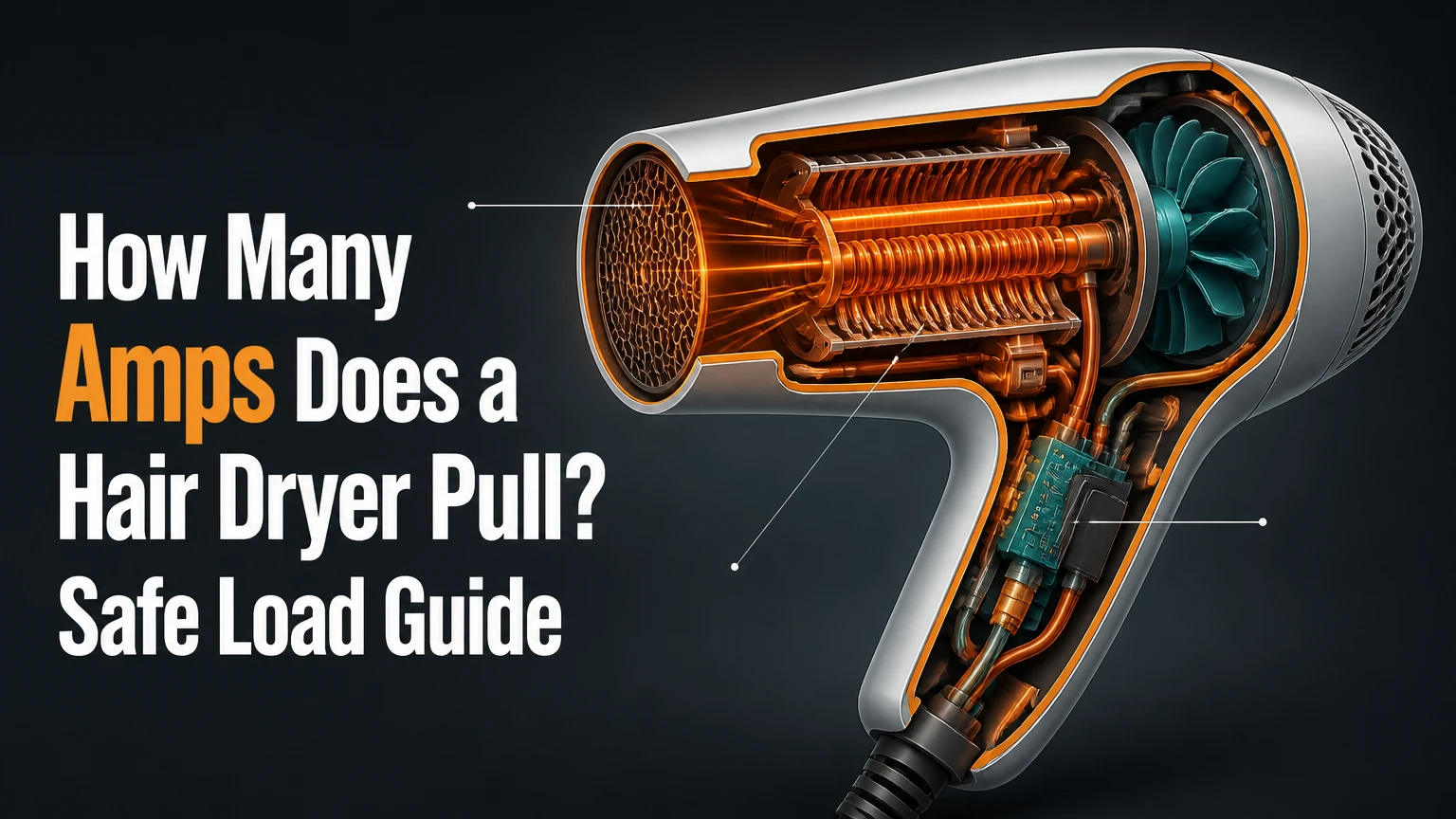
A hair dryer typically pulls 7.5-15 amps on a 120-volt household supply, with the exact current determined by its wattage and selected heat level. An 1800-watt hair dryer calculates to 15 amps at 120 volts, while a 1200-watt travel model calculates to 10 amps. The rating label provides the final answer for that appliance.
Key Facts at a Glance
A 1200 W hair dryer draws 10.0 A at 120 V.
A 1500 W hair dryer draws 12.5 A at 120 V.
An 1800 W hair dryer draws 15.0 A at 120 V.
A 15 A breaker may trip when a high-wattage dryer shares a circuit with other appliances.
A hair dryer’s cool-shot mode usually uses less power because the heating element is off.
A dual-voltage dryer draws fewer amps at 240 V than at 120 V for the same wattage.
How Many Amps Does a Hair Dryer Pull?
A hair dryer pulls approximately 7.5-15 amps in common United States household use, although compact models may draw less and some professional models may draw more. The simplest calculation is watts divided by volts, so a 1875 W dryer on a 125 V supply draws 15 A before accounting for the exact label rating and operating conditions.
Current is not a fixed characteristic shared by every blow dryer. A 1000 W model and an 1875 W model use different heating elements, and a high-heat setting energizes more of the element than a low-heat setting. The fan motor adds a smaller load, commonly tens of watts, while the heater produces most of the demand.
Use the nameplate whenever possible. If the label says 15.6 A, that marked current takes priority over a rounded calculation based on an advertised wattage.
What is the calculation for current?
The electrical relationship is:
Current in amps = Power in watts ÷ Voltage in volts
For example:
1800 W ÷ 120 V = 15 A
The formula describes approximate operating current for a mostly resistive heating load. Household voltage varies by location and momentary conditions, so the actual measured current can differ slightly from the calculated value. A clamp meter or plug-in power meter can measure real consumption, but the measurement must be made with equipment rated for the load.
How do watts, volts, and amps differ?
Watts describe power consumption, volts describe electrical potential, and amps describe current flow. A hair dryer converts electrical power into heat and airflow, so its wattage provides the most useful first estimate of current.
| Dryer rating | Calculation at 120 V | Approximate current |
|---|---|---|
| 900 W | 900 ÷ 120 | 7.5 A |
| 1000 W | 1000 ÷ 120 | 8.3 A |
| 1200 W | 1200 ÷ 120 | 10.0 A |
| 1500 W | 1500 ÷ 120 | 12.5 A |
| 1600 W | 1600 ÷ 120 | 13.3 A |
| 1800 W | 1800 ÷ 120 | 15.0 A |
| 1875 W | 1875 ÷ 120 | 15.6 A |
| 2000 W | 2000 ÷ 120 | 16.7 A |
What Does Each Hair Dryer Setting Draw?
A hair dryer’s heat setting controls the electrical power sent to the heating element, while fan-speed controls change motor demand and airflow. Typical current ranges are about 0.5-1 A for fan-only operation, 7-10 A for lower heat, and 12.5-16 A for maximum heat on common 120 V models.
The numbers below are useful estimates rather than universal specifications. Some dryers switch separate heating coils, and others use electronic controls that alter temperature without reducing power in a simple linear way.
| Operating mode | Typical power at 120 V | Approximate current | Main load |
|---|---|---|---|
| Cool shot, fan low | 50-90 W | 0.4-0.8 A | Fan motor and controls |
| Cool shot, fan high | 80-150 W | 0.7-1.3 A | Faster fan motor |
| Low heat | 800-1100 W | 6.7-9.2 A | Partial heater plus motor |
| Medium heat | 1100-1450 W | 9.2-12.1 A | Larger heater section plus motor |
| High heat, standard model | 1500-1800 W | 12.5-15.0 A | Most or all heater sections |
| High heat, 1875 W model | 1875 W | 15.6 A | Full rated load |
Does cool shot use fewer amps?
Yes. Cool-shot mode normally disconnects the heating element, leaving the fan motor and control electronics active. A 75 W fan load at 120 V calculates to only 0.63 A, although the exact value depends on motor design and fan speed.
Cool air is not necessarily produced by a separate refrigeration system. Most consumer dryers simply stop adding heat while continuing to move room-temperature air. The cool-shot button therefore reduces power sharply but does not reduce current to zero.
Does low heat cut the current in half?
Often, but not always. A dryer rated at 1800 W may use roughly 900-1000 W on a lower heat selection, producing about 7.5-8.3 A at 120 V, but some models retain nearly the same heater power and regulate temperature through airflow or cycling.
The only reliable way to establish a particular setting’s current is to consult the manual or measure the appliance. A lower temperature setting does not guarantee a proportional reduction in wattage.
Which Dryer Wattages Fit a 15 Amp Circuit?
A 1200-1500 W dryer is easier to accommodate on a 15 A branch circuit than a 1800 W model, but circuit suitability depends on every load connected to that circuit. An 1800 W dryer already calculates to 15 A at 120 V, leaving no useful capacity for lights, a vacuum, a space heater, or another styling tool.
A 15 A breaker protects the wiring from excessive current; it does not promise that every appliance marked below 15 A can operate safely alongside other equipment. The National Electrical Code includes rules for branch-circuit ratings, receptacles, and continuous loads, while local authorities determine adopted requirements.
| Branch-circuit rating | Practical dryer range at 120 V | Current at listed wattage | Shared-use implication |
|---|---|---|---|
| 15 A | 1000 W | 8.3 A | Leaves about 6.7 A nominally |
| 15 A | 1200 W | 10.0 A | Small remaining margin |
| 15 A | 1500 W | 12.5 A | Very limited margin |
| 15 A | 1800 W | 15.0 A | Do not add meaningful loads |
| 20 A | 1800 W | 15.0 A | More branch capacity, same dryer current |
| 20 A | 2000 W | 16.7 A | Requires suitable wiring, receptacle, and appliance rating |
The practical rule is simple: plug a high-wattage dryer directly into an appropriate wall receptacle and avoid simultaneous high-power appliances. Do not replace a 15 A breaker with a 20 A breaker unless a qualified electrician confirms that the entire circuit is designed for it.
Can a hair dryer trip a breaker?
Yes. A hair dryer can trip a breaker when its current combines with other loads, when a circuit is overloaded, or when the appliance or wiring has a fault. A 15 A breaker may trip quickly with a 1800 W dryer plus a 300 W vacuum because the combined theoretical load is about 17.5 A.
Repeated trips require diagnosis rather than repeated resetting. A single trip after adding another appliance suggests overload, but trips with the dryer alone can indicate a damaged cord, failing motor, heating-element fault, receptacle problem, or weak breaker.
Does a bathroom outlet change the answer?
A bathroom outlet does not reduce the dryer’s current. A ground-fault circuit interrupter, or GFCI, detects an imbalance between outgoing and returning current and disconnects power rapidly when leakage occurs; it protects against shock, not ordinary overload.
Bathrooms commonly require GFCI protection under adopted electrical codes, and a hair dryer should be used only at a properly installed, dry, grounded receptacle. Keep the appliance and cord away from sinks, tubs, wet floors, and standing water.
How Much Does a Hair Dryer Cost to Run?
An 1800 W hair dryer uses 0.03 kilowatt-hours during a one-minute session and 0.09 kWh during three minutes. At an electricity rate of $0.20 per kWh, those sessions cost approximately $0.006 and $0.018, excluding fixed utility charges.
The energy formula is:
Kilowatt-hours = watts ÷ 1000 × operating hours
Current determines circuit loading, while watt-hours determine energy cost. A high-current appliance can cost little to operate when used for only a few minutes.
| Dryer power | 1-minute energy | 5-minute energy | Cost at $0.20/kWh for 5 minutes |
|---|---|---|---|
| 1000 W | 0.0167 kWh | 0.0833 kWh | $0.017 |
| 1200 W | 0.0200 kWh | 0.1000 kWh | $0.020 |
| 1500 W | 0.0250 kWh | 0.1250 kWh | $0.025 |
| 1800 W | 0.0300 kWh | 0.1500 kWh | $0.030 |
| 1875 W | 0.0313 kWh | 0.1563 kWh | $0.031 |
Does a faster dryer always use more energy?
No. A 1800 W dryer uses more power per minute than a 1200 W model, but a faster drying time can narrow the total energy difference. Hair moisture, airflow, nozzle design, hair length, and pre-drying with a towel affect duration.
Ionic, ceramic, and tourmaline features may change airflow distribution, heat behavior, or drying time, but none of those labels proves a lower amperage. Compare the wattage plate and actual session duration instead of inferring electrical demand from the technology name.
Are Travel Hair Dryers Different Electrically?
Travel dryers typically draw 8.3-10 A on a 120 V supply because their ratings commonly fall between 1000 W and 1200 W. Dual-voltage models designed for 120 V and 220-240 V supplies draw approximately half as many amps at the higher voltage when wattage remains comparable.
A dual-voltage switch does not make an ordinary single-voltage dryer safe overseas. The product must be specifically marked for the destination voltage, and plug-shape adapters do not convert voltage.
| Dryer category | Typical rating | Current at 120 V | Current at 240 V |
|---|---|---|---|
| Compact travel | 1000 W | 8.3 A | 4.2 A |
| Foldable travel | 1200 W | 10.0 A | 5.0 A |
| Standard consumer | 1600 W | 13.3 A | 6.7 A |
| Standard high-power | 1800 W | 15.0 A | 7.5 A |
| Professional 2000 W | 2000 W | 16.7 A | 8.3 A |
Actual international voltage may be 220, 230, or 240 V, and the dryer’s nameplate determines its approved operating range. A voltage converter also needs a wattage rating above the dryer’s maximum demand, and many small travel converters are unsuitable for heating appliances.
Can a Hair Dryer Run From an Inverter or Power Station?
A hair dryer can run from a portable power station or inverter only when the source provides enough continuous watts, surge capacity, waveform quality, and battery energy. An 1800 W dryer should not be connected to a 1000 W inverter, even if the battery has a large capacity.
Resistive heating is an especially demanding load for batteries. An inverter supplying 1800 W at 120 V delivers 15 A on its AC output, while a 12 V battery system may supply more than 160 A after inverter losses.
| Power source | Published continuous output | Suitable for 1200 W dryer | Suitable for 1800 W dryer |
|---|---|---|---|
| Small inverter | 500 W | No | No |
| Compact power station | 1000 W | No | No |
| Mid-size power station | 1500 W | Usually yes | No |
| Large power station | 2000 W | Yes | Usually yes |
| 3000 W pure-sine inverter | 3000 W | Yes | Yes |
A 2000 Wh battery does not deliver 2000 Wh to the dryer because inverter and battery losses reduce usable output. At an effective 1800 W load, a realistic operating period may be about 50-60 minutes, depending on the power station’s efficiency and reserve cutoff.
What Should You Check Before Using an Extension Cord?
A hair dryer should be plugged directly into the wall whenever possible. If an extension cord is permitted by the manufacturer and unavoidable temporarily, the cord must have a current rating at least equal to the dryer, suitable conductor gauge, intact grounding, and enough length without being coiled.
A thin, long, damaged, or coiled cord can heat internally even when the breaker does not trip. The cord’s printed rating is more important than its appearance.
| Extension-cord example | Typical conductor | Common rating | Suitability for 1800 W at 120 V |
|---|---|---|---|
| Lightweight indoor cord | 18 AWG | 10 A | Not suitable |
| Medium indoor cord | 16 AWG | 13 A | Not suitable |
| Heavy-duty short cord | 14 AWG | 15 A | Borderline at full rating |
| Heavy-duty cord | 12 AWG | 15-20 A | More appropriate, if approved |
| Outdoor heavy-duty cord | 10-12 AWG | 15-20 A | Suitable only when conditions and labeling allow |
Do not run a cord under rugs, through doorways, across wet surfaces, or beneath furniture. Stop using the cord if the plug, insulation, or connections become warm, discolored, cracked, or loose.
Why Does a Hair Dryer Shut Off During Use?
A hair dryer that shuts off while room power remains on usually activated its internal thermal protection, while a dryer that shuts off with the room circuit usually caused an overload or electrical fault. The two symptoms require different responses.
Restricted intake airflow is a frequent cause of thermal protection. Dust, lint, and hair reduce cooling, raise internal temperature, and can trigger a thermal cutoff before the household breaker reaches its trip threshold.
What should you do when the dryer shuts off?
- Turn the dryer off and unplug it.
- Let the appliance cool for at least 15 minutes.
- Clean the rear intake screen according to the manual.
- Inspect the cord, plug, housing, and filter for damage.
- Test it only from a clear, dry receptacle with other high-load appliances off.
- Stop using the dryer if it shuts off again, smells hot, sparks, or makes abnormal noise.
Never bypass a thermal fuse or thermal cutoff. Those parts prevent overheating, and bypassing them can turn a temporary airflow problem into a fire hazard.
| Symptom | Likely cause | Safe response |
|---|---|---|
| Dryer stops, lights remain on | Thermal cutoff or motor overheating | Unplug, cool, clean intake |
| Dryer and room outlets lose power | Breaker overload or fault | Remove loads, inspect, reset once |
| Burning plastic odor | Cord, plug, or internal insulation damage | Stop use and replace or service |
| Visible sparks | Internal fault, debris, or worn switch | Unplug immediately, do not reopen |
| Weak airflow with high heat | Blocked filter or failing motor | Clean filter, discontinue if unchanged |
| GFCI trips repeatedly | Leakage or wetness | Keep unplugged and obtain repair |
Is hair electrolysis related to hair dryer amperage?
No. Hair electrolysis is a permanent hair-removal procedure that uses a probe and controlled electrical energy at the follicle, whereas a hair dryer uses high-power AC to operate a fan and heating element. Electrolysis equipment usually has a much lower appliance power rating, but its electrical output at the probe is a specialized treatment parameter rather than a household current comparison.
A salon should follow the manufacturer’s electrical specification for electrolysis equipment separately from its requirements for blow dryers, curling irons, and other styling appliances. The two devices should not be grouped under the same wattage assumption.
How Do Ionic, Ceramic, and Professional Dryers Affect Demand?
Ionic, ceramic, tourmaline, and traditional wire-element dryers can have similar current demands when their wattage ratings are similar. The technology may affect heat distribution, airflow, drying time, or hair handling, but the name alone does not establish amperage.
| Technology or design | Electrical implication | Typical wattage range | Practical trade-off |
|---|---|---|---|
| Nichrome element | Converts electrical power directly to heat | 1000-2000 W | Simple, high heat demand |
| Ceramic heater | Distributes heat across a coated or ceramic surface | 1200-1875 W | Even heating, wattage varies |
| Tourmaline component | Often paired with ionic output | 1300-1875 W | Feature does not set current |
| Ionic generator | Adds a small electronic load | 1200-1875 W | May alter drying feel and time |
| Brushless digital motor | Motor may be efficient and compact | 1200-2000 W | Total demand still follows label |
| Salon high-power model | Larger heater and airflow system | 1600-2200 W | May need a dedicated suitable circuit |
A professional label reading 2200 W at 120 V calculates to 18.3 A and cannot be treated as a normal 15 A receptacle load. Some professional products use other voltage ratings, so check the actual nameplate before installation or commercial use.
What Are the Most Common Electrical Mistakes?
The most common mistake is judging safety from the dryer alone instead of adding every appliance on the branch circuit. A 1500 W dryer uses 12.5 A at 120 V, leaving little practical capacity on a 15 A circuit for lights, a vacuum, or a heated styling tool.
Follow these operating rules:
- Read the dryer’s volts, watts, and amps label before plugging it in.
- Use a properly grounded, dry receptacle with GFCI protection where required.
- Keep a high-wattage dryer away from space heaters and other heating appliances.
- Avoid power strips, plug multipliers, and lightweight extension cords.
- Clean the intake filter regularly.
- Replace a damaged dryer rather than taping a split cord.
- Reset a breaker once only after removing the suspected load.
- Call an electrician for repeated trips, warm receptacles, buzzing, scorch marks, or loose outlets.
One counterintuitive point matters: a breaker that does not trip does not prove that a cord or receptacle is healthy. Localized resistance at a loose connection can create heat without producing enough total current to open the breaker.
Frequently Asked Questions
How many amps does an 1875 watt hair dryer use?
An 1875 W hair dryer uses approximately 15.6 A at 120 V, calculated as 1875 divided by 120. Many North American products are marked 1875 W and may list a current value near 15.6 A. The marked amperage and the electrical requirements in the manufacturer’s manual control over a rounded calculation.
Can I use a 1500 watt hair dryer on a 15 amp circuit?
A 1500 W hair dryer calculates to 12.5 A at 120 V and may operate on a 15 A circuit when no substantial loads share that circuit. The remaining nominal capacity is only 2.5 A, so a vacuum, heater, or second styling appliance can cause a trip. Use a dedicated or lightly loaded receptacle.
What gauge extension cord do I need for a blow dryer?
A short, heavy-duty 14 AWG or 12 AWG cord may be appropriate for a dryer marked near 15 A, but direct wall connection is safer and preferred. A 16 AWG or 18 AWG lightweight cord is commonly unsuitable for a full-power 1800 W dryer. Follow both cord and appliance instructions.
Do hair dryers use more electricity than curling irons?
Usually, yes. A typical curling iron may use about 30-100 W, while a hair dryer commonly uses 1000-1875 W. A curling iron can remain hot for longer, so total energy depends on operating time. The dryer creates much greater instantaneous circuit demand, even during a shorter session.
How can I measure a dryer’s actual amps?
Use a properly rated plug-in power meter that supports the dryer’s voltage and current, or have an electrician use suitable test equipment. Measure one setting at a time, keep the appliance dry, and do not open the housing. A meter reading can reveal actual cycling behavior that the maximum nameplate rating does not show.
Why does my hair dryer trip only one outlet?
A single outlet may be connected to a branch-circuit section with a GFCI device, loose connection, damaged receptacle, or different circuit load. If the dryer trips the same outlet repeatedly, stop using that outlet and have the wiring and appliance checked. Do not assume that moving the plug to another nearby outlet changes the circuit.
The Bottom Line
A hair dryer typically pulls 7.5-15 amps, and an 1800 W model calculates to 15 amps at 120 volts. Use the appliance nameplate for the exact rating, account for every other load on the circuit, and connect the dryer directly to a suitable dry receptacle. For the query how many amps does a hair dryer pull, wattage divided by voltage gives the reliable starting answer, while circuit condition and operating setting determine the safe practical result.