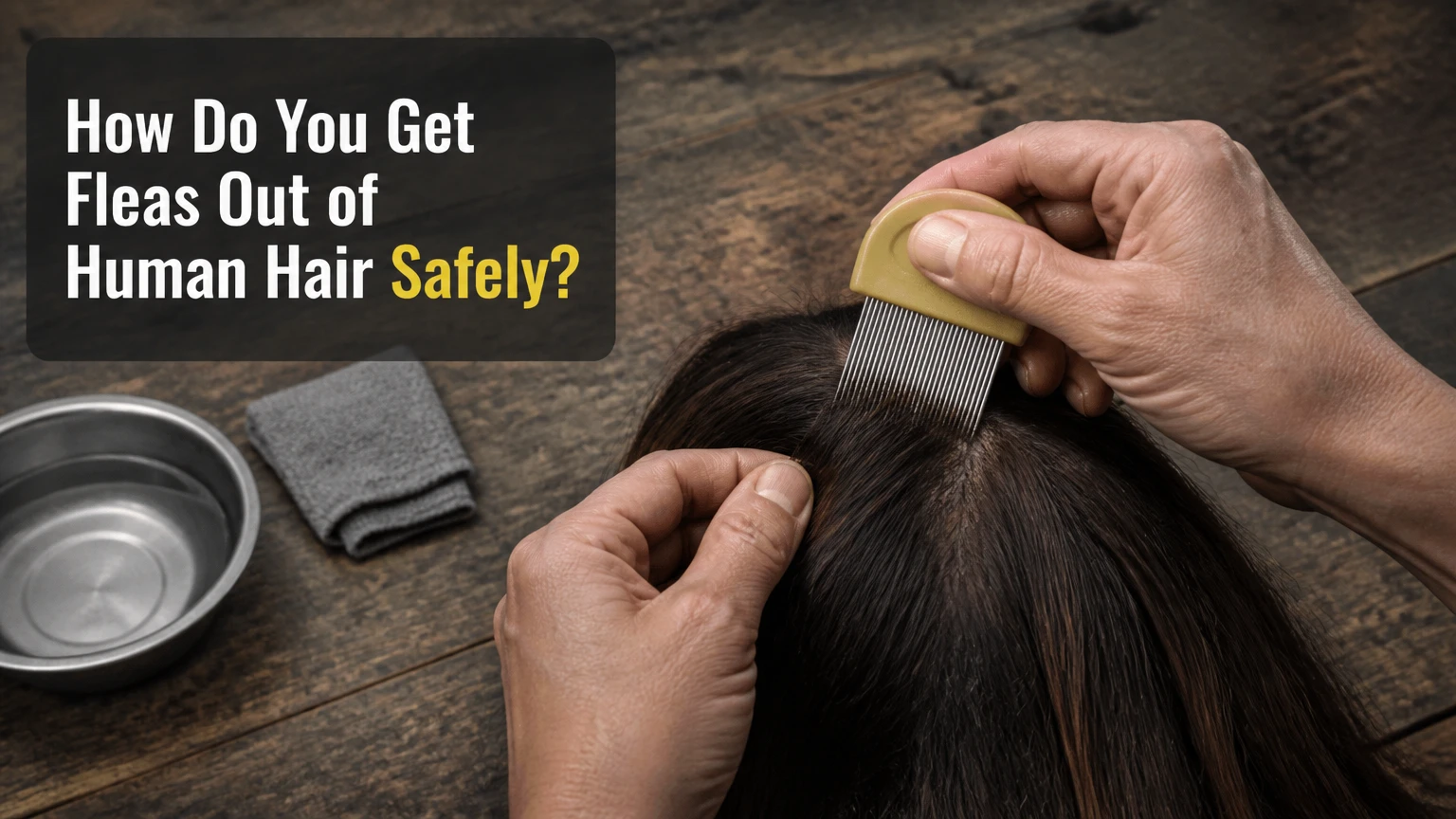
To get fleas out of human hair, wash the hair with ordinary shampoo, rinse thoroughly, and comb wet, conditioned hair with a fine-toothed comb. Fleas rarely remain on human heads because people are a poor long-term host. Permanent relief requires treating infested pets, bedding, carpets, and upholstered areas at the same time.
Key Facts at a Glance
- Fleas can bite people, but they usually do not colonize human hair or reproduce there.
- Shampoo and water remove transient adult fleas; a fine-toothed comb helps verify and extract them.
- Human hair should not be treated with dog or cat flea medication, flea collars, or veterinary spot-on products.
- Washing hair alone cannot end an infestation if fleas remain in pets, carpets, furniture, or pet bedding.
- Flea bites often occur around the ankles and lower legs, while head lice usually remain close to the scalp.
- Persistent scalp itching without visible fleas requires consideration of head lice, dermatitis, scabies, bed bugs, or another skin condition.
Do Fleas Live in Human Hair?
Fleas generally do not live in human hair as a stable infestation. Adult fleas may jump onto a person, bite the scalp, or become temporarily trapped in long hair, but human hair and human sleeping habits do not provide the same reliable environment as a dog, cat, wildlife host, carpet, or upholstered resting place.
The common cat flea, Ctenocephalides felis, is the flea most often involved in household infestations, including homes with dogs. Fleas feed on blood, but adult fleas spend much of their time on an animal host or in the surrounding environment. Flea eggs, larvae, and pupae develop primarily in bedding, floor coverings, cracks, and shaded resting areas rather than on a person’s head.
The “undercoat” explanation is too absolute. Human hair is not biologically impossible for a flea to enter, but fleas cannot grip human hair shafts and remain attached as efficiently as head lice. A live insect in the hair therefore needs removal, while repeated sightings point toward an untreated environmental source or a misidentified parasite.
How Can You Tell Fleas From Head Lice?
Fleas jump and move rapidly, while head lice crawl and attach their eggs to individual hair shafts near the scalp. A flea is usually dark brown to reddish-brown, laterally flattened, and difficult to hold still; a head louse is pale gray or tan, wingless, and adapted to crawling through scalp hair.
| Feature | Flea | Head louse | Bed bug |
|---|---|---|---|
| Typical adult size | 1.5-3.3 mm | 2-3 mm | 4-7 mm |
| Main movement | Jumps; rapid crawling | Crawls; does not jump | Crawls; cannot jump |
| Egg location | Environment, fibers, bedding | Glued to hair shafts | Cracks, seams, furniture |
| Common bite pattern | Ankles, legs, exposed skin | Scalp, neck, behind ears | Exposed skin during sleep |
Use a bright light and inspect the scalp, hairline, behind the ears, and clothing seams. A flea may disappear before inspection, whereas a louse tends to remain near the scalp and its nits stay attached to hair. White flakes, dried product, and scalp scale slide along the hair; viable nits remain firmly cemented close to the scalp.
What Does Flea Evidence Look Like?
Flea dirt consists of black or dark reddish specks made from digested blood. Place suspected debris on a wet white tissue. If it produces a reddish-brown halo, flea feces become more likely, although this test cannot identify the insect by itself.
| Observation | More consistent with | Useful confirmation |
|---|---|---|
| Tiny brown insect jumps from hair | Flea | Capture on clear tape or in a sealed container |
| White oval objects glued near roots | Head lice | Inspect with magnification |
| Black specks turn rust-red when wet | Flea dirt | Compare with a known clean hair section |
| Itchy bumps after sleeping | Bed bugs, fleas, or dermatitis | Inspect mattress seams and pets |
How Do You Get Fleas Out of Human Hair?
The safest removal method takes about 15-30 minutes and uses shampoo, water, conditioner, a fine comb, clean towels, and a sealed bag. Wash first, comb while the hair is wet and slippery, and then launder clothing rather than relying on scalp insecticides. The home and pets determine whether fleas return.
Before You Start
| Item | Typical amount or specification | Purpose |
|---|---|---|
| Ordinary shampoo | 1-2 tablespoons, depending on hair length | Cleans hair and removes insects |
| Conditioner | 2-4 tablespoons for medium-long hair | Adds slip for safe combing |
| Fine-toothed comb | Teeth spaced about 0.2-0.3 mm | Captures insects and debris |
| Bowl of soapy water | 1-2 liters of warm water | Immobilizes extracted insects |
| Laundry bag | 1 sealable bag per clothing set | Contains potentially affected clothing |
| White towel or tissue | 1-2 pieces | Makes insects and debris easier to see |
Avoid dry, forceful combing, especially with tightly curled, coily, chemically treated, or fragile hair. Do not use boiling water on the scalp, concentrated essential oils, kerosene, bleach, rubbing alcohol, or a household insecticide.
Step 1: Isolate Clothing and Towels
Remove the clothing worn during suspected exposure and place it directly into a sealed bag or washing machine. Keep used towels, hats, scarves, and bedding away from clean laundry, bathroom rugs, and upholstered furniture.
Fleas can jump from fabric onto floors or furniture. This step reduces transfer while the hair is being cleaned.
Success checkpoint: Clean clothes, a clean towel, and a contained laundry load are ready before washing.
Common mistake: Walking through the home in the same clothing after showering.
Step 2: Wash the Hair With Ordinary Shampoo
Wet the scalp and hair completely with comfortably warm water. Apply enough regular shampoo to cover the scalp and hair, massage gently for about two minutes, rinse, and repeat if the hair contains visible debris or many insects.
A mild shampoo is preferable to dish soap for repeated use because dish soap can dry or irritate the scalp. Soap and surfactants help remove insects during washing, but no reliable evidence supports a precise claim that every flea dies after a particular five-minute soak.
Success checkpoint: The hair is clean, fully saturated, and free of visible live insects after rinsing.
Common mistake: Scrubbing aggressively enough to create scalp abrasions, which increase irritation and infection risk.
Step 3: Apply Conditioner and Divide the Hair
Apply a generous layer of conditioner, then divide the hair into four to eight manageable sections. Keep the conditioner in place while combing. Start with hair that is wet and detangled, because a dry fine comb can snag strands and cause unnecessary breakage.
For short hair, work from the scalp outward in overlapping passes. For long or dense hair, secure completed sections with clips and keep untreated sections separate.
Success checkpoint: The comb can travel from the roots to the ends without pulling or stopping repeatedly.
Common mistake: Combing only the visible top layer while missing the nape, temples, and hair behind the ears.
Step 4: Comb From Scalp to Ends
Place the fine comb against the scalp and draw it slowly through one section to the ends. Wipe the comb onto white tissue after every pass, then place any insect or debris into the bowl of soapy water. Repeat each section at least twice, changing the angle slightly on the second pass.
Clean the comb teeth frequently. A flea comb removes insects mechanically, but combing cannot remove fleas hiding in clothing, carpets, pet bedding, or furniture.
Success checkpoint: Several consecutive passes produce no live jumping insects.
Common mistake: Using a wide-tooth detangling comb, which may remove loose debris but cannot reliably capture small insects.
Step 5: Rinse, Dry Gently, and Recheck
Rinse out the conditioner with comfortably warm water and dry the hair using a towel or a normal, scalp-safe blow-dryer setting. Do not use very hot water or hold a high-heat dryer against the scalp. Heat that feels tolerable to the scalp is not a validated household flea-control method, and excessive heat can burn skin or damage hair.
Inspect again under bright light after drying. If a live flea appears, repeat targeted conditioning and combing rather than applying a pet pesticide.
Success checkpoint: No live insects appear during a final scalp, hairline, and clothing inspection.
Common mistake: Assuming a hot blow-dry sterilizes the hair or prevents a flea from jumping back from the room.
Which Products Are Safe for Human Hair?
Ordinary shampoo, conditioner, water, and a fine-toothed comb are the appropriate first-line tools when fleas are suspected on a person. Human permethrin products are intended for diagnosed head lice or scabies, not routine flea exposure, and they should be used only according to the label or a clinician’s direction.
| Product or method | Use on human scalp? | Main limitation or hazard |
|---|---|---|
| Ordinary shampoo | Yes, for washing | No lasting environmental protection |
| Conditioner and flea comb | Yes, for physical removal | Requires careful section-by-section work |
| Human permethrin 1% lice product | Only for confirmed lice and label use | Unnecessary for ordinary flea exposure |
| Pet spot-on, flea collar, or pet shampoo | No | Animal dosing and formulations are not approved for people |
| Tea tree, peppermint, or concentrated oils | Not recommended as flea treatment | Can cause allergic or irritant dermatitis |
| Household flea spray | No | May contain solvents or pesticides unsafe on skin |
Veterinary products such as fipronil, imidacloprid, selamectin, and pyrethroid formulations must never be applied to human hair. If accidental exposure occurs, remove contaminated clothing, rinse skin and hair thoroughly, and contact Poison Control in the United States at 1-800-222-1222 or the relevant poison center in your country.
What Should You Do for Flea Bites on the Scalp?
Flea bites usually improve with washing, cool compresses, and avoidance of further exposure. For an adult with intact skin, calamine or a short course of 1% hydrocortisone may reduce itch, but products must follow the label and should not be applied to infected, open, or eye-adjacent skin.
| Symptom | Reasonable home care | Seek medical advice when |
|---|---|---|
| Mild itch or small red bump | Cool compress for 10 minutes | Symptoms persist beyond 7-10 days |
| Several itchy bites | Calamine or labeled 1% hydrocortisone | Bites become warm, painful, or draining |
| Scratched scalp | Gentle cleansing and trimmed nails | Yellow crust, pus, fever, or spreading redness |
| Swelling or hives | Stop suspected exposure and monitor | Facial swelling, breathing trouble, or faintness |
The American Academy of Dermatology Association recommends avoiding scratching because broken skin can allow bacteria to enter. Children, pregnant people, and people with eczema should ask a pharmacist or clinician before using medicated creams on the scalp.
Why Do Fleas Keep Coming Back After Hair Washing?
Fleas return after hair washing when adult fleas or immature stages remain in the surrounding environment. The flea life cycle includes eggs, larvae, pupae, and adults; pupae inside protective cocoons can remain dormant and emerge when vibration, warmth, or carbon dioxide signals a host.
The Centers for Disease Control and Prevention recommends treating the pet and home together, washing bedding, and vacuuming regularly. The CDC also notes that flea control may require repeated treatment because immature stages are protected from many initial interventions.
Treat Pets Through a Veterinary Plan
Contact a veterinarian for a product matched to each animal’s species, weight, age, health, and pregnancy status. Never substitute a dog product for a cat product. Permethrin, which appears in some dog products, can cause severe poisoning in cats.
Do not combine multiple flea products unless the veterinarian confirms that combination is safe. Wash pet bedding according to its care label, and ask the veterinarian whether every household pet needs treatment, because treating only the visibly affected animal often fails.
Clean Rooms on a Repeating Schedule
Vacuum carpets, rugs, upholstered furniture, floor edges, cracks, and pet-resting sites. Empty a bagless vacuum outdoors into a sealed trash bag, or remove and dispose of a vacuum bag outside the living area.
| Area | Action | Typical frequency |
|---|---|---|
| Pet bedding | Hot wash and fully dry if fabric allows | Immediately, then weekly |
| Carpets and rugs | Vacuum edges, under furniture, and resting zones | Daily for 7-14 days |
| Upholstery | Vacuum seams and cushion gaps | Every 1-2 days initially |
| Hard floors | Vacuum or mop perimeter areas | Daily for 7 days |
| Outdoor pet zones | Reduce shaded organic debris | Weekly during active infestation |
The U.S. Environmental Protection Agency advises following every pesticide label, keeping people and animals away during application, and observing the stated re-entry time. Insect growth regulators can help interrupt immature development, but a household spray is not a substitute for vacuuming and veterinary pet control.
How Long Does Flea Control Take?
A person’s hair can usually be washed and combed in 15-30 minutes, but household flea control commonly requires 2-8 weeks of repeated monitoring and cleaning. The longer timeframe reflects pupae emerging after the first cleaning, not failure of the shampoo or comb.
| Task | Typical time | Typical cost in the United States |
|---|---|---|
| Shampoo and comb one person | 15-30 minutes | $0-$20 if supplies are available |
| Wash and dry pet bedding | 1-3 hours including drying | $0-$15 |
| Daily vacuuming | 15-30 minutes per session | $0-$10 for bags or disposal supplies |
| Veterinary flea treatment | Same day to several days | About $20-$100 per pet, product-dependent |
| Professional flea service | 1-2 visits | Commonly $150-$500, region-dependent |
Prices vary by location, home size, number of pets, and whether follow-up visits are included. A one-time treatment may reduce adults quickly while leaving protected pupae behind, so ask pest professionals about retreatment terms and preparation requirements.
What Changes for Children or Textured Hair?
Children should receive shampoo-and-comb care rather than experimental pesticide treatment when fleas are suspected. Use a tear-free shampoo, protect the eyes, avoid concentrated essential oils, and ask a pediatric clinician before applying hydrocortisone to a young child’s scalp.
For curly, coily, thick, or fragile hair, detangle gently with conditioner and work in small sections. A plastic fine-toothed comb may be more comfortable than a rigid metal comb, although the teeth still need to be close enough to capture small insects.
| Situation | Adaptation | Avoid |
|---|---|---|
| Toddler | Adult supervision and tear-free shampoo | Pet products and essential oils |
| Long straight hair | Eight sections and root-to-end passes | One fast pass over the top |
| Curly or coily hair | Conditioner, finger-detangle, small sections | Dry combing and forceful pulling |
| Eczema-prone scalp | Fragrance-free products and gentle rinsing | Dish soap and scented oils |
| Multiple pets | Veterinary plan for every relevant animal | Treating only the pet with visible fleas |
What Are the Most Common Treatment Mistakes?
The most damaging mistake is treating a suspected flea problem as a head-lice problem without confirming the insect. Flea exposure needs environmental control, while confirmed head lice require a different household and scalp-management plan.
- Applying veterinary medication to a person: Wash it off immediately and contact Poison Control if exposure was substantial or symptoms develop.
- Using heat to “sterilize” hair: Excessive heat can burn the scalp without addressing fleas in the room.
- Vacuuming once: Continue daily or near-daily cleaning during the initial 7-14 days.
- Treating only one pet: Ask a veterinarian whether all dogs, cats, and other susceptible animals need coordinated treatment.
- Using essential oils on children or pets: Concentrated oils can irritate skin and may be toxic if swallowed or absorbed.
- Scratching bites: Keep nails short and use cool compresses to reduce skin damage.
A practical rule is to confirm the insect before escalating treatment. A clear photograph, sealed specimen, or veterinary or medical examination is more useful than repeatedly applying stronger chemicals.
When Should You Contact a Doctor or Pest Professional?
Contact a clinician for breathing difficulty, facial swelling, widespread hives, fever, rapidly spreading redness, pus, severe pain, or a child with extensive reactions. Seek medical evaluation when scalp itching continues after environmental cleaning, because persistent symptoms may indicate head lice, scabies, allergic dermatitis, fungal infection, or bacterial folliculitis.
Contact a licensed pest professional when fleas remain visible after coordinated pet treatment and 2-3 weeks of consistent cleaning, when the infestation involves multiple rooms, or when residents cannot safely use available products. Ask for the active ingredients, preparation steps, ventilation requirements, and exact follow-up schedule.
Frequently Asked Questions
Can fleas lay eggs in human hair?
Fleas do not normally establish egg-laying colonies in human hair. Adult fleas may briefly feed on a person, but eggs are usually released into pet bedding, carpets, upholstery, and floor debris. Finding repeated small insects in the hair therefore warrants inspection of pets and rooms, as well as confirmation that the insects are fleas rather than lice.
Will washing hair with dish soap kill fleas?
Dish soap can help remove insects by wetting and cleaning the hair, but it is not a proven complete flea treatment. Frequent dish-soap use can dry or irritate the scalp. Ordinary shampoo followed by conditioner and careful fine-comb extraction is usually gentler and more practical for a person.
Can a flea comb remove fleas from human hair?
A flea comb can mechanically remove fleas from human hair when the hair is wet, conditioned, divided into sections, and combed from scalp to ends. The comb does not treat the home or pets, and it may cause breakage in dry, tangled, curly, or chemically processed hair unless conditioner provides adequate slip.
Should you use lice shampoo for suspected fleas?
Do not use lice shampoo solely because a flea was found. Lice products are labeled for diagnosed head lice, and unnecessary insecticide exposure provides no lasting protection from fleas in the environment. Use ordinary shampoo and combing first, then seek confirmation if crawling insects remain attached near the scalp.
How can you tell whether fleas are gone?
Fleas are less likely to remain on the head when repeated wet-combing passes produce no live insects and no new bites occur after pets and rooms receive appropriate treatment. Continue checking the hair, clothing, pet bedding, and floor areas for at least 2-4 weeks because emerging pupae can create new adults.
Can fleas in human hair make you sick?
Flea bites commonly cause localized itching, redness, or small welts, but fleas can rarely transmit infectious diseases depending on geography and exposure. The CDC links fleas with diseases including plague and murine typhus in specific circumstances. Seek medical care for fever or systemic symptoms after substantial flea exposure.
The Bottom Line
How do you get fleas out of human hair? Wash with ordinary shampoo, condition the hair, comb every section from roots to ends, and contain the clothing and towels. Do not apply pet flea medicine or excessive heat to the scalp. If fleas return, treat the household source through veterinary care, laundering, vacuuming, and label-directed environmental control.