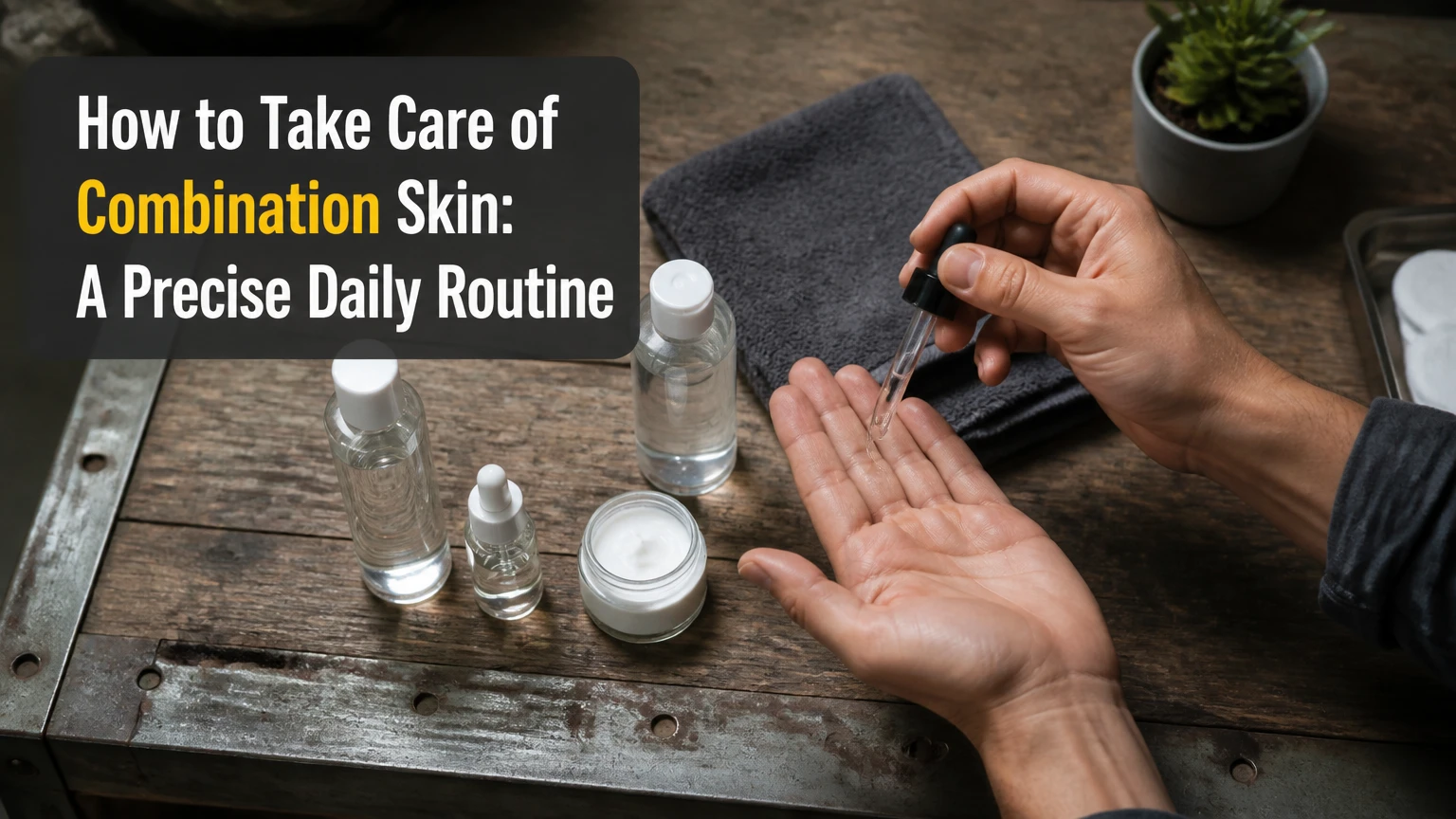
Combination skin needs six coordinated steps: map your zones, cleanse gently, use BHA selectively, hydrate, moisturize by area, and apply sunscreen each morning. Allow 10-15 minutes daily, plus 15 minutes for patch testing. The main success factor is treating the oily T-zone and dry cheeks as different zones rather than using one heavy formula everywhere.
Before You Start
Set up two simple routines before introducing active ingredients. In the morning, use cleanser, hydrating serum, moisturizer, and sunscreen. At night, use cleanser, BHA on selected evenings, hydrating serum, and moisturizer.
A basic routine costs about $35-$100, depending on product size, brand, and whether you already own sunscreen. A complete first setup usually takes 10-15 minutes, while patch testing takes two days.
| Item | Quantity or spec | Typical cost | Purpose |
|---|---|---|---|
| Cleanser | 1 water-based gel, gentle foam, or cream cleanser | $8-$20 | Removes oil, sweat, sunscreen, and debris |
| BHA | 1% or 2% salicylic acid liquid | $8-$25 | Loosens congestion in oily areas |
| Hydrating serum | 2% or lower niacinamide, or hyaluronic acid | $8-$25 | Adds water-based hydration |
| Gel moisturizer | 1 oil-free gel cream | $8-$25 | Hydrates the T-zone without a heavy finish |
| Rich moisturizer | 1 ceramide or emollient cream | $8-$25 | Reduces tightness on cheeks and jawline |
| Sunscreen | Broad-spectrum SPF 50, fluid or gel texture | $10-$30 | Limits UV-related pigmentation and irritation |
| Microfiber towel | 1 clean, soft towel | $3-$10 | Pats skin dry without rubbing |
| Blotting papers | 1 pack | $3-$10 | Removes midday shine without another wash |
Check Your Skin Zones First
Combination skin commonly has visible shine or clogged pores through the forehead, nose, and chin, while the cheeks or jawline feel tight, rough, or flaky. This pattern should remain fairly consistent across several days.
Wash your face with a gentle cleanser, apply no products, and observe it after 30-60 minutes. Do not use this test immediately after exfoliation, shaving, sun exposure, or a hot shower, because temporary irritation can mimic dry skin.
Patch-test each new leave-on product behind the ear or on the inner forearm. Apply a small amount once daily for two days. Stop if you develop swelling, hives, blistering, or intense persistent burning, and seek medical advice for a significant reaction.
Step-by-Step Routine
| Step | Action | Time | Most common mistake |
|---|---|---|---|
| 1 | Map zones and patch-test products | 5 minutes setup | Treating temporary irritation as skin type |
| 2 | Cleanse with lukewarm water | 60 seconds | Scrubbing or washing more than twice daily |
| 3 | Apply BHA to congested areas | 2-3 minutes | Applying acid to dry or flaky cheeks |
| 4 | Press hydrating serum into damp skin | 1 minute | Applying too much or rubbing aggressively |
| 5 | Use different moisturizers by zone | 1-2 minutes | Spreading rich cream across the T-zone |
| 6 | Apply sunscreen every morning | 2 minutes | Using too little or omitting ears and neck |
Morning and Evening Steps
Step 1: Map Your Zones and Patch-Test Products
Identify your oily and dry zones, then patch-test every new leave-on product before applying it to your face.
Start with a clean face and wait 30-60 minutes without skincare. Mark the forehead, nose, and chin as T-zone areas if they become shiny or congested. Mark cheeks and jawline as dry zones if they feel tight, rough, or visibly flaky. If one cheek behaves differently from the other, treat them separately.
Patch-test serum, BHA, moisturizer, and sunscreen on separate small areas. Use one new product at a time, waiting at least three days before adding another. This makes the cause of a rash or breakout easier to identify.
You’ll know it worked when you can name the areas that need lighter hydration, richer hydration, or no active treatment. Your face should not feel hot, sting, or look increasingly red after testing.
The common mistake is diagnosing skin immediately after washing. Wait the full 30-60 minutes, and repeat the observation on another day if the result is unclear.
Step 2: Cleanse With Lukewarm Water
Cleanse your face for 60 seconds with one dime-sized pump of gentle cleanser and lukewarm water.
Wet your hands and face with water that feels comfortably warm, never hot. Dispense one dime-sized pump into your fingertips, then massage gently. Spend approximately 40 seconds across the forehead, nose, and chin, using light circular movements, followed by 20 seconds on the cheeks and jawline.
Keep your fingertips moving without pressing hard enough to stretch the skin. Rinse thoroughly around the hairline, nostrils, and jaw. Pat dry with a clean microfiber towel instead of rubbing. Cleanse in the morning and evening, but do not add a third wash to control shine.
A gel or gentle foam works well for normal daily oil. Choose a non-foaming glycerin or ceramide cream cleanser if your cheeks feel tight after washing. If you wear waterproof sunscreen or makeup, remove it first with micellar water or a cleansing balm, then perform the 60-second cleanse.
You’ll know it worked when the skin feels clean and comfortable, without squeaking, tightness, burning, or an oily film.
The common mistake is using hot water or scrubbing the nose. Both can increase irritation while leaving the underlying congestion unresolved.
Step 3: Apply BHA Only to Congested Areas
Apply 3-4 drops of 1%-2% salicylic acid BHA to the oily T-zone at night, beginning twice weekly.
Use BHA after cleansing and drying your face completely. Apply the drops to clean fingertips or a reusable cotton round, then spread a thin layer over the forehead, nose, chin, and visibly enlarged-pore areas. Avoid the cheeks, jawline, nostril creases, eyelids, lips, cuts, and flaky patches.
Let the product absorb for 2-3 minutes before applying serum. Start on two nonconsecutive evenings per week for two weeks. If your skin remains comfortable, increase to three evenings weekly. More frequent use is not automatically better, especially when the cheeks are dry or sensitive.
The American Academy of Dermatology recommends introducing irritating acne-care products gradually and stopping when severe irritation develops. BHA can also increase dryness when combined with retinoids, benzoyl peroxide, scrubs, or strong exfoliating acids.
You’ll know it worked when the T-zone feels smooth without persistent stinging, and congestion gradually becomes less noticeable over several weeks. Mild tingling is possible, but burning is a stop signal.
The common mistake is applying BHA to the whole face because the liquid feels lightweight. Keep the application zone narrow.
Step 4: Press Hydrating Serum Into Damp Skin
Press 2-3 drops of hyaluronic acid or a niacinamide serum into slightly damp skin across the entire face.
After cleansing, leave a thin film of water on the skin rather than drying it completely. Dispense 2-3 drops into your palm, touch the serum across the forehead, cheeks, nose, chin, and jawline, and press it in with flat fingertips for about one minute.
Use a fragrance-free formula if your skin is reactive. Niacinamide can support oil-control and barrier comfort, while hyaluronic acid mainly adds water-binding hydration. Neither replaces moisturizer, because water can evaporate from the surface if you leave the serum uncovered.
If the serum pills, reduce the amount and wait at least 60 seconds before moisturizer. On BHA nights, apply the serum only after the acid has absorbed for 2-3 minutes.
You’ll know it worked when the face feels supple and lightly tacky, not wet, slippery, or tight.
The common mistake is applying several full droppers. Excess serum increases pilling without improving hydration.
Step 5: Moisturize Each Zone With a Different Texture
Apply one pea-sized amount of gel cream to the T-zone and one pea-sized amount of richer cream to the cheeks and jawline.
Use clean fingertips to place the lightweight gel cream on the forehead, nose, and chin. Apply the richer ceramide or emollient cream to the cheeks and jawline only. Blend each product with gentle upward circles for 1-2 minutes, stopping before the skin feels coated.
You may use the richer cream on isolated flaky spots rather than the entire cheek. Conversely, use the gel cream on cheeks during humid weather if it prevents tightness. The correct amount depends on product thickness, so reduce each portion if your sunscreen rolls or makeup becomes greasy.
A moisturizer should follow every BHA application. Barrier-supporting ingredients such as ceramides, glycerin, squalane, and fatty alcohols can improve comfort, but avoid assuming every oil is pore-clogging or every “natural” ingredient is gentle.
You’ll know it worked when cheeks feel comfortable for several hours and the T-zone looks hydrated without a thick, shiny coating.
The common mistake is using one rich cream everywhere. That approach often creates more congestion without solving the T-zone’s underlying dehydration.
Step 6: Apply Sunscreen Every Morning
Apply two finger lengths of broad-spectrum SPF 50 sunscreen to your face, ears, and neck every morning.
Dispense two continuous strips along the index and middle fingers. Treat this as a practical face, ears, and neck amount, then divide it into two thin layers if blending is difficult. Apply the first layer across the forehead, cheeks, nose, and chin, then cover ears and neck with the remainder.
Choose a fluid, gel, or gel-matte sunscreen labeled non-comedogenic if shine or clogged pores are concerns. Allow approximately two minutes for blending and wait 15 minutes before makeup or outdoor exposure. Reapply after swimming, heavy sweating, towel drying, or prolonged outdoor activity.
The American Academy of Dermatology recommends broad-spectrum, water-resistant sunscreen with at least SPF 30. SPF 50 provides a higher labeled protection level, but adequate application and reapplication matter more than choosing a very high number.
You’ll know it worked when the sunscreen forms an even film without missed edges, rolling, or painful stinging around the eyes.
The common mistake is reducing the amount because sunscreen feels oily. Change the formula or layer a small amount of gel moisturizer beneath it, but do not reduce protection.
Common Mistakes and How to Fix Them
| Symptom | Likely cause | Recovery plan |
|---|---|---|
| Cheeks flake or feel tight | Harsh cleanser, hot water, or excessive BHA | Stop BHA for seven days, use a gentle cream cleanser, and apply ceramide moisturizer |
| T-zone suddenly breaks out | Heavy moisturizer, sunscreen, makeup, or too many new products | Return to the last tolerated routine, then test products individually |
| Products roll into small balls | Too much product, fast layering, or incompatible formulas | Use thinner layers and wait at least 60 seconds between products |
| Skin feels greasy but dehydrated | Barrier irritation or insufficient water-based hydration | Stop active ingredients temporarily and use gentle cleanser, serum, and moisturizer |
| Skin burns after BHA | Application on damp skin, excessive frequency, or another active nearby | Rinse if burning persists, stop BHA until calm, and restart once weekly only if tolerated |
Recover From Flaking Cheeks
Stop BHA, scrubs, retinoids, and strong vitamin C for seven days. Cleanse only at night if the morning wash leaves your skin tight. Apply a fragrance-free cream containing ceramides or glycerin to damp cheeks.
Do not compensate with multiple layers of facial oil. Oil can reduce water loss, but it does not replace water-based hydration or fix an irritated barrier by itself.
Reduce T-Zone Breakouts
Review everything touching the area, including sunscreen, hair products, bangs, makeup brushes, and pillowcases. Change one product at a time, and allow two to four weeks before deciding whether a new moisturizer is contributing to congestion.
Do not respond by washing repeatedly. Blot shine with blotting papers by pressing and lifting, rather than dragging the paper across the skin.
Stop Pilling
Layer from thinnest to thickest: serum, gel moisturizer, rich moisturizer, then sunscreen. Use less of each product, allow 60 seconds between layers, and avoid vigorous rubbing after the sunscreen is applied.
If pilling continues, test the moisturizer and sunscreen separately. Silicone-heavy sunscreen over a tacky serum is a common combination that rolls.
Variations for Climate, Sensitivity, and Makeup
| Situation | Change the routine | Keep unchanged |
|---|---|---|
| Hot and humid climate | Use gel moisturizer on more areas and a fast-drying fluid SPF | Cleanse only twice daily and maintain sunscreen |
| Cold or dry climate | Use richer cream on cheeks, jawline, and flaky patches | Keep gel cream on the T-zone if it remains comfortable |
| Sensitive or beginner skin | Delay BHA for one week and begin once weekly | Continue gentle cleansing, moisturizer, and SPF |
| Makeup or water-resistant SPF | Add micellar water or cleansing balm before the evening cleanser | Keep the second cleanse gentle and brief |
| Active acne | Consider dermatologist-guided benzoyl peroxide or prescription treatment | Do not combine several acne actives without a plan |
If You Have Sensitive Skin
Begin with cleanser, moisturizer, and sunscreen for one week. Add hydrating serum next, then BHA once weekly if congestion remains. Avoid fragrance, essential oils, abrasive scrubs, and multiple acids while establishing tolerance.
A dermatologist should assess painful nodules, scarring, widespread redness, recurring rashes, or acne that does not improve after eight to twelve weeks of consistent care.
If You Wear Makeup
Remove makeup before cleansing at night. Micellar water can work for light makeup, while a cleansing balm or oil cleanser is more suitable for long-wear or waterproof products.
Rinse thoroughly and follow with the gentle cleanser. Do not use a rough cloth to compensate for incomplete makeup removal, because friction commonly worsens dry cheeks.
If You Cannot Use BHA
BHA is optional, not a prerequisite. Omit it if your skin is sensitive, eczema-prone, peeling, or already receiving a prescribed acne treatment.
Instead, maintain gentle cleansing, zone-specific moisturization, and daily sunscreen. For persistent blackheads or acne, ask a dermatologist about alternatives such as adapalene or benzoyl peroxide rather than adding random exfoliants.
How Long Does It Take and What Does It Cost?
| Routine component | Typical time | Typical replacement period |
|---|---|---|
| Morning cleanse and serum | 2-3 minutes | Cleanser, 2-4 months |
| Moisturizer | 1-2 minutes | 2-4 months |
| Sunscreen application | About 2 minutes | 1-3 months, depending on amount |
| Evening cleanse | 1-2 minutes | Cleanser, 2-4 months |
| BHA application | 2-3 minutes | 3-6 months |
| Full daily routine | 6-10 minutes | Varies by product use |
A practical starter routine costs approximately $35-$100. The lower end assumes drugstore cleanser, serum, moisturizer, and sunscreen; the higher end reflects separate gel and rich moisturizers plus a branded BHA.
Expect comfort and reduced tightness within one to two weeks if irritation is the main problem. T-zone congestion often needs four to eight weeks of consistent, tolerated care. Stop changing products every few days, because that prevents useful comparison.
Frequently Asked Questions
Should combination skin be washed twice a day?
Usually, cleanse in the morning and evening, with a third wash only when medically advised or after heavy sweating. If morning cleansing makes your cheeks tight, rinse with lukewarm water and cleanse at night. Never extend the massage or increase pressure to compensate for skipping a morning cleanser.
Is hyaluronic acid suitable for oily skin?
Yes, hyaluronic acid is a water-binding ingredient and generally feels lightweight. Apply 2-3 drops to slightly damp skin, then cover it with moisturizer. Using a large amount or leaving it uncovered in very dry air can leave the surface feeling tight rather than comfortable.
Can I apply the same sunscreen to every zone?
Yes, sunscreen should cover the entire face, ears, and neck. Choose a lighter fluid or gel texture if the T-zone becomes shiny, but do not apply less there. If the formula causes breakouts, test a different non-comedogenic sunscreen rather than omitting sun protection.
How can I tell whether my moisturizer causes breakouts?
Introduce the moisturizer alone after your basic routine is stable, then use it consistently for two to four weeks. Watch for repeated new bumps in the same application zones. Also check hair products, makeup, sunscreen, and touching habits before blaming one formula.
Should I use blotting papers or powder for midday oil?
Use blotting papers first by pressing and lifting them over the forehead, nose, and chin. Powder can be added afterward if needed, but repeated powder layers may become heavy and emphasize flakes. Do not wash your face again solely because the T-zone looks shiny.
When should I stop the routine and see a dermatologist?
Seek professional assessment for facial swelling, hives, blistering, severe burning, painful cysts, spreading redness, infection signs, or acne that scars. Also seek advice if dryness and oiliness persist despite eight weeks of gentle, consistent care, because dermatitis, medication effects, or another condition may be involved.
Conclusion
The reliable way to how to take care of combination skin is to separate the zones without creating an unnecessarily complicated routine. Cleanse gently twice daily, use BHA only on congested areas, hydrate damp skin, choose moisturizer textures by zone, and apply SPF 50 every morning. Start slowly, use the checkpoints, and change one product at a time.