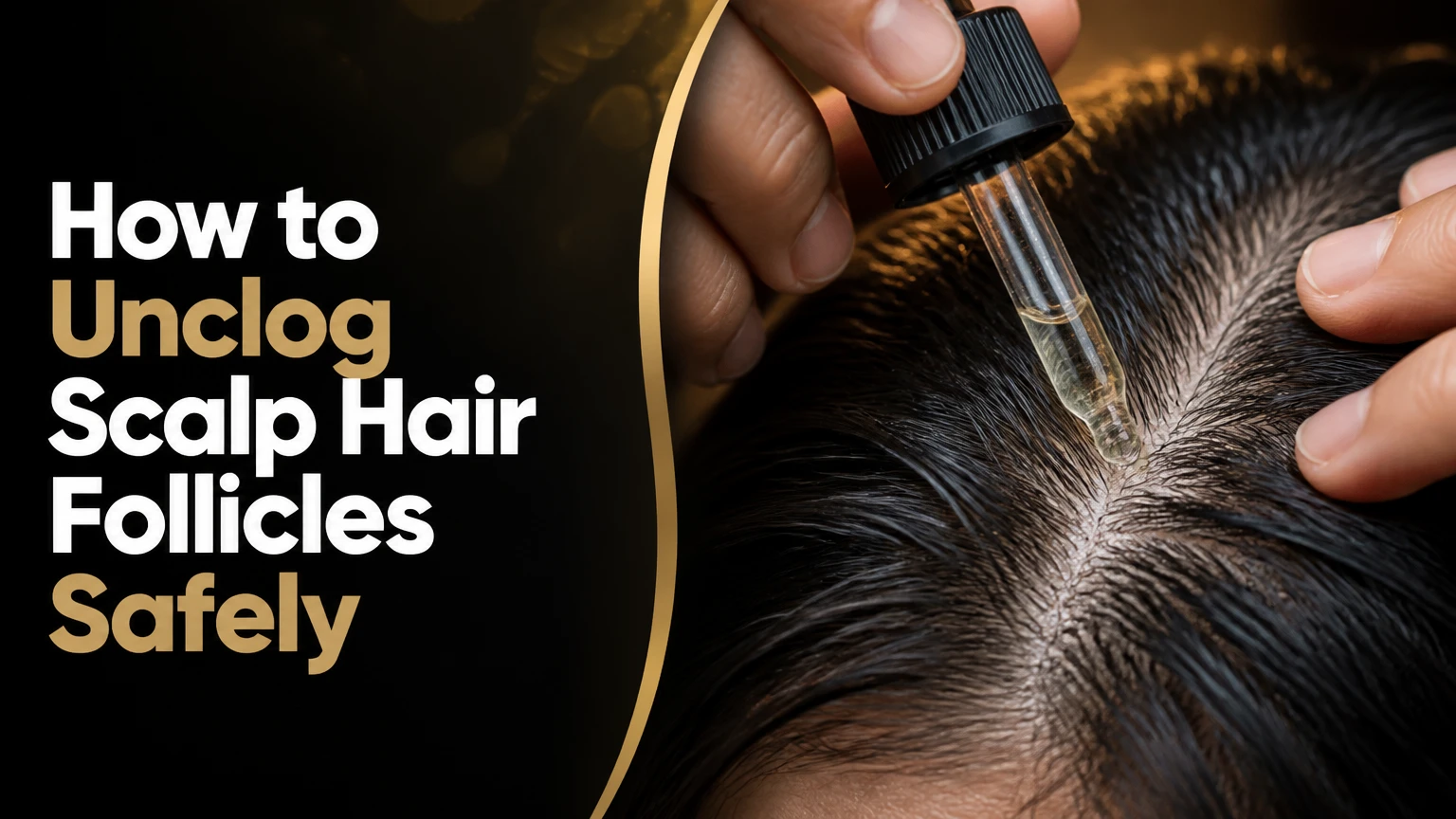
To unclog scalp hair follicles, soften residue with lukewarm water, shampoo the scalp thoroughly, and use a gentle salicylic-acid treatment only when scale persists. Avoid nails, harsh scrubs, undiluted vinegar, and picking bumps. The safest routine removes surface buildup while identifying dandruff, psoriasis, folliculitis, or hair loss that needs medical treatment.
Key facts
Scalp buildup usually consists of sebum, corneocytes, sweat, minerals, and styling-product residue on the skin surface.
A clean scalp does not guarantee faster hair growth because follicle activity depends mainly on genetics, hormones, inflammation, nutrition, and disease.
Salicylic acid can loosen adherent scale, but frequent use may cause dryness, burning, or irritant dermatitis.
A soft silicone brush is safer than fingernails, salt, sugar, or a sharp extraction tool.
Ketoconazole shampoo treats some dandruff and yeast-related inflammation; a clarifying shampoo does not treat fungal disease.
Pus, spreading redness, severe pain, scarring, fever, or sudden hair loss warrants a clinician’s assessment.
What Does a Clogged Scalp Follicle Mean?
A “clogged scalp follicle” usually describes visible residue around a follicle opening rather than a pore packed deep inside the skin. Sebum from sebaceous glands combines with shed skin cells, sweat, dry shampoo, waxes, gels, dust, and mineral deposits, producing greasy scale, flakes, or a waxy coating.
The scalp continuously sheds corneocytes, just as facial skin does. A person who washes infrequently, exercises heavily, uses water-resistant styling products, or has seborrheic dermatitis may accumulate more material between washes. Humidity can increase sweating and make residue feel heavier, but humidity does not create a separate disease called follicle “suffocation.”
Routine cleansing can improve odor, itch, scale, and styling residue. It cannot revive a scarred follicle or reverse every cause of shedding. The American Academy of Dermatology summarizes the diagnostic principle this way: “The key to treating hair loss is finding out what’s causing it.”
What Can Form Around the Follicle?
| Appearance or symptom | More likely explanation | Useful first action | When to escalate |
|---|---|---|---|
| Greasy yellow-white scale | Seborrheic dermatitis or oil buildup | Shampoo regularly; consider ketoconazole | Persistent redness or heavy scale after 2-4 weeks |
| Fine dry flakes | Dry scalp, dandruff, or irritation | Use gentle shampoo; avoid hot water | Bleeding, thick plaques, or severe itch |
| Waxy product film | Pomade, wax, dry shampoo, or silicone residue | Clarifying shampoo once | Burning, rash, or residue that does not wash away |
| Red itchy bumps with pus | Bacterial or yeast folliculitis | Stop picking and irritating products | Prompt medical assessment |
| Firm, round, tender lump | Cyst or inflamed lesion | Do not squeeze or lance | Pain, drainage, growth, or recurrent lumps |
| Hair casts around strands | Keratin or sebum sleeves | Gentle shampoo and combing | Persistent casts with hair loss or inflammation |
| Smooth patch of hair loss | Alopecia areata or another hair-loss disorder | Photograph and arrange evaluation | Sudden, expanding, or eyebrow-associated loss |
How Does Scalp Buildup Develop?
Scalp buildup develops when oil, shed cells, sweat, and product residue remain at the skin surface longer than they are removed. The material can adhere to hair shafts and follicle openings, but normal shampooing does not need to “open” the follicle or extract a plug from its entire length.
Sebum production varies with age, hormones, genetics, climate, and some medications. Styling products containing petrolatum, beeswax, heavy oils, polyquaterniums, or resins can leave a film, especially when applied directly to the scalp. Dry shampoo absorbs oil temporarily; it does not replace washing because starches and powders remain on the skin.
Inflammatory conditions change the picture. Seborrheic dermatitis involves oil-rich areas and Malassezia-associated inflammation. Psoriasis can create sharply defined, thick plaques that extend beyond the hairline. Tinea capitis, which is more common in children, can cause scale, broken hairs, and patches of loss and requires prescription treatment.
Before You Start: Safe Scalp-Cleaning Checklist
A basic home session takes 10-20 minutes and costs approximately $5-$35 when using products already available at home. The essential factor is low mechanical force combined with a product matched to the scalp condition, not the number of tools used.
| Item | Typical specification | Amount or time | Purpose |
|---|---|---|---|
| Shampoo | Fragrance-free or regular rinse-out shampoo | 5-10 mL per wash | Removes oil and residue |
| Treatment shampoo | Salicylic acid 1-3% or ketoconazole 1% | Label-directed contact time | Loosens scale or treats dandruff |
| Water | Lukewarm, approximately 32-38°C | 2-5 minutes | Softens residue without heat stress |
| Silicone brush | Soft, flexible rounded tips | 1-2 minutes | Improves distribution without scratching |
| Clean towel | Washed, non-abrasive fabric | 5 minutes air-drying | Reduces friction after washing |
| Wide-tooth comb | Rounded teeth, 3-6 mm spacing | As needed | Detangles lengths without scraping scalp |
Do not begin with an acid treatment if the scalp has open sores, sunburn, a fresh chemical treatment, active eczema, or unexplained painful bumps. Do not combine salicylic acid, glycolic acid, tea tree oil, essential oils, and a scrub in one session.
Step 1: Loosen the Residue With Water
Wet the scalp completely with lukewarm water for two to three minutes before shampooing. Separate dense hair into four to six sections if necessary, and direct water toward the skin rather than only wetting the outer hair layer.
Water softens water-soluble sweat and reduces the force needed to spread shampoo. Very hot water does not open scalp pores; it can increase dryness, itch, and barrier irritation. Very cold water may feel soothing but does less to soften waxy residue.
You will know this step worked when the scalp feels fully saturated and the hair moves apart without dry patches. The common mistake is applying shampoo to partly dry hair, which encourages excessive rubbing and leaves the roots unevenly cleaned.
Step 2: Shampoo the Scalp, Not Only the Hair
Apply about 5-10 mL of shampoo to the scalp, adding water if needed to distribute it across the roots. Massage with the pads of the fingers for 60-90 seconds, then rinse for at least 30 seconds, because leftover surfactant can mimic or worsen itch.
A second wash is reasonable after heavy styling-product use or strenuous exercise. The first wash emulsifies oil and product; the second wash reaches the skin more evenly. People with oily scalps may wash daily, while people with dry, tightly coiled, or chemically treated hair may use a longer interval if the scalp remains comfortable and clean.
You will know this step worked when the scalp feels clean without a tight, squeaky sensation. The common mistake is scrubbing hair lengths aggressively, which increases tangling and breakage without improving scalp cleansing.
Step 3: Choose One Chemical Exfoliant
Use a salicylic-acid scalp product at approximately 1-3% once weekly when adherent scale or product film remains after ordinary washing. Apply only to the scalp, follow the label’s contact time, and rinse thoroughly. Glycolic acid can loosen surface corneocytes, but it generally has a higher irritation risk on sensitive scalp skin.
Salicylic acid is a keratolytic, meaning it helps separate compacted dead skin. It is not a treatment for genetic hair loss, and stronger concentration does not mean better follicle health. Avoid applying it to cracked skin, and ask a clinician before use if you have an aspirin allergy, extensive eczema, or a condition requiring prescription scalp medication.
You will know this step worked when scale becomes easier to rinse and the scalp remains comfortable for the next 24 hours. The common mistake is leaving the product on overnight when the label specifies a brief rinse-off application.
| Ingredient or product | Typical use | Starting frequency | Main limitation |
|---|---|---|---|
| Salicylic acid | Adherent scale and oily residue | 1 time weekly | Can dry or sting irritated skin |
| Glycolic acid | Surface keratin and product film | Every 10-14 days | More likely to burn sensitive skin |
| Ketoconazole 1% | Dandruff and seborrheic dermatitis support | 2 times weekly for 2-4 weeks | Does not remove heavy wax alone |
| Zinc pyrithione | Dandruff-control shampoo where available | Label-directed | Availability and regulations vary |
| Selenium sulfide | Dandruff with oil and scale | 1-2 times weekly | Can irritate or affect hair feel |
| Clarifying shampoo | Cosmetic residue and mineral film | Every 1-4 weeks | May strip color or dry curls |
Step 4: Use a Soft Brush Only During Shampooing
A soft silicone scalp brush may help spread shampoo through dense hair and lift loose surface scale. Use light pressure for 60-120 seconds, keep the brush moving, and stop if the skin becomes sore, hot, or visibly red.
A brush cannot safely extract a deep cyst, infected follicle, or embedded lesion. Fingernails are worse because their sharp edges create microscopic breaks that increase inflammation and infection risk. Sea salt, sugar, crushed aspirin, and stiff bristles add abrasion without providing a controlled medical benefit.
You will know this step worked when lather reaches the scalp and loose debris rinses away without tenderness. The common mistake is pressing harder to chase a bump, which can convert minor irritation into folliculitis or prolong an existing flare.
Step 5: Condition the Hair Lengths and Dry Gently
Apply conditioner from the mid-lengths to the ends, unless a clinician has prescribed a scalp conditioner. Rinse the scalp well and blot with a towel instead of rubbing wet hair, because wet hair is more vulnerable to mechanical damage.
People with very dry or tightly coiled hair may need conditioner closer to the roots for manageability. That choice is not automatically harmful; the practical rule is to keep heavy, waxy products away from an oily or inflamed scalp and to rinse any product that causes itching.
You will know this step worked when the hair detangles while the scalp feels calm and non-greasy. The common mistake is using a heavy oil to compensate for irritation caused by over-cleansing, which can trap more residue and make diagnosis harder.
How Often Should You Repeat the Routine?
Repeat ordinary scalp washing according to oil production and product use, not according to a fixed “detox” calendar. A clarifying shampoo is typically needed every one to four weeks, while a salicylic-acid treatment usually starts at once weekly and stops when scale is controlled.
| Scalp situation | Washing pattern to trial | Clarifying interval | Treatment caution |
|---|---|---|---|
| Oily scalp or daily exercise | Daily or every other day | 1-2 weeks | Watch for tightness and burning |
| Normal scalp with light styling | Every 2-3 days | 2-4 weeks | Avoid unnecessary acids |
| Dry or tightly coiled hair | Every 5-10 days, as tolerated | 3-6 weeks | Prioritize scalp access and gentle handling |
| Dandruff or seborrheic dermatitis | Treatment shampoo 2 times weekly | Usually unnecessary | Follow label and clinician advice |
| Bleached or fragile hair | Every 2-4 days, as tolerated | 4-6 weeks | Keep clarifier off fragile lengths |
| Contact dermatitis suspicion | Stop new products | Do not clarify initially | Seek assessment if rash persists |
The best schedule leaves no persistent greasy film, heavy scale, or odor while avoiding stinging and tightness. A scalp that becomes increasingly irritated after each wash needs less chemical and mechanical exposure, not a stronger detox.
Which Exfoliant or Shampoo Should You Choose?
Salicylic acid is usually the most practical exfoliant for oily, adherent scale, while ketoconazole is the more appropriate category when dandruff includes itch, redness, or recurring yellow scale. Clarifying shampoo addresses cosmetic residue, but it does not treat an inflammatory or fungal scalp condition.
Choose one active approach for two to four weeks before judging the result. Switching between several actives every wash makes it difficult to identify irritation and can damage the scalp barrier.
Salicylic Acid Versus Glycolic Acid
| Decision factor | Salicylic acid | Glycolic acid |
|---|---|---|
| Chemical class | Beta-hydroxy acid | Alpha-hydroxy acid |
| Typical scalp range | 1-3% rinse-off | Approximately 5-10% cosmetic formulas |
| Best match | Oily scale and compact residue | Surface dullness and mild keratin film |
| Main risk | Dryness, peeling, stinging | Burning, redness, irritation |
| Beginner frequency | Once weekly | Every 10-14 days |
| Avoid when | Cracked or aspirin-sensitive skin | Eczema, sunburn, or active rash |
Clarifying Shampoo Versus Medicated Shampoo
Use a clarifying shampoo for styling residue, hard-water film, or infrequent deep cleansing. Use an anti-dandruff shampoo for recurring flakes and inflammation, following the product’s instructions for scalp contact time.
A clarifier may make hair feel lighter after one wash. It will not eliminate Malassezia-associated dandruff, psoriasis plaques, lice, tinea capitis, or bacterial folliculitis. Conversely, medicated shampoo may control inflammation while leaving a heavy wax film that requires ordinary cleansing.
Which Alternatives Are Safe?
Diluted apple cider vinegar is optional, not necessary, and not a proven method for opening scalp follicles or resetting scalp pH. Vinegar’s acidity can sting damaged skin and cause irritant dermatitis, so a formulated product with a known pH is more predictable than a kitchen mixture.
Avoid undiluted vinegar, lemon juice, baking soda, hydrogen peroxide, and essential oils applied directly to the scalp. Tea tree oil may help some dandruff products, but concentrated oil can trigger allergic contact dermatitis. “Natural” describes an origin, not a safety profile.
A simple alternative is a second gentle shampoo after heavy product use. Another is a fragrance-free shampoo combined with more thorough sectioning, which often solves the access problem without adding an exfoliant.
What If the Problem Is Dandruff?
If flakes recur with itch, redness, or greasy scale, treat possible dandruff rather than repeatedly scrubbing the scalp. Ketoconazole 1% shampoo is a common over-the-counter option in some countries; use it according to the label, often two times weekly for two to four weeks, while maintaining gentle washing on other days.
Dandruff can improve before the skin barrier fully settles. Continue only as directed, then reduce frequency if the label permits. Zinc pyrithione, selenium sulfide, and ciclopirox are other active categories, but availability and prescription status vary by country.
Seek professional advice if symptoms persist after four weeks, spread to the ears or face, form thick plaques, or cause substantial shedding. Psoriasis, eczema, contact allergy, and tinea capitis can resemble dandruff but need different treatment.
When Is a Scalp Bump Not Buildup?
A bump is unlikely to be simple residue when it is painful, warm, pus-filled, fixed, rapidly enlarging, or associated with bleeding or hair loss. Do not squeeze, pierce, or scrape such a lesion because mechanical trauma can worsen infection and scarring.
| Finding | Possible condition | Why home unclogging is unsuitable | Typical next step |
|---|---|---|---|
| Pus-filled tender bumps | Folliculitis | May require culture or prescription therapy | Medical evaluation |
| Thick plaque beyond hairline | Scalp psoriasis | Acids can aggravate fissures | Dermatology assessment |
| Broken hairs and patchy scale | Tinea capitis | Requires oral antifungal treatment | Prompt clinician visit |
| Firm movable lump | Pilar cyst | Extraction is not a shampoo function | Assessment or planned removal |
| Itchy rash after new product | Contact dermatitis | More products increase exposure | Stop suspect product |
| Smooth expanding bald patch | Alopecia areata | Cleansing does not restart immunity-driven loss | Dermatology evaluation |
When Should You See a Dermatologist?
Arrange medical care promptly for spreading redness, fever, severe pain, pus, foul drainage, or rapidly worsening swelling. Schedule an appointment for scarring, recurrent bleeding, a persistent lump, sudden patchy hair loss, or symptoms that do not improve after two to four weeks of appropriate care.
Professional “scalp scaling” can remove adherent debris and make the scalp easier to examine. It does not prove that a follicle was blocked, and it does not replace treatment for androgenetic alopecia, alopecia areata, psoriasis, tinea, or infection.
What Do Professional Treatments Cost?
Costs vary substantially by country, clinic, diagnosis, and whether treatment includes medication. The following are typical private-clinic ranges, not universal prices.
| Service | Typical price range | Typical schedule | What it can and cannot do |
|---|---|---|---|
| In-clinic scalp cleansing | $30-$150 per session | 1 session as needed | Removes surface residue |
| Dermatology consultation | $75-$250 | 1 initial visit | Identifies disease and treatment |
| Prescription dandruff care | $10-$60 monthly | 2-8 weeks initially | Controls selected inflammation |
| Low-level light therapy | $30-$150 per session | 2-3 times weekly | May support selected hair-loss plans |
| PRP injection | $500-$1,500 per session | Often 3 sessions | Hair-loss treatment, not cleansing |
| Mesotherapy | $100-$500 per session | Provider-specific | Evidence and formulations vary |
PRP, mesotherapy, and low-level light therapy should not be marketed as follicle-unclogging procedures. Their purpose, evidence, risks, and eligibility differ from scalp cleansing.
Common Mistakes and How to Fix Them
- Scrubbing until the scalp feels raw. Stop abrasive tools for at least several days, use a gentle cleanser, and seek care if redness or pain continues.
- Using multiple acids in one wash. Return to one active product at the label frequency; burning indicates irritation, not effective detoxification.
- Applying oil to an already greasy scalp. Remove the oil with ordinary shampoo and avoid leave-in scalp oils while assessing the cause.
- Dry-shampoo layering for several days. Wash the scalp rather than repeatedly adding powder, especially when itching or odor develops.
- Picking flakes or bumps. Keep nails short and use a shampoo treatment; picking creates wounds and can cause post-inflammatory marks.
- Blaming buildup for every case of hair loss. Photograph the part and hairline monthly, and arrange evaluation when shedding is sudden, patchy, or progressive.
A counterintuitive rule helps: a tight, squeaky scalp is not a cleaner scalp. That sensation often signals excessive removal of surface lipids, which can increase discomfort and encourage more product use.
How Should Thick or Curly Hair Be Managed?
People with thick, curly, or tightly coiled hair should prioritize scalp access and low manipulation rather than increasing exfoliation strength. Divide the hair into sections, apply shampoo directly to the exposed scalp, and let the lather rinse through the lengths.
A nozzle bottle can improve placement, but it should be cleaned and used only for products designed for scalp application. A soft silicone brush can assist with distribution, although detangling combs should not be used to scrape the skin.
Conditioning frequency should reflect hair-fiber needs. A person may condition the lengths heavily while still keeping waxes, pomades, and occlusive oils away from an oily or inflamed scalp.
How Should an Oily, Active Scalp Be Managed?
An oily scalp that experiences frequent exercise often benefits from washing daily or every other day with a mild shampoo. Sweat itself is not dirt, but sweat, sebum, helmets, hats, and styling products can create a humid environment that increases odor and irritation.
Wash after heavy sweating when practical, dry the scalp rather than leaving it damp under a tight covering, and clean hats or helmet liners according to their care instructions. Witch hazel wipes and fragranced scalp sprays may mask odor but can irritate skin and do not replace cleansing.
Does Unclogging Follicles Regrow Hair?
Unclogging scalp hair follicles can improve comfort, scale, and product residue, but cleansing alone does not reliably regrow hair. Hair density is influenced by androgenetic alopecia, alopecia areata, thyroid disease, iron deficiency, medications, inflammation, infection, and scarring.
Hair grows in cycles, so improvement in an underlying scalp condition may take several weeks before shedding or breakage appears different. New growth from a treated hair-loss disorder often takes months, and the timeframe depends on the diagnosis and therapy.
A clean scalp can support treatment adherence and reduce inflammation in some conditions. It is not a substitute for evidence-based hair-loss evaluation, and “detox” products cannot remove genetic sensitivity from a follicle.
FAQ
Can I unclog scalp follicles with coconut oil?
Coconut oil can reduce friction on the hair shaft, but it does not dissolve scalp buildup or treat folliculitis. On an oily or dandruff-prone scalp, leave-in oil may increase residue and make symptoms harder to assess. Use it sparingly on hair lengths rather than inflamed scalp skin.
Should I wash my hair every day to prevent clogged follicles?
Daily washing is appropriate for some oily scalps, athletes, and people using heavy styling products, provided the shampoo does not cause burning or persistent dryness. Dry, curly, or chemically treated hair may need less frequent washing. Scalp comfort and visible residue are better guides than a universal schedule.
Can clogged follicles cause permanent hair loss?
Ordinary surface buildup rarely causes permanent hair loss by itself. Persistent inflammation, infection, scratching, or scarring disorders can damage follicles, while unrelated conditions may cause shedding at the same time. Sudden patches, scarring, pus, or progressive thinning require diagnosis rather than stronger cleansing.
Is a scalp detox treatment worth paying for?
A professional scalp-cleaning treatment may be worthwhile for temporary removal of stubborn residue or for people who cannot access their scalp easily. It is not necessary for routine hygiene and does not replace treatment for dandruff, psoriasis, folliculitis, or patterned hair loss. Ask what diagnosis and measurable outcome the service addresses.
Can I use a scalp massager every day?
Gentle fingertip massage or a soft silicone brush can be used briefly if the skin remains comfortable. Daily pressure does not have established proof of increasing hair growth, and brushing over inflamed bumps can worsen irritation. Stop when soreness, redness, bleeding, or increased shedding appears.
What is the fastest safe way to remove scalp buildup?
The fastest safe approach is a thorough lukewarm-water rinse followed by one or two shampoo applications, with a soft brush only if needed. Persistent adherent scale may respond to a once-weekly salicylic-acid product. Painful bumps, thick plaques, and pus require diagnosis instead of faster exfoliation.
The Bottom Line
To unclog scalp hair follicles safely, soften residue, shampoo the scalp with controlled fingertip pressure, use one appropriate treatment active, and avoid scraping or picking. Salicylic acid can help adherent scale, while ketoconazole targets some dandruff. Apple cider vinegar, harsh scrubs, and professional “detox” claims are not essential. If bumps hurt, drain, scar, or accompany sudden hair loss, seek medical assessment rather than repeating the routine.