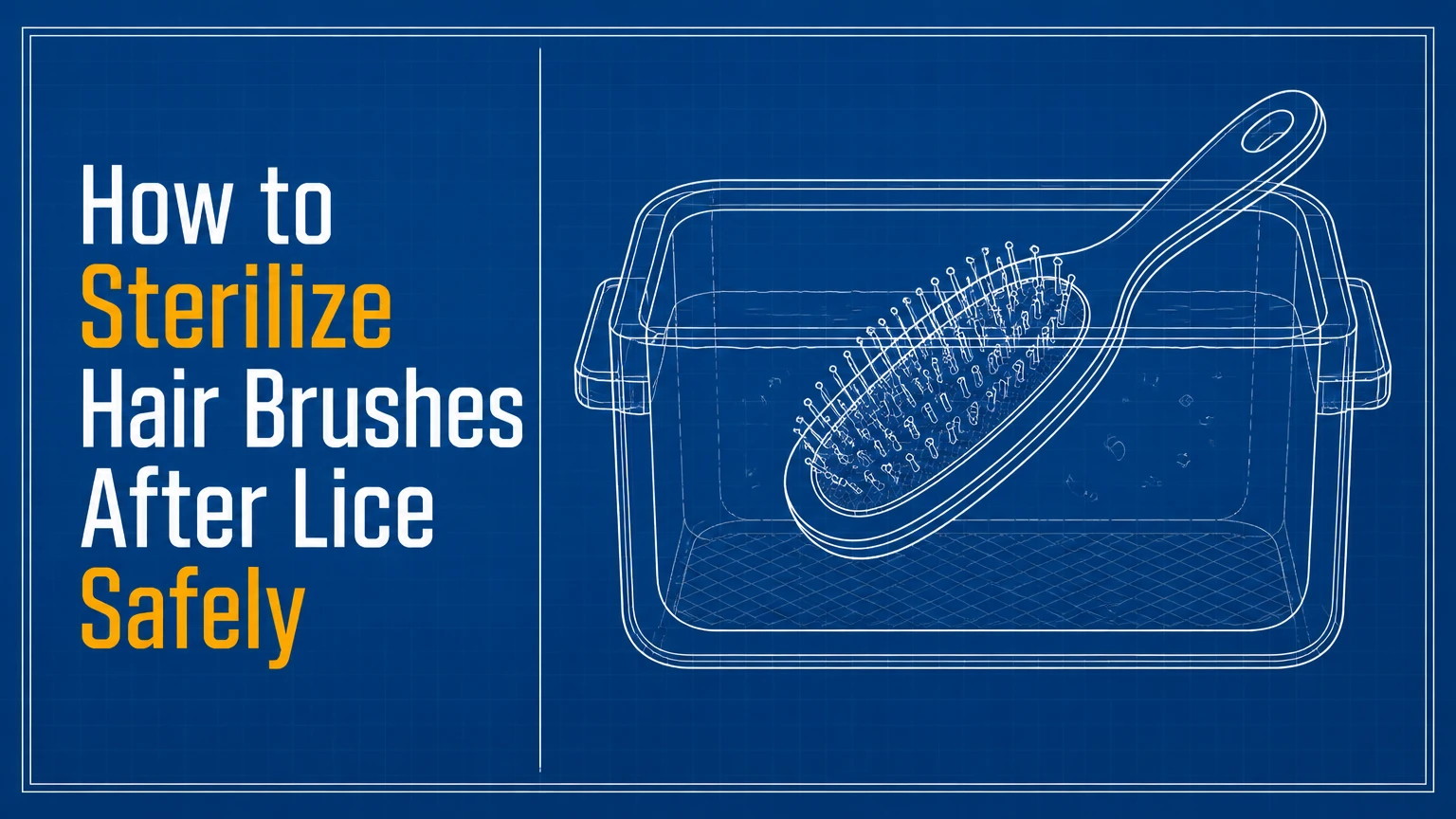
To sterilize hair brushes after lice, remove trapped hair, wash the brush with soap, then submerge a washable brush or comb in water at least 130°F (54°C) for 5-10 minutes. For wooden, padded, or water-sensitive tools, seal the dry brush in a plastic bag for 2 weeks instead. Treating the scalp remains the main reinfestation-control step.
Key Facts at a Glance
- Head lice usually survive away from the human scalp for about 1-2 days because they need blood meals and body warmth.
- The CDC recommends soaking combs and brushes in water at least 130°F for 5-10 minutes.
- A sealed, room-temperature bag for 2 weeks is a low-risk alternative for brushes that cannot tolerate hot water.
- Rubbing alcohol, bleach, insecticide sprays, and lice shampoo are unnecessary for routine brush decontamination and can create fire, residue, or skin-irritation hazards.
- A brush must be cleaned of loose hair before heat or isolation can reach the bristle base.
- A brush with melted plastic, detached bristles, cracked padding, or trapped moisture should be replaced.
What Does Decontaminating a Hairbrush After Lice Mean?
Decontaminating a hairbrush after lice means removing hair, skin debris, lice, and potentially viable eggs, then using heat or time-based isolation to eliminate any remaining insects. The technical word “sterilize” implies destruction of all microorganisms, while household lice care usually requires cleaning and disinfection aimed at head lice.
Head lice are obligate human parasites. The insect, Pediculus humanus capitis, feeds on scalp blood and does not reproduce on furniture, brushes, or carpets. The CDC states that adult lice generally die within 1-2 days when separated from a person, and eggs away from scalp warmth are unlikely to hatch and usually die within about a week.
That biology limits the value of aggressive house cleaning. A brush can theoretically transfer a louse if used immediately after contact, but environmental surfaces are a secondary concern compared with an untreated scalp. The brush still deserves attention because it touches hair repeatedly and can retain hairs close to the cushion or bristle roots.
Why does physical cleaning come first?
Physical cleaning comes first because hair and product residue can shield lice from hot water and prevent a complete inspection. Heat does not remove glued nits, styling wax, dead skin, or the hair strands where lice may be hiding.
Work over a disposable towel or sink. Wear disposable gloves if the person has scratched skin or you find live insects. Pull out every strand with fingers, a tail comb, or tweezers, and place the waste directly into a tied plastic bag before putting it in an outdoor bin.
How Long Can Lice Live on a Hairbrush?
Live head lice on a hairbrush typically survive about 24-48 hours without a human host, while nits away from scalp heat generally do not hatch successfully and die within approximately 7 days. The exact survival time varies with temperature, humidity, and whether a louse recently fed, so immediate cleaning remains preferable to relying on time alone.
The key distinction is between survival and infestation risk. A brush does not provide blood, stable body heat, or the conditions needed for a normal lice life cycle. Nits are cemented to hair shafts, not to plastic or metal, although a shed hair carrying a nit can remain caught in bristles.
The National Pest Management Association and public-health guidance therefore emphasize targeted cleaning rather than fumigating a home. Do not spray insecticide on furniture, brushes, bedding, or rooms unless a licensed professional gives a specific, lawful instruction. Pesticide residue can reach the scalp and eyes without improving lice control.
| Item | Typical off-host concern | Recommended response |
|---|---|---|
| Adult louse on brush | About 24-48 hours | Clean immediately or isolate for 2 weeks |
| Nit on shed hair | Usually fails away from scalp heat | Remove hair and discard it |
| Brush used yesterday | Low likelihood of live lice remaining | Wash or bag it before reuse |
| Brush used minutes ago | Highest practical transfer possibility | Stop sharing and decontaminate now |
How to Sterilize Hair Brushes After Lice
The safest routine method for a washable plastic brush or metal comb is a five-step process: remove hair, wash with dish soap, soak in water at least 130°F for 5-10 minutes, rinse, and dry completely. The determining factor is the brush’s construction, especially glue, rubber padding, wood, and electrical components.
Before You Start
| Requirement | Typical value | Why it matters |
|---|---|---|
| Active work time | 10-15 minutes | Covers removal, washing, and inspection |
| Hot-water soak | 5-10 minutes at 130°F or higher | CDC-supported treatment for combs and brushes |
| Room-temperature isolation | 14 days | Provides a conservative off-host interval |
| Household cost | $0-$5 | Dish soap, bag, gloves, or replacement tool |
| Tools | 1 towel, 1 bag, dish soap, tweezers | Contains hair and residue during cleaning |
Check the care label before using water. A solid plastic vent brush and stainless-steel nit comb usually tolerate the recommended soak, but a wooden barrel, glued decoration, electronic dryer brush, or air-filled cushion may fail.
Do not use a saucepan of boiling water as a shortcut. Water near 212°F (100°C) can warp nylon, loosen adhesive, deform rubber, and damage a brush that would have survived the CDC temperature range.
Step 1: Remove Every Hair and Contaminated Material
Pull hair from the bristles, cushion, seams, and vent holes. Use a tail comb for long strands and tweezers for compact knots, then seal the removed material in a plastic bag.
Inspect the hair under bright light. A nit is an oval structure firmly attached to a hair shaft, usually within about 6 millimeters of the scalp in a newly laid egg. White flakes that slide easily along the bristle or hair are more consistent with dandruff or product residue.
You will know this step worked when: no loose hair remains in the bristle field, cushion edge, or vent openings.
Common mistake: cutting or pulling only the visible surface hair while leaving a dense mat beneath the brush pad.
Step 2: Wash the Brush With Dish Soap
Add a small amount of ordinary dishwashing liquid to warm water. Scrub the bristles, base, seams, and handle with an old toothbrush or small cleaning brush, then rinse away oil and product residue.
The wash is a cleaning step, not a substitute for the hot-water treatment. Soap helps detach organic material and makes the later inspection more reliable, but ordinary dish soap should not be treated as a lice-killing medication.
You will know this step worked when: the water runs clear, the bristle base has no greasy film, and the brush has no visible hair clumps.
Common mistake: soaking a wood-handled or air-cushioned brush during the wash even though its construction cannot dry internally.
Step 3: Use the 130°F Hot-Water Soak
Heat water to at least 130°F (54.4°C), verify the temperature with a kitchen thermometer, and submerge the washable brush or comb completely for 5-10 minutes. Keep the water at or above the target temperature for the full soak, but do not approach boiling.
The CDC lists hot-water soaking for combs and brushes among household measures for head lice. A 130°F soak is hot enough to damage lice and eggs while remaining materially safer than boiling water, although manufacturers’ care instructions still control for delicate tools.
Use tongs to place and remove the item if the container is deep. Do not place a brush into a microwave, clothes dryer, oven, or dishwasher. Those appliances create uneven heat and can damage plastic, rubber, adhesive, or electrical parts.
You will know this step worked when: the whole brush was submerged for the complete time and the water did not fall below 130°F for a prolonged period.
Common mistake: starting the timer while the water is still heating or measuring the water only after the brush has been removed.
Step 4: Rinse and Dry Completely
Rinse the brush under clean running water, shake out trapped droplets, and place it bristle-side down or in a position that allows air circulation. Allow at least several hours of drying, and leave a thick rubber-cushioned brush overnight if moisture remains inside its vents.
A dry brush is safer for the scalp and less likely to develop mildew. The CDC does not require disinfecting a brush with bleach or alcohol after the hot-water step, and those chemicals add risk without addressing the primary source of reinfestation.
You will know this step worked when: the cushion, vent holes, handle joints, and bristle roots feel dry rather than cool or damp.
Common mistake: returning a wet paddle brush to a closed drawer, where trapped moisture can damage the cushion or support mold growth.
Step 5: Inspect Before Returning the Brush to Use
Examine the brush under bright light, paying attention to the bristle roots and any remaining shed hair. Remove residual hair mechanically, then discard or isolate the brush again if you cannot clean the base thoroughly.
A visible nit does not automatically prove that the nit is viable. Eggs farther from the scalp on a growing hair are often empty, hatched, or nonviable, but removing the hair is still the simplest way to eliminate uncertainty.
You will know this step worked when: the brush is clean, dry, structurally intact, and free of trapped hair.
Common mistake: assuming a clean-looking handle means the bristle base has also been decontaminated.
Which Method Fits Each Brush Material?
Solid plastic and metal tools are the best candidates for a 130°F hot-water soak. Wood, natural bristle, glued cushions, and electrical brushes are better isolated in a sealed bag for 2 weeks or replaced when their construction makes reliable cleaning impossible.
| Brush or tool type | Hot-water suitability | Safer treatment | Replacement trigger |
|---|---|---|---|
| Solid plastic comb | Usually suitable at 130°F for 5-10 minutes | Hot-water soak | Warped teeth or cracks |
| Plastic vent brush | Usually suitable if fully washable | Hot-water soak, then air-dry | Melted vents or loose bristles |
| Wooden brush | Poor suitability for prolonged immersion | Dry isolation for 14 days | Swelling, splitting, or odor |
| Boar-bristle brush | Poor suitability for immersion | Dry isolation for 14 days | Matted, shedding, or contaminated bristles |
| Rubber-cushioned paddle brush | Variable, depending on sealed construction | Bag for 14 days if water enters vents | Loose cushion or trapped moisture |
| Heated or electrical brush | Not suitable for immersion | Unplug, wipe exterior, isolate for 14 days | Residue inside vents or electrical damage |
Can a wooden or boar-bristle brush go in hot water?
A wooden or boar-bristle brush should not be submerged in 130°F water unless the manufacturer specifically permits immersion. Water can swell wood, loosen adhesive, distort natural bristles, and remain trapped where the brush cannot dry safely.
Remove all hair first, wipe the surface with a lightly damp soapy cloth, and dry it immediately. Then place the fully dry brush in a sealed bag for 14 days. If the brush has a hollow barrel, cracked finish, deep cushion, or visible contamination that cannot be removed, replacement is the more reliable choice.
What should you do with a padded or electric brush?
A padded or electric brush should be unplugged and kept out of water. Remove hair, wipe accessible surfaces with a small amount of soapy water on a cloth, dry the exterior, and isolate the tool in a sealed bag for 14 days.
Never pour liquid through ventilation holes or immerse a powered tool. If a brush has a removable washable head, clean only that head according to the manufacturer’s instructions. A hair dryer or heated styling brush that cannot be inspected internally may be cheaper and safer to replace than to salvage.
Which Lice-Brush Treatment Is Best?
For most washable plastic brushes, the best option is the CDC-aligned 130°F hot-water soak for 5-10 minutes. For delicate or water-sensitive brushes, two-week bagged isolation is the safest practical alternative; freezer treatment is optional, less standardized, and can damage wood or moisture-sensitive materials.
| Method | Temperature or duration | Best use | Main limitation |
|---|---|---|---|
| Hot-water soak | At least 130°F, 5-10 minutes | Solid plastic and metal | May damage glue, wood, rubber |
| Sealed bag isolation | 14 days at room temperature | Delicate brushes and backups | Brush remains unavailable |
| Freezer isolation | About 0°F, typically 24-48 hours | Small, dry, nonfragile tools | Household freezer performance varies |
| Replacement | Immediate | Damaged or noncleanable tools | Typical cost $3-$30 |
Is freezing a hairbrush effective after lice?
Freezing a completely dry brush in a sealed bag for 24-48 hours may kill lice, but freezing is not the primary CDC household recommendation and should not be assumed to eliminate every egg under every freezer condition. A domestic freezer may cycle above its stated setting, and cold penetration depends on packaging and brush density.
If you use this option, seal the dry brush in a freezer bag, place it deep in a freezer set near 0°F (-18°C), and leave it for 48 hours. Let the sealed bag return to room temperature before opening it, which reduces condensation on the brush. Do not freeze wood, leather, or expensive natural materials unless the manufacturer permits it.
Should you use rubbing alcohol or lice shampoo?
Routine brush decontamination does not require rubbing alcohol or lice shampoo. Alcohol is flammable, can damage finishes and rubber, and may irritate a scratched scalp; lice shampoos are formulated for hair and scalp use, not for soaking household tools.
Do not mix alcohol with bleach or other cleaners. Do not spray pediculicide on a brush, sofa, mattress, or room. If a healthcare professional or product label gives a specific tool-cleaning instruction, follow that instruction exactly, but hot water or isolation is generally simpler and safer.
Should You Throw Away Hairbrushes After Lice?
You do not usually need to throw away an intact, washable hairbrush after lice. Replace a brush when it has deep trapped hair, cracked plastic, detached bristles, a damaged cushion, internal moisture, or a material that cannot be cleaned or isolated reliably.
Replacement is reasonable when the brush costs less than the time and risk of recovery. A typical drugstore plastic brush costs $3-$15, while a specialty wooden or boar-bristle brush may cost $20-$60 or more. Keep a separate clean brush available while the original remains bagged.
| Situation | Cleaning decision | Typical cost | Reason |
|---|---|---|---|
| Solid plastic brush, intact | Hot-water soak | $0-$2 | Washable and inexpensive to process |
| Wooden luxury brush | Bag for 14 days | $0.25-$2 | Avoids moisture damage |
| Brush with dense glued debris | Replace | $3-$30 | Base cannot be inspected reliably |
| Cracked or shedding brush | Replace | $3-$60 | Damage creates inaccessible surfaces |
| Shared salon tool | Clean between users | $0-$5 per tool | Prevents cross-client transfer |
How Should Household Cleaning Fit Into Lice Treatment?
Household brush cleaning supports lice treatment, but treating every room is unnecessary. Focus on items that touched the affected person’s head during the previous 48 hours, while directing most effort toward detecting and treating live lice on the scalp.
Wash recently used pillowcases, hats, towels, and clothing in hot water and dry them on the highest heat the fabric permits. Items that cannot be washed can be sealed for 2 weeks. Vacuum floors and furniture where hair may have fallen, but avoid insecticide foggers and room sprays.
Lice do not jump or fly. Direct head-to-head contact and shared objects used close to the head create the more relevant exposure routes. Do not share brushes, combs, hats, helmets, headphones, hair accessories, or towels until the active infestation is controlled.
When should you clean the brush?
Clean the brush on the same day the infestation is identified, ideally after the first scalp treatment and before the brush is used again. If the brush was used by several household members, treat it as contaminated until each person has been assessed.
| Timeline | Action | Purpose |
|---|---|---|
| Day 0 | Treat the scalp as directed and clean brushes | Removes current exposure |
| Day 0-1 | Wash or bag recent head-contact items | Addresses short off-host survival |
| Day 7-10 | Repeat treatment if product instructions require it | Targets newly hatched lice |
| Day 14 | Reinspect scalp and release isolated tools | Confirms the control interval |
The exact retreatment date depends on the product label. Some treatments require a second application after 7-10 days because eggs may survive the first application. Follow the label and ask a pharmacist or clinician about children, pregnancy, allergies, or treatment failure.
Common Mistakes and How to Fix Them
The most common brush-cleaning failures are incomplete hair removal, excessive heat, chemical misuse, and moisture trapped inside padded tools. Each failure has a different remedy, so repeating the same method without diagnosing the problem can damage the brush or leave the user exposed.
| Mistake | What goes wrong | Corrective action | Replace when |
|---|---|---|---|
| Boiling a plastic brush | Plastic warps and glue softens | Discard damaged brush; use 130°F water next time | Teeth or bristles stay distorted |
| Applying bleach | Residue irritates skin and damages materials | Rinse repeatedly; do not use on scalp-contact tools | Odor or surface damage remains |
| Using alcohol near heat | Fire and inhalation risk increase | Ventilate, keep away from flame, avoid routine use | Finish or rubber is degraded |
| Bagging a wet brush | Moisture remains trapped | Remove, dry fully, then restart isolation | Mildew, odor, or cushion swelling appears |
| Leaving hair in the brush | Lice or nits remain physically protected | Remove debris and repeat cleaning | Base remains inaccessible |
| Cleaning only the handle | Bristle roots stay contaminated | Scrub and inspect the entire head | Dense debris cannot be removed |
A brush that warped during soaking should not be straightened with more heat. Permanent deformation can create sharp edges or inaccessible gaps, so replacement is safer.
A brush that was sprayed with bleach should be rinsed thoroughly with water and dried in ventilation, but never mix bleach with vinegar, ammonia, alcohol, or other cleaners. If chemical odor persists, discard the item rather than placing it against the scalp.
A brush that was frozen should remain sealed while thawing. Condensation forms on cold surfaces when warm humid air reaches them, and opening the bag immediately can transfer moisture into wood or padding.
What If You Have No Backup Brush?
If no backup brush is available, clean a washable plastic brush using the hot-water procedure and use it only after complete cooling and drying. For a delicate brush, use a clean wide-tooth comb temporarily, purchase an inexpensive plastic comb, or keep the original sealed for 14 days.
Do not return a wet or chemically treated brush to the scalp for convenience. A temporary $2-$5 comb is usually safer than exposing irritated skin to bleach, concentrated alcohol, or residual pediculicide.
Children should not share the temporary tool. Label each household member’s brush or comb, especially when one person has confirmed live lice and others have not yet been examined.
What Are the Practical Costs and Downtimes?
Most brush decontamination costs $0-$5 and takes 10-15 minutes of active work. The hot-water method has the shortest downtime, while bagged isolation has the lowest material risk but keeps the brush unavailable for 14 days.
A thermometer is useful but not mandatory if the water temperature can be verified reliably; however, a thermometer reduces the chance of using water that is too cool to meet the recommended threshold or hot enough to deform plastic. Typical replacement costs range from $3 for a basic comb to $60 for a specialty brush.
The economic decision changes with material. A $5 plastic brush is often worth replacing if it has embedded debris, while a $40 brush with intact construction is a reasonable candidate for dry isolation.
Frequently Asked Questions
Can lice spread from a brush to clean hair?
A live louse can potentially move from a recently used brush to hair, but the risk is lower than direct head-to-head contact because head lice survive poorly away from the scalp. Clean the brush immediately, avoid sharing it, and examine household members for live lice or crawling nymphs.
Can nits survive on a hairbrush overnight?
A nit attached to a shed hair may remain physically present overnight, but eggs generally need scalp warmth to develop and hatch. Remove all hair from the brush, discard it in a sealed bag, and use hot-water treatment or two-week isolation instead of relying on overnight storage alone.
Can I clean a hairbrush with vinegar after lice?
Vinegar is not a reliable lice treatment for brushes. Vinegar may loosen some residue, but it does not replace the 130°F hot-water soak or two-week isolation, and concentrated vinegar can irritate skin or damage finishes when used repeatedly.
How do I clean hair ties and clips after lice?
Wash washable hair ties and plastic clips with dish soap and warm water, then use the 130°F soak only if their material and adhesive tolerate it. For fabric, leather, embellished, or heat-sensitive accessories, seal them in a bag for 14 days or replace inexpensive items.
How can I tell whether lice are gone?
The strongest sign is the absence of live crawling lice during careful scalp inspection, especially behind the ears and at the nape. Itching can continue after treatment because bites irritate skin, while empty nits may remain attached to hair. Follow the product’s retreatment instructions and seek clinical advice if live lice persist.
The Bottom Line
To sterilize hair brushes after lice, remove every hair, wash the tool with dish soap, soak washable plastic or metal items at 130°F or higher for 5-10 minutes, rinse, and dry completely. Bag wood, boar bristle, padded, or electrical brushes for 14 days instead. Clean the brush alongside appropriate scalp treatment, because environmental decontamination cannot cure an untreated infestation.