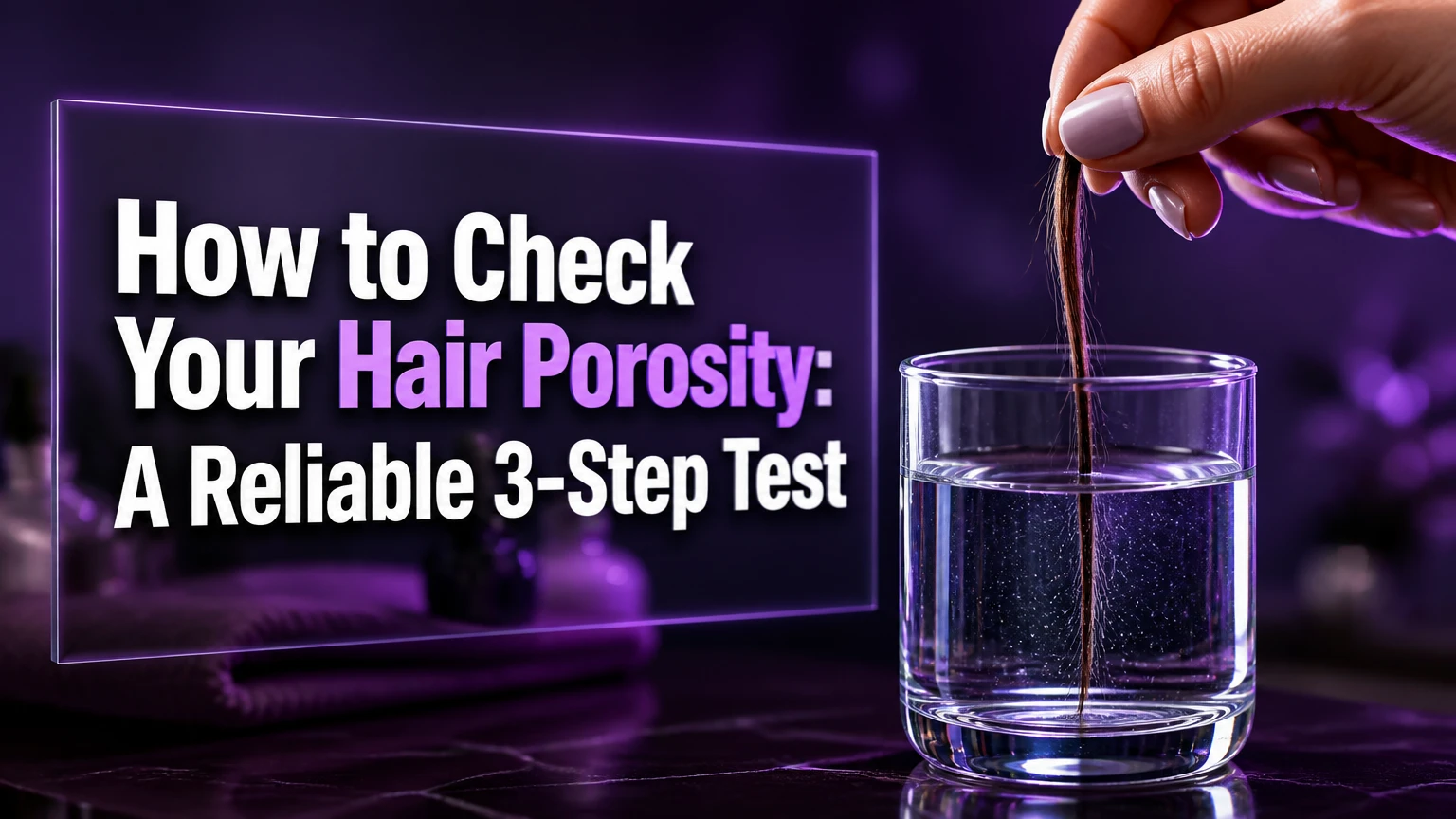
Hair porosity describes how readily a hair fiber takes in and releases water. To check your hair porosity, cleanse away product residue, let your hair dry completely, then combine a water-spray observation with wash-day and drying-time clues; use the float test only as a rough experiment, not as a diagnosis.
Key Facts
Hair porosity can vary between the roots, mids, and ends of the same head.
Bleach, permanent color, relaxers, repeated heat, sunlight, and friction can increase porosity by damaging the cuticle.
The float test is easily distorted by surface tension, air bubbles, oils, and styling residue.
A clean spray test plus consistent wash-day behavior usually provides more useful information than one strand in water.
Drying time is evidence, not proof, because density, strand diameter, humidity, and airflow change the result.
Hair porosity is different from hair texture, density, curl pattern, and moisture balance.
What Hair Porosity Measures
Hair porosity measures the movement of water and conditioning ingredients into and out of the hair shaft. The outer cuticle consists of overlapping protective cells around the cortex, and the condition of that surface affects wetting, drying, friction, and product accumulation.
Low-porosity hair tends to resist wetting because water spreads slowly across the fiber. High-porosity hair wets quickly but may lose water quickly because chemical processing, weathering, or mechanical damage has made the surface less intact. Medium porosity describes behavior between those extremes, not a precise laboratory category.
Porosity is not a permanent label for every strand. Natural fiber structure contributes to baseline behavior, while bleaching, relaxing, permanent coloring, high heat, ultraviolet exposure, rough detangling, and worn ends can create more porous sections. Robbins describes the cuticle and cortex as distinct structural regions whose condition affects the physical and chemical behavior of human hair in Chemical and Physical Behavior of Human Hair, 5th edition, 2012.
Porosity is not the same as dryness
Dryness describes how hair feels or behaves at a particular time. Porosity describes how readily the fiber wets and how effectively it holds water. A low-porosity head can feel dry because conditioner remains on the surface, while high-porosity hair can feel soft immediately after conditioning and become dry several hours later.
Hair texture also matters. Straight, wavy, curly, and coily hair can each have low, medium, or high porosity. Curl pattern changes the path water takes around the fiber and can make drying uneven, but curl pattern alone cannot identify porosity.
How to Check Your Hair Porosity at Home
Use three observations rather than one isolated test: a controlled spray test, the feel of clean strands, and the way hair behaves during washing and drying. The complete process takes about 20-40 minutes, excluding air-drying time, and costs nothing if you already have shampoo and a spray bottle.
Before You Start
| Item | Typical requirement | Why it matters |
|---|---|---|
| Clarifying or residue-removing shampoo | 1 wash, 30-60 seconds of lather | Removes oils, polymers, silicones, and styling products |
| Clean hair sections | 4 sections from crown, sides, nape, and ends | Captures regional variation |
| Spray bottle | 10-20 mL of room-temperature water | Creates a controlled mist |
| Drying observation | 1 wash day, preferably 2 | Separates a single anomaly from a pattern |
| Recording method | Notes or phone timer | Tracks wetting, drying, buildup, and frizz |
Avoid testing immediately after bleach, a relaxer, a perm, or a major color service. Wait until the next normal wash, because chemical residue and temporary surface changes can distort the observation. Do not apply conditioner, oil, leave-in cream, gel, mousse, or serum before testing.
Step 1: Cleanse and Dry the Hair
Wash your hair with a shampoo that removes ordinary styling residue, then rinse thoroughly and allow the hair to dry completely without leave-in products. If your hair contains heavy waxes, oils, or silicone-rich styling products, use a clarifying shampoo once rather than repeatedly scrubbing the scalp.
Cleanse the scalp and lengths, but do not roughen the hair by piling it into a tight knot. Rinse with comfortably warm water, squeeze out excess water with a towel or cotton T-shirt, and let the hair air-dry if possible. Record whether water spread quickly during washing, whether the hair took hours to become dry, and whether the ends dried before the roots.
You will know the step worked when the strands feel clean but not coated, and no visible cream or oil remains. The common mistake is testing wet hair, because water already inside the fiber changes how the strand behaves.
Step 2: Sample Several Clean Strands
Collect one or two naturally shed strands from four areas, including the crown, side, nape, and oldest ends. If you cannot collect shed strands, trim a few millimeters from the ends with clean scissors; do not pull hair from the scalp.
Keep root-side and tip-side orientation if possible. Examine the ends for splitting, white dots, severe roughness, or previous color demarcation. A damaged end may represent high porosity even when newer growth near the scalp behaves differently.
You will know the step worked when at least four areas have been sampled and the strands are dry and free from visible residue. The common mistake is using one unusually fine or damaged strand as a verdict for the entire head.
Step 3: Run the Water Spray Test
Place a small dry section against a dark background and mist it lightly from about 15 centimeters away using room-temperature water. Watch the droplets for 30-60 seconds without touching the hair, then repeat on two or three other sections.
Water that remains in round beads can indicate a resistant or coated surface, but beading alone does not prove low porosity. Water that spreads and disappears quickly suggests easier wetting, although very fine hair, heat, low humidity, or a highly damaged end can produce the same appearance.
| Spray observation | More likely explanation | What to check next |
|---|---|---|
| Beads remain for 30-60 seconds | Low wetting or surface residue | Clarify and repeat on clean hair |
| Droplets spread slowly | Moderate resistance to wetting | Compare with wash-day behavior |
| Water disappears within seconds | High wetting or damaged ends | Check drying speed and tangling |
| Different sections respond differently | Mixed porosity or varied damage | Treat roots and ends separately |
| Droplets roll off without soaking | Product film or heavy oil | Wash again before interpreting |
You will know the step worked when the same pattern appears across several clean sections. The common mistake is spraying too much water, because saturation makes every section appear highly absorbent.
Is the Float Test Reliable?
The float test is a rough demonstration of buoyancy, not a dependable measurement of hair porosity. A clean strand may remain on the surface because water’s surface tension supports it, while oil, air bubbles, or product film can change its apparent position.
If you still want to perform it, fill a transparent glass with room-temperature water, place three or four dry strands on the surface without pushing them down, and observe them for five minutes. Record whether each strand remains at the surface, suspends below it, or sinks. Do not force a strand beneath the water, because that removes the very variable you are trying to observe.
| Float-test result after 5 minutes | Traditional interpretation | Safer interpretation |
|---|---|---|
| Surface | Low porosity | Resistant wetting, surface tension, or coating |
| Mid-water | Medium porosity | Indeterminate without other observations |
| Bottom | High porosity | Greater density or wetting, not proof of damage |
| Strand clings to glass | Variable | Static, bubbles, or wall contact may interfere |
The float test cannot reliably measure cuticle gaps, water retention, or chemical damage. Cosmetic chemistry sources often describe the test as a consumer screening method, but its result depends on strand mass, surface tension, contamination, and handling. Use it only when it agrees with the spray test and wash-day evidence.
Which Porosity Test Should You Trust Most?
The most useful home assessment combines the spray test, clean-strand feel, and repeated wash-day behavior. The spray test shows initial wetting, the tactile check shows surface friction, and drying observations reveal how the whole head handles water.
| Method | Time | Main variable | Useful clue | Main limitation |
|---|---|---|---|---|
| Spray test | 5-10 minutes | Droplet spreading | Surface wetting speed | Residue can cause false beading |
| Tactile test | 2-5 minutes | Friction along strand | Smoothness or roughness | Sensitive to strand damage and curl |
| Float test | 5 minutes | Buoyancy in water | Rough comparison only | Surface tension strongly interferes |
| Wash-day observation | 1-2 wash days | Whole-head behavior | Wetting, drying, retention | Humidity and density alter timing |
| Stylist assessment | 10-20 minutes | Visual and tactile inspection | Section-by-section variation | Subjective and experience-dependent |
| Microscopy | Several days to weeks | Surface imaging | Cuticle condition | Usually unnecessary for routine care |
A practical rule is to count two or more matching clues as meaningful. For example, slow wetting, persistent surface droplets, and substantial buildup support a low-porosity interpretation more strongly than a single strand floating in water.
What Do Low, Medium, and High Porosity Mean?
Low, medium, and high porosity describe patterns of wetting and moisture retention, not fixed hair-quality grades. High porosity does not automatically mean unhealthy hair, and low porosity does not guarantee strong or moisturized hair.
| Porosity pattern | Wetting behavior | Drying behavior | Common care problem | Typical clue |
|---|---|---|---|---|
| Low | Water spreads slowly | Often takes 3-8 hours, depending on density | Buildup and product sitting on surface | Hair resists becoming fully wet |
| Medium | Water wets hair predictably | Often dries in 1-5 hours | Routine balance is usually easier | Products absorb without immediate heaviness |
| High | Water wets rapidly | May dry in 30 minutes to 3 hours | Moisture loss, tangling, breakage | Ends feel rough or swell quickly |
These drying ranges are typical household observations, not diagnostic thresholds. A dense head of low-porosity coily hair may take longer than eight hours, while fine high-porosity hair in moving air may dry in under an hour. Compare your own hair under similar conditions instead of applying a universal cutoff.
What does low-porosity hair usually need?
Low-porosity hair usually benefits from smaller product quantities, thorough rinsing, and lightweight conditioning. Warm water during washing can improve spreading, while gentle heat during a deep-conditioning treatment may help the conditioner distribute more evenly.
Start with a small amount of conditioner and apply it to thoroughly wet hair. Water-based formulas and lighter emollients may reduce residue, but ingredient categories are not universal rules: a heavy product can work for a small amount of dense hair, and a lightweight product can still cause buildup if used too often.
What does high-porosity hair usually need?
High-porosity hair often benefits from consistent conditioning, reduced friction, and a film-forming product that slows water loss. Hydrolyzed proteins may temporarily improve feel and strength for some damaged hair, but protein is not a permanent repair and excess use can make strands feel stiff.
Apply conditioner in sections, detangle from ends toward roots, and reduce direct heat. A leave-in conditioner or cream can help protect the surface, while a small amount of oil may reduce friction. Heavy oils and butters are options, not requirements, and can create buildup or weigh down fine hair.
How should medium-porosity hair be managed?
Medium-porosity hair usually needs the least aggressive adjustment because it wets and dries predictably. Keep the routine simple, change one product at a time, and use buildup removal only when hair becomes dull, coated, or unusually difficult to wet.
Medium porosity can shift along the same head. Sun-exposed ends may be more porous than protected roots, especially after coloring or repeated hot-tool use. Routine observation matters more than preserving the label.
Can Hair Have Mixed Porosity?
Hair can have mixed porosity across different sections, and this is common after chemical processing or years of environmental exposure. Newer roots may resist water while older, bleached ends wet instantly, tangle, and dry quickly.
| Hair area | Likely exposure | Possible behavior | Practical response |
|---|---|---|---|
| New growth | Minimal chemical and heat exposure | Lower porosity | Use lighter products near roots |
| Crown | Sun, brushing, and heat | Moderate or high porosity | Add surface protection |
| Mid-lengths | Repeated styling exposure | Variable | Test several subsections |
| Ends | Oldest fiber and split ends | Highest porosity | Condition, trim, and reduce friction |
| Color boundary | Bleach or permanent dye | Abrupt porosity change | Treat processed section separately |
Section-specific care is more accurate than applying a heavy high-porosity routine to the entire head. Place conditioner where the fiber feels roughest, and keep roots free from unnecessary layers if they become greasy or coated.
How Damage Changes Porosity
Bleaching and other alkaline chemical services can increase cuticle disruption and alter the fiber’s ability to retain water. Repeated flat-ironing, curling, ultraviolet exposure, chlorine, tight styles, and abrasive towel drying can also increase roughness and breakage over time.
A high-porosity result does not identify the cause of damage. Hair that wets instantly may be naturally porous, chemically processed, mechanically worn, or simply covered in a product that changes how water spreads. Examine service history, split ends, elasticity, and breakage before selecting treatment.
Hair porosity cannot be permanently repaired with a conditioner because the visible hair fiber is nonliving keratin. Conditioning agents can reduce friction, improve combability, and form temporary films, while trimming removes irreversibly split portions. That limitation is important when evaluating claims about “sealing” or “closing” the cuticle permanently.
What Mistakes Produce False Results?
Testing errors often explain contradictory results better than an unusual porosity pattern. Product films, surface tension, inconsistent sampling, and environmental differences can make the same hair appear low porosity in one test and high porosity in another.
| Mistake | False impression | Correction |
|---|---|---|
| Testing after oil or leave-in | Hair appears water-resistant | Shampoo, rinse fully, and dry completely |
| Using one strand | One damaged end represents all hair | Sample four sections |
| Pushing strand underwater | Hair appears highly absorbent | Let it enter naturally |
| Using excessive spray | Every section seems high porosity | Apply a light, repeatable mist |
| Comparing humid and dry days | Drying time seems inconsistent | Compare similar weather and airflow |
| Testing soon after bleach | Temporary service effects dominate | Wait for a normal wash cycle |
| Treating split ends as new growth | Whole head seems damaged | Inspect roots, mids, and ends separately |
What should you do when tests disagree?
When results conflict, repeat the spray test after one residue-free wash and prioritize repeated whole-head behavior over the float position. If clean hair beads but becomes fully wet during washing, the beading may reflect light spray volume or surface tension rather than low porosity.
If hair wets rapidly but takes many hours to dry, density, strand thickness, curl structure, and low airflow may explain the delay. If hair floats yet dries quickly and feels rough, the float result is probably less informative than the other observations.
Home Tests Versus Professional Analysis
A stylist can compare several sections under consistent lighting and inspect chemical history, but a salon consultation remains a visual and tactile judgment. Laboratory imaging can show surface structure more directly, although microscopy is rarely needed to choose an everyday shampoo or conditioner.
| Assessment route | Typical cost | Typical time | Best use | Limitation |
|---|---|---|---|---|
| Home spray and wash observation | $0-$10 | 20-40 minutes plus drying | Routine decisions | No standardized measurement |
| Salon consultation | $20-$75 | 10-30 minutes | Mixed damage and chemical history | Depends on stylist experience |
| Trichology consultation | $50-$200 | 30-60 minutes | Scalp or hair-loss concerns | Porosity may not be the main issue |
| Laboratory or microscopic imaging | $100-$300 or more | 1-4 weeks | Research or unusual cases | Cost rarely improves routine care |
Seek medical advice for sudden shedding, bald patches, scalp pain, persistent scaling, or severe breakage. A porosity test cannot diagnose androgenetic alopecia, telogen effluvium, inflammatory scalp disease, or nutritional deficiency.
How Much Time and Money Does Testing Take?
A useful home assessment usually costs $0-$10 and requires one preparation wash, 5-10 minutes for spray and strand observations, and one or two normal drying observations. A salon assessment typically costs $20-$75, while microscopy or specialized analysis can cost $100-$300 or more, depending on location and provider.
The most valuable “tool” is a consistent record. Note shampoo used, whether conditioner was applied, weather, approximate drying time, tangling, frizz, and how quickly hair became coated. A two-wash comparison is more informative than repeating the float test six times in one afternoon.
How Should You Use the Result?
Use porosity as a product and technique adjustment, not as a permanent identity. Low-porosity hair may need lighter layers and more thorough rinsing; high-porosity hair may need conditioning, reduced friction, and protection from repeated chemical or thermal stress; medium-porosity hair usually needs fewer changes.
| Result pattern | First adjustment | Avoid first | Reassess after |
|---|---|---|---|
| Low wetting and buildup | Use less product and rinse longer | Adding several heavy layers | 2-3 washes |
| Fast wetting and rough ends | Condition in sections and protect ends | Frequent high heat | 2-4 washes |
| Predictable wetting and drying | Keep current routine stable | Changing every product | 3-4 washes |
| Mixed roots and ends | Use section-specific amounts | One formula from scalp to tips | 2-3 washes |
Ingredients alone cannot determine success. Glycerin, aloe, oils, silicones, proteins, and butters behave differently according to concentration, formula, climate, strand diameter, and how much product is applied. Judge the routine by wetting, detangling, softness, breakage, buildup, and styling performance.
What is a practical rule for proteins?
Use protein when damaged hair feels overly soft, limp, weak, or difficult to style, and reduce it if hair becomes stiff, brittle, or rough. Protein products temporarily deposit or reinforce the surface; they do not reconstruct missing cuticle cells.
Is a cold-water rinse necessary?
A cold-water rinse is optional, not a required porosity treatment. Cooler water may feel more comfortable and reduce swelling for some people, but it cannot permanently seal a damaged cuticle or reverse chemical damage. Gentle cleansing, conditioning, low-friction drying, and heat protection have a larger practical effect.
FAQ
Can I test hair porosity with a strand from my brush?
You can, but brush-collected hair may contain sebum, dust, dry shampoo, styling residue, and fibers from different ages. Wash the strand gently, let it dry, and treat the result as a rough clue. A controlled spray test on freshly cleansed hair usually provides more useful information.
Does hair porosity determine which curl type I have?
No. Hair porosity and curl type describe different properties. Curl type refers mainly to the shape of the fiber’s natural pattern, while porosity concerns wetting and moisture movement. Straight, wavy, curly, and coily hair can all show low, medium, high, or mixed porosity.
Why does my hair feel dry if it has low porosity?
Low-porosity hair can feel dry when water and conditioner do not spread through dense or tightly grouped strands, or when buildup prevents consistent wetting. Use enough water during conditioning, apply smaller product amounts in sections, rinse thoroughly, and clarify when coating becomes noticeable.
Can damaged hair become low porosity again?
Damaged lengths cannot biologically return to their original cuticle condition because the visible hair shaft is nonliving. Conditioning treatments can reduce friction and improve appearance temporarily. New growth may have a different baseline, and trimming severely split or weathered ends removes the least manageable portion.
How often should I retest hair porosity?
Retest after a major chemical service, a substantial change in routine, or several months of growth, rather than every wash. For routine care, observe behavior once every four to eight weeks. Repeating tests too frequently encourages product changes based on normal weather or styling variation.
Is hair that sinks always high porosity?
No. A sinking strand may be denser, thinner, waterlogged, or affected by surface conditions that have little to do with cuticle damage. Confirm the result with clean-hair wetting, drying behavior, surface feel, and section-specific history before calling the hair high porosity.
The Bottom Line
To check your hair porosity, cleanse away residue, dry the hair completely, sample several sections, and use a light water spray alongside repeated wash-day observations. Treat the float test as a rough experiment, not proof. Hair porosity may differ across one head, and the most useful result is the pattern that helps you adjust product weight, conditioning, friction, and heat exposure.