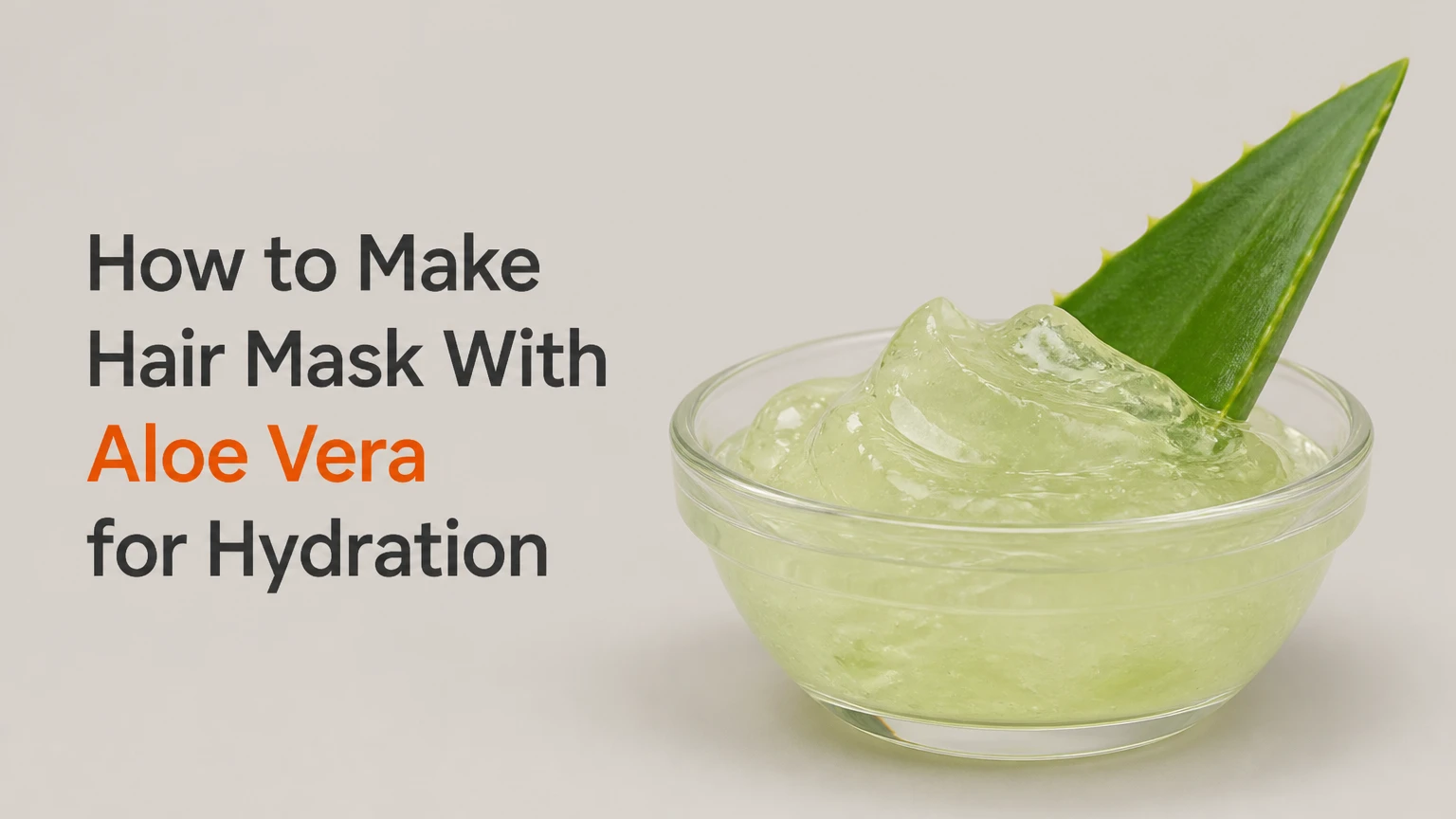
To make a hair mask with aloe vera, blend 3 tablespoons of clear aloe vera gel with 1 tablespoon of a suitable conditioner or lightweight oil, apply it to clean, damp hair for 20-30 minutes, then rinse thoroughly. Drain the yellow latex from fresh leaves first, because the latex can irritate the scalp and skin.
Key Facts at a Glance
A basic aloe vera hair mask uses 3 tablespoons of clear gel and 1 tablespoon of conditioner or oil.
Apply aloe vera to clean, damp hair for 20-30 minutes, then rinse with lukewarm water.
Fresh aloe leaves require latex drainage, peeling, blending, and straining before use.
Aloe vera can improve temporary softness, slip, and scalp comfort, but it is not a proven hair-growth treatment.
Make only enough for one application unless the mixture contains a validated cosmetic preservative.
Fine hair usually tolerates plain aloe or lightweight jojoba better than coconut or castor oil.
What Does an Aloe Vera Hair Mask Do?
An aloe vera hair mask is a short-contact conditioning treatment for the hair shaft and, when tolerated, the scalp. Aloe vera gel contains a high proportion of water and polysaccharides that can make hair feel softer and easier to detangle, while the finished result depends heavily on the added conditioner, oil, hair porosity, and rinsing technique.
Aloe vera is better understood as a hydrating, slip-enhancing cosmetic ingredient than as a repair agent. Damaged cuticle layers cannot be permanently rebuilt by a homemade mask, and split ends still require trimming. Aloe can temporarily reduce rough feel by lubricating the surface and adding water, but oils and conditioning agents usually determine how long the softness lasts.
The commonly repeated claim that aloe vera clears follicles or stimulates new growth needs restraint. Proteolytic enzymes and plant compounds have plausible scalp-related functions, but robust clinical evidence does not establish a homemade aloe mask as a treatment for androgenetic alopecia, telogen effluvium, or other causes of hair loss.
How Does Aloe Vera Work on Hair and the Scalp?
Aloe vera works mainly by adding water and surface lubrication, not by permanently repairing keratin or reliably activating follicles. Aloe gel contains polysaccharides, including acemannan, alongside minerals and plant compounds, but the concentration and activity vary between fresh gel and commercial products.
Aloe vera’s natural pH is often reported near the mildly acidic range, although the final pH changes with processing and formulation. Hair and scalp compatibility therefore depends on the complete mask, not aloe alone. Lemon juice should not be added to force a lower pH, because concentrated lemon juice can sting the scalp and irritate skin.
| Aloe-related component | Practical hair effect | Evidence limitation | Best use |
|---|---|---|---|
| Water | Temporarily increases wetting and softness | Water evaporates without a conditioning film | Dry, freshly washed hair |
| Polysaccharides | Adds slip and a light coating | Results vary by gel processing | Detangling and frizz control |
| Plant enzymes | May loosen surface debris | No established follicle-clearing treatment effect | Occasional scalp application |
| Vitamins A, C, and E | Antioxidant activity in the plant | Topical hair-growth benefit is unproven | Ingredient-support context |
| Acemannan | Film-forming and soothing potential | Hair-shaft repair claims lack strong clinical proof | Light conditioning |
| Aloe latex compounds | Can irritate skin | Not desirable in a hair mask | Drain and discard |
Does Aloe Vera Repair Damaged Hair?
Aloe vera does not fuse split ends or restore permanently broken hair fibers. The mask can reduce friction, improve detangling, and make porous hair feel smoother, while a conditioner containing cationic agents or hydrolyzed proteins usually provides more reliable cosmetic repair.
Use aloe as a supportive treatment after shampooing, not as a substitute for a rinse-out conditioner, bond-building product, heat protection, or professional care. Hair that snaps during brushing needs reduced tension and mechanical protection first.
What Do You Need Before Making the Mask?
Prepare 3 tablespoons of clear aloe gel, 1 tablespoon of rinse-out conditioner or jojoba oil, a clean bowl, a blender, a spoon, a fine sieve, sectioning clips, and a shower cap. The typical preparation takes 5-10 minutes, and one batch should cover shoulder-length hair with medium density.
| Item | Quantity | Typical cost | Function |
|---|---|---|---|
| Clear aloe gel | 3 tablespoons, about 45 ml | $0.50-$2 fresh | Hydration and slip |
| Rinse-out conditioner | 1 tablespoon, about 15 ml | $0.20-$1 | Emollience and detangling |
| Jojoba oil | 1 teaspoon, about 5 ml | $0.30-$1 | Lightweight surface lubrication |
| Clean glass bowl | 1 | Reusable | Mixing |
| Fine sieve or cheesecloth | 1 | $1-$5 | Removes aloe fibers |
| Shower cap | 1 | $0.20-$2 | Prevents drying and dripping |
Wash a greasy scalp first if styling products, waxes, or silicone-heavy products have accumulated. For dry or curly hair, apply the mask after shampooing and use a gentle cleanser so the treatment does not compete with heavy buildup.
How to Make Hair Mask With Aloe Vera
Use the following eight-step method for a basic aloe vera treatment. The most important success factor is completely removing yellow latex and fibrous pieces before application.
Step 1: Drain and Prepare the Aloe Leaf
Cut one mature aloe leaf near its base and stand it upright in a glass for 15-30 minutes so the yellow latex drains away. Rinse the leaf, remove both pointed ends and the serrated sides, then peel away the green skin with a clean knife.
Scoop only the transparent inner gel. Do not use yellow, pink, or cloudy material. Blend the gel for 20-30 seconds and strain it through a fine sieve or cheesecloth.
Success checkpoint: The gel looks clear to translucent and contains no green skin or yellow sap.
Common mistake: Scraping directly through the green rind introduces latex and bitter plant residue.
Step 2: Measure the Base Ingredients
Add 3 tablespoons of prepared aloe gel to a clean glass bowl. Mix in 1 tablespoon of plain rinse-out conditioner for the most predictable conditioning result, or use 1 teaspoon of jojoba oil for fine hair.
The conditioner option suits most hair types because it supplies emulsifiers and detangling agents that aloe gel lacks. Oil and water do not form a stable mixture, so stir immediately before application.
Success checkpoint: The mixture has a smooth, spreadable texture without visible leaf fibers.
Common mistake: Adding two tablespoons of heavy oil to three tablespoons of aloe can leave fine or low-porosity hair greasy.
Step 3: Adjust the Recipe for Your Hair Type
Choose one additional ingredient according to hair texture and scalp condition. Keep the total oil low during the first trial so you can identify the source of any irritation or residue.
| Hair situation | Aloe gel | Secondary ingredient | Contact time |
|---|---|---|---|
| Fine or oily hair | 3 tablespoons | 1 tablespoon conditioner | 15-20 minutes |
| Dry or frizzy hair | 3 tablespoons | 1 tablespoon conditioner plus 1 teaspoon coconut oil | 20-30 minutes |
| Thick or coarse hair | 4 tablespoons | 1 tablespoon avocado puree | 20-30 minutes |
| Low-porosity hair | 3 tablespoons | 1 teaspoon jojoba oil | 15-20 minutes |
| Color-treated hair | 3 tablespoons | 1 teaspoon argan oil | 15-20 minutes |
| Dry scalp without open sores | 3 tablespoons | 1 tablespoon conditioner | 15-20 minutes |
Coconut oil can reduce protein loss from some hair fibers, but it produces stiffness or buildup for some users. Castor oil is thick and difficult to distribute; use no more than 1 teaspoon in a 3-tablespoon aloe batch.
Success checkpoint: The formula spreads in a thin layer instead of forming an oily coating.
Common mistake: Treating “natural” ingredients as universally compatible.
Step 4: Shampoo and Blot the Hair
Cleanse the hair with a gentle shampoo, then blot with a towel until it is damp rather than dripping. Damp hair distributes the mask more evenly, while saturated hair dilutes the mixture and increases runoff.
Do not aggressively scrub the scalp to make aloe penetrate. Hair fibers do not need abrasion, and scratching can worsen irritation or create small breaks in the skin.
Success checkpoint: Water no longer drips from the ends when you squeeze a section.
Common mistake: Applying the mask over heavy dry shampoo, wax, or oil buildup.
Step 5: Apply the Mask in Sections
Divide the hair into four to six sections. Apply the mixture from mid-lengths to ends first, then use the small amount remaining on your fingers at the scalp if your scalp tolerates aloe.
People with oily scalps should keep most of the product below the roots. People with tightly curled or very dry hair may distribute it closer to the roots, but a scalp application is optional, not essential.
Success checkpoint: Every section feels lightly coated and remains flexible, with no dripping.
Common mistake: Pouring the mixture onto the crown, which creates concentrated residue in one area.
Step 6: Cover the Hair Without Adding Excess Heat
Place the hair under a shower cap for 20-30 minutes. The cap limits evaporation and keeps the treatment contained; a heated dryer is unnecessary and can increase scalp discomfort.
Aloe gel that dries hard on the hair tends to create flakes and tangling. Check the mask after 10 minutes and add a small amount of water to your hands if the surface begins to dry.
Success checkpoint: The hair remains damp and pliable under the cap.
Common mistake: Leaving the treatment on overnight, especially when the formula contains food ingredients or unpreserved fresh gel.
Step 7: Rinse With Lukewarm Water
Rinse until the water runs clear and the hair no longer feels coated. Use lukewarm water rather than hot water, and use cool water only if it is comfortable and the mask is already mostly removed.
Egg-based recipes require special care. Lukewarm water prevents egg from setting on the hair, while very hot water can make removal harder.
Success checkpoint: Fingers move through the hair without slimy residue or stuck fibers.
Common mistake: Rinsing briefly and assuming a slippery feel always means hydration rather than leftover gel.
Step 8: Condition, Dry, and Evaluate
Apply a small amount of conditioner to the lengths if the hair feels rough, then rinse and dry without high heat. Evaluate the result after the hair is fully dry, because wet hair can hide oiliness, stiffness, or residue.
Record the formula, contact time, and result after the first use. Change one ingredient at a time during later trials.
Success checkpoint: Hair feels soft and detangles with less friction, without scalp itching or visible flakes.
Common mistake: Increasing the number of ingredients after a disappointing first attempt, which makes the cause impossible to identify.
Which Aloe Vera Recipe Should You Choose?
The best aloe vera recipe depends on the problem being addressed, with plain aloe and conditioner providing the lowest-risk starting point for most people. Oil-heavy formulas suit coarse, very dry lengths better than fine roots, and no recipe below should be treated as a medically validated growth or dandruff treatment.
| Recipe | Exact formula | Best fit | Main limitation |
|---|---|---|---|
| Basic conditioning | 3 tbsp aloe plus 1 tbsp conditioner | Most hair types | Temporary effect |
| Dry-length formula | 3 tbsp aloe plus 1 tsp coconut oil | Coarse, porous lengths | Can cause stiffness or buildup |
| Lightweight formula | 3 tbsp aloe plus 1 tsp jojoba oil | Fine, straight, low-density hair | Less rich for very coarse hair |
| Scalp-comfort formula | 3 tbsp aloe plus 1 tbsp conditioner | Mild dryness without broken skin | Does not treat scalp disease |
| Protein-rich formula | 3 tbsp aloe plus 1 egg yolk | Occasional use on damaged lengths | Food safety and protein stiffness |
| Thickening-style formula | 4 tbsp aloe plus 1 tsp castor oil | Coarse hair needing more grip | No proven growth benefit |
Can You Use Aloe Vera for Hair Growth?
Aloe vera cannot be recommended as a proven hair-growth treatment. It may improve scalp comfort or reduce the appearance of dryness, but hereditary thinning, sudden shedding, and patchy loss require diagnosis rather than repeated cosmetic masks.
Castor oil also lacks strong clinical evidence for growing new hair. If shedding lasts longer than three months, creates visible gaps, or follows illness, pregnancy, medication changes, or major weight loss, consult a dermatologist.
Can Aloe Vera Help Dandruff?
Aloe vera may temporarily soothe tightness and reduce visible dryness, but persistent dandruff commonly involves seborrheic dermatitis and needs an evidence-based antifungal shampoo. A mask containing yogurt, honey, or aloe should not replace ketoconazole, selenium sulfide, or another clinician-recommended treatment.
Avoid applying any mask to cracked, bleeding, infected, or intensely inflamed skin. Food ingredients can add contamination and fragrance-related irritation without treating the underlying cause.
Is Fresh Aloe Better Than Bottled Gel?
Fresh aloe is inexpensive and gives control over the ingredients, but bottled cosmetic gel is usually safer and more consistent when it is preserved, fragrance-free, and free from drying alcohol high in the ingredient list. Fresh gel has a short shelf life and a higher handling-contamination risk.
| Feature | Fresh leaf gel | Preserved cosmetic gel | Aloe hair product |
|---|---|---|---|
| Preparation time | 15-30 minutes | 1-2 minutes | None |
| Texture consistency | Variable | Usually uniform | Formulated for spreadability |
| Preservation | None unless processed | Listed preservative system | Validated cosmetic system |
| Latex-removal work | Required | Usually completed by manufacturer | Completed during formulation |
| Storage after opening | Refrigerate, use promptly | Follow label, often months | Follow label |
| Typical cost per use | $0.50-$2 | $0.50-$2 | $2-$8 |
| Main risk | Latex or contamination | Fragrance or alcohol sensitivity | Product-specific irritation |
Read the ingredient list. Prefer “Aloe Barbadensis Leaf Juice” or gel near the beginning, and avoid products that contain high amounts of denatured alcohol, essential oils, or strong fragrance if the scalp is sensitive.
How Often Should You Use an Aloe Mask?
Use an aloe mask once every 7-14 days to begin, then adjust based on residue, oiliness, and softness. Severely dry lengths may tolerate weekly use, while fine, oily, or low-porosity hair may need it only every two to four weeks.
| Hair profile | Starting frequency | Maximum practical trial | Stop or reduce when |
|---|---|---|---|
| Fine and oily | Every 3-4 weeks | Once weekly | Roots look flat within 24 hours |
| Normal, straight hair | Every 2 weeks | Once weekly | Hair feels coated |
| Dry or coarse hair | Weekly | Twice weekly for lengths only | Hair becomes stiff |
| Curly or coily hair | Every 1-2 weeks | Weekly | Curls lose spring |
| Color-treated hair | Every 2-3 weeks | Weekly | Color-care products are disrupted |
| Sensitive scalp | Patch test first | Every 2-4 weeks | Burning, itching, or rash occurs |
Aloe is a water-rich treatment, not a replacement for regular conditioner. Hair that feels brittle after repeated use may be reacting to the total routine, added protein, or insufficient emollience.
How Long Does Homemade Aloe Mask Last?
Use a homemade aloe mask immediately, or refrigerate plain prepared gel in a clean sealed container for no more than 3-5 days. Discard the mixture sooner if it develops an off smell, color change, gas, separation with unusual odor, or visible growth.
Do not store a mask containing egg, yogurt, avocado, or honey for later use. Food ingredients increase spoilage risk, and a refrigerator does not make an unpreserved cosmetic mixture sterile.
| Mixture | Room-temperature limit | Refrigerated limit | Storage instruction |
|---|---|---|---|
| Fresh unpreserved aloe | 2 hours | 3-5 days maximum | Clean sealed glass container |
| Aloe plus conditioner | 2 hours | Same day preferred | Mix only one application |
| Aloe plus coconut or jojoba oil | 2 hours | 1-2 days preferred | Protect from heat and light |
| Aloe plus egg yolk | 1 hour | Do not store | Discard leftovers |
| Aloe plus yogurt or avocado | 1 hour | Do not store | Prepare and use immediately |
| Preserved commercial gel | Label-specific | Label-specific | Follow manufacturer instructions |
Typical DIY cost is $0.50-$2 per treatment when using a fresh leaf and existing household tools. The price is not a reliable indicator of safety; preservation, packaging, and ingredient labeling matter more.
What Are the Common Problems and Fixes?
Most aloe-mask failures come from latex residue, undissolved fibers, excessive oil, or leaving the mixture on until it dries. Stop use immediately when burning, swelling, hives, or intense itching appears.
| Problem | Likely cause | Immediate fix | Prevention |
|---|---|---|---|
| White flakes | Fibers or dried gel | Rinse and shampoo gently | Blend and strain |
| Itchy scalp | Latex, fragrance, or allergy | Rinse immediately | Patch-test and drain leaf |
| Greasy roots | Too much oil | Shampoo the scalp once | Use jojoba or conditioner |
| Stiff hair | Coconut oil or egg protein | Condition and avoid protein | Use plain aloe formula |
| Runny application | Excess water or thin gel | Apply in smaller sections | Add conditioner, not flour |
| Sour smell | Spoilage | Discard entire batch | Make one-use portions |
| No visible benefit | Severe damage or wrong target | Reassess routine | Use conditioner and heat protection |
Aloe gel should never be thickened with flour, cornstarch, or unapproved cosmetic additives. Those materials can leave residue and do not provide a safe preservation system.
Which Hair Types Need a Different Formula?
Fine hair benefits from less oil, coarse hair benefits from more emollience, and curly hair benefits from sectioned application that preserves water without leaving a brittle film. Hair porosity is useful as a practical guide, but simple float tests do not reliably diagnose porosity because surface residue changes the result.
Fine, Straight, or Oily Hair
Use 3 tablespoons of aloe with 1 tablespoon of lightweight conditioner or 1 teaspoon of jojoba oil. Keep the mask off the scalp if oiliness is a concern, and limit contact to 15-20 minutes.
Thick, Coarse, or Highly Porous Hair
Use 4 tablespoons of aloe with 1 tablespoon of conditioner and, if needed, 1 teaspoon of avocado or coconut oil. Apply in four to six sections so the mixture reaches the inner layers rather than coating only the outside.
Curly or Coily Hair
Apply the mask to soaking damp, sectioned hair after shampooing, then rinse while gently finger-detangling. Follow with a regular conditioner or leave-in product if the curls feel rough after rinsing.
Color-Treated Hair
Choose a fragrance-free, preserved gel or a basic aloe-conditioner formula. Avoid lemon juice and harsh clarifying shampoo immediately before the mask, because scalp irritation and dryness can be mistaken for color-related problems.
What Safety Precautions Matter Most?
Patch-test commercial gel on the inner arm for 24 hours and test a small hidden hair section before applying a new recipe to the scalp. Fresh aloe latex can cause irritation, and even clear gel can trigger contact dermatitis in susceptible users.
Do not use an aloe mask on broken skin, active infection, or a scalp with unexplained sores. Essential oils, lemon juice, baking soda, undiluted apple cider vinegar, and fragranced products add irritation risk without improving the basic treatment.
Seek medical advice for facial swelling, breathing difficulty, widespread hives, blistering, or symptoms that persist after rinsing. See a dermatologist for sudden hair loss, painful scaling, pus, or dandruff that does not improve with an appropriate medicated shampoo.
What Can Replace Aloe Vera?
A fragrance-free rinse-out conditioner is the most predictable alternative when the goal is softness and detangling. Glycerin-containing products can support moisture in suitable humidity, while a commercial deep conditioner offers controlled preservatives, emulsifiers, and conditioning agents that a homemade aloe mixture cannot reproduce.
| Alternative | Typical use | Main advantage | Main limitation |
|---|---|---|---|
| Rinse-out conditioner | 5-10 minutes after shampoo | Reliable detangling | Less scalp-soothing sensation |
| Commercial deep conditioner | 10-20 minutes weekly | Preserved and formulated | Higher cost |
| Glycerin conditioner | 5-15 minutes | Humectant moisture support | Can feel sticky in high humidity |
| Jojoba oil pre-shampoo | 15-30 minutes before washing | Light lubrication | Does not hydrate by itself |
| Diluted oat-based product | 10-15 minutes | Comfort for dry-feeling skin | Needs proper preservation |
| Plain water mist plus conditioner | Short refresh | Minimal ingredients | Temporary effect |
FAQ
Can I Apply Aloe Vera Directly to My Scalp?
You can apply strained, latex-free aloe gel directly to an intact scalp if a patch test causes no reaction. Leave it for 10-15 minutes and rinse. Direct scalp use is optional, and it should not be used to treat persistent dandruff, psoriasis, infection, or unexplained shedding.
Should I Apply an Aloe Mask Before or After Shampoo?
Apply an aloe vera hair mask after shampooing when the hair is clean and damp. Clean hair distributes the treatment more evenly, although very dry curly hair can use a pre-shampoo mask if shampoo routinely removes too much moisture.
Can I Mix Aloe Vera With Olive Oil?
You can mix aloe vera with olive oil, but use about 3 tablespoons of aloe gel and 1 teaspoon of olive oil because olive oil is heavier than jojoba. The formula suits coarse, porous lengths better than fine or oily hair, and the ingredients will separate unless mixed immediately.
Can Aloe Vera Make Hair Thicker?
Aloe vera cannot reliably increase the number or diameter of hair follicles. The gel can temporarily improve volume perception by reducing dryness and friction, but persistent thinning requires evaluation for genetic, hormonal, nutritional, inflammatory, or medication-related causes.
Why Does Aloe Vera Make My Hair Feel Dry?
Aloe vera may feel drying when the gel dries into a film, when the formula lacks an emollient, or when repeated use leaves residue that requires stronger shampooing. Reduce the contact time, add conditioner, rinse thoroughly, and stop if the scalp becomes irritated.
Can I Leave Aloe Vera in My Hair Overnight?
Avoid leaving a homemade aloe vera mask overnight. Unpreserved gel can dry into flakes, food ingredients can spoil, and prolonged scalp contact increases the chance of irritation. A 15-30 minute application provides the practical conditioning effect with less residue and contamination risk.
The Bottom Line
Aloe vera is most useful as a short, low-cost conditioning treatment that improves slip and temporary softness when applied to clean, damp hair. To make a hair mask with aloe vera safely, drain the leaf latex, blend and strain the clear gel, mix 3 tablespoons with a suitable conditioner or lightweight oil, leave it on for 20-30 minutes, and rinse thoroughly. Use plain aloe and conditioner first, then adjust the formula for oiliness, texture, porosity, or scalp sensitivity. Do not rely on aloe or castor oil to treat hair loss, and discard any unpreserved mixture that shows spoilage.