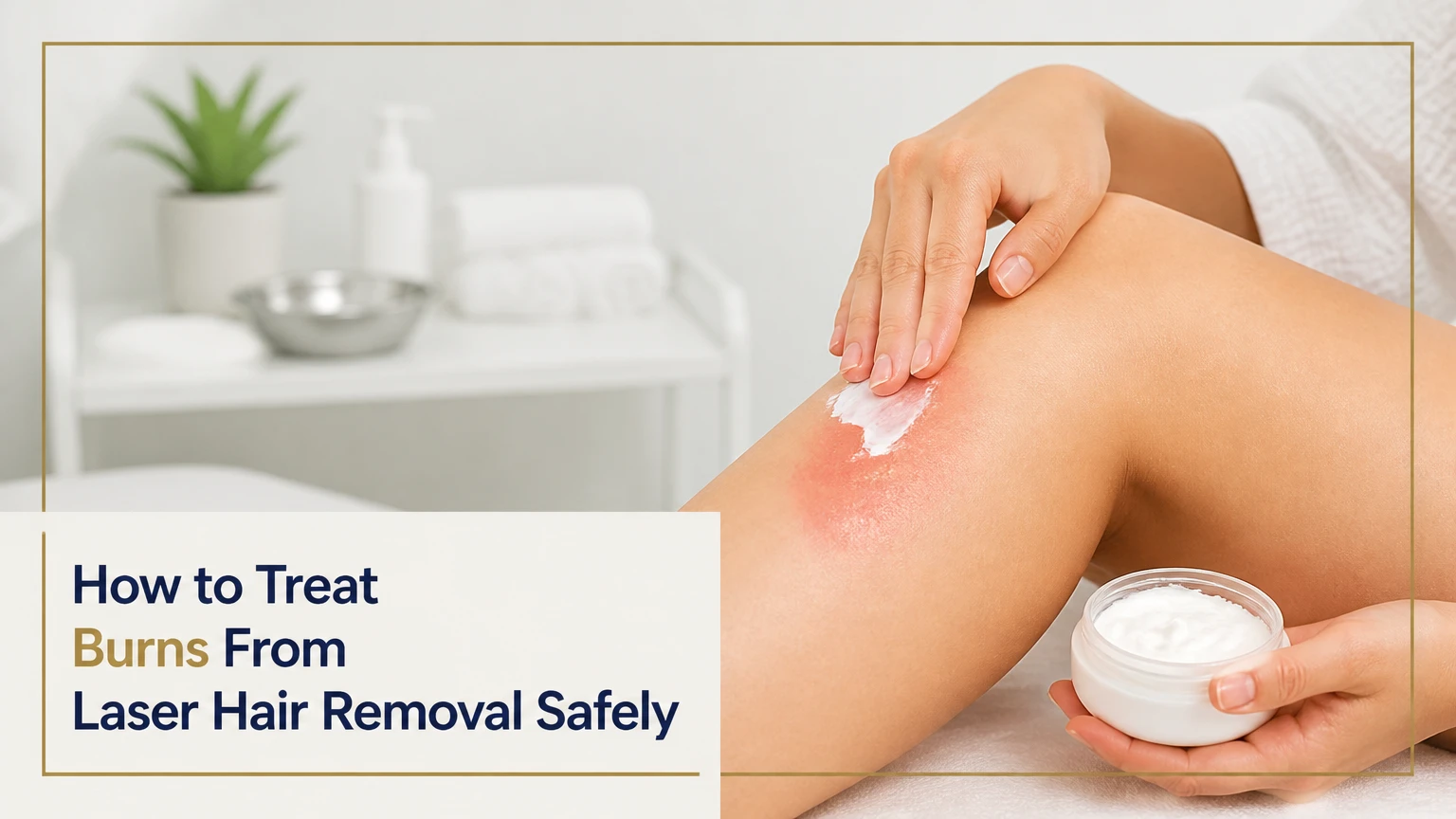
Laser hair removal burns should be cooled with clean, cool running water for 20 minutes, then protected with plain petroleum jelly and a non-stick dressing if the skin is intact or lightly raw. Blisters, open skin, severe pain, infection signs, eye-area injuries, and burns larger than the patient’s palm require prompt medical assessment.
Key Facts at a Glance
- Laser hair removal burns result from excess heat reaching surrounding epidermal or dermal tissue.
- Cool running water for 20 minutes is safer and better supported than ice or frozen gel packs.
- Plain petroleum jelly is suitable for a minor, closed superficial burn, but not as a substitute for medical care.
- Do not pop blisters, apply alcohol, scrub peeling skin, or put acids and retinoids on the area.
- A blistering, enlarging, intensely painful, infected, or slow-healing burn needs clinician review.
- Dark or pale marks can persist for weeks to months after the surface has healed.
What Causes a Laser Hair Removal Burn?
A laser hair removal burn occurs when absorbed light produces more heat than the skin can safely dissipate. Selective photothermolysis is designed to concentrate laser energy in melanin within the hair shaft and follicle; recently tanned skin, excessive fluence, poor cooling, or overlapping pulses can redirect more heat into the epidermis.
A laser setting that is appropriate for one person may injure another person with a different skin tone, tan level, hair density, medication history, or cooling response. Darker, coarse hair absorbs energy efficiently, while epidermal melanin also competes for that energy. Fitzpatrick skin types IV-VI therefore require careful wavelength selection, conservative parameter changes, and reliable cooling, although any skin tone can burn.
Typical causes include these treatment or patient factors:
| Risk factor | Mechanism | Typical warning sign | Corrective action |
|---|---|---|---|
| Recent tanning | More epidermal melanin absorbs laser light | Brown skin, uneven treatment response | Postpone treatment until untanned |
| Excessive fluence | Delivers more joules per square centimeter | Immediate sharp pain or whitening | Stop treatment and reassess settings |
| Overlapping pulses | Reheats the same tissue | Grid-like or patchy burns | Avoid repeat passes |
| Poor cooling | Limits heat removal | Burning sensation during pulses | Check cooling tip or spray |
| Photosensitizing medication | May increase reactivity | Unexpected redness or blistering | Review medicines before treatment |
| Dark coarse hair | Absorbs substantial energy | Strong follicular swelling or heat | Use individualized parameters |
The American Society for Dermatologic Surgery describes laser complications as dependent on device choice, settings, skin type, and operator technique. A normal endpoint can include temporary perifollicular redness and swelling, but blistering is not a routine endpoint.
How Can You Tell a Burn From Normal Irritation?
Normal post-treatment irritation usually appears as small red or swollen halos around follicles and improves within 24-48 hours. A laser burn is more likely when redness forms sharply defined patches, pain feels intense or escalating, skin becomes gray, white, brown, or unusually dark, or blisters and raw areas develop.
| Finding | More consistent with normal response | More consistent with a burn |
|---|---|---|
| Redness | Small follicle-centered spots | Solid patch or geometric pattern |
| Duration | Improves within 24-48 hours | Persists or expands after 48 hours |
| Sensation | Mild warmth or brief sting | Severe pain, throbbing, or burning |
| Blisters | Absent | Clear, cloudy, or blood-filled blisters |
| Surface | Intact skin | Erosion, weeping, peeling, or raw tissue |
| Color | Pink or red | White, gray, deep brown, or black areas |
| Function | Normal movement | Pain limiting movement or contact |
A superficial laser injury can initially resemble sunburn, so appearance alone is not always enough. Photograph the area in good light, record the treatment time and body site, and contact the treating clinic if symptoms intensify during the first several hours.
How to Treat Burns From Laser Hair Removal Immediately
Immediate care has four priorities: stop additional heat, cool the tissue, protect the surface, and identify features that need medical evaluation. Do not apply ice directly, rub the area, or continue a laser session over painful skin.
Step 1: Cool the Area
Hold the affected skin under cool or lukewarm running tap water for 20 minutes as soon as possible. The NHS first-aid instruction is direct: “Cool the burn with cool or lukewarm running water for 20 minutes.” If running water is impractical, place a clean, cool, wet cloth over the area and refresh it frequently.
Do not use ice, frozen packs, butter, toothpaste, essential oils, or alcohol. Extreme cold can further injure already stressed tissue, while greasy household substances can complicate examination and trap contaminants.
Success checkpoint: pain and heat should begin to settle during cooling, although redness may remain.
Common mistake: using a brief 2-minute rinse and then applying a hot towel or heating pad.
Step 2: Remove Irritating Items
Remove tight clothing, jewelry, adhesive patches, and fragranced products near the injury before swelling develops. Do not pull away fabric stuck to an open wound; cut around it and obtain medical help.
For a facial burn, keep products away from the eyes, lips, and nostrils. For a bikini-area burn, avoid internal genital tissue and seek professional advice if mucosal skin is involved.
Step 3: Protect Intact or Lightly Raw Skin
After cooling, gently pat the surrounding skin dry and apply a thin layer of plain white petrolatum to an intact superficial burn. Cover a raw area with a sterile, non-stick dressing, changing it daily or whenever wet or dirty.
Petrolatum reduces water loss and friction. It does not sterilize a wound, prevent every infection, or treat a deep burn. Avoid cotton wool directly on the surface because fibers can adhere to exposed tissue.
Step 4: Manage Pain Safely
Acetaminophen can reduce pain when used according to the package dose and personal medical guidance. Ibuprofen may reduce pain and inflammation for some adults, but people with kidney disease, stomach ulcers, anticoagulant use, NSAID allergy, pregnancy, or certain cardiovascular conditions should ask a clinician or pharmacist first.
Never place topical anesthetic products containing benzocaine or lidocaine on large, blistered, or open areas without medical advice. Numbing pain can conceal worsening tissue injury.
Which Products Are Safe for a Laser Burn?
Plain petroleum jelly and a sterile non-stick dressing are the most predictable over-the-counter options for a minor superficial injury. Aloe vera may soothe intact skin, but many commercial gels contain alcohol, fragrance, colorants, or preservatives that sting damaged skin and create contact dermatitis.
| Product | Suitable use | Avoid when | Typical cost |
|---|---|---|---|
| White petrolatum | Intact superficial burn, thin layer | Deep wound or suspected infection without assessment | $4-$12 |
| Non-stick dressing | Raw or blistered surface protection | Dressing sticks or causes increasing pain | $3-$15 |
| Fragrance-free cleanser | Gentle daily cleaning after cooling | Scrubbing or active exfoliation | $6-$15 |
| 1% hydrocortisone | Intact, itchy inflammation after advice | Open skin, blister base, face, genitals, prolonged use | $5-$12 |
| Aloe gel | Intact skin if alcohol-free and fragrance-free | Broken skin or botanical sensitivity | $6-$15 |
| Silicone gel or sheets | Closed skin with raised scar risk | Open, wet, infected, or crusted wounds | $15-$45 |
| Antibiotic ointment | Only when specifically advised | Routine prevention or known contact allergy | $7-$20 |
Topical antibiotics are not automatically better than petrolatum. Neomycin and bacitracin can cause allergic contact dermatitis, which may look like worsening redness or a spreading rash.
When Is Hydrocortisone Appropriate?
One-percent hydrocortisone can sometimes reduce itching and inflammation on intact skin, but it should not be applied to blisters, erosions, open wounds, infected areas, or the eyelids and genitals unless a clinician directs it. Hydrocortisone does not replace cooling, wound protection, or evaluation of a partial-thickness burn.
For a small, intact, itchy patch, a pharmacist or clinician may approve a thin layer once or twice daily for a short period. Stop if burning, rash, swelling, or worsening redness occurs. Avoid prolonged use because corticosteroids can thin skin and may worsen some infections.
A common error is treating every red laser reaction with steroid cream. Red follicular swelling that is improving needs gentle aftercare, while blistering requires wound assessment rather than stronger self-treatment.
How Should Blisters Be Managed?
Leave laser hair removal blisters intact and cover them with a sterile non-stick dressing. The blister roof protects the underlying tissue, and deliberate puncturing introduces bacteria and removes a natural barrier.
If a blister breaks by itself, wash gently with clean water, do not peel away attached skin, apply a non-stick dressing, and arrange medical advice if the area is large, painful, draining, or located near an eye, joint, or genital tissue. A clinician can decide whether drainage is needed under clean conditions.
| Blister feature | Recommended response | Reason |
|---|---|---|
| Tiny, intact, painless | Protect and monitor | Lower contamination risk |
| Multiple small blisters | Contact treating clinic or clinician | Indicates more than simple irritation |
| Large or tense blister | Same-day medical advice | May need controlled drainage |
| Broken blister | Clean and cover | Exposed tissue needs protection |
| Yellow drainage or odor | Prompt medical assessment | Possible infection |
| Blood-filled blister | Urgent clinical advice | May indicate deeper injury |
When Is Medical Care Necessary?
Seek urgent medical care for a laser burn involving the eye, eyelid, mouth, internal genital tissue, hands, feet, a major joint, or a large area. Same-day assessment is appropriate for extensive blistering, severe or increasing pain, white or black skin, numbness, spreading redness, pus, fever, foul odor, red streaks, or a burn larger than the patient’s palm.
People with diabetes, poor circulation, immune suppression, impaired sensation, or a history of difficult wound healing should obtain advice earlier. Children and older adults also warrant a lower threshold for evaluation.
Call emergency services for breathing difficulty, facial swelling, collapse, extensive burns, or suspected chemical exposure from a device product. Laser hair removal burns are usually superficial, but depth cannot be reliably diagnosed from a photograph or from pain intensity alone.
How Long Does Recovery Take?
A superficial laser burn commonly improves over 3-7 days, while a blistering partial-thickness injury may need 2-3 weeks for surface closure. Red, brown, or pale discoloration can remain for 2-6 months, and deeper pigment loss or scarring may last longer.
| Injury pattern | Surface recovery | Residual changes | Review point |
|---|---|---|---|
| Follicular irritation | 24-48 hours | Usually none | Contact clinic if worsening |
| Superficial burn | 3-7 days | Pink or brown color for days to weeks | Review if not improving by day 3 |
| Small blistering burn | 1-3 weeks | Pigment change for 2-6 months | Clinician advice recommended |
| Deep or infected injury | Variable, often over 3 weeks | Higher scar risk | Prompt medical assessment |
| Hypopigmented patch | Months to 12 months or more | May be incomplete | Dermatology review if persistent |
Healing time depends on depth, location, friction, UV exposure, infection, skin tone, and whether the burn is repeatedly irritated. Do not resume treatment simply because pain has stopped; the barrier may remain fragile after symptoms improve.
How Are Dark or Pale Marks Treated?
Sun protection is the first treatment for post-inflammatory hyperpigmentation after a laser burn. Once the surface has completely closed, use broad-spectrum SPF 30 or higher, cover the area with clothing when possible, and ask a dermatologist before adding azelaic acid, vitamin C, retinoids, kojic acid, peels, or pigment lasers.
Do not apply lightening agents to an open, peeling, or tender wound. Irritation can intensify pigment production, particularly in Fitzpatrick IV-VI skin. A dermatologist may prescribe azelaic acid, hydroquinone, or another treatment after confirming that the burn has healed and that the mark is not an infection or another pigment disorder.
Hypopigmentation appears lighter or white rather than brown. It may gradually repigment over many months, but permanent melanocyte injury is possible; camouflage and dermatology assessment may be appropriate if the contrast remains significant.
What Changes for Different Body Areas and Skin Tones?
Body location changes the risk from friction, moisture, sun exposure, and accidental product contact, but it does not change the need for cooling and triage. Darker skin has a greater risk of prolonged hyperpigmentation after inflammation, so preventing irritation and UV exposure matters especially after the wound closes.
| Situation | Main concern | Safe adjustment | Seek advice when |
|---|---|---|---|
| Face | Eye exposure and visible pigment change | Use no active products near eyes | Eyelid or eye pain occurs |
| Underarm | Friction and deodorant irritation | Stop deodorant until closed | Drainage or spreading redness appears |
| Bikini line | Moisture and rubbing | Wear loose clothing | Mucosal tissue is involved |
| Legs or arms | Sun and clothing friction | Cover and use sunscreen after closure | Area enlarges or blisters |
| Fitzpatrick IV-VI | Hyperpigmentation or hypopigmentation | Strict UV protection and gentle care | Color change persists or spreads |
| Home-device injury | Incorrect settings or repeated pulses | Stop device and document model | Blistering or severe pain develops |
Skin tone should influence laser parameters, not emergency thresholds. A blister on deeply pigmented skin deserves the same medical attention as a blister on lightly pigmented skin.
What Should You Avoid During Healing?
Avoid heat, friction, UV exposure, and active skincare until the surface is fully closed and comfortable. Hot showers, saunas, steam rooms, intense workouts, swimming pools, tight clothing, shaving, waxing, scrubs, retinoids, AHAs, BHAs, benzoyl peroxide, fragrance, and alcohol-based products can delay barrier recovery.
| Avoidance | Minimum practical interval | Why it matters |
|---|---|---|
| Sauna and steam | At least 48 hours, longer if tender | Heat increases inflammation |
| Intense exercise | 24-48 hours, longer with open skin | Sweat and friction irritate tissue |
| Swimming | Until all skin is closed | Water can contaminate open areas |
| Scrubs and acids | Until fully healed | Chemical and mechanical injury |
| Shaving or waxing | Until pain, peeling, and rawness end | Prevents friction and re-injury |
| Sun exposure | Strictly until healed, then SPF 30+ | Reduces pigment change |
Do not pick peeling skin. Do not use silicone products, makeup, or occlusive layers over a wet, infected, or open wound unless a clinician recommends them.
Common Mistakes and How to Fix Them
- Applying ice directly: Remove it, warm the area gradually, and use cool running water instead.
- Popping a blister: Stop manipulating it, cover it with a non-stick dressing, and seek advice if it is large or open.
- Using hydrocortisone on raw skin: Wash gently and stop the steroid until a clinician confirms appropriate use.
- Applying fragranced aloe or body lotion: Rinse away irritants and use plain petrolatum on intact skin.
- Scrubbing away dark or peeling areas: Leave the surface alone; mechanical trauma can deepen pigment change.
- Returning for another laser session too soon: Wait until the skin has fully recovered and the provider has reviewed the settings and cause.
The treating provider should document the device, wavelength, fluence, pulse duration, spot size, cooling method, body site, and exposure pattern. Those details help a dermatologist assess the injury and help the clinic prevent a repeat event.
When Can You Resume Hair Removal?
Resume laser hair removal only after the skin has completely closed, feels normal, and has no active redness, tenderness, blistering, scaling, or drainage. After a blistering burn or persistent pigment change, obtain clearance from a dermatologist or medically supervised laser provider before another session.
Do not wax or use an epilator over healing skin. Shaving is usually less traumatic, but wait until peeling and tenderness have stopped. The next session may require a different wavelength, lower fluence, larger cooling margin, test spot, longer interval, or postponement until tanning has faded.
A provider who dismisses blistering as an expected result without reviewing settings, cooling, and skin exposure is not providing adequate follow-up.
Typical Costs and Treatment Options
Basic care for a minor superficial burn commonly costs $10-$30 for petrolatum, dressings, and a gentle cleanser. A medical visit often costs approximately $75-$250 before insurance adjustments, while specialist care, prescription treatment, or pigment correction can cost substantially more.
| Care option | Typical price range | Best use | Main limitation |
|---|---|---|---|
| Home supplies | $10-$30 | Small intact superficial injury | Not suitable for deep burns |
| Primary care or urgent care | $75-$250 | Blisters, uncertain depth, infection concern | May refer to dermatology |
| Dermatology consultation | $150-$400 | Persistent pigment or scarring | Follow-up may add cost |
| Prescription treatment | $10-$100 | Selected inflammation or infection | Requires diagnosis |
| Scar or pigment procedure | $200-$600+ per session | Persistent marks after healing | May require several sessions |
These are typical United States self-pay ranges, not fixed prices. Insurance, location, facility type, and treatment complexity change the final amount.
Preventing a Repeat Injury
Preventing another laser hair removal burn requires postponing treatment after tanning, disclosing medicines and skin conditions, and confirming that the provider adjusts settings for skin tone, hair thickness, treatment area, and prior reaction. A test spot is particularly useful when changing devices, wavelengths, settings, or treating recently sensitive skin.
Before the next appointment, ask which wavelength and cooling method will be used, what fluence and pulse duration are planned, how the provider handles a prior burn, and which symptoms should trigger immediate contact. Avoid self-tanning products and significant sun exposure before treatment, and follow the device-specific interval recommended by the clinician.
Home IPL devices are not identical to professional lasers. Repeated passes, poor contact, dirty windows, unsuitable skin tone settings, and use over tattoos or dark moles can increase injury risk. Stop using the device after a burn and follow the manufacturer’s adverse-event instructions.
FAQ
Can I put Vaseline on a laser hair removal burn?
Plain petroleum jelly can protect a small, superficial burn after cooling, provided the skin is intact or only mildly raw and there are no infection signs. Apply a thin layer rather than a thick, heat-trapping coating. Do not use petroleum jelly to manage extensive blistering, deep tissue changes, or an untreated infected wound.
Is aloe vera better than petroleum jelly?
Aloe vera is not automatically better. An alcohol-free, fragrance-free gel may soothe intact irritated skin, but commercial formulas often contain ingredients that sting or cause dermatitis. Plain white petrolatum has fewer ingredients and is generally more predictable for a minor superficial burn.
Can laser hair removal burns leave scars?
Laser hair removal burns can scar when tissue damage is deep, healing is delayed, infection develops, or blisters are repeatedly traumatized. Most superficial reactions do not scar permanently. Prompt cooling, non-stick protection, blister preservation, infection monitoring, and strict sun protection reduce avoidable complications.
Should I contact the salon after a burn?
Yes. Contact the treating clinic promptly, especially if blistering, severe pain, raw skin, or color change occurs. Request the device and treatment parameters, document the injury with dated photographs, and seek independent medical care when symptoms are significant or the provider minimizes them.
Can I use sunscreen on a fresh burn?
Do not put sunscreen on open, blistered, wet, or actively peeling skin unless a clinician instructs you to do so. Cover the area with clean clothing or a dressing instead. After the surface closes and tolerates moisturizer, use broad-spectrum SPF 30 or higher and minimize direct sun exposure.
What is the bottom line for treating this injury?
Cool the area with running water for 20 minutes, protect the skin, leave blisters intact, and avoid heat and irritating products. Medical care is needed for blistering, open or discolored tissue, infection signs, sensitive locations, severe pain, or delayed healing. Do not schedule another laser session until recovery is complete.
The safest answer to how to treat burns from laser hair removal is immediate cooling followed by gentle protection and early triage. Minor redness often settles within 48 hours, but blistering, worsening pain, infection, or persistent pigment change deserves professional assessment rather than stronger home remedies.