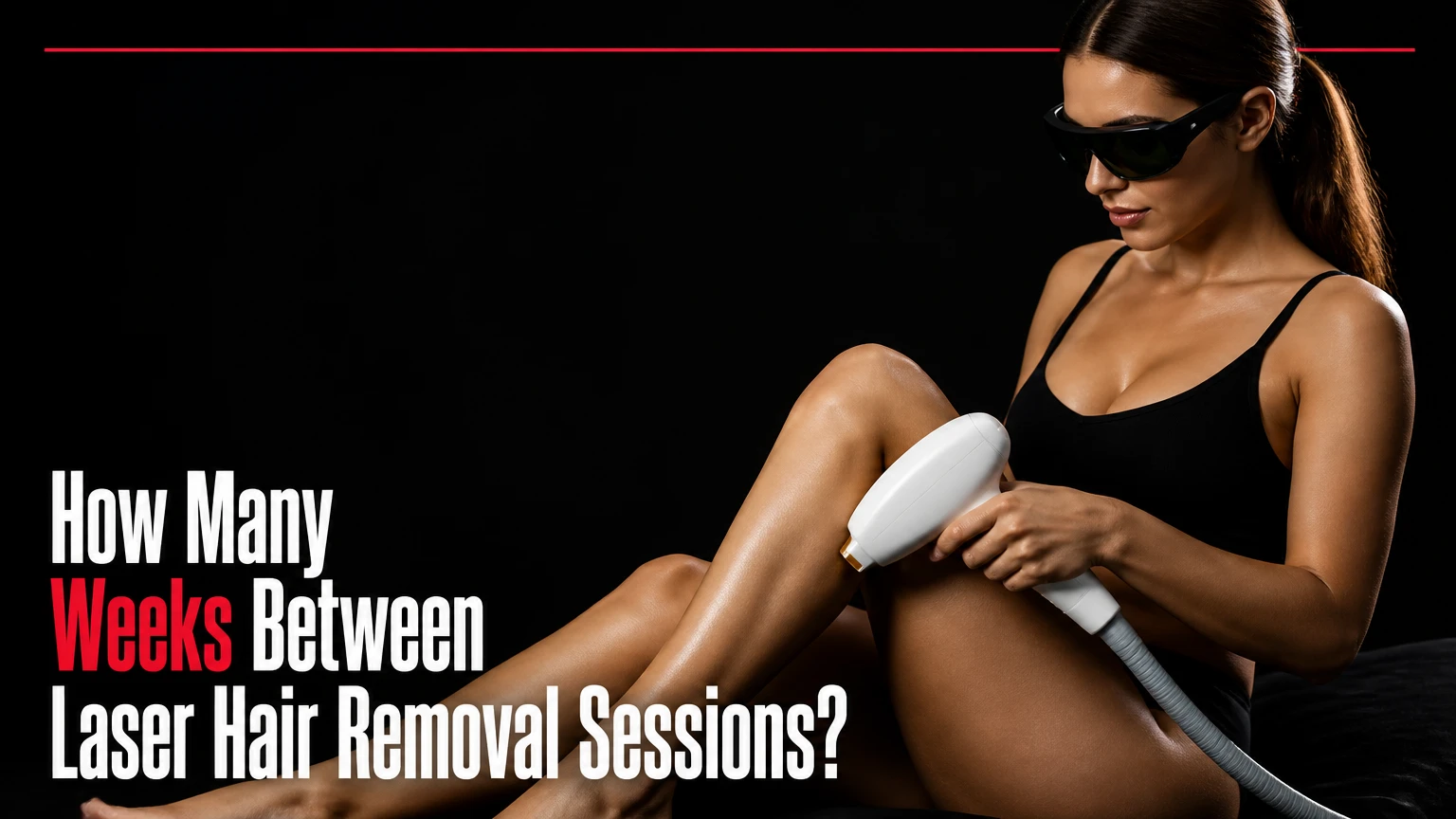
Laser hair removal sessions are typically scheduled 4-10 weeks apart, with facial treatments commonly at 4-6 weeks and leg treatments at 8-10 weeks. The correct interval depends on the treatment area, visible regrowth, hair-growth cycle, laser device, skin response, and hormonal factors, so a clinic should confirm the schedule after inspecting the skin and hair.
Key Facts at a Glance
Face: typically 4-6 weeks between professional laser hair removal sessions.
Underarms and bikini: typically 4-6 weeks, although some clinics use 6-8 weeks as regrowth slows.
Arms, chest, and back: typically 6-8 weeks.
Legs: typically 8-10 weeks because leg hair often cycles more slowly.
Laser targets pigmented hair in the active growth phase, not every follicle at once.
Shaving is usually acceptable between treatments; waxing, threading, and plucking can reduce the laser’s target.
How Many Weeks Between Laser Hair Removal Sessions?
Most people need 4-10 weeks between professional laser hair removal sessions. Book the next visit when a meaningful amount of new, coarse hair is visible, rather than treating on a fixed calendar date when the skin is still smooth and little target hair has returned.
The interval is a treatment window, not a universal prescription. A face may need an appointment after four weeks, while the legs may need ten weeks. A clinician may also lengthen later intervals when density and growth speed decrease.
Typical interval by treatment area
| Treatment area | Typical interval | Common initial course | Main scheduling signal |
|---|---|---|---|
| Upper lip and chin | 4-6 weeks | 8-12 sessions | New coarse hairs and hormonal regrowth |
| Underarms | 4-6 weeks | 6-8 sessions | Visible dark stubble or emerging hairs |
| Bikini line | 4-6 weeks | 6-8 sessions | Returning coarse hairs, not mild redness |
| Arms and torso | 6-8 weeks | 6-8 sessions | Sufficient new growth across the area |
| Full back and chest | 6-8 weeks | 6-10 sessions | Patchy or widespread active regrowth |
| Legs | 8-10 weeks | 6-8 sessions | Noticeable new growth after shedding |
These are typical professional ranges, not device instructions. The American Academy of Dermatology Association describes laser treatment as reducing unwanted hair and notes that patients often need multiple treatments because hair grows in cycles. The term permanent hair reduction is more accurate than permanent removal: some follicles may later produce hair because of hormonal change, incomplete follicular injury, or previously inactive follicles.
Why Does Laser Hair Removal Require Waiting?
Laser hair removal requires waiting because laser energy works best when a hair is attached to an active follicle in the anagen, or growth, phase. Hairs in catagen and telogen are less suitable targets, so treating too soon can expose skin without effectively reaching many new follicles.
Hair cycles overlap rather than moving together. The commonly quoted estimate that about 15%-20% of hairs are actively growing at a given time is a useful teaching approximation, but the percentage varies by body site, individual biology, medication, hormones, and hair density.
| Hair-cycle phase | What happens in the follicle | Laser relevance | Scheduling implication |
|---|---|---|---|
| Anagen | Hair shaft remains connected to the follicle | Best target for pigment-based heating | Treat when new anagen hairs emerge |
| Catagen | Follicle shrinks and detaches from the shaft | Reduced targeting potential | Waiting improves future coverage |
| Telogen | Follicle rests before a new shaft develops | Little useful exposed pigment | A calendar-only schedule can miss it |
| Early regrowth | New hair becomes visible at the surface | Indicates more targets may be available | Provider may approve the next session |
A common practitioner rule is to judge the next appointment by regrowth density, not by the date alone. The rule matters because an early session cannot force resting follicles into anagen, while an excessively late session usually does not erase prior progress, but may prolong the overall course.
What Is the Schedule for Each Body Area?
Facial areas usually require the shortest interval, while legs generally require the longest. Underarms and bikini hair often return earlier because the hair is coarse and visibly pigmented, but the correct appointment date still depends on how much untreated growth has appeared.
Face: 4-6 weeks
Upper-lip, chin, jawline, and sideburn treatments are commonly spaced four to six weeks apart. Facial hair can respond quickly, but chin and jawline hair may be strongly influenced by androgens, polycystic ovary syndrome, menopause, or medication.
Facial laser treatment deserves closer monitoring than leg treatment because fine surrounding hair can be less responsive and, rarely, may become more noticeable after exposure. A clinician should reassess settings and diagnosis if fine hair spreads beyond the original area.
Underarms and bikini: 4-6 weeks
Underarm and bikini sessions are commonly scheduled every four to six weeks during the early course. Coarse, dark hair usually provides a strong pigment target, although skin exposed to deodorant irritation, friction, self-tanner, or recent sun should not be treated until safe.
Some providers extend these areas to six or eight weeks after several successful sessions. Less hair does not automatically mean treatment has failed; it often means the interval should be adjusted to the slower regrowth pattern.
Arms, chest, and back: 6-8 weeks
Arms, chest, shoulders, and back usually need six to eight weeks between visits. Torso hair varies widely in density and may respond unevenly because follicles are distributed across a large area and may enter growth phases at different times.
Chest and back treatment also require careful assessment for fine hair. Applying low settings broadly to fine, lightly pigmented hair may produce little benefit and can increase the risk of paradoxical hypertrichosis in susceptible areas.
Legs: 8-10 weeks
Leg sessions commonly occur eight to ten weeks apart. Leg hair often grows more slowly, so treating at four-week intervals may capture little new target hair and add cost without adding equivalent benefit.
The visible timeline can be misleading. Hair that appears one to three weeks after treatment may be shedding from treated follicles rather than growing from new follicles.
How Many Sessions Are Usually Needed?
A typical initial course involves six to twelve professional sessions, with facial and hormonally affected areas often requiring more visits than the legs or underarms. Session count depends on hair pigment, thickness, skin tone, device selection, energy settings, hormones, and how consistently appointments are timed.
| Area or situation | Typical sessions | Typical maintenance | Main reason for variation |
|---|---|---|---|
| Underarms | 6-8 | Every 6-12 months if needed | Coarse pigment often responds well |
| Bikini line | 6-8 | Every 6-12 months if needed | Hormonal and friction-related regrowth |
| Legs | 6-8 | Occasional annual treatment | Slower growth and broad area |
| Face without known hormonal disorder | 8-10 | Every 3-6 months if needed | Shorter cycle and fine-hair variation |
| PCOS-related facial hair | 8-12 or more | Often more frequent | Ongoing androgen-driven follicle activation |
| Light, gray, or red hair | Variable, often poor response | Not predictable | Insufficient melanin for selective absorption |
Laser hair removal does not treat every future follicle in one course. Hormonal changes, pregnancy-related shifts, stopping hormonal contraception, or certain medications can activate growth later, which explains why maintenance visits may be appropriate even after a strong initial reduction.
Can You Have Laser Hair Removal Every Two or Three Weeks?
Most people should not schedule professional laser hair removal every two or three weeks for the same area. A two-week interval usually catches shedding or resting hairs rather than a substantially new population of active-growth follicles, so it can waste sessions and increase cumulative skin irritation.
An exception may occur when a qualified provider uses a specific protocol for a particular device or small area, but a clinic’s protocol should not be replaced with a generic internet timetable. Treating sooner is not a shortcut to faster permanent reduction.
What indicates that an appointment may be too early?
| Observation before the proposed visit | Likely meaning | Better action |
|---|---|---|
| Skin is smooth with minimal new hair | Too few new targets | Ask whether the appointment can move later |
| Only loose hairs are shedding | Post-treatment shedding | Wait and avoid aggressive exfoliation |
| Redness, crusting, or blistering remains | Skin has not fully recovered | Do not treat; obtain medical review |
| Dense dark regrowth is visible | More targets may be present | Contact the provider for confirmation |
| Hair is finer and lighter | Reduced laser target quality | Reassess settings and expected benefit |
Which Laser or IPL Schedule Should You Follow?
The treatment schedule should follow the device manufacturer’s protocol and the provider’s assessment, not the wavelength label alone. Alexandrite, diode, and Nd:YAG lasers can all be used in professional hair reduction, while IPL uses a broad spectrum of light and is not technically a laser.
| Technology | Nominal wavelength or light type | Common suitability | Important limitation | Typical interval |
|---|---|---|---|---|
| Alexandrite | 755 nm | Light to medium skin with dark hair | Higher epidermal-melanin risk after tanning or on deep skin | 4-10 weeks by area |
| Diode | About diode 800-810 nm | Broad range of light to medium-dark skin | Requires careful fluence and cooling calibration | 4-10 weeks by area |
| Nd:YAG | 1064 nm | Medium-dark to deep skin tones | Less efficient for fine or lightly pigmented hair | 6-10 weeks by area |
| IPL | Broad filtered spectrum, not one wavelength | Fair skin with dark hair | Greater mismatch risk with tanning and light hair | Follow device protocol |
The wavelength does not remove the need for a patch test, sun-exposure review, and correct fluence. Nd:YAG is often selected for darker skin because its longer wavelength has lower absorption by epidermal melanin, but “safest” does not mean risk-free, and operator skill remains decisive.
At-home IPL devices are a separate category. Their instructions may recommend weekly or biweekly early use because the energy, optical design, and treatment protocol differ from those of clinic lasers; consumers should never transfer a home IPL schedule to professional laser treatment.
How Should Skin Tone and Hair Color Change the Plan?
Dark, coarse hair usually responds best because melanin absorbs the laser’s optical energy, while blonde, gray, white, and many red hairs provide less of the pigment needed for selective heating. Skin tone affects device choice and burn risk because the epidermis also contains melanin.
| Skin and hair combination | Expected response | Main safety concern | Sensible discussion |
|---|---|---|---|
| Fair skin, dark coarse hair | Usually favorable | Temporary redness or pigment change | Compare alexandrite and diode options |
| Olive skin, dark hair | Often favorable with calibration | Post-inflammatory hyperpigmentation | Ask about cooling and test spots |
| Deep skin, dark hair | Possible with appropriate settings | Burns or pigment alteration | Seek an experienced Nd:YAG provider |
| Fair skin, blonde hair | Limited and inconsistent | Overtreatment without benefit | Discuss electrolysis or realistic reduction |
| Any skin tone, gray or white hair | Usually poor laser target | Repeated ineffective sessions | Electrolysis may be more suitable |
| Recently tanned skin, any hair color | Treatment may be postponed | Increased epidermal heating | Wait until the tan fades according to provider guidance |
Electrolysis uses electrical energy delivered into individual follicles and can work on hair colors that lasers cannot target, but it is slower for large areas. Laser is generally more efficient for extensive dark hair, while electrolysis may be better for a small number of light hairs.
What Should You Do Before and Between Sessions?
Shave the treatment area when instructed, usually one day before treatment, and avoid removing the hair from its root between sessions. The follicle must retain a target structure for laser energy to reach it, while a long surface hair can increase odor, discomfort, and superficial heating.
| Timing | Action | Typical instruction | Avoid |
|---|---|---|---|
| 2-4 weeks before | Stop root-removal methods | Avoid waxing, threading, epilating, and plucking | Removing the follicular target |
| Several days before | Report medication and skin changes | Tell the provider about photosensitizing drugs or active rash | Hiding a new reaction |
| 12-24 hours before | Shave if directed | Leave the skin clean and free of cuts | Waxing or applying self-tanner |
| Treatment day | Clean the area | Remove deodorant, oils, lotion, and makeup from the site | Treating over unreported irritation |
| Between visits | Shave or trim only | Use a clean razor without scraping the skin | Plucking, threading, or waxing |
| After treatment | Protect the skin | Follow provider aftercare and use broad-spectrum sunscreen | Heat, tanning, and friction while irritated |
Cleveland Clinic describes laser hair removal as a procedure that “uses a concentrated beam of light to remove unwanted hair.” The phrase explains why pigment, follicle access, and skin protection matter more than simply treating as often as possible.
What Happens After a Laser Session?
Mild redness, swelling around follicles, and a warm or prickling sensation can occur immediately after laser hair removal. Treated hairs commonly shed over approximately one to three weeks, so apparent hair growth during that period does not automatically mean new growth or treatment failure.
Do not pull out shedding hairs with tweezers. Gentle washing is usually sufficient, while exfoliation should wait until the skin is calm and should follow the treating clinic’s instructions. Avoid tanning, hot tubs, saunas, and vigorous friction for the period specified by the provider.
When is a reaction abnormal?
Contact the provider promptly about blistering, severe pain, spreading swelling, marked color change, pus, or crusting that persists or worsens. Burns and pigment changes require assessment rather than stronger treatment at the next appointment.
What If You Miss an Appointment?
Missing a laser hair removal appointment usually does not reverse previous progress. Reschedule rather than doubling up, and do not book an unusually early replacement simply to restore the original calendar.
| Situation | Recommended response | Why |
|---|---|---|
| Appointment delayed by 1-2 weeks | Attend when the provider confirms regrowth | More active targets may be available |
| Several months missed | Request a new assessment | Growth pattern and settings may have changed |
| No visible regrowth | Ask whether to wait longer | The area may not yet contain enough targets |
| Tanned before the visit | Tell the clinic before attending | Treatment may need postponement for safety |
| Waxed or plucked recently | Disclose the date | The next session may be less effective |
| Skin reacted after the last visit | Obtain clearance first | Repeating treatment can worsen injury |
Scheduling mistakes are usually less damaging than treating over recently tanned or injured skin. A delayed session costs time; an avoidable burn can create weeks or months of pigment problems.
Why Is Hair Still Growing After Several Sessions?
Hair can still appear after several laser sessions because untreated follicles may be entering anagen, treated hairs may be shedding, settings may be inadequate, or hormonal signals may be activating new facial growth. Hair reduction is gradual, and early improvement often appears as slower growth, lower density, and finer shafts rather than complete smoothness.
Ask the provider to compare standardized photographs, hair density, shaft thickness, and regrowth speed. A simple impression based on shaving frequency can miss meaningful reduction.
Common failure modes and fixes
- Appointments are too close together.
Move from a fixed four-week schedule to the area’s actual regrowth pattern. A leg appointment may need eight to ten weeks. - Waxing or plucking continues between visits.
Stop root removal and shave instead. The next session may be less productive because fewer follicles contain a reachable hair target. - Hair is too light for the device.
Stop purchasing repeated sessions without a candidacy review. Electrolysis may provide a more appropriate route for gray, white, or very light hair. - Facial hair worsens around the treated area.
Ask for an assessment of paradoxical hypertrichosis, especially when fine hair was treated at low settings. The solution may involve stopping that area, changing the treatment plan, or considering electrolysis. - PCOS or another hormonal driver is untreated.
Discuss irregular periods, acne, sudden facial hair, scalp hair loss, or rapid progression with a qualified clinician. Shortening every appointment to four weeks cannot correct ongoing androgen stimulation. - Settings are changed without regard to skin tone.
Request a patch test and documented parameters. Higher energy is not automatically better when epidermal melanin or recent tanning raises the injury risk.
How Much Does a Full Course Cost?
Professional laser hair removal commonly costs about $30-$300 per session, depending on treatment area, location, clinic type, and whether a package is purchased. Small areas such as the upper lip or underarms cost less than full legs, chest, or back, while consultation fees and maintenance visits can increase the total.
| Area size | Typical single-session range | Typical course length | Possible course total |
|---|---|---|---|
| Small, lip or chin | $30-$80 | 8-12 sessions | $240-$960 |
| Small, underarms | $50-$150 | 6-8 sessions | $300-$1,200 |
| Medium, bikini or arms | $70-$200 | 6-10 sessions | $420-$2,000 |
| Large, full legs | $150-$400 | 6-8 sessions | $900-$3,200 |
| Large, back or chest | $150-$400 | 6-10 sessions | $900-$4,000 |
These are broad typical planning ranges rather than a universal price list. Ask whether the quote includes consultation, patch testing, aftercare, touch-ups, taxes, and treatment of the full requested area rather than only a limited zone.
When Should You Delay the Next Session?
Delay laser hair removal when the area is recently tanned, sunburned, irritated, infected, wounded, blistered, or still showing a significant reaction from the previous session. Pregnancy, medication changes, active skin disease, and photosensitizing drugs also warrant a provider review before treatment.
A safe interval cannot compensate for unsafe skin conditions. Tell the clinic about isotretinoin history, antibiotics, topical retinoids, recent chemical peels, tattoos near the area, herpes outbreaks, and any new medication, because policies differ and medical risk assessment is individualized.
A practical readiness checklist
- The skin has returned to its normal color and texture.
- No blister, open sore, active rash, or worsening crust remains.
- No recent tanning or sunburn affects the treatment area.
- Enough new target hair has returned for the provider to assess.
- Waxing, threading, and plucking have stopped.
- The clinic has reviewed medications and relevant hormonal symptoms.
How Do You Choose the Next Appointment Date?
Choose the next laser hair removal date by combining the usual body-area interval with visible new growth and complete skin recovery. Use four weeks as a common lower boundary for facial and bikini areas, and eight to ten weeks as a common leg interval, unless the treating clinician gives a different protocol.
A useful planning method is to photograph the area under similar lighting before each session. Record the appointment date, shaving date, shedding period, regrowth onset, skin reaction, and any tanning or medication change. Those observations help a trained provider distinguish insufficient interval from ineffective settings.
Laser hair removal scheduling is a feedback process. The best calendar is the one that captures new active-growth hairs while protecting the skin, not the one with the greatest number of appointments.
Frequently Asked Questions
Can I shave between laser hair removal sessions?
Yes, shaving is generally the preferred way to manage visible hair between professional laser sessions because shaving cuts the shaft without removing the follicle. Use a clean razor and avoid scraping irritated skin. Follow the clinic’s timing instructions before treatment, since some providers request shaving 12-24 hours beforehand.
Is six weeks between laser sessions always correct?
No. Six weeks is a common midpoint, not a universal rule. Facial, underarm, and bikini treatments may occur at four to six weeks, while legs often need eight to ten weeks. The provider should also consider regrowth density, skin recovery, device protocol, hair color, and hormonal influences.
Can I get laser hair removal if I am pregnant?
Many clinics postpone elective laser hair removal during pregnancy because safety data are limited and hormonal changes can alter hair growth and skin sensitivity. Contact the treating clinician and obstetric provider before continuing. Do not resume automatically after delivery if pigmentation or hair growth has changed substantially.
Why did laser hair removal stop working on one area?
A stalled response may result from lighter or finer hair, incorrect settings, tanning-related energy limits, poor interval timing, hormonal activation, or a device that is unsuitable for the hair and skin combination. Request a review of photographs, settings, hair thickness, and medical factors before buying more sessions.
Does laser hair removal permanently remove hair?
Laser hair removal usually provides long-term reduction rather than guaranteed removal of every hair. The FDA uses the term permanent hair reduction for a stable reduction in regrowing hairs measured after a treatment course. Maintenance treatments may be needed when hormones, age, medication, or previously inactive follicles change growth.
Is IPL faster than professional laser hair removal?
IPL is not automatically faster or more effective than professional laser treatment. IPL emits a broad spectrum of light, while a laser uses a specific wavelength, and home devices use lower-energy protocols than many clinic systems. Compare the device, skin-tone restrictions, hair pigment, treatment schedule, and expected maintenance rather than the label alone.
The Bottom Line
The answer to how many weeks between laser hair removal sessions is usually 4-10 weeks: four to six weeks for the face, underarms, and bikini area; six to eight weeks for the torso and arms; and eight to ten weeks for the legs. Use visible regrowth and fully healed skin to refine the date, continue shaving rather than waxing, and obtain professional guidance when hormones, tanning, dark skin, light hair, or an unusual reaction changes the risk profile.