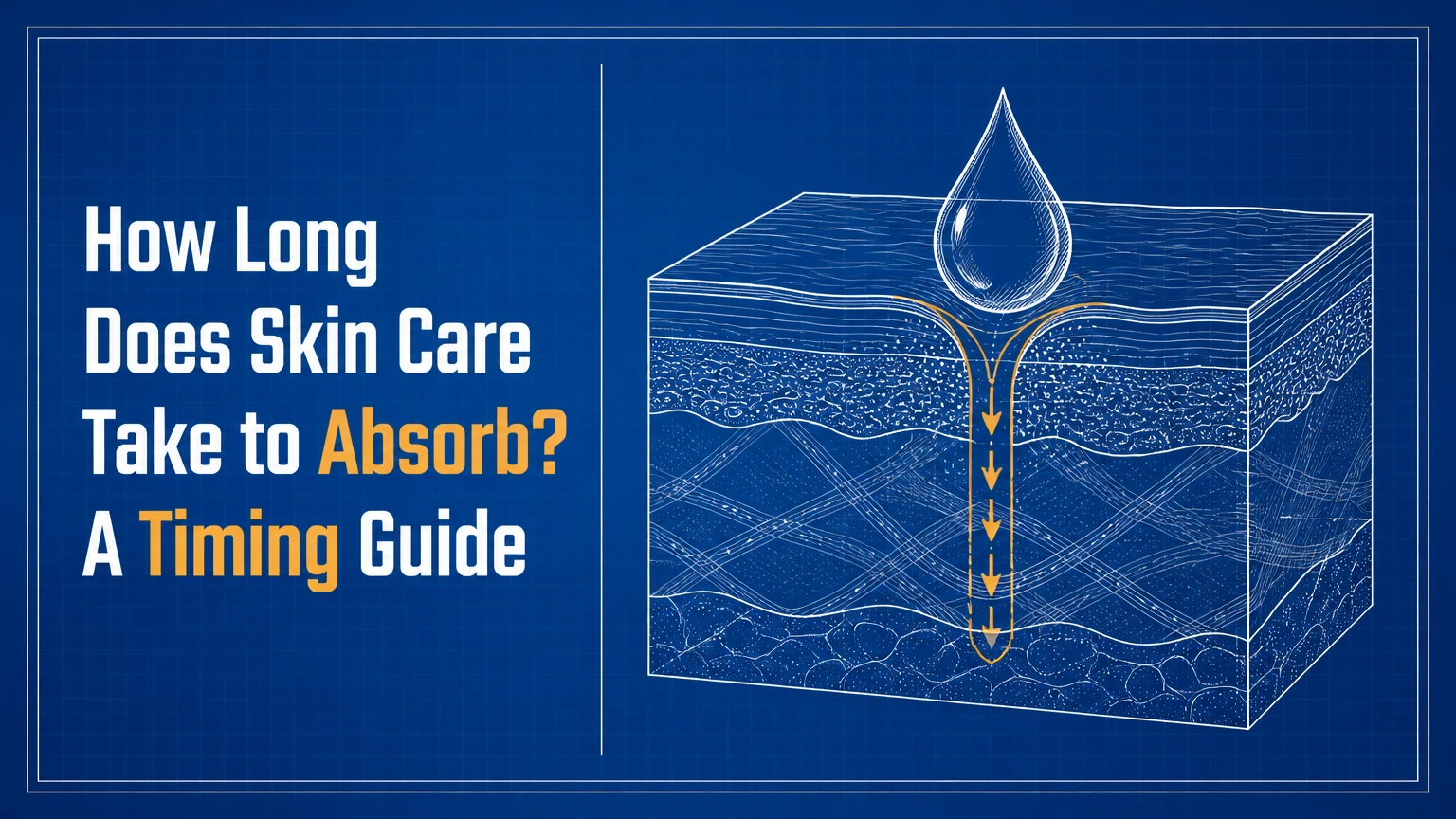
Most leave-on skin care products take about 30-60 seconds to settle enough for the next layer, while a full routine usually takes 5-10 minutes. Skin care does not “fully absorb” on one universal schedule: water evaporates quickly, some ingredients remain in a surface film, and active molecules may continue interacting with skin for hours.
Key Facts at a Glance
- A 30-60 second wait is usually enough between compatible leave-on skin care layers.
- Cleanser does not need absorption time because it is rinsed from the skin.
- Moisturizer may feel settled after 2-5 minutes, especially when applied generously or over damp skin.
- Sunscreen does not need to disappear into the skin to protect it; it needs an even, undisturbed film.
- Retinoids and exfoliating acids often cause less irritation on fully dry skin.
- Pilling usually reflects excess product, rubbing, or formula incompatibility rather than slow absorption.
What Does “Absorbed” Mean in Skin Care?
Skin care absorption has three separate meanings: the product feels dry, ingredients enter the outer skin, and ingredients reach their intended biological target. Those events do not occur at the same speed, so a serum that feels dry after 45 seconds may still be interacting with the stratum corneum, the outermost skin layer.
A product’s vehicle controls much of its behavior. Water-based gels lose water quickly, humectants retain water at the surface, silicones create a smooth film, and oils spread through the outer lipid-rich layer rather than vanishing completely. Occlusive ingredients are supposed to remain partly on the surface because that film reduces water loss.
The practical question is therefore not “Has every molecule disappeared?” A better question is, “Has the product settled enough that the next layer will not dilute, move, or pill it?”
Does skin absorb skin care in 30-60 seconds?
Skin can accept a thin, well-spread layer within 30-60 seconds, but 30-60 seconds is not a scientifically fixed deadline for complete ingredient penetration. The interval is a useful application rule because most lightweight formulas have stopped feeling wet, while longer waits rarely improve results when products are compatible.
Ingredient penetration depends on molecular size, concentration, pH, solvent system, skin hydration, temperature, application area, and barrier condition. A damaged barrier can increase penetration of irritating compounds while reducing comfort, so “faster absorption” is not automatically better.
A practical checkpoint is tactile rather than chronological: the layer should feel settled, not wet or mobile. Slight tackiness is acceptable for hydrating products. A glossy, slippery film indicates that more time or less product may be needed.
How Long Does Each Skin Care Step Take?
The following ranges describe typical facial application timing for thin layers used at home. They indicate when a person can normally continue, not the moment when every ingredient has completed its action.
| Product step | Typical wait before next layer | Typical amount | Main reason for the interval |
|---|---|---|---|
| Cleanser | 0 seconds after rinsing | 1-2 pumps or nickel-sized amount | Remove residue without leaving surfactants on skin |
| Toner or essence | 15-30 seconds | 3-5 drops or a teaspoon spread over face | Let excess water settle |
| Water-based serum | 30-60 seconds | 2-3 drops or pea-sized amount | Reduce dilution and rolling |
| Retinoid or exfoliating acid | 5-10 minutes on sensitive skin | Product-label amount | Lower sting on dry skin |
| Moisturizer | 2-5 minutes before makeup | Pea to nickel-sized amount | Allow the film to set |
| Facial oil | 2-5 minutes | 1-3 drops | Reduce transfer and shine |
| Sunscreen | Apply 15 minutes before outdoor exposure when possible | Two-finger amount for face and neck | Protect an even film from rubbing and sweat |
What is the practical wait time between layers?
Wait 30-60 seconds between most lightweight products and continue when the previous layer is no longer visibly wet. Add two to five minutes after a rich moisturizer or facial oil, but do not impose a 15-minute wait after every step unless a product label or clinician specifically requires it.
Apply small amounts and spread them across the entire treatment area. A thin film settles faster than a large drop concentrated on the cheeks or forehead. Pressing gently can distribute the formula, whereas repeated rubbing can reactivate the wet layer and create pilling.
A fast routine can use a simple sequence: cleanse, apply one hydrating or treatment layer, moisturize, then apply sunscreen in the morning. Multiple toners, essences, serums, and oils increase surface load and often create more delay than benefit.
Does product quantity change absorption time?
Product quantity changes settling time more than it changes the intended dose. Applying twice as much serum can leave a wet or sticky film for several minutes, while using too little sunscreen creates an uneven protective layer even if the product feels dry immediately.
| Product | Typical facial amount | If too much is used | If too little is used |
|---|---|---|---|
| Cleanser | 1-2 pumps | Tightness or residue after rinsing | Incomplete removal of sunscreen or makeup |
| Serum | 2-3 drops | Stickiness, rolling, prolonged wetness | Uneven treatment coverage |
| Moisturizer | Pea to nickel-sized | Grease, transfer, longer setting time | Persistent tightness or dry patches |
| Eye cream | Half a pea for both eyes | Migration into eyes, milia-like bumps | Missed orbital area |
| Sunscreen | Two finger lengths for face and neck | Shine, rubbing, pilling | Lower real-world protection |
The two-finger sunscreen measure is a consumer rule of thumb, not a universal laboratory unit for every face size. A larger face, ears, exposed neck, or hairline requires additional product.
Should Active Ingredients Go on Damp Skin?
Hydrating ingredients such as glycerin, hyaluronic acid, and many essences can be applied to slightly damp skin, while retinoids and strong exfoliating acids are usually better tolerated on dry skin. Dampness can increase spread and potentially increase delivery, which may also increase stinging.
Retinol and prescription retinoids
Apply retinol, adapalene, or tretinoin to clean, completely dry skin if irritation is a concern. After cleansing, wait until the face feels dry, commonly 5-10 minutes, then use a pea-sized amount for the entire face unless the prescriber gives different instructions.
The “sandwich” method can reduce irritation: apply a thin moisturizer layer, let it settle, apply the retinoid, then add moisturizer if needed. This approach may slightly reduce immediate intensity, but tolerability often matters more than maximum delivery because consistent use determines long-term results.
Avoid applying retinoids to eyelids, corners of the nose, and lip corners unless a clinician specifically directs it. These areas have thinner or more reactive skin.
Vitamin C and exfoliating acids
L-ascorbic acid serums are commonly formulated at low pH, often around pH 2.5-3.5, but the label and formulation determine use. Apply a thin layer to dry or slightly damp skin according to the manufacturer’s directions, and stop if burning persists rather than extending the waiting period.
Glycolic, lactic, salicylic, and polyhydroxy acids differ in strength and irritation potential. Do not combine several strong exfoliating products merely because each layer has “absorbed.” Irritation can emerge hours later through cumulative barrier stress.
Hydrating serums
Humectant serums work well on slightly damp skin because water supports their surface hydration effect. Seal them with moisturizer, particularly in dry indoor air, because a humectant layer without an adequate emollient or occlusive layer may leave skin feeling tight.
Why Does Moisturizer Take Longer to Feel Absorbed?
Moisturizer often feels slower because emulsions contain water, oils, fatty alcohols, polymers, and occlusives that remain as a protective film. A moisturizer that leaves a slight sheen after five minutes is not necessarily failing to absorb; the sheen may be the intended barrier function.
| Moisturizer texture | Typical settling time | Common finish | More suitable situation |
|---|---|---|---|
| Water gel | 30-90 seconds | Low-shine, slightly tacky | Oily skin or humid weather |
| Gel cream | 1-3 minutes | Soft satin | Combination skin |
| Lotion | 2-4 minutes | Light sheen | Normal or mildly dry skin |
| Cream | 3-5 minutes | Noticeable sheen | Dry skin or cold weather |
| Balm or ointment | 5-10 minutes | Occlusive shine | Localized fissures or severe dryness |
Use less moisturizer on areas that become oily and more on dry zones. If the face remains greasy after 10 minutes, first reduce the amount by 25-50 percent, then reassess the formula before adding longer waits.
An important practitioner rule is that “absorbed” does not mean “invisible.” A barrier cream should leave some material behind. Removing every visible trace is the wrong target for dry or eczema-prone skin.
How Long Should Sunscreen Sit Before Going Outside?
Apply sunscreen about 15 minutes before outdoor exposure when practical, but sunscreen does not need to absorb completely before it protects. Organic UV filters work within a continuous product film, and mineral filters such as zinc oxide and titanium dioxide also protect while present on the skin surface.
The FDA advises using broad-spectrum sunscreen with SPF 15 or higher as directed, while the American Academy of Dermatology recommends broad-spectrum SPF 30 or higher for routine protection. A sunscreen’s labeled SPF assumes a standardized application amount, approximately 2 milligrams per square centimeter in testing, which is far more product than many people casually apply.
| Sunscreen situation | Recommended action | Reapplication or timing |
|---|---|---|
| Daily commute | Use broad-spectrum SPF 30 or higher | Reapply after prolonged outdoor exposure |
| Beach or pool | Use water-resistant sunscreen as labeled | Reapply at least every 2 hours and after swimming or sweating |
| Makeup application | Let moisturizer settle 2-5 minutes, then apply SPF | Allow the sunscreen film to set before makeup |
| Physical outdoor work | Cover exposed skin and use SPF 30 or higher | Reapply at least every 2 hours |
| Short winter exposure | Apply to exposed face, ears, and neck | UV exposure still occurs through clouds |
The American Academy of Dermatology’s public guidance uses a memorable rule: “The best sunscreen is the one you will use again and again.” The practical implication is important: a comfortable sunscreen applied in the labeled amount is more useful than a theoretically ideal product that causes pilling and gets skipped.
Do not mix sunscreen into moisturizer or foundation. Mixing changes the tested concentration and can produce an uneven film.
When Can Makeup Go Over Skin Care?
Makeup can usually go over moisturizer after 2-5 minutes, once the surface no longer feels wet or slides under light fingertip pressure. Sunscreen should be the final skin care layer, and makeup should be pressed or lightly spread over it rather than aggressively massaged.
| Surface checkpoint | Interpretation | Next action |
|---|---|---|
| Wet and slippery | Product has not settled | Wait 1-3 minutes |
| Slightly tacky | Hydrating layer remains workable | Apply the next thin layer |
| Smooth with mild sheen | Moisturizer or sunscreen film is set | Apply makeup gently |
| Flaking or rolling | Pilling or excess product | Remove loose balls, reduce layers |
| Tight and patchy | Insufficient moisturization or irritation | Stop adding actives and reassess |
Primer is optional. If sunscreen pills under makeup, simplify the routine before buying another product: use fewer layers, reduce moisturizer, wait longer, and avoid rubbing.
Why Does Skin Care Pill Instead of Absorbing?
Skin care pills when polymers and films roll into visible particles during rubbing, usually because the layers are too thick, partially dried, or chemically incompatible. Silicone ingredients ending in forms such as “-cone” can contribute, but silicone itself is not automatically the cause.
Pilling can also result from carbomer gels, acrylate polymers, high-molecular-weight hyaluronic acid, sunscreen film formers, and friction from brushes or fingers. The formula pair matters more than whether one product is labeled water-based or silicone-based.
How can you stop pilling?
Use this troubleshooting sequence:
- Cut each leave-on product to the label amount or reduce nonessential layers.
- Allow 30-60 seconds between lightweight layers.
- Press or pat instead of repeatedly rubbing.
- Apply moisturizer before sunscreen and sunscreen before makeup.
- Test incompatible combinations on one cheek before changing the entire routine.
- Replace one product at a time if pilling persists.
A product that pills alone may have been applied too heavily. A product that never pills alone but pills over another layer indicates a film interaction or excessive friction.
Do Skin Type and Climate Change Absorption Time?
Skin type and climate change how products feel and settle, but they do not create a reliable biological absorption ranking. Humidity can keep humectant products tacky, heat can increase sweating, and dry air can make the same lotion feel faster while leaving the barrier less comfortable.
| Situation | What commonly happens | Timing adjustment | Practical response |
|---|---|---|---|
| Oily skin, humid climate | More shine and slower film setting | Add 1-3 minutes | Use gel textures and thin layers |
| Dry skin, cold climate | Cream feels rich and remains visible | Add 2-5 minutes | Use cream, then avoid over-rubbing |
| Sensitive skin, any climate | Stinging may appear quickly | Dry skin before actives | Reduce frequency and layer moisturizer |
| Dehydrated skin, heated room | Humectant feels tight or tacky | No longer wait required | Apply hydrating layer, then seal it |
| Sweaty skin, outdoor work | Products move before setting | Wait until skin cools | Blot, reapply sunscreen, avoid stacking |
Oily skin does not necessarily absorb active ingredients faster. Sebum changes spreading and surface feel, while the formula’s vehicle and the condition of the skin barrier control delivery more directly.
Which Skin Care Steps Can Be Skipped?
Toner and eye cream are optional for most routines, while cleanser, moisturizer, and sunscreen have clearer practical roles. A minimal routine can use cleanser when needed, a targeted treatment if prescribed or tolerated, moisturizer according to dryness, and broad-spectrum sunscreen during daytime exposure.
| Step | Can most people skip it? | What replaces its function |
|---|---|---|
| Toner | Yes | A serum or moisturizer can provide hydration |
| Essence | Yes | No replacement is needed |
| Eye cream | Yes | Face moisturizer can cover the orbital bone carefully |
| Serum | Often | Use only if a defined concern requires it |
| Moisturizer | Sometimes | Sunscreen may moisturize some oily skin types |
| Sunscreen | No for exposed daytime skin | Clothing and shade reduce, but do not replace, topical coverage |
A shorter routine often improves outcomes because fewer layers reduce irritation, pilling, cost, and decision fatigue. Facial oils are also optional and should not replace sunscreen.
Where Do Facial Oils Fit?
Facial oil usually goes after moisturizer or is mixed into moisturizer only when the product instructions allow it. Oils mainly soften the outer stratum corneum and reduce water loss, so they do not need to vanish before the routine can continue.
Apply one to three drops over moisturizer, concentrating on dry areas. Applying oil before a water-based serum can make spreading uneven and may reduce contact between the serum and skin, although the effect varies by formula and quantity.
Facial oil is not a substitute for a humectant, moisturizer, or sunscreen. It is also a poor choice over active acne for some users, depending on the oil, occlusiveness, and individual response.
How Does Body Lotion Differ From Facial Skin Care?
Body lotion commonly settles within 2-10 minutes, depending on thickness, hair, sweat, and application area. Arms and legs can tolerate richer textures than many facial areas, but fragranced products may still irritate eczema-prone or freshly shaved skin.
Apply body lotion within several minutes after bathing while skin remains slightly damp. Use a thicker cream or ointment for rough patches, and avoid applying fragranced lotion to broken skin.
For body sunscreen, use enough to cover all exposed areas and reapply after swimming, sweating, or towel drying. A thin layer that feels absorbed quickly may provide less coverage than a properly applied layer that remains slightly noticeable.
What If Skin Stings After Application?
Persistent burning, swelling, hives, blistering, or marked redness is an adverse reaction, not a normal absorption stage. Rinse the product, stop the suspected irritant, and seek medical advice promptly if symptoms are severe, spreading, or associated with breathing difficulty.
Mild brief tingling can occur with acids or low-pH vitamin C, but repeated stinging signals that the product, frequency, concentration, or skin condition needs review. Damp skin can increase the delivery of some irritating ingredients, particularly retinoids and exfoliating acids.
Do not solve irritation by waiting longer between layers while continuing the same aggressive combination. Remove one active, restore a bland moisturizer routine, and reintroduce products individually only after the skin is comfortable.
What Is the Fastest Effective Routine?
The fastest effective routine uses three morning steps and two evening steps, taking about 3-5 minutes when products are spread thinly. The controlling factor is not a mandatory wait between every bottle; it is applying compatible formulas in adequate amounts without disturbing the sunscreen film.
Morning routine
- Cleanse or rinse, depending on skin type and overnight oil.
- Apply a single serum if needed and wait 30-60 seconds.
- Apply moisturizer if the skin feels dry, then wait 2-5 minutes.
- Apply broad-spectrum SPF 30 or higher as the final skin care layer.
Evening routine
- Remove makeup and sunscreen, using an oil cleanser first when residue is heavy.
- Cleanse with a gentle water-based cleanser.
- Apply treatment to dry skin if using a retinoid or exfoliating acid.
- Apply moisturizer after the treatment has settled.
The routine can be shortened further by skipping toner, eye cream, and redundant serums. The skin care steps that should not be skipped are the steps addressing a real need.
How Much Does an Effective Routine Cost?
A basic routine can cost about $25-$80 initially, excluding prescription treatment, while a multi-product routine commonly costs $80-$250. Product price does not determine absorption speed, active performance, or irritation risk.
| Routine level | Products included | Typical initial cost | Typical daily time |
|---|---|---|---|
| Minimal | Cleanser, moisturizer, SPF | $25-$80 | 3-5 minutes |
| Targeted | Minimal routine plus one serum | $45-$130 | 4-7 minutes |
| Retinoid-focused | Cleanser, moisturizer, SPF, retinoid | $35-$120 plus prescription cost | 5-10 minutes |
| Layered routine | Cleanser, toner, two serums, cream, SPF | $80-$250 | 8-15 minutes |
Prescription retinoids, dermatologist visits, and treatment for dermatitis or acne add costs that cannot be estimated from over-the-counter product prices alone. A simple routine is often financially efficient because each product has a defined role.
The Bottom Line
Skin care generally takes 30-60 seconds per lightweight layer to settle, while moisturizer may need 2-5 minutes and sunscreen should ideally be applied about 15 minutes before outdoor exposure. Skin care does not need to become invisible to be effective, and sunscreen does not need to fully absorb because its protection depends on an even surface film.
Use touch and appearance as checkpoints, not rigid timers. Apply thin layers, keep strong actives on dry skin when irritation is possible, and reduce product quantity before adding longer waits. For the query “how long does skin care take to absorb,” the most useful answer is a 5-10 minute routine with targeted pauses, not a 15-minute wait after every product.
Frequently Asked Questions
Does hyaluronic acid absorb faster on damp skin?
Hyaluronic acid serum usually spreads more easily on slightly damp skin and may feel less sticky when followed by moisturizer. Damp application does not guarantee deeper penetration, and applying too much can increase tackiness or tightness. Use two to three drops, spread evenly, and seal the layer with moisturizer.
Can I apply moisturizer immediately after serum?
You can apply moisturizer immediately after serum when the serum has spread evenly and is no longer visibly wet. A 30-60 second interval is usually sufficient. Waiting longer may help if the serum remains slippery, pills under pressure, or contains a high concentration of polymers.
Should I wait after cleansing before applying skin care?
You do not usually need to wait after cleansing before applying hydrating products. Pat the face until damp, then apply toner, essence, or moisturizer. Wait until the skin is fully dry before retinoids or strong exfoliating acids if stinging or irritation is a concern.
Does skin care work if it stays on the surface?
Skin care can work while remaining partly on the surface because moisturizers, occlusives, and sunscreens are designed to form films. A surface film can reduce water loss or block ultraviolet radiation. “Absorbed” is therefore not the same as “effective,” particularly for barrier products and sunscreen.
How long should I wait between retinol and moisturizer?
A moisturizer can follow retinol after about 30-60 seconds if the product has spread and the skin tolerates it. Sensitive users can apply moisturizer before and after retinol, or wait several minutes on dry skin. Follow the prescribing clinician’s instructions for tretinoin or other prescription retinoids.
Why does my skin feel greasy after ten minutes?
Skin that remains greasy after ten minutes usually has excess product, a rich formula, high humidity, or several overlapping film-formers. Reduce the moisturizer amount by 25-50 percent, remove redundant layers, and test the routine without facial oil. Persistent oiliness may require a lighter gel cream rather than a longer absorption wait.