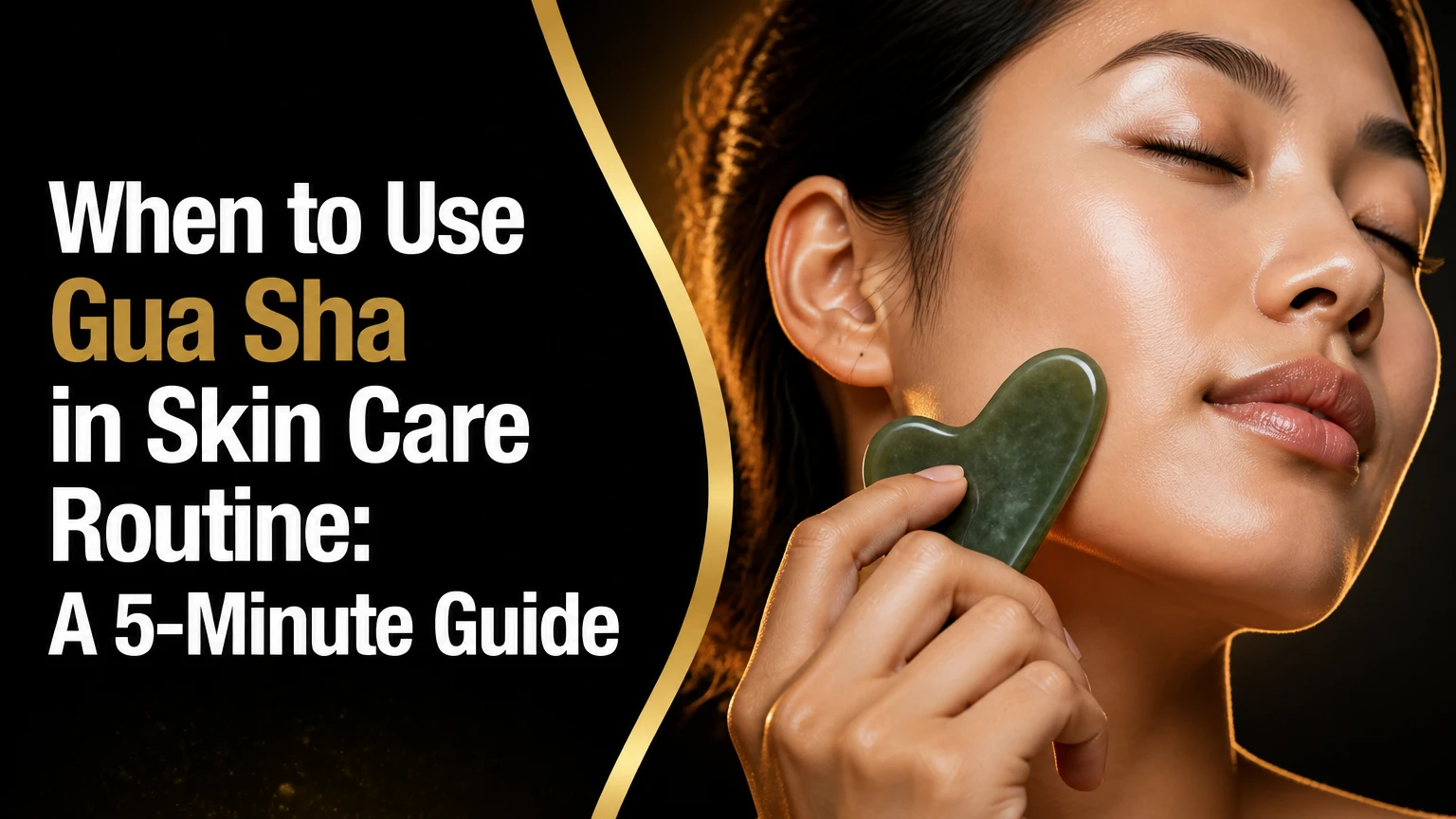
Use a gua sha after cleansing and after applying a product that gives the skin sustained slip, usually facial oil or a rich serum. In the morning, use it before sunscreen and makeup; at night, use it after treatment products that will not irritate with massage. The best session lasts 3-10 minutes with light pressure.
Key Facts at a Glance
- Gua sha belongs after cleansing and before sunscreen, makeup, or any final product that needs an undisturbed film.
- Facial oil or squalane usually provides safer, longer-lasting slip than a water-based serum alone.
- A typical beginner session takes 3-5 minutes and uses 2-5 drops of lubricant.
- Gua sha can temporarily reduce the appearance of puffiness and relax facial tension, but it cannot permanently lift skin or remove facial fat.
- Redness, broken capillaries, tenderness, or bruising means the pressure or frequency is too high.
- Clean the tool after every use with mild soap and lukewarm water, then dry it completely.
Where Does Gua Sha Fit in the Routine?
Gua sha fits after cleansing and after hydrating or treatment products, provided the final product creates enough slip for the tool to glide without pulling. The sequence changes slightly by time of day: morning gua sha comes before sunscreen, while evening gua sha can be the last massage step after moisturizer or facial oil.
A practical evening sequence is cleanser, hydrating toner or essence, non-irritating serum, moisturizer or facial oil, gua sha, then any product that should remain untouched. Many people place gua sha directly after cleansing and oil because fewer layers reduce pilling and make it easier to judge friction.
The tool should never drag across dry skin. A dry surface increases mechanical irritation, especially around the nose, mouth, eyelids, and cheekbones. If the lubricant absorbs during the session, pause and add one or two drops rather than continuing over resistance.
What should go on before gua sha?
Apply a bland, high-slip product before gua sha. Squalane, jojoba oil, and a fragrance-free facial oil are practical choices because they remain workable for several minutes; a thin hyaluronic acid serum may dry too quickly unless layered with cream.
| Product before gua sha | Typical amount | Best use | Main caution |
|---|---|---|---|
| Squalane | 2-5 drops | Sensitive or combination skin | Add more if the surface becomes tacky |
| Jojoba oil | 2-5 drops | Normal, dry, or balanced skin | Patch-test fragranced blends |
| Facial moisturizer | Pea-sized layer | Oil-averse users | Some creams pill under repeated strokes |
| Water-based serum | 1-2 pumps plus cream | Hydration-focused routines | Serum alone may lose slip within 2 minutes |
| Retinoid or acid serum | Prescribed amount | Only if tolerated and clinician-approved | Massage may amplify irritation |
Avoid massaging strong exfoliating acids, freshly applied retinoids, benzoyl peroxide, or prescription products when the skin already stings. The issue is not that the stone chemically changes every ingredient. Repeated rubbing can increase discomfort on an already compromised barrier.
Is Morning or Night Better for Gua Sha?
Morning gua sha is better for temporary depuffing and a more alert-looking face, while evening gua sha is better for relaxation and jaw tension. Neither time has proven superiority for permanent lifting or collagen production, so the better choice is the session you can perform gently and consistently.
Morning use should end with broad-spectrum sunscreen of SPF 30 or higher. Allow the lubricant to settle, blot excess oil if necessary, and apply sunscreen without aggressively rubbing the treated areas. Makeup may slide if too much oil remains.
Night use avoids that layering problem. It also makes a useful transition after cleansing, particularly for people who clench their jaw or carry tension around the temples. A five-minute evening session is sufficient; longer sessions create more opportunity for friction without established additional benefit.
| Routine timing | Recommended sequence | Practical benefit | Makeup or product issue |
|---|---|---|---|
| Morning | Cleanse, hydrate, oil or cream, gua sha, sunscreen | Temporary reduction in morning puffiness | Excess oil can affect foundation |
| Evening | Cleanse, gentle serum, moisturizer or oil, gua sha | Relaxation and jaw tension relief | Minimal layering conflict |
| Post-workout | Rinse or cleanse, lubricant, gua sha, moisturizer | Cooling massage after heat | Do not massage unwashed, sweaty skin |
| Before an event | Gua sha 1-3 hours beforehand | Temporary surface and puffiness improvement | Avoid vigorous treatment immediately before makeup |
What Do You Need Before Starting?
A safe home session needs four items: a smooth, intact gua sha tool, clean hands, a high-slip lubricant, and a clean towel. Typical starting cost is $15-$40 for a tool and $8-$35 for facial oil, although price does not establish stone quality or skin benefit.
Jade and rose quartz are common, but their supposed skincare properties are not established by strong clinical evidence. The useful attributes are a smooth edge, comfortable shape, easy cleaning, and freedom from chips or sharp points. A $20 tool used carefully can be more suitable than an expensive tool with rough edges.
| Item | Typical specification | Typical price | Replacement or disposal trigger |
|---|---|---|---|
| Gua sha tool | Smooth, nonporous stone or coated material | $15-$60 | Chip, crack, sharp edge, or persistent staining |
| Squalane | Fragrance-free, simple formula | $10-$35 | Oxidized odor or changed texture |
| Jojoba oil | Cosmetic-grade, sealed bottle | $8-$25 | Odor change, contamination, or expiration |
| Mild cleanser or soap | Fragrance-free, non-abrasive | $4-$15 | Replace according to package date |
| Soft towel | Clean, lint-free cotton or microfiber | $3-$12 | Wash after each use |
Wash your hands first. Inspect the tool under good light, because a tiny chip can scrape skin during a stroke. Do not chill the stone in a freezer; extreme cold can cause discomfort and adds no established therapeutic benefit.
How Do You Use Gua Sha Correctly?
A complete facial gua sha routine takes about 5 minutes and follows a consistent order: prepare the skin, work the neck, massage the jaw, cheeks, under-eye area, forehead, and finish down the neck. Use the tool at a shallow angle with light pressure, and make one-way strokes rather than sawing back and forth.
Step 1: Cleanse and inspect the skin
Cleanse with lukewarm water, pat dry, and check for cuts, active irritation, sunburn, cold sores, or inflamed acne. Apply 2-5 drops of oil to the face and neck, distributing it until the tool can glide continuously.
You will know the surface is ready when the tool moves without catching, whitening the skin, or producing a pulling sensation. The common mistake is applying a small amount of fast-absorbing serum and continuing after the surface becomes dry.
Step 2: Apply slip and set pressure
Hold the gua sha almost parallel to the skin, commonly around 15-30 degrees rather than upright. Exact angle is less important than keeping a broad edge in contact and avoiding a sharp edge digging into the surface.
Use only the weight of the tool at first. A useful checkpoint is skin that remains comfortable and mostly its normal color during the stroke. The common mistake is assuming a deeper mark indicates a more effective massage; bruising indicates tissue trauma, not superior drainage.
Step 3: Work the neck first
Use the long edge to glide from the collarbone upward toward the underside of the jaw, completing 2-3 passes per side. Then use very light downward strokes along the side of the neck toward the collarbone if that direction feels comfortable.
The neck-first sequence is a massage convention, not proof that a person must “open” lymph nodes before facial work. The lymphatic system does not require manual activation in the way the AI Overview suggests. You will know the step is appropriate when the neck feels relaxed and the skin shows no persistent redness.
Step 4: Massage the jawline
Use the curved notch or long edge from the center of the chin toward the earlobe, completing 2-3 slow passes on each side. Keep the tool shallow and let the free hand stabilize the skin rather than stretching it forcefully.
For jaw tension, pause for 2-3 seconds over the masseter muscle near the back of the cheek, using gentle stationary pressure. Avoid pressing directly over a painful joint. The common mistake is repeatedly scraping the same spot to create a sharper contour.
Step 5: Sweep across the cheeks
Place the broad edge beside the nose and move outward toward the temple across the cheek. Use 2-3 passes per section, covering the lower cheek, mid-cheek, and cheekbone without dragging over a blemish.
The direction does not prevent future sagging, and there is no reliable evidence that downward strokes permanently loosen facial skin. Direction mainly helps create a controlled, comfortable massage pattern. Stop if the cheek becomes hot, itchy, or markedly red.
Step 6: Treat the under-eye area lightly
Use a rounded corner and feather-light pressure from the inner orbital area toward the temple, with one or two passes per side. Keep the tool on the bony orbital rim rather than pressing into the soft eyelid or directly over the eyeball.
Under-eye skin is thin and easily irritated. The common mistake is using the same pressure used on the jaw. Gua sha cannot remove structural dark circles, tear-trough shadows, or permanent bags, although temporary fluid shifts may make morning puffiness look less prominent.
Step 7: Finish the forehead and neck
Glide from between the eyebrows upward to the hairline, then move from the center of the forehead toward each temple. Finish with two gentle strokes from the side of the face down the neck toward the collarbone.
A full session should take 3-10 minutes. You will know the routine is complete when the skin feels comfortable and the lubricant remains evenly distributed. Wipe away excess product or leave it as the final moisturizing layer if the formula suits your skin.
How Much Pressure, Time, and Frequency Are Appropriate?
Beginners should use 3-5 minutes, 2-3 passes per area, and two or three sessions per week. People with tolerant skin may use a brief session daily, but daily use is not necessary for visible temporary effects and can become irritating when combined with active skin treatments.
No universal clinical standard establishes 15 degrees, exactly five passes, or a required 10-minute duration. Those figures are useful operating limits, not medically validated settings. Pressure, skin sensitivity, lubricant, and the tool’s edge matter more than precision to a particular angle.
| User situation | Session length | Frequency | Pressure and pass limit |
|---|---|---|---|
| First two weeks | 3-5 minutes | 2 times weekly | Light pressure, 1-2 passes |
| Tolerant normal skin | 5-10 minutes | 3-5 times weekly | Light pressure, 2-3 passes |
| Sensitive or dry skin | 2-4 minutes | 1-2 times weekly | Feather-light, 1 pass |
| Jaw tension focus | 5-7 minutes | 3-5 times weekly | Light, brief holds over muscle |
| Acne-prone skin | 2-5 minutes | 1-2 times weekly | Avoid inflamed lesions completely |
A practitioner rule of thumb is simple: if redness lasts longer than about an hour, reduce pressure or frequency at the next session. Persistent redness, burning, pinpoint bleeding, or bruising warrants stopping rather than adding more lubricant.
Which Products and Ingredients Should You Avoid?
Avoid products that sting, exfoliate aggressively, or become sticky while you massage. Fragrance-heavy oils, essential oils, rough scrubs, and freshly applied high-strength retinoids or acids create more irritation risk than benefit during mechanical manipulation.
Non-comedogenic labeling can help acne-prone users, but it is not a guarantee that every individual will tolerate an oil. Introduce one product at a time, patch-test when practical, and clean the stone after use. A breakout after gua sha may reflect contaminated equipment, occlusive product, or friction rather than the stone itself.
| Product category | Gua sha suitability | Safer approach | Reason to avoid or modify |
|---|---|---|---|
| Plain squalane | Usually suitable | Use 2-5 drops | Stop if burning or congestion develops |
| Fragrance-free moisturizer | Often suitable | Apply a thin, even layer | May pill under repeated strokes |
| Essential-oil blend | Variable | Prefer fragrance-free alternative | Fragrance can irritate sensitive skin |
| AHA, BHA, or peel | Poor during irritation | Use on a separate routine | Massage may worsen stinging |
| Retinoid | Conditional | Massage before application or on another night | Retinoids commonly increase sensitivity |
| Benzoyl peroxide | Conditional | Avoid rubbing over treated lesions | Can dry and irritate skin |
What Changes for Acne, Rosacea, or Sensitive Skin?
People with active inflammatory acne, rosacea flares, eczema, sunburn, open wounds, or a damaged barrier should skip gua sha on affected areas. Sensitive skin can sometimes tolerate a short session on calm skin, but the tool should never pass over pustules, papules, broken skin, or visibly flushed patches.
Acne-prone users should prioritize hygiene and a light, non-irritating lubricant. Rosacea-prone users should avoid heat, vigorous pressure, and repeated passes because mechanical stimulation may increase flushing. Dry or mature skin benefits from more slip, not more force.
When should you stop?
Stop immediately when the skin burns, feels scraped, develops purple or dark red marks, or becomes increasingly tender. Wash off the lubricant if needed, apply a bland moisturizer, and avoid additional exfoliating or retinoid products until the skin feels normal.
Seek medical advice for swelling, blistering, persistent pain, or a suspected allergic reaction. Gua sha is a cosmetic massage practice, not treatment for acne, rosacea, migraine, sinus disease, or lymphedema.
Can You Use Gua Sha After Botox or Fillers?
Do not use facial gua sha over recent Botox, dermal filler, threads, laser treatment, microneedling, or surgery until the treating clinician gives a specific clearance. Timing varies by procedure, injection site, product, and healing response, so a generic 24-hour or 48-hour rule is not reliable.
Massage can add pressure to swollen or healing tissue and may interfere with clinician instructions. Ask the injector or surgeon when light touch, facial massage, exercise, heat, and active products are permitted. The same caution applies to dental procedures when the jaw or cheek is painful or swollen.
How Does Gua Sha Compare With Other Facial Massage Tools?
Gua sha offers more control over pressure and contact area than a roller, while fingers offer the easiest hygiene and the least equipment. No home tool has established superiority for permanent lifting, collagen remodeling, fat reduction, or structural facial reshaping.
A roller may suit users who want a quick cooling sensation with less technique. Fingers work well for cleanser massage or jaw relaxation and are easier to stop instantly when skin becomes uncomfortable. Professional lymphatic or therapeutic massage is different from cosmetic gua sha and may be appropriate only under qualified guidance for medical conditions.
| Method | Typical session | Main benefit | Limitation |
|---|---|---|---|
| Gua sha | 3-10 minutes | Controlled gliding and jaw massage | Requires slip, cleaning, and technique |
| Facial roller | 2-5 minutes | Cooling, simple depuffing routine | Less precise pressure control |
| Fingers | 2-5 minutes | No tool cost and easy feedback | Product may absorb quickly |
| Professional facial massage | 30-60 minutes | Supervised technique and relaxation | Typical cost is $50-$200 |
| No massage | 0 minutes | Lowest irritation risk | No temporary massage-related effect |
What Results Can You Realistically Expect?
Gua sha may produce a temporarily less puffy appearance, increased subjective relaxation, and reduced awareness of facial muscle tension after a session. Results commonly fade within hours, and controlled evidence does not establish that routine home use permanently lifts skin, erases wrinkles, dissolves fat, or changes facial anatomy.
The stone itself does not possess proven anti-aging properties because it is jade or rose quartz. Cooling can feel soothing, while the main visible effect likely comes from gentle mechanical massage, temporary fluid redistribution, and reduced muscle tension. Cleveland Clinic describes facial gua sha as a massage technique and notes that evidence for broad health claims remains limited.
Take a baseline photograph in the same lighting if you want to judge change. Do not evaluate a routine from a single immediate mirror impression, because lighting, hydration, sleep, salt intake, and facial position can alter apparent puffiness.
Common Problems and How Do You Fix Them?
Most gua sha problems come from excessive pressure, inadequate slip, dirty tools, or treating compromised skin. The safest correction is to stop, let the skin recover, and restart with fewer passes rather than trying to counter irritation with more oil or a colder stone.
| Problem | Likely cause | Immediate fix | Restart rule |
|---|---|---|---|
| Bright red streaks | Too much pressure or sharp edge | Stop and rinse if irritated | Resume with one pass after normal color returns |
| Bruising | Excess force or fragile vessels | Stop until bruising resolves | Avoid the area and reduce frequency |
| Burning or tightness | Active product or dry surface | Remove irritants and moisturize | Use bland squalane on calm skin |
| Breakouts | Occlusive oil, residue, or dirty tool | Clean tool and change lubricant | Test a smaller area first |
| No visible depuffing | Normal variation or unrealistic goal | Track results over several sessions | Use short morning sessions |
| Pilling | Too many layers underneath | Simplify to moisturizer or oil | Apply sunscreen after the skin settles |
Clean the tool after every session with mild soap and lukewarm water. Rinse away residue, dry it with a clean towel, and store it in a ventilated container rather than a damp bathroom pouch. Do not share a gua sha tool.
FAQ
Can I use gua sha without oil?
Use gua sha without oil only when another product provides lasting slip, such as a sufficiently rich moisturizer. Bare skin is unsuitable because friction can cause irritation, especially around the eyes and nose. If a water-based serum dries within the session, add a cream or oil rather than continuing over a tacky surface.
Should gua sha come before or after moisturizer?
Gua sha can come after moisturizer when the moisturizer remains slippery and does not pill. A thin facial oil layered over moisturizer often provides more reliable glide, but oily or acne-prone users may prefer a small amount of non-comedogenic lotion. Apply sunscreen after morning gua sha.
How often should I replace a gua sha tool?
Replace a gua sha tool when it cracks, chips, develops a sharp edge, or cannot be cleaned adequately. A sound, nonporous tool does not have a fixed monthly replacement schedule. Inspect it before each use, because a damaged edge can cause more irritation than the massage itself.
Can gua sha remove a double chin?
Gua sha cannot remove submental fat or permanently reshape a double chin. Massage may temporarily alter fluid-related puffiness and can relax nearby muscles, but lasting changes require evaluation of skin laxity, fat distribution, anatomy, and medically appropriate treatment options.
Can I use gua sha over active acne?
Avoid active acne lesions, pustules, cysts, scabs, and open areas. Dragging a tool across inflamed skin can increase pain, spread product or bacteria across nearby areas, and worsen irritation. Massage only calm surrounding skin with a clean tool and stop if redness increases.
Is a cold gua sha better than a room-temperature tool?
A chilled gua sha can feel more soothing and may temporarily reduce the sensation of heat or puffiness, but cold does not make the tool more effective at lifting skin. Refrigeration is optional. Avoid freezing the tool, and stop if cold causes pain, numbness, or blotchy discoloration.
The Bottom Line
The answer to “when to use gua sha in skin care routine” is after cleansing and after applying enough facial oil, moisturizer, or another high-slip product to prevent dragging. Choose morning for temporary depuffing or evening for relaxation, keep sessions to 3-10 minutes, and use light pressure. Gua sha is a temporary massage technique, not a permanent lifting or acne treatment.