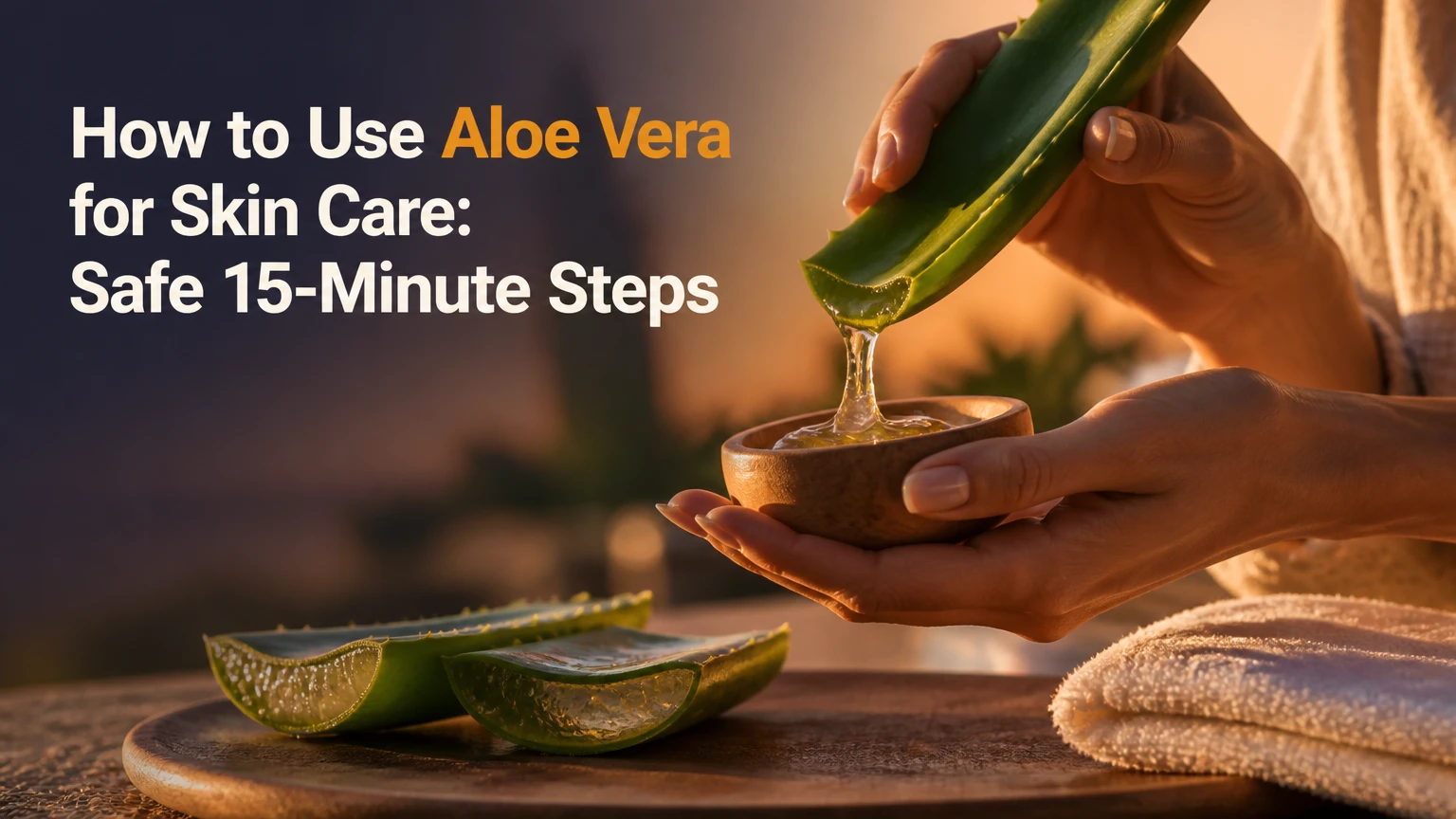
Aloe vera can be used on intact skin as a lightweight hydrating layer or short-contact soothing mask. Apply a fragrance-free, preserved aloe gel in a thin layer after cleansing, or prepare fresh gel by removing the leaf’s yellow latex and green rind, then patch-test for 24-48 hours before facial use.
Key Facts at a Glance
- Aloe vera gel hydrates mainly through its water content and forms a temporary, lightweight film on skin.
- Aloe latex, also called aloin-containing sap, is yellow and can irritate skin; it must not be deliberately applied to the face.
- Fresh homemade aloe gel is perishable and should be refrigerated in a clean sealed container for approximately 3-4 days.
- A patch test on the intended facial area for 24-48 hours is more informative than testing only on the wrist.
- Aloe vera can soothe minor irritation on intact skin, but it does not replace sunscreen, acne medication, wound care, or medical treatment.
- A commercial gel with aloe vera high on the ingredient list is usually more predictable and hygienic than unpreserved leaf gel.
What Does Aloe Vera Do for Skin?
Aloe vera gel provides temporary hydration, cooling, and soothing for some people with mildly irritated or dry skin. The clear inner gel contains water, polysaccharides such as acemannan, and other plant compounds, while the outer rind and yellow latex contain different substances with greater irritation potential.
The evidence supports modest topical comfort, not universal treatment claims. The U.S. National Center for Complementary and Integrative Health, or NCCIH, notes that “There’s not enough reliable information to determine whether aloe is useful for most of the conditions for which people use it.” That limitation matters because marketing often presents aloe as a cure for acne, scars, wrinkles, pigmentation, or sun damage.
Aloe is best treated as a supporting ingredient. It can reduce the tight feeling that follows cleansing and may calm mild heat or irritation, but a separate moisturizer is often needed for dry skin because aloe alone contains little oil and does not reliably prevent water loss.
How does aloe hydrate the skin?
Aloe hydrates by adding water to the outer skin layer and leaving a thin film after evaporation. That effect is temporary, so dry or eczema-prone skin usually benefits from applying a cream or a few drops of a compatible emollient over the aloe while the skin remains slightly damp.
Is Fresh Aloe Better Than Packaged Aloe Gel?
Packaged aloe gel is usually the safer first choice because preservatives, manufacturing controls, and standardized ingredients reduce contamination and batch variation. Fresh leaf gel can work on intact skin, but home preparation cannot reliably measure residual latex, microbial load, or product stability.
Raw aloe has three relevant layers: the green outer rind, the yellow latex near the rind, and the clear inner gel. The clear gel is the intended topical portion. Cutting, peeling, and storing it at home introduces bacteria from the knife, cutting board, hands, and container.
| Aloe option | Typical preparation time | Main advantage | Main limitation |
|---|---|---|---|
| Preserved commercial gel | 1-2 minutes | Consistent texture and lower contamination risk | May contain fragrance, alcohol, colorants, or preservatives |
| Fresh inner leaf gel | 15-25 minutes | Minimal ingredients and no added fragrance | Perishes quickly and may retain irritating latex |
| Aloe lotion or cream | 1-3 minutes | Adds glycerin, oils, or ceramides for barrier support | Aloe concentration may be lower than the label suggests |
| Aloe cosmetic mask | 5-10 minutes | Convenient short-contact application | May include fragrance, essential oils, or exfoliating acids |
Choose a product with aloe vera or Aloe barbadensis leaf juice near the beginning of the ingredient list, without perfume if your skin is reactive. “99% aloe” does not automatically mean low irritation because the remaining 1% can include fragrance, denatured alcohol, dyes, or essential oils.
Before You Start
The easiest routine takes about 2-5 minutes with packaged gel and 15-25 minutes when preparing a leaf. Fresh gel costs roughly $1-$4 per leaf in typical grocery or garden settings, while a 6-8 ounce packaged gel commonly costs about $6-$18, depending on formulation and brand.
| Requirement | Recommended specification | Typical quantity or time |
|---|---|---|
| Aloe source | Fragrance-free preserved gel or mature Aloe barbadensis leaf | 1-2 teaspoons |
| Cleaning | Gentle, non-exfoliating cleanser | 1 wash |
| Tools for fresh leaf | Sanitized knife, board, spoon, clean jar | 4 items |
| Patch test | Small amount on jawline or inner forearm | 24-48 hours |
| Refrigeration | Sealed clean glass container at 4°C or below | 3-4 days maximum for homemade gel |
Do not prepare fresh aloe beside raw meat or other contamination sources. Wash your hands, sanitize the tools, and use a jar that has been washed and fully dried. Skip raw aloe if you cannot control cleanliness or if the leaf has mold, a damaged surface, a sour smell, or extensive browning.
How Do You Prepare Fresh Aloe Vera Safely?
Prepare fresh aloe by draining the yellow latex, removing every spine and green surface, rinsing the clear gel, and storing only a small amount in the refrigerator. A 15-minute drain can reduce visible latex, but it does not prove that all irritating compounds have been removed.
Step 1: Drain the Yellow Latex
Cut off the bottom 1-2 centimeters of a mature leaf and stand it upright in a clean cup for 15-30 minutes. Let the yellow sap run out, then rinse the leaf under cool running water.
The yellow material is aloe latex, not the clear moisturizing gel. Its composition varies with the plant, cut location, and handling, so color alone cannot confirm complete removal.
Success checkpoint: No yellow liquid remains on the cut surface after rinsing.
Common mistake: Treating a short drain as a guaranteed aloin-removal test.
Step 2: Remove Spines and Green Rind
Lay the leaf on a clean board, slice away both serrated edges, and remove the top and bottom green rind with a sharp knife. Keep the blade just beneath the rind so the clear gel remains, then rinse the exposed gel thoroughly.
Do not scrape yellow residue into the clear portion. If the gel remains yellow, sticky, or strongly bitter-smelling, discard it rather than trying to rescue the batch.
Success checkpoint: The gel is clear to slightly translucent and free from green skin.
Common mistake: Leaving a thin green layer attached because it appears harmless.
Step 3: Collect and Store a Small Batch
Scoop the clear gel with a clean spoon and place it in a sanitized, dry glass jar. Mash it gently with a fork for a spreadable texture; blending for about 5 seconds is optional, but prolonged blending adds air and accelerates oxidation.
Store the jar at 4°C or below and label it with the preparation date. Homemade aloe has no validated home-use shelf life, so discard it after 3-4 days, even if the appearance seems acceptable.
Success checkpoint: The gel smells neutral, has no mold, and remains clear or pale translucent.
Common mistake: Keeping a large batch for a week because refrigeration slows spoilage but does not stop it.
How Do You Apply Aloe Vera to Your Face?
Apply aloe vera to freshly cleansed, slightly damp skin in a thin layer of about 1/8 teaspoon for the face. Leave it on for 10-15 minutes as a mask and rinse, or allow a small amount to absorb before applying moisturizer and sunscreen.
Step 4: Patch-Test the Formula
Apply a small amount of the exact aloe product to a 2-centimeter area near the jawline or behind the ear. Leave it in place according to the intended use, then repeat once daily for 24-48 hours.
A forearm test can identify some reactions, but facial skin may respond differently. Patch testing cannot guarantee safety, particularly when the product contains fragrance, preservatives, or botanical extracts.
Success checkpoint: No increasing itch, burning, swelling, hives, or persistent redness appears.
Common mistake: Testing the aloe alone while planning to use it mixed with honey, oils, or essential oils.
Step 5: Apply a Thin Layer
Cleanse with lukewarm water and a gentle cleanser, pat without rubbing, and spread a thin layer across the face while the skin is slightly damp. Avoid the eyelids, lash line, lips, nostrils, and broken skin.
| Intended use | Amount for face | Contact time | Finish |
|---|---|---|---|
| Lightweight hydration | Pea-sized amount | Leave on | Follow with moisturizer |
| Soothing mask | 1/4 teaspoon | 10-15 minutes | Rinse and moisturize |
| Small irritated patch | Rice-grain to pea-sized amount | 10 minutes initially | Stop if burning occurs |
| Body application | 1/2-1 teaspoon per area | Leave on if tolerated | Reapply moisturizer as needed |
Success checkpoint: The skin feels cool or comfortable, without stinging, tightness, or a tacky film that persists after absorption.
Common mistake: Applying a thick layer, which can pill, dry into a tight film, or increase exposure to irritating ingredients.
Which Skin Concerns Can Aloe Vera Support?
Aloe vera is most useful for temporary hydration and mild discomfort on intact skin. It may support comfort after heat exposure or shaving, but evidence is not strong enough to treat acne, scars, hyperpigmentation, aging, or significant inflammation by itself.
| Skin concern | Potential role of aloe | Better companion step | Avoid or limit when |
|---|---|---|---|
| Mild dryness | Adds water-based hydration | Ceramide cream or petrolatum on dry areas | Skin becomes tighter after drying |
| Shaving irritation | Cooling layer on intact skin | Fragrance-free moisturizer | Cuts, folliculitis, or worsening bumps appear |
| Mild sun discomfort | Cooling comfort after cooling the skin | Broad-spectrum SPF 30+ on later exposure | Blisters, severe pain, or widespread peeling occur |
| Acne-prone skin | Lightweight, usually low-oil hydration | Proven acne treatment such as benzoyl peroxide | Product contains coconut oil or fragrance |
| Sensitive skin | May calm mild transient redness | Minimal-ingredient moisturizer | Burning, hives, eczema flare, or swelling occurs |
Aloe does not provide meaningful sun protection. The American Academy of Dermatology recommends broad-spectrum, water-resistant sunscreen with SPF 30 or higher, so aloe cannot substitute for that step after outdoor exposure.
Can aloe vera clear acne?
Aloe vera alone should not be considered an acne treatment. Small studies and laboratory findings suggest anti-inflammatory or antimicrobial activity, but acne involves follicular plugging, oil production, inflammation, and sometimes bacterial imbalance; a cosmetic aloe gel does not address all of those mechanisms.
For mild acne, use aloe only as a non-comedogenic comfort layer if it does not sting. Proven options include salicylic acid, benzoyl peroxide, adapalene, and prescription treatments selected according to the acne pattern and skin tolerance.
Can aloe help a sunburn?
Aloe can provide cooling comfort for a minor sunburn affecting intact skin, but it does not reverse ultraviolet injury. Cool, damp compresses, bland moisturizer, fluids, and sun avoidance are more dependable supportive measures.
Do not apply aloe to large blisters, deep burns, open blisters, infected areas, or skin with severe swelling. Seek medical care for extensive blistering, fever, confusion, severe pain, or burns involving the face, hands, genitals, or major joints.
Aloe Vera Versus Moisturizer and Other Ingredients
Aloe vera is a humectant-style water-based layer, not a complete moisturizer for every skin type. A moisturizer containing glycerin, ceramides, fatty alcohols, or petrolatum generally supports the skin barrier more effectively, especially when dryness results from a damaged barrier.
| Option | Primary function | Typical irritation concern | Best use case |
|---|---|---|---|
| Aloe gel | Water-based soothing and hydration | Latex, fragrance, preservatives | Mild heat, shaving discomfort, lightweight hydration |
| Ceramide cream | Barrier support and reduced water loss | Low, unless fragranced | Dry, sensitive, or over-exfoliated skin |
| Petrolatum | Occlusive water-loss reduction | Folliculitis or heaviness in some users | Cracked dry patches and nighttime sealing |
| Honey | Humectant and sticky occlusive layer | Pollen, fragrance, contamination | Short-contact use only, if tolerated |
| Tea tree oil | Fragrant essential oil with antimicrobial activity | Irritant or allergic contact dermatitis | Not recommended as a casual aloe additive |
Avoid adding tea tree oil directly to homemade aloe unless a qualified clinician has advised a properly diluted formula. Essential oils can cause allergic contact dermatitis, and homemade dilution is often inaccurate.
Aloe also should not be mixed automatically with lemon juice, baking soda, toothpaste, undiluted apple cider vinegar, or exfoliating acids. These combinations can disrupt the skin barrier and create irritation that users may mistake for “detoxification” or active treatment.
How Often Should You Use Aloe Vera?
Start with two or three applications per week, then increase to once daily only if the skin remains comfortable for seven days. Sensitive skin should begin with a 10-minute rinse-off application, while tolerant skin may use a thin leave-on layer under moisturizer.
| Skin profile | Starting frequency | First contact time | Adjustment point |
|---|---|---|---|
| Sensitive or eczema-prone | 2 times weekly | 5-10 minutes | Increase only after 7 reaction-free days |
| Dry skin | 3 times weekly | 10-15 minutes | Add cream immediately afterward |
| Oily skin | 3-5 times weekly | Leave-on thin layer | Stop if pilling or clogged pores appear |
| Acne-prone skin | 2-3 times weekly | 10 minutes | Use only fragrance-free, non-comedogenic gel |
A persistent tight feeling is a sign that aloe is evaporating without enough barrier support. Apply moisturizer over damp skin instead of increasing the aloe quantity.
What Are the Risks and Warning Signs?
Aloe vera can cause irritant contact dermatitis or allergic contact dermatitis, particularly when the product contains latex residue, fragrance, preservatives, or other botanical extracts. Stop using the product and rinse with lukewarm water if burning, itching, swelling, or increasing redness develops.
| Symptom | Likely cause | Immediate response | Medical threshold |
|---|---|---|---|
| Mild brief tingling | Formula irritation or alcohol | Rinse and discontinue | Medical advice if it persists |
| Red itchy patch | Contact dermatitis | Wash, avoid reapplication | Clinician review if spreading |
| Hives or facial swelling | Possible allergy | Stop product immediately | Urgent care for swelling or breathing symptoms |
| Sour odor or mold | Microbial spoilage | Discard the entire jar | No topical reuse |
| Brown watery gel | Oxidation or contamination | Discard rather than dilute | No medical care unless a reaction occurred |
Aloe latex exposure is a separate concern from clear inner gel exposure. The outer plant material can irritate skin, and oral aloe latex has additional safety concerns that do not apply to ordinary topical gel use. Never consume homemade leaf preparations for a skin-care routine.
What should you do after an aloe reaction?
Rinse the area thoroughly, stop all aloe products, and use a bland moisturizer if the skin is intact and only mildly irritated. Do not apply acids, retinoids, scrubs, essential oils, or another “soothing” botanical while the reaction is active.
Seek urgent help for trouble breathing, throat tightness, widespread hives, rapid facial swelling, or dizziness. Arrange medical evaluation for blistering, severe pain, eye exposure, or redness that continues beyond 24-48 hours.
How Long Does Homemade Aloe Gel Last?
Homemade aloe gel should be refrigerated and discarded after 3-4 days. A sour odor, mold, gas, separation with an unusual color, or a slimy change means the gel should be thrown away immediately.
Commercial products last longer because manufacturers use preservatives, controlled filling, and tested packaging. Follow the product’s expiration date and the period-after-opening symbol, and close the container after each use.
Do not freeze a large jar and repeatedly thaw it. Dividing fresh gel into single-use portions can reduce repeated contamination, but freezing does not correct poor preparation or remove latex.
Common Mistakes and How to Fix Them
- Using the whole leaf: Green rind and yellow latex increase irritation risk. Remove both completely and rinse the inner gel.
- Skipping the patch test: Facial reactions can be uncomfortable and persistent. Test the final formula for 24-48 hours.
- Applying aloe to broken skin: Raw preparations are not sterile. Use appropriate wound care and seek advice for deep or infected wounds.
- Choosing “natural” over preserved: A preservative-free product may spoil faster. Select a reputable commercial gel when hygiene is uncertain.
- Adding essential oils: Tea tree, peppermint, and citrus oils can irritate or sensitize skin. Keep the routine single-ingredient initially.
- Replacing moisturizer or sunscreen: Aloe supplies neither reliable barrier protection nor ultraviolet protection. Layer moisturizer and SPF 30 or higher when appropriate.
The Bottom Line
The safest way to use aloe vera for skin care is to apply a thin layer of fragrance-free commercial gel after cleansing, patch-test the exact formula for 24-48 hours, and add moisturizer when skin feels dry. Fresh leaf gel is optional, but remove the rind and yellow latex, refrigerate it, and discard it after 3-4 days.
Aloe can improve short-term comfort and lightweight hydration. It cannot cure acne, erase scars, replace sunscreen, or treat serious burns and wounds. Stop promptly at the first sign of burning, hives, swelling, or persistent redness.
Frequently Asked Questions
Can I leave aloe vera on my face overnight?
You can leave a thin layer of a properly formulated commercial aloe gel overnight if a patch test produced no reaction and the product contains no irritating fragrance or alcohol. Fresh homemade gel is less predictable and may contaminate during storage, so a 10-15-minute rinse-off application is the safer starting method.
Should I apply aloe before or after moisturizer?
Apply aloe before moisturizer because aloe is primarily a water-based layer. Put it on slightly damp, cleansed skin, allow excess product to absorb for about one minute, then apply a fragrance-free cream or lotion if your skin feels tight or dry.
Can aloe vera remove dark spots or scars?
Aloe vera should not be expected to remove established dark spots or scars. It may reduce temporary dryness that makes uneven texture more noticeable, but pigment and scar treatment usually requires sun protection and targeted ingredients such as azelaic acid, retinoids, or professionally selected procedures.
Is aloe vera safe around the eyes?
Keep aloe vera away from the eyelids, lash line, and eyes because gels can contain preservatives or plant particles that sting and irritate. If product enters the eye, rinse with clean lukewarm water for several minutes and seek care if pain, redness, or blurred vision continues.
Can children use aloe vera gel?
Children should use only a simple, fragrance-free commercial product with adult supervision and a patch test. Do not apply homemade aloe to broken skin, diaper-area rashes, or unexplained pediatric rashes without clinical advice, because infection and allergic conditions can resemble ordinary irritation.
Can I use aloe vera after a chemical peel or laser treatment?
Do not apply ordinary aloe gel after a chemical peel, laser treatment, microneedling session, or surgery unless the treating clinician approves it. Post-procedure skin has a weakened barrier, and preservatives, fragrance, plant latex, or contamination can interfere with recovery. Use the aftercare product and schedule provided by the clinician.