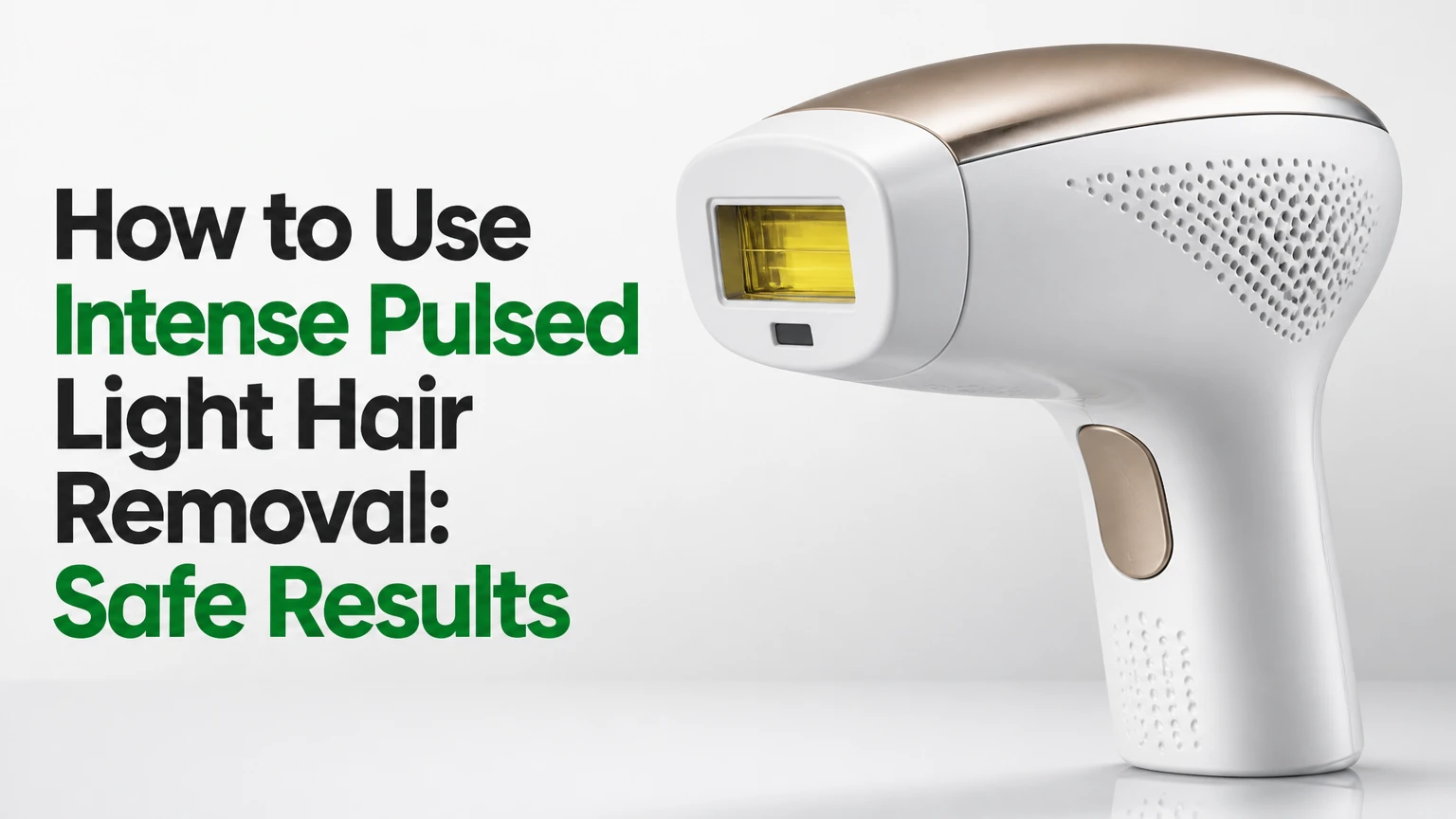
Intense pulsed light hair removal works by directing broad-spectrum light into melanin in the hair shaft, where absorbed energy becomes heat and disrupts active-growth follicles. To use IPL safely, screen your skin and medication risks, shave rather than wax, patch-test, select the device-approved setting, flash each area once, and follow a consistent treatment schedule.
Key Facts at a Glance
IPL hair removal targets pigment in the hair, so dark brown or black hair usually responds better than blonde, red, white, or gray hair.
Shaving preserves the follicle, while waxing, epilating, and plucking remove the target that IPL needs.
A home IPL device should touch clean, dry skin with its treatment window fully flat against the surface.
One session cannot treat every follicle because hair cycles through anagen, catagen, and telogen phases.
Typical home schedules range from weekly to every two weeks initially, but the device manual takes priority.
IPL produces long-term hair reduction, not a guarantee that every treated follicle will disappear permanently.
What Is Intense Pulsed Light Hair Removal?
Intense pulsed light hair removal is a light-based method that uses multiple wavelengths rather than the single, tightly selected wavelength used by most laser systems. Melanin absorbs part of the pulse, heat travels along the hair shaft toward the follicle, and repeated treatments can reduce the follicle’s ability to produce a thick hair.
Home devices use lower energy and more restrictive safety controls than professional systems. IPL is therefore convenient, but it does not equal clinic laser treatment in power, wavelength selectivity, or suitability for every skin tone.
The U.S. Food and Drug Administration uses the phrase “permanent hair reduction” for a “long-term, stable reduction in the number of hairs regrowing after a treatment regime.” That wording matters: permanent reduction does not mean complete, lifelong hair removal.
How does IPL disable hair growth?
IPL relies on selective photothermolysis, in which light energy becomes heat inside a pigmented target while limiting exposure to surrounding tissue. A dark hair absorbs more light than lightly pigmented skin, and the resulting heat can injure follicular growth structures during the active anagen phase.
IPL cannot reliably affect a follicle when the hair is dormant, when the hair contains little pigment, or when surrounding skin absorbs too much energy. Several sessions are necessary because follicles enter anagen at different times.
Before You Start IPL Hair Removal
The correct preparation period is usually four weeks for waxing and plucking avoidance, followed by shaving shortly before treatment. Preparation also requires checking the device’s skin-tone chart, avoiding tanning, reviewing photosensitizing medicines, and confirming that the treatment area contains no tattoo, suspicious lesion, open wound, or active infection.
Before-you-start checklist
| Item | Typical requirement | Why it matters | Checkpoint |
|---|---|---|---|
| Treatment time | 10-30 minutes | Covers one or several body areas | Device battery or power cord ready |
| Hair removal method | Shave 0-24 hours before | Leaves the follicle below the skin | No long hair above the surface |
| Skin condition | Clean, dry, unbroken skin | Reduces surface heating and irritation | No lotion, deodorant, oil, or makeup |
| Patch test | 24-48 hours before | Screens for excessive reaction | No blistering or severe pain |
| Treatment cost | $200-$600 home device, typical | Establishes total ownership cost | Replacement and warranty checked |
| Required tools | Razor, cleanser, device, sunscreen | Supports the complete process | All items available before starting |
Who should postpone or avoid IPL?
Do not use IPL over recently tanned or sunburned skin, tattoos, dark moles, very dark pigmented lesions, open cuts, active dermatitis, or areas with infection. People who are pregnant, taking photosensitizing medication, using isotretinoin, or managing a light-sensitive condition should obtain individualized medical advice before treatment.
Device restrictions differ. A home IPL model may permit some medium-to-deep skin tones, while another may prohibit them because epidermal melanin can absorb excess energy. Never override the manufacturer’s skin-tone sensor or printed compatibility chart.
How to Use Intense Pulsed Light Hair Removal at Home
Use home IPL in seven controlled stages: screen the area, stop root-removing methods, shave, cleanse and dry, patch-test, flash methodically, and complete aftercare. A full session commonly takes 10-30 minutes, and the factor that most determines success is consistent coverage at a safe device-approved intensity.
Step 1: Screen your skin, hair, and treatment area
Confirm that your hair has enough pigment for the device to detect and that your skin falls within the permitted tone range. Compare untreated skin, not tanned skin, with the device chart, and inspect every area for tattoos, moles, scars, rash, sunburn, or medication-related sensitivity.
You will know it is ready when: the device permits treatment, the area is intact, and no contraindication applies.
Common mistake: assuming a skin sensor makes every skin tone safe. Sensors reduce risk, but they do not replace the manual.
Step 2: Stop waxing, epilating, and plucking
Stop removing hair from the root approximately four weeks before the first session, or follow the longer interval in the manual. Shaving is acceptable because it cuts the hair at the surface while leaving the follicle and its pigment pathway underneath.
You will know it is ready when: the follicle has had time to regrow after the last root-removing treatment.
Common mistake: waxing between IPL sessions, which can make later pulses less effective until the follicle returns.
Step 3: Shave the treatment area
Shave closely within 24 hours of treatment. A long surface hair can absorb energy above the skin, creating a hot, singed smell and unnecessary irritation, although a mild hair smell can still occur with a close shave.
Use a clean razor and avoid pressing hard enough to create micro-cuts. For sensitive areas, shave the evening before rather than immediately before flashing.
You will know it is ready when: the skin feels smooth and no visible hair projects above the surface.
Common mistake: treating unshaved legs because the device is marketed as painless.
Step 4: Cleanse and dry the skin
Wash away lotion, body oil, deodorant, makeup, sunscreen, and residue from shaving products. Pat the skin completely dry before placing the treatment window against it.
Do not apply numbing cream, perfume, essential oil, or an occlusive moisturizer unless a clinician and the device manufacturer specifically permit it. Unknown products can change heat transfer and make an irritation reaction harder to interpret.
You will know it is ready when: the skin is clean, dry, and free of visible product.
Common mistake: applying aloe or moisturizer before treatment instead of after treatment.
Step 5: Patch-test and choose the setting
Patch-test a small section using the lowest effective device-approved level, then wait the period specified by the manufacturer, commonly 24-48 hours. If the test area develops blistering, crusting, marked swelling, severe pain, or persistent color change, stop using the device and seek medical advice.
For later sessions, increase intensity only when the previous treatment caused no concerning reaction. A warm snap, brief sting, or mild follicular redness can be normal; escalating through significant pain is unsafe.
You will know it is ready when: the patch area has no abnormal reaction and the device makes full skin contact.
Common mistake: choosing the highest number immediately because darker settings do not always mean faster results.
Step 6: Flash each section once
Hold the IPL window flat against the skin at approximately 90 degrees. Press the activation button, wait for the pulse, then move to the adjacent section with a small visual margin so no strip is skipped.
Use stamp mode for the underarms, bikini line, and small facial sections. Use glide mode only where the device allows it and where you can maintain full contact without accidentally repeating a spot.
Do not flash the same location twice in one session. Make a simple grid with body landmarks, such as ankle to knee and knee to thigh, to track coverage without overlapping.
You will know it is working when: each pulse feels tolerable, the device fires consistently, and the skin shows mild temporary redness around follicles rather than burning pain.
Common mistake: repeatedly pulsing a missed-looking area, which increases heat without accelerating the hair cycle.
Step 7: Apply aftercare
Use a cool compress for 5-10 minutes if the area feels warm. A plain, fragrance-free moisturizer or aloe gel may help mild irritation, while broad-spectrum SPF 30 or higher protects exposed treated skin from pigment changes.
For the first 24-48 hours, avoid tanning, hot baths, saunas, steam rooms, vigorous exercise, abrasive scrubs, fragranced products, and tight clothing over irritated areas. Follow stricter instructions if the device manual or clinician provides them.
You will know aftercare is adequate when: warmth and mild redness settle rather than intensify during the next several hours.
Common mistake: using ice directly on skin or applying an exfoliating acid immediately after treatment.
How Often Should You Use IPL?
Use IPL according to the device manual, commonly once every one to two weeks for an initial four-to-twelve-week course, followed by maintenance every one to three months. More frequent flashing does not force resting follicles into anagen and can increase irritation.
| Treatment phase | Typical interval | Typical duration | Expected observation |
|---|---|---|---|
| Patch test | 24-48 hours before session | One small spot | No blistering or severe reaction |
| Initial home course | 7-14 days | 4-12 weeks | Slower, finer regrowth |
| Early maintenance | 4-8 weeks | 3-6 months | Fewer recurring hairs |
| Long-term maintenance | 1-3 months | Ongoing as needed | Isolated regrowth and touch-ups |
| Professional IPL course | 4-6 weeks | 4-8 sessions | Clinic-specific reduction plan |
Hair commonly sheds over one to two weeks after an effective pulse, but visible change varies by body area and hair cycle. Do not judge the final result after one session.
Why does IPL miss some hairs?
IPL misses hair when the follicle is outside the active growth phase, when hair pigment is insufficient, when coverage is incomplete, or when the energy is too low to create a follicular effect. Hormonal changes can also stimulate new facial or body hair after an initially successful course.
Track the same area under similar lighting every four weeks. Photographing a small marked region is more reliable than judging daily stubble, which can vary with shaving angle and skin hydration.
Which IPL Device Features Matter?
The most useful home IPL features are a skin-contact sensor, clear skin-tone restrictions, adjustable energy levels, a suitable facial attachment, and a treatment window large enough for the intended body area. Cooling can improve comfort, but cooling does not make an incompatible skin tone or hair color safe.
| Feature | Useful specification | Best application | Limitation |
|---|---|---|---|
| Skin sensor | Full-contact activation | Reduces accidental flashes | Does not replace the chart |
| Energy control | 3-5 or more levels | Gradual tolerance building | Numbers are not comparable across brands |
| Treatment window | Approximately 3-4 cm² | Legs and torso | Small windows increase session time |
| Facial precision head | Approximately 1-2 cm² | Upper lip and chin | Some devices prohibit male facial use |
| Cooling contact | Active or passive cooling | Underarms and bikini line | Comfort feature, not extra efficacy |
| Power source | Corded or rechargeable | Corded for long sessions | Batteries lose capacity over time |
Home devices often advertise hundreds of thousands of flashes, but flash count is less important than safe coverage, warranty support, and a reliable skin sensor. A device with 250,000 flashes can already exceed the practical needs of one user.
Is IPL Better Than Laser, Waxing, or Shaving?
IPL is usually the most convenient option for eligible users who want gradual reduction at home, while professional laser generally offers stronger, more selective treatment and electrolysis remains the better pigment-independent option. Shaving is cheapest and fastest, but it provides no follicle reduction; waxing lasts longer between sessions but removes the IPL target.
| Method | Typical session cost | Regrowth pattern | Skin and hair limits | Best use |
|---|---|---|---|---|
| Home IPL | $200-$600 device | Reduction over 4-12 weeks | Pigment and chart dependent | Private maintenance |
| Clinic IPL | $150-$300 per session | Gradual reduction | Clinic-specific screening | Supervised light treatment |
| Diode laser | $200-$500 per session, typical | Strong long-term reduction | Wavelength and skin type matter | Dark hair under trained care |
| Nd:YAG laser | $250-$600 per session, typical | Long-term reduction | Often selected for darker skin | Professional treatment |
| Waxing | $30-$100 per session | Usually 3-4 weeks | Irritation and ingrown hairs | Temporary smoothness |
| Shaving | $0.10-$2 per shave, typical | Often 1-3 days | Razor burn and cuts | Immediate, painless control |
| Electrolysis | $50-$150 per hour, typical | Permanent removal of treated follicles | Slow, operator dependent | Light-colored hair |
Laser and IPL are not interchangeable terms. A laser emits a narrower wavelength band, whereas IPL produces a broad, filtered spectrum, so treatment performance depends on wavelength, fluence, pulse duration, spot size, cooling, and skin contrast.
What Results Can You Expect?
Most users should expect slower regrowth, reduced density, and finer remaining hairs rather than complete hairlessness. A commonly cited consumer expectation is approximately 70%-90% reduction after a complete course, but results vary by device, body site, hormone status, skin contrast, and adherence.
Clinical advertisements may use “permanent hair reduction,” while regulatory language does not promise permanent removal of every hair. Underarm and lower-leg hair often responds more predictably than hormonally influenced chin, neck, or abdomen hair.
Suitability by hair and skin combination
| User situation | Likely IPL response | Main risk or limitation | Practical choice |
|---|---|---|---|
| Light skin, dark brown hair | Usually favorable | Temporary redness | Home IPL or clinic laser |
| Medium skin, dark hair | Device dependent | Epidermal heating | Use chart and sensor exactly |
| Deep skin tone, dark hair | Often restricted for home IPL | Burns or pigment change | Dermatology consultation |
| Blonde or light red hair | Often weak | Low melanin target | Electrolysis or selected laser advice |
| Gray, white, or red-gray hair | Usually poor | Insufficient shaft pigment | Electrolysis is more suitable |
| Recently tanned skin | Postpone treatment | Increased surface melanin | Wait until tan fades |
| PCOS-related facial hair | Variable and recurrent | New hormonal growth | Medical evaluation plus reduction plan |
Dark skin is not automatically unsuitable for every light-based treatment, but many consumer IPL devices are unsafe or untested for the deepest tones. A professional may choose a long-pulsed Nd:YAG laser or another approach after assessing skin type, tanning, hair, and medical history.
Body-Area Rules and Situational Variations
Body-area technique changes the safety margin, because facial skin, the bikini line, and tattooed skin have different pigment and irritation risks. Use only attachments and locations named in the manual, and never flash directly on mucous membranes, internal genital tissue, nipples, eyes, or a dark tattoo.
Face and upper lip
Use a facial attachment if provided and keep the flash below the cheekbones unless the manufacturer explicitly permits another area. Avoid the eyelids, eyebrows, beard areas prohibited by the manual, dark freckles, and recently exfoliated or irritated skin.
Facial hair can be hormonally driven. If chin or neck regrowth becomes suddenly heavier, discuss causes such as PCOS or medication effects with a clinician rather than increasing IPL frequency.
Underarms and bikini line
Stamp small sections and keep skin flat where possible. Avoid internal genital areas and any location the manual labels as restricted; external bikini skin may be permitted, but pigmentation differences can require a lower approved setting.
Tattoos, moles, and scars
Cover tattoos and avoid dark moles or lesions completely. Do not use IPL to diagnose, lighten, or treat a changing mole, because light and heat can injure pigmented tissue and complicate medical assessment.
Common IPL Mistakes and How to Fix Them
Most IPL problems result from incorrect target preparation, repeated flashes, unsuitable skin exposure, or inconsistent coverage. Recovery depends on the symptom: mild warmth usually needs cooling and observation, while blistering, severe pain, or pigment change requires stopping treatment.
| Problem | Likely cause | Immediate action | Resume treatment? |
|---|---|---|---|
| Device will not flash | Poor skin contact or sensor block | Flatten window and clean sensor | Yes, if device permits |
| Strong burning pain | Excess energy or tanned skin | Stop, cool gently, inspect skin | No until medically cleared |
| Singed-hair smell | Surface hair too long | Stop and shave closer next time | Only after skin settles |
| Patchy regrowth | Missed sections or irregular schedule | Map area and follow calendar | Yes, on normal schedule |
| Blisters or crusting | Thermal injury | Stop IPL and contact clinician | No without advice |
| Dark or light marks | Pigment reaction or sun exposure | Stop, protect from UV, seek advice | No until evaluated |
| No reduction after 12 weeks | Wrong hair pigment, low setting, or poor coverage | Reassess suitability and device | Consider professional evaluation |
A mild perifollicular red bump can indicate a normal short-term response, but redness that spreads, intensifies, or persists beyond roughly 48 hours should not be treated as proof of effectiveness. Never apply an additional session to compensate for a missed area.
How Much Does IPL Hair Removal Cost?
A quality home IPL device typically costs $200-$600, while professional IPL commonly costs $150-$300 per session and may require four to eight sessions. Total cost depends on treatment area, clinic location, maintenance visits, replacement parts, and whether a consultation is included.
| Cost option | Typical upfront cost | Typical first-course cost | Hidden consideration |
|---|---|---|---|
| Entry-level home device | $100-$250 | $100-$250 | Fewer controls or smaller window |
| Premium home device | $300-$600 | $300-$600 | Warranty and attachments vary |
| Clinic IPL course | $150-$300 per visit | $600-$2,400 | Consultation and maintenance may be extra |
| Clinic laser course | $200-$600 per visit | $800-$4,800 | Price changes sharply by body area |
| Electrolysis | $50-$150 per hour | $500-$3,000 or more | Many shorter appointments may be needed |
Home treatment has a lower recurring cash cost but requires time, accurate coverage, and self-screening. Clinic treatment costs more, yet professional assessment can matter more than the equipment price for deep skin tones, facial hair, medication use, or previous pigment reactions.
When Should You Stop IPL and Get Help?
Stop IPL immediately for blistering, open skin, severe swelling, intense pain, pus, spreading redness, eye symptoms, or new dark or pale patches. Seek urgent medical care for severe burns, facial or eye injury, breathing symptoms, or rapidly worsening swelling.
For mild warmth or redness, cool the area indirectly for 5-10 minutes and avoid heat, friction, and sun. Do not puncture blisters or apply harsh antiseptics, acids, retinoids, or fragrance to a newly irritated area.
Professional assessment is also appropriate when twelve weeks of correct use produces no reduction, when facial hair increases, or when the device’s skin-tone instructions do not clearly include you.
IPL Hair Removal FAQ
Can you use IPL every day?
No. Daily IPL does not improve follicle targeting because hair growth cycles do not reset overnight. Follow the manufacturer’s interval, commonly seven to fourteen days during the initial course. Excessive use raises cumulative heat exposure and can cause irritation or pigment changes without treating more follicles.
Does IPL hurt more on the bikini area?
The bikini area can feel sharper than the lower legs because skin is more sensitive and hair may be coarser. Use the permitted attachment, keep the skin flat, begin with a lower approved level, and avoid internal genital tissue. Burning pain is abnormal and requires stopping.
Can you use IPL after waxing?
Wait until the follicle has regrown sufficiently, often about four weeks or the interval stated by the device manual. Waxing removes the hair root and reduces the pigmented pathway that IPL needs. Shaving is the preferred method between sessions because it leaves the follicle intact.
Is IPL safe during pregnancy?
Manufacturers commonly advise avoiding cosmetic IPL during pregnancy because controlled safety data are limited, even though the device targets superficial tissue. Pregnancy can also alter pigmentation and hair growth, making reactions and results less predictable. Resume only after discussing timing with a qualified healthcare professional.
Why is IPL not working on blonde hair?
Blonde hair often contains too little melanin to absorb enough IPL energy for reliable follicle heating. Red, white, and gray hair present the same limitation to varying degrees. Electrolysis can treat individual hairs regardless of pigment, while a clinician can assess whether any remaining darker hairs are suitable for laser or IPL.
Can IPL permanently remove facial hair?
IPL can produce long-term reduction in facial hair, but it cannot guarantee permanent removal of every follicle. Hormonal conditions, including PCOS, can stimulate new growth after treatment. Facial hair also needs conservative settings and precise area restrictions, so persistent or increasing growth warrants dermatological assessment.
The Bottom Line
To use intense pulsed light hair removal safely, verify skin and hair compatibility, avoid root removal and tanning, shave closely, cleanse and dry the area, patch-test, flash each section once, and follow the device schedule. IPL is most predictable when dark hair contrasts with eligible skin, while light hair, deep skin tones, tattoos, medications, and hormonal facial growth require additional caution.