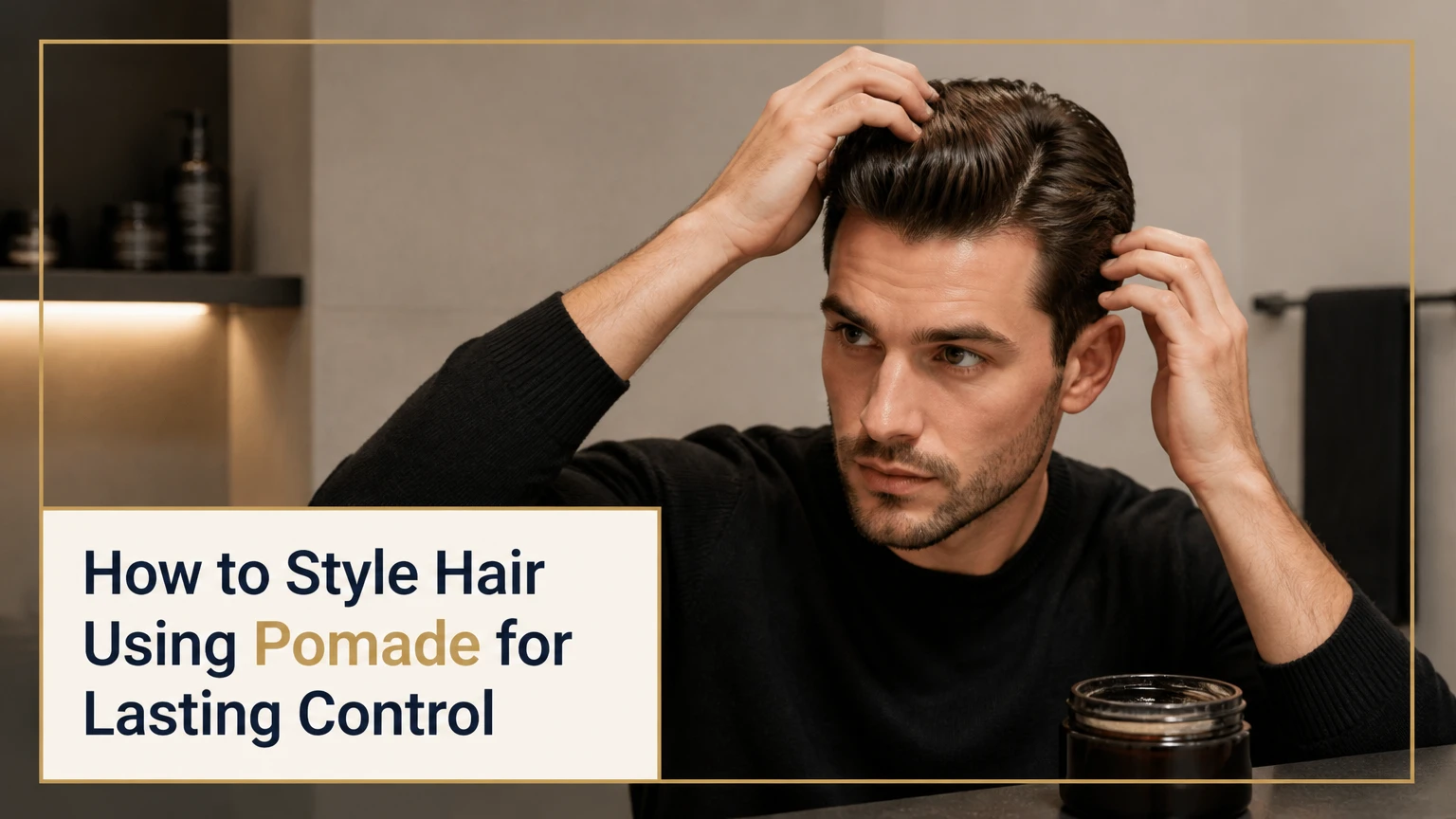
To style hair using pomade, prepare clean, slightly damp or fully dry hair, emulsify a small amount between your palms, apply from the back toward the front, then shape with a comb or fingers. The process usually takes 3-7 minutes, and the correct product, amount, and hair moisture determine whether the result looks controlled or greasy.
Key Facts at a Glance
- Pomade provides hold, shape, and varying levels of shine without necessarily creating a hard gel-like shell.
- A dime-sized amount is a practical starting dose for short to medium hair.
- Apply pomade to damp hair for shine and slickness, or dry hair for volume and texture.
- Oil-based pomade remains reworkable but usually requires conditioner and clarifying shampoo to remove.
- Water-based pomade washes out more easily but may stiffen as water evaporates.
- Fine hair generally needs less product and benefits from matte clay or lightweight paste.
What Is Pomade and How Does It Work?
Pomade is a hair-styling product that coats hair strands with oils, waxes, clays, creams, or water-soluble polymers to create control, separation, shine, or texture. The product changes how strands adhere to one another, allowing the user to flatten, direct, lift, or group hair into defined sections.
Traditional oil-based pomades commonly contain petrolatum, mineral oil, lanolin, or waxes. Modern water-based formulas use water, emulsifiers, humectants, and film-forming polymers. Clay pomades add ingredients such as kaolin or bentonite to absorb oil and create a drier finish.
Pomade works through a combination of adhesion and cohesion. Adhesion helps the product attach to the hair shaft, while cohesion gives the styling film enough internal strength to resist movement. A soft pomade can be reshaped with a comb or fingers because the product remains flexible rather than forming a brittle surface.
Pomade is not a treatment for hair loss, and it does not permanently alter hair growth. The American Academy of Dermatology Association notes that styling products can irritate the scalp in some people, especially when fragrance or other ingredients trigger contact dermatitis. Patch-test a new formula if your scalp is reactive.
Does Pomade Make Hair Look Wet?
Pomade can make hair look wet when the formula has high shine or when the hair is applied damp. The wet appearance comes from reflected light on the product film, not from increased hydration inside the hair shaft.
A high-shine oil-based pomade creates the strongest wet-look effect. A matte clay or low-shine paste produces less reflection and usually separates strands more visibly. Product quantity matters as much as formula: doubling the dose can turn a polished side part into a visibly greasy style.
How to Choose the Right Pomade Type
Choose pomade according to four variables: desired shine, required hold, hair density, and how easily you need to wash the product out. Oil-based pomade suits durable classic styles, water-based pomade suits cleaner daily styling, clay suits volume and matte texture, and cream or paste suits lighter control.
| Pomade type | Typical finish | Typical hold | Washout and best use |
|---|---|---|---|
| Oil-based | High shine, slick | Medium to heavy | Difficult washout, pompadours and slickbacks |
| Water-based | Medium to high shine | Medium to firm | Easy washout, side parts and quiffs |
| Clay pomade | Matte, dry texture | Medium to heavy | Moderate washout, crops and fine hair |
| Cream or paste | Natural to low shine | Light to medium | Easy to moderate washout, casual movement |
What Is the Difference Between Oil-Based and Water-Based Pomade?
Oil-based pomade offers the strongest reworkability and usually the highest shine, while water-based pomade offers easier removal and a cleaner finish. Oil-based formulas remain pliable throughout the day; water-based formulas may become firmer as their water content evaporates.
| Decision factor | Oil-based pomade | Water-based pomade |
|---|---|---|
| Restyling | Works with a comb or fingers | Usually needs water or fresh product |
| Shine | High to very high | Medium to high |
| Washout | Conditioner plus shampoo often needed | Usually one or two shampoo cycles |
| Rain performance | Often remains workable | Can soften or lose structure |
| Fine-hair suitability | Can flatten fine strands | Better with light application |
| Classic-style control | Excellent | Very good |
Clay and paste are not always technically pomades, because manufacturers use the labels inconsistently. Read the ingredient list and performance description rather than relying on the jar name alone.
Before You Start
| Requirement | Typical recommendation | Why it matters |
|---|---|---|
| Styling time | 3-7 minutes | Covers application and shaping |
| Product quantity | 0.5-2 g initially | Prevents excess buildup |
| Hair condition | Damp for shine, dry for volume | Controls finish and grip |
| Main tool | Wide-tooth or medium-tooth comb | Distributes product evenly |
| Finishing tool | Hair dryer, towel, or fingers | Adds direction and texture |
| Product cost | $8-$35 per 2-4 oz jar | Typical retail range |
Start with clean or lightly dirty hair. Excess sebum can increase shine and reduce volume, while freshly washed hair may feel too slippery for some water-based formulas. If the hair is very soft, a small amount of prestyler or sea-salt spray can increase grip, but additional product also increases buildup.
A medium-tooth comb works for side parts and slickbacks. Fingers work better for textured crops, loose quiffs, and curly styles. Keep a towel nearby because wet hands can unintentionally dilute the pomade and change its hold.
How to Style Hair Using Pomade in 7 Steps
The seven-step pomade method is: prepare the hair, measure the product, emulsify it, apply from back to front, establish direction, refine the finish, and check the result after setting. Most short and medium styles take 3-7 minutes, but the amount of pomade is the factor that most determines whether the finish looks intentional.
Step 1: Prepare the Hair at the Correct Moisture Level
Wash or rinse the hair, towel-dry it, and choose the moisture level based on the style. Leave short or medium hair slightly damp for a slick, shiny result, or blow-dry it mostly or completely dry for volume, matte texture, and stronger root lift.
| Desired style | Hair condition | Preparation method |
|---|---|---|
| Slickback | 10-20% damp | Towel-dry, then brush backward |
| Side part | 5-15% damp | Create the part before product |
| Pompadour | 80-100% dry | Blow-dry upward and backward |
| Textured crop | 100% dry | Use fingers to separate sections |
| Curly shape | 50-70% damp | Preserve curl grouping and avoid brushing dry |
Use a hair dryer on medium heat rather than maximum heat, keeping it about 15 cm from the hair. Direct airflow from roots toward the intended shape. You will know preparation worked when the hair already follows the style loosely before pomade is added.
Common mistake: Applying heavy pomade to soaking-wet hair. The product becomes diluted, the hold weakens, and the finished hair can separate into greasy-looking strands.
Step 2: Measure a Small Amount
Scoop a dime-sized portion, approximately 0.5-1.5 g, for short or medium hair. Long, thick, or highly resistant hair may need 2-4 g total, but apply that amount in two or three passes rather than one large scoop.
| Hair situation | First dose | Maximum initial total |
|---|---|---|
| Short, fine hair | 0.25-0.5 g | 1 g |
| Short, thick hair | 0.5-1 g | 2 g |
| Medium, average-density hair | 0.75-1.5 g | 3 g |
| Long or very thick hair | 1-1.5 g | 4 g |
| Curly hair | 0.25-0.75 g | 2 g |
The back of a thumbnail gives a useful visual measure, but jar formulas differ in density. A hard wax scoop weighs more than an airy cream scoop. Start low because adding product is easier than removing it.
Common mistake: Copying another person’s scoop size. Hair density, length, porosity, and product strength can make the same volume look light on one person and overloaded on another.
Step 3: Emulsify Pomade Between Your Palms
Rub the pomade between your palms and fingers for 5-10 seconds until the product becomes a thin, even film. Oil-based pomade should soften; clay should lose visible lumps; water-based pomade should spread without white pieces or thick streaks.
Warmth and friction distribute the product. The goal is not to heat the pomade until it becomes liquid, but to remove concentrated clumps that would otherwise land on one section of hair.
You will know emulsification worked when your palms look lightly coated rather than covered by a thick blob. Spread product over the fingers because the fingers are the main delivery surface for root coverage.
Common mistake: Applying a solid scoop directly to the hairline. The front receives too much product, while the crown and back receive too little, creating a dark clump at the forehead.
Step 4: Apply From the Back Toward the Front
Place your fingers into the crown and back of the head first, then work forward toward the fringe. Push the product through the roots and lengths with deliberate passes, covering the sides and back before using any remaining product at the front.
Back-to-front application prevents the hairline from receiving the entire first dose. Root-to-tip application gives the style a foundation, but avoid scraping the scalp with fingernails, especially when using a firm clay.
For a slickback, use flat palms and fingers to press hair backward. For a side part, distribute product across both sides before defining the part. For a textured crop, use short raking motions that lift rather than flatten.
You will know coverage is even when no section feels dry, sticky, or dramatically heavier than the rest. The hair should move as a connected shape without looking coated in isolated patches.
Common mistake: Applying only to the surface. Surface-only application creates flyaways and weak hold at the roots, particularly in thick hair.
Step 5: Establish the Main Shape
Set the overall direction before working on detail. Use a comb for a side part, slickback, executive contour, or pompadour; use fingers for a quiff, crop, messy finish, waves, or naturally curly hair.
Comb from the roots toward the ends with steady pressure. Establish the part with the comb’s spine or teeth, then make two or three controlled passes rather than repeatedly disturbing the same area.
For volume, lift the front with a comb while directing warm air underneath, then reduce the dryer’s heat before finishing. For texture, pinch small sections and twist them in alternating directions. For curls, press product into curl groups instead of pulling individual strands straight.
The shape is ready for refinement when the silhouette looks correct from the front and side. Detail work cannot rescue an incorrect foundation.
Common mistake: Chasing texture before establishing direction. Excessive finger movement can break the shape and distribute more product to the ends than the roots.
Step 6: Refine the Finish
Add a second half-scoop only where the first application failed. Smooth flyaways with a lightly coated palm, sharpen the part with a clean comb, or pinch selected strands to increase separation.
A slick style benefits from a fine or medium-tooth comb, while coarse hair often responds better to a wide-tooth comb followed by palm smoothing. Do not repeatedly comb fine hair after it has formed, because repeated passes can collapse volume and expose the scalp.
For a matte look, stop when the texture appears separated rather than shiny. For high shine, add a tiny amount to the surface and comb it into place. Shine should be built gradually.
Common mistake: Adding more product because the style looks unfinished before the formula settles. Wait 5-10 minutes first, especially with water-based pomade.
Step 7: Inspect and Let the Style Set
Check the hairline, crown, sides, and profile in natural light. Allow water-based pomade 15-30 minutes to become firmer, while oil-based pomade remains pliable and can be adjusted throughout the day.
A successful finish has consistent product distribution, a stable silhouette, and no visible white residue. If the hair feels stiff, sticky, or visibly wet beyond the intended finish, the dose was probably too high.
Which Styles Work Best With Pomade?
Pomade works best for side parts, slickbacks, pompadours, quiffs, contours, textured crops, and controlled curly styles. The formula should match the geometry of the hairstyle: high-shine products support smooth planes, while matte products support separation and lift.
| Style | Recommended pomade | Application method | Typical result |
|---|---|---|---|
| Slickback | Medium or heavy oil-based | Damp hair, comb backward | High shine, durable control |
| Side part | Medium water-based | Slightly damp, combed | Defined part, moderate shine |
| Pompadour | Firm water-based or oil-based | Dry prestyling, lift roots | Height and structured volume |
| Textured crop | Matte clay | Dry hair, finger rake | Separation and low shine |
| Loose quiff | Paste or clay | Dry roots, lift fringe | Flexible volume |
| Curly shape | Cream pomade | Damp curls, scrunch lightly | Definition with reduced frizz |
Pomade is less suitable for beachy, weightless volume, very soft touchable movement, or styles that need zero visible product. A lightweight cream, mousse, or salt spray may perform better in those situations.
How Should You Style Fine or Thinning Hair?
Fine or thinning hair should be styled with a light matte clay or paste on dry, pre-shaped hair. Use approximately 0.25-0.5 g initially, keep the roots lifted, and avoid high-shine oil-based pomade because reflection and strand separation can make the scalp appear more visible.
Blow-dry the roots upward before applying product. Place the pomade on the fingertips and work it into selected areas rather than coating the entire surface. A textured crop or short quiff usually creates more visual density than a tightly slicked style.
Pomade cannot increase the number of hair follicles or reverse genetic hair loss. If thinning is sudden or accompanied by scalp symptoms, a dermatologist is more appropriate than a stronger styling product.
How Should You Style Thick, Coarse, or Unruly Hair?
Thick or coarse hair usually needs a medium-to-heavy pomade applied in two passes. Begin with damp hair for easier distribution, use a firm water-based or oil-based formula, and comb from the roots so the product controls the internal bulk rather than merely coating the exterior.
A blow-dryer can reduce the amount of pomade required by setting direction first. Work in sections if the hair is longer than about 8 cm. Apply the second pass only to resistant areas, such as the crown or side panels.
How Should You Use Pomade on Curly or Wavy Hair?
Use a cream pomade or flexible water-based formula on damp curly or wavy hair. Spread a small amount across the palms, press it into curl groups, then scrunch upward without brushing the curls apart.
Pomade can reduce frizz and add definition, but a heavy wax formula may stretch curls, reduce spring, or leave buildup. Dry the hair with a diffuser on low airflow if additional volume is needed.
Pomade Compared With Other Styling Products
Pomade is the better choice when reworkable direction, controlled shine, or a combed shape matters more than a dry, invisible finish. Gel gives a harder set, wax gives localized separation, clay gives matte volume, paste gives softer movement, and hairspray provides a finishing layer rather than primary shaping.
| Product | Hold behavior | Finish | Best application |
|---|---|---|---|
| Pomade | Flexible to firm | Natural to high shine | Side parts, slickbacks, quiffs |
| Gel | Hard after drying | Wet to glossy | Spikes and rigid shapes |
| Wax | Flexible, concentrated | Natural to shiny | Short separation and definition |
| Clay | Dry, texturizing | Matte | Volume, crops, fine hair |
| Paste | Soft to medium | Natural | Casual movement and medium hair |
| Hairspray | Surface-setting | Variable | Locking an already shaped style |
The terms “pomade,” “wax,” and “paste” are not regulated categories. Two products with the same label can contain different bases and behave differently, so hold and finish descriptions should be confirmed through ingredients and user instructions.
How Long Does Pomade Last?
Pomade typically provides visible control for 8-12 hours, although oil-based formulas may remain reworkable longer and lightweight creams may lose structure sooner. Water-based pomade often becomes firmer within 15-30 minutes as moisture evaporates.
| Variable | Typical range | Effect on performance |
|---|---|---|
| Daily styling session | 3-7 minutes | Application plus shaping |
| Water-based set time | 15-30 minutes | Hold becomes firmer |
| Oil-based reworkability | 8-14 hours | Shape can be reset |
| Typical jar lifespan | 3-9 months | Depends on dose and frequency |
| Product shelf period after opening | About 12-24 months | Check smell, texture, and separation |
A jar’s calendar shelf life is not the same as the number of styling sessions it provides. Daily use of 2 g can consume a 100 g jar in approximately 50 days, while occasional use of 0.5 g may extend the same jar for six months or more.
Common Pomade Problems and Their Fixes
Most pomade failures come from excessive quantity, incorrect hair moisture, incomplete emulsification, or a mismatch between hold and hair density. Fix the application variable first before buying a stronger product.
| Problem | Likely cause | Immediate fix | Prevention |
|---|---|---|---|
| Greasy, flat hair | Too much oil-based product | Blot and comb through | Start with 0.5-1 g |
| Front clump | Product applied at hairline first | Distribute backward with comb | Apply crown first |
| White residue | Poor emulsification | Rub and rework with damp fingers | Emulsify 5-10 seconds |
| Tugging | Firm clay on dry hair | Add slight moisture | Apply clay to prepared hair |
| Weak hold | Too little product or wet hair | Dry and add half-scoop | Match formula to density |
| Visible flakes | Dried water-based film or buildup | Wash thoroughly | Remove product regularly |
Dry shampoo or texture powder can absorb some excess oil, but these products may create additional residue. If the hair is heavily overloaded, washing is more reliable than repeatedly layering absorbent powders.
How Do You Wash Pomade Out?
Remove oil-based pomade by applying conditioner to dry hair first, massaging it through the lengths, rinsing with warm water, and then shampooing. Water-based pomade usually needs one or two shampoo cycles, while clay and wax may require a longer rinse because their waxes adhere to the hair.
The conditioner-first method helps loosen oily ingredients before water contacts them. Use a clarifying shampoo occasionally rather than at every wash, because excessive clarification can dry the hair and irritate the scalp.
| Product base | First removal step | Shampoo expectation |
|---|---|---|
| Oil-based | Conditioner on dry hair | Clarifying shampoo may be needed |
| Water-based | Warm rinse | One or two regular shampoos |
| Clay | Thorough warm rinse | One or two shampoos |
| Cream or paste | Warm rinse and conditioner | Usually one regular shampoo |
Wash the scalp as well as the lengths. Persistent itching, redness, pimples, or flaking can indicate irritation or folliculitis, and stopping the offending product is safer than masking symptoms with more styling products.
What Does Pomade Cost?
A typical pomade costs $8-$35 for a 2-4 oz container, with professional and imported formulas often costing more. Price does not reliably predict hold, shine, washability, or suitability for a specific hair type.
| Category | Typical price | Common size | Practical buyer |
|---|---|---|---|
| Budget water-based | $8-$15 | 3-4 oz | Daily side parts and quiffs |
| Mid-range clay | $15-$25 | 2-4 oz | Matte texture and volume |
| Premium oil-based | $18-$35 | 3-4 oz | Classic styles and reworkability |
| Professional cream | $18-$35 | 2-4 oz | Curls and flexible movement |
Read the ingredient list if you have acne-prone skin or a sensitive scalp. Avoid applying pomade directly to facial skin, wash pillowcases regularly, and do not share jars because fingers introduce oils, water, and microbes into the product.
Can Hair Electrolysis Help With Pomade Styling?
Hair electrolysis does not improve scalp-hair styling because electrolysis is a permanent hair-removal procedure that targets individual follicles. Electrolysis may be relevant to unwanted facial or body hair, but it should not be used to alter the scalp hairline for a pompadour, side part, or slickback.
Styling concerns such as an uneven hairline, excess baby hairs, or neck hair should be discussed with a licensed electrologist or dermatologist. Do not treat the hairline with electrolysis simply to make pomade application easier.
Frequently Asked Questions
Can You Apply Pomade Every Day?
You can apply pomade daily if you remove buildup regularly and your scalp tolerates the formula. Use the smallest effective amount, avoid sleeping with heavy product when possible, and wash pillowcases and combs frequently. Stop using the product if it causes persistent itching, redness, bumps, or scaling.
Should You Use Pomade Before or After Blow-Drying?
Apply most pomades after blow-drying when you want volume, texture, or root lift. Apply pomade to slightly damp hair when you want maximum slickness and shine. A small amount of lightweight prestyler can be used before drying, but layering products increases weight and residue.
Is Pomade Bad for Your Hair?
Pomade is not inherently damaging, but heavy buildup, aggressive removal, heat, and scalp irritation can create problems. Oil-based formulas can weigh down fine hair, while firm clays may cause tugging if applied to dry, tangled strands. Gentle application and complete removal reduce those risks.
Can Pomade Hold Hair in Humidity?
Pomade can control hair in humidity, but performance depends on the base and style. Oil-based formulas remain flexible, while water-based formulas may soften when exposed to rain or high humidity. Use a firm product, dry the hair thoroughly, and avoid excessive shine products if humidity causes strand separation.
How Much Pomade Should a Beginner Use?
A beginner should start with 0.5-1 g for short or medium hair, emulsify it fully, and add another 0.25-0.5 g only where control is missing. Long or thick hair may require up to 4 g, but several small applications distribute more evenly than one large scoop.
Can Pomade Be Used on Long Hair?
Pomade can control long hair, especially flyaways, low ponytails, slicked-back styles, and defined waves. Use a cream or light paste for movement, and apply mainly to the roots and surface. Heavy oil-based pomade can make long hair look stringy, flat, and difficult to wash.
The Bottom Line
The most reliable way to style hair using pomade is to match the formula to the desired finish, prepare the hair at the correct moisture level, start with a small dose, and apply from the back toward the front. Use a comb for smooth structure and fingers for texture, then wait several minutes before adding more product. Wash oil-based buildup with conditioner followed by shampoo, and choose matte clay or lightweight paste when shine or weight would expose fine hair.