To dispose of a hair dryer, unplug and cool the appliance, check whether it is safe to reuse, then take it to an accepted small-appliance or e-waste collection point. Donate only a fully functional dryer with an intact cord. Do not place the main unit in a recycling bin unless your local program specifically accepts small electrical appliances.
Key Facts at a Glance
- A hair dryer is a small electrical appliance containing a motor, wiring, heating element, plastics, and sometimes a circuit board.
- A working hair dryer can be donated only when it operates safely and has no frayed cord, burning smell, sparking, or overheating.
- A broken hair dryer should go to an e-waste, small-appliance, retailer take-back, or household hazardous-waste program, depending on local rules.
- Curbside recycling acceptance varies by municipality, so the local waste authority, not the appliance material alone, determines the correct bin.
- Most single-item drop-offs are free, while private collection services often impose a minimum charge of approximately $50-$150.
- Keep the hair dryer intact unless the receiving facility specifically instructs you to remove a component.
What Makes a Hair Dryer E-Waste?
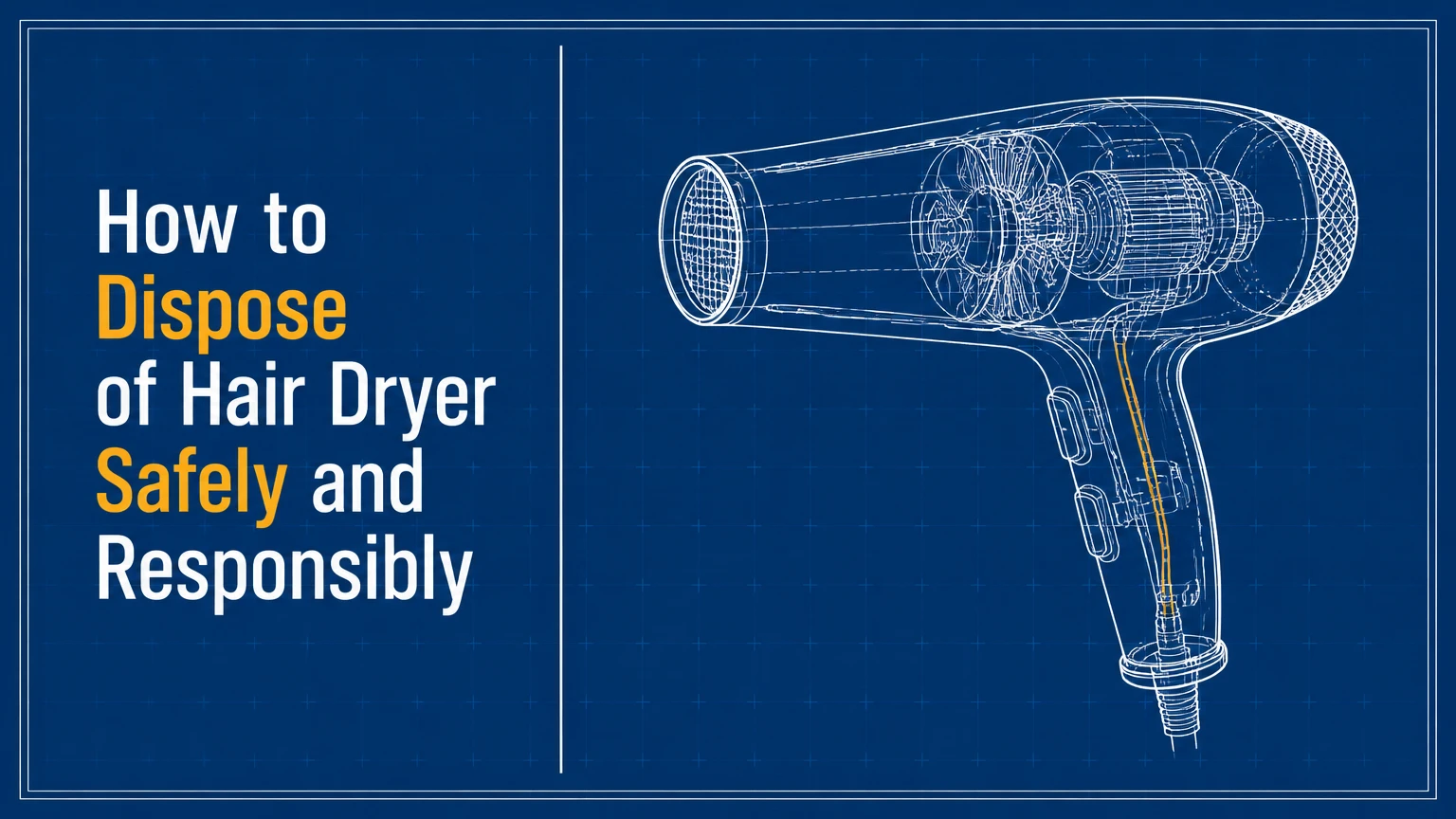
A hair dryer is e-waste because it uses electricity and contains integrated electrical and mechanical components. The appliance normally includes a copper conductor, electric motor, fan, nichrome or ceramic heating element, thermal cut-off device, switches, heat-resistant polymers, and, in newer models, control electronics or a printed circuit board.
The classification matters because ordinary plastic recycling is designed for separated packaging polymers, not assembled appliances with cords, motors, metals, and heat-resistant parts. A recycling facility may recover copper, steel, aluminum, and selected plastics, but recovery depends on the facility’s equipment and downstream contractor.
A hair dryer is usually not classified as hazardous waste merely because it is electrical. The correct stream depends on local rules, the appliance’s condition, and whether it contains a battery or another regulated component. The United Kingdom treats covered electrical equipment through WEEE arrangements, while Australian guidance directs residents to approved e-waste services rather than assuming household recycling acceptance.
Why the internal parts affect disposal
A hair dryer combines materials that require different processing methods. A motor and heating assembly may be separated through mechanical shredding, while copper wiring and ferrous metals can enter metal-recovery processes; mixed plastics may have lower recovery value because heat resistance, additives, and contamination complicate sorting.
Power cords also create a practical processing problem. Cords can wrap around rotating equipment at some material-recovery facilities, although the exact risk depends on the facility’s machinery and whether the program accepts electrical products. That is why a municipal program may tell residents to keep electrical appliances out of the blue bin even when the appliance contains recyclable metal.
Before You Start
| Requirement | Typical value | Why it matters |
|---|---|---|
| Preparation time | 5-10 minutes | Allows cooling, cleaning, and condition checks |
| Drop-off time | 5-15 minutes onsite | Applies to a prepared single appliance |
| Direct cost | $0 at many public programs | Confirm before traveling |
| Materials | 1 bag or small box, 1 label | Prevents cord tangling and confusion |
| Required condition | Dry, unplugged appliance | Protects the person transporting it |
| Main decision | Reuse or e-waste | Determines the correct destination |
Do not test a wet hair dryer, a dryer with exposed wiring, or a unit that has already produced smoke. A safe inspection needs no screwdriver, wire cutter, electrical tester, or casing removal. The objective is to identify a safe reuse candidate, not to diagnose the appliance.
How to Dispose of Hair Dryer in Four Steps
Step 1: Check the Hair Dryer Safely
Unplug the hair dryer and let it cool completely before inspecting the casing, air inlet, switch, plug, and power cord. If the dryer is dry and appears intact, a brief supervised test may confirm operation, but skip testing when the unit sparks, smells of burning insulation, rattles severely, overheats, or has exposed conductors.
Check these conditions:
- Cord jacket: no cuts, melted areas, flattened sections, or exposed wires.
- Plug: no bent pins, scorching, cracked housing, or loose connection.
- Body: no cracked casing, missing guard, or sharp broken edge.
- Operation: no smoke, electrical arcing, abnormal heat, or repeated shutoff.
- Attachments: no melted diffuser, brittle nozzle, or contamination that cannot be cleaned.
You will know the dryer is a possible donation candidate when it runs normally, remains stable, and has a sound cord and plug. The common mistake is plugging in a questionable appliance “for one last check.” A damaged cord can create shock or fire risk before the motor even starts.
Step 2: Choose Reuse or Recycling
Donate or resell a hair dryer only when the complete appliance works safely and its condition is described accurately. Send a nonworking, overheating, sparking, or cord-damaged dryer to an electrical recycling route instead of a charity shop or marketplace.
| Hair dryer condition | Recommended route | Donation status | Preparation |
|---|---|---|---|
| Works normally, intact cord | Charity, shelter, resale, or reuse group | Usually eligible | Clean and disclose age |
| Works intermittently | E-waste or repair assessment | Do not donate | Label the fault |
| Frayed, melted, or exposed cord | E-waste or local hazardous-electrical route | Not eligible | Do not plug in |
| Burning smell or smoke | E-waste advice line or hazardous-waste program | Not eligible | Keep isolated and dry |
| Missing guard or cracked casing | E-waste or repair service | Usually not eligible | Keep intact |
| Unknown condition | E-waste collection point | Avoid donation | State “untested” |
A charity may have a stricter acceptance policy than a recycler because it assumes a donated appliance will be used by another person. Goodwill, Salvation Army branches, shelters, Buy Nothing groups, and local marketplaces make sense only after confirming that the recipient accepts electrical grooming tools and that the dryer is safe.
Clean hair, dust, and styling residue from the exterior and removable attachments. Do not conceal defects with tape or describe a dryer as working when it has not been tested.
Step 3: Find an Accepted Drop-Off Point
Search your municipal waste authority for “small electrical appliances,” “e-waste,” “WEEE,” or “household electrical recycling,” then verify that the site accepts plug-in hair dryers. Facility categories differ: some civic sites accept all small electricals, while others restrict appliances by size, brand, working condition, or residency.
Use the following starting points:
| Region | Useful locator or authority | Search term to use | Acceptance caution |
|---|---|---|---|
| United States | Earth911, municipal solid-waste department | “small appliance recycling” | Call to confirm hair dryers |
| United Kingdom | Recycle Your Electricals | “hair dryer recycling” | Check retailer and council rules |
| Ireland | WEEE Ireland and local authority | “WEEE small electricals” | Confirm civic amenity access |
| Australia | Planet Ark Recycling Near You | “electrical recycling hair dryer” | Use an approved e-waste site |
| Canada | Provincial or municipal waste authority | “small electrical appliance depot” | Rules vary by province |
| Singapore | ALBA e-waste collection network | “small household electrical appliance” | Check collection-bin limits |
Earth911 and Recycle Your Electricals are useful discovery tools, but a locator result does not guarantee that a particular branch accepts every appliance. Ask four questions before traveling:
- Do you accept plug-in hair dryers?
- Is the service free for residents?
- Must the appliance be working, intact, or under a stated size?
- Do you accept units with damaged cords or suspected internal faults?
Step 4: Package and Drop Off the Dryer
Place the unplugged, dry hair dryer in a small box or reusable bag so the cord remains contained during transport. Keep the unit intact, avoid stacking heavy objects on its casing, and follow the site’s instructions for the marked small-appliance or e-waste container.
You will know the step is complete when the receiving employee or posted signage identifies the destination as electrical recycling, WEEE, small appliances, or an equivalent approved stream. The common mistake is leaving the appliance beside a collection cage instead of placing it inside the designated container, which can expose workers and contaminate the site.
Remove detachable nozzles only if the facility instructs you to do so. A plastic resin code does not automatically make an attachment acceptable in curbside recycling because local programs may reject small rigid plastics, mixed materials, black plastic, or items under a minimum size. Keep the attachment with the dryer when uncertain.
Which Disposal Method Should You Choose?
The best route depends on condition, local acceptance, cost, and the number of appliances involved. For one broken dryer, a free municipal e-waste drop-off is usually more suitable than hiring a junk-removal crew; for a working dryer, verified donation avoids processing and extends product use.
| Method | Typical cost | Typical time | Best condition or situation |
|---|---|---|---|
| Municipal e-waste site | $0-$15 | 20-60 minutes including travel | One broken residential dryer |
| Retailer take-back | $0-$15 | 10-30 minutes | Customer already visiting a participating store |
| Charity or reuse group | $0 | 15-45 minutes | Fully functional dryer with intact cord |
| Repair shop | $0-$40 assessment | 1-14 days | Intermittent fault or repairable premium unit |
| Mail-back program | $5-$25 typical shipping | 3-10 days | No nearby physical drop-off |
| Junk removal company | $50-$150 minimum | Same day to 1 week | Multiple appliances or a house clearance |
| Salon e-waste contractor | Contract or load-based | 1-30 days | Several professional tools with records |
Municipal e-waste collection
Municipal drop-off sites are generally the first choice for a broken household hair dryer because they are designed to consolidate electrical items and route them to approved processors. Some sites charge nothing to residents, while others apply fees to nonresidents or commercial loads.
A civic amenity site is not automatically “100% eco-safe.” Ask whether the operator uses an authorized downstream recycler and whether commercial quantities require separate arrangements. The site remains a strong option when its acceptance policy is clear and the dryer is transported safely.
Retailer take-back
Retailer programs can be convenient, but acceptance depends on country, store, product category, and current policy. In the United States, Best Buy has offered recycling services for selected electronics and appliances, but service limits and fees can change by location. In countries covered by WEEE rules, retailer obligations may require take-back under specific conditions, such as a one-for-one purchase or a product-size threshold.
Do not assume a retailer must accept a hair dryer because it sells hair dryers. Check the store’s current recycling page or call the branch before carrying in a broken unit.
Donation and resale
Reuse is preferable when a dryer is safe and still useful. A charity, shelter, salon-training program, or local reuse group may accept a working appliance, but organizations can reject personal-care electrical equipment because of liability, hygiene, storage, or testing limits.
Disclose the brand, model, age, heat settings, included attachments, and any defect. Clean the filter and housing without soaking the motor area. A functioning dryer with a worn cord is not a donation candidate.
Junk removal
Junk removal is a convenience service rather than an economical single-item recycling method. Companies such as 1-800-GOT-JUNK? may collect small electrical appliances as part of a larger load, but the final recycling route and minimum charge require confirmation.
Junk removal makes sense when a salon, landlord, or household is already paying for a substantial clearance. It is poor value for one lightweight hair dryer that fits in a car.
Can a Hair Dryer Go in the Recycling Bin?
A hair dryer should not go in a standard curbside recycling bin unless the local recycling authority explicitly lists plug-in small appliances as accepted materials. The main unit combines a cord, motor, heating element, and mixed plastics, so placing it with bottles, cans, and packaging can cause rejection or equipment problems.
| Disposal instruction | Usually appropriate? | Reason | Verification |
|---|---|---|---|
| Blue or mixed recycling bin | No | Appliance is assembled and corded | Municipal accepted-materials list |
| General trash | Usually no | Loses material recovery and may create fire risk | Local waste authority |
| E-waste drop-off | Yes | Designed for electrical appliances | Facility confirmation |
| Charity donation | Yes, if safe | Extends useful life | Charity acceptance policy |
| Metal scrap bin | Usually no | Nonmetal motor and plastics remain attached | Scrap-yard instructions |
| Household hazardous-waste event | Sometimes | Some programs accept damaged electrical goods | Event category list |
The blanket claim that every curbside program rejects hair dryers is too broad. Waste systems differ, and a few jurisdictions collect small electricals through special curbside services. The practical rule is simple: follow the named local material list, not a generic internet rule.
What Should You Do With a Broken or Dangerous Dryer?
A broken or dangerous hair dryer should remain unplugged, dry, intact, and away from sinks, children, pets, and combustible materials until the receiving program gives disposal instructions. Do not donate it, put it in a recycling bin, cut the cord, crush the casing, or open the appliance.
Use this decision table:
| Warning sign | Immediate action | Preferred destination | Do not do |
|---|---|---|---|
| Frayed cord | Stop using it | E-waste or electrical-waste program | Tape and donate it |
| Burning smell | Unplug if safe, isolate when cool | E-waste advice line | Retest repeatedly |
| Smoke or sparks | Disconnect power if safe | Local hazardous-electrical guidance | Put it in household trash |
| Water exposure | Keep unplugged and dry | Repair or e-waste assessment | Test it while damp |
| Broken guard | Stop use | E-waste or repair service | Operate without the guard |
| Rattling motor | Stop use if severe | Repair or e-waste program | Shake or dismantle it |
A hair dryer normally does not contain the large rechargeable lithium battery found in many cordless tools, but cordless models can include one. Do not place a battery-equipped model in a general e-waste cage until the facility confirms its battery procedure. Battery removal is a facility-specific instruction, not a default home task.
Can You Recycle Attachments and the Power Cord Separately?
Keep the power cord attached to the hair dryer unless the recycler specifically requests separation. Cutting the cord creates exposed conductors and does not improve household recycling; professional processors can separate copper and other materials using controlled equipment.
Detachable attachments need separate verification. A concentrator nozzle or diffuser may be made from heat-resistant plastic, silicone, or a mixed material, and a resin number alone does not prove acceptance by the local curbside program. Wash and dry a reusable attachment if donating the dryer. Otherwise, place it with the main unit and let the receiving program decide.
One practitioner rule is reliable: when two components were sold and used as one electrical appliance, deliver them together. Separation is worthwhile only when the facility has published a component-specific instruction.
How Much Does Hair Dryer Disposal Cost?
Hair dryer disposal typically costs $0-$15 at a public drop-off or retailer program, while donation is usually free. Private mail-back services may charge approximately $5-$25, and junk removal often costs $50-$150 because the company applies a minimum pickup fee rather than pricing the dryer by weight.
| Route | Typical single-item cost | Typical processing or service time | Main variable |
|---|---|---|---|
| Donation | $0 | Same day | Organization acceptance |
| Municipal site | $0-$15 | 5-15 minutes onsite | Residency and local fee |
| Retail take-back | $0-$15 | 10-30 minutes | Store policy and limits |
| Mail-back | $5-$25 | 3-10 days transit | Box and shipping weight |
| Repair assessment | $0-$40 | 1-14 days | Brand and fault complexity |
| Junk removal | $50-$150 | Same day to 1 week | Minimum call-out charge |
| Salon contractor | $25-$200+ typical batch | 1-30 days | Quantity and documentation |
The $50-$150 junk-removal figure is a typical minimum range, not a universal price. Municipal sites can also charge for commercial quantities, oversized loads, or nonresident access. Confirm the fee before travel or booking.
How Long Does Recycling Take?
A prepared drop-off usually takes 5-15 minutes onsite, while the complete recycling chain can take roughly 1-3 weeks before sorting and material processing, according to industry disposal guidance. The exact interval depends on collection volume, transport schedules, processor capacity, and whether the item waits for a consolidated load.
Consumers normally do not receive a material-by-material report for one household hair dryer. The recycler may first depollute or inspect the appliance, then shred or dismantle it, separate ferrous and nonferrous metals, and send residual plastics to a suitable downstream processor. Recovery rates vary by facility.
Do not pay a premium solely for a claimed processing speed. For a single dryer, verified acceptance and a documented downstream route matter more than whether processing takes seven days or three weeks.
Salon and Professional-Use Equipment
Salon owners should collect old hair dryers in a labeled e-waste container, record quantities and condition, and use a commercial electrical-waste contractor when municipal programs exclude business waste. A contractor can provide pickup records, weight tickets, or chain-of-custody documentation, which helps distinguish responsible recycling from general waste disposal.
| Salon situation | Recommended route | Record to retain | Avoid |
|---|---|---|---|
| One working dryer | Staff reuse or verified donation | Recipient and date | Untracked giveaway |
| Five damaged dryers | Commercial e-waste collector | Pickup receipt and quantity | General dumpster |
| Mixed dryers and clippers | Salon-tool recycler | Itemized manifest | Separating cords onsite |
| Whole salon closure | Licensed clearance contractor | Waste transfer paperwork | Unverified “green” claims |
| Premium repairable units | Repair assessment | Repair invoice | Automatic disposal |
Sustainable Salons accepts selected salon tools and e-waste through its own program in relevant service areas, but eligibility depends on location and item category. A salon should ask whether the program accepts hair dryers, whether there is a minimum quantity, and what documentation it supplies.
Hair dryers also differ from hair-electrolysis equipment. An electrolysis machine may include a power supply, foot pedal, handpiece, display, treatment controls, and potentially regulated sharps or contaminated accessories. The electrical console should follow an e-waste or medical-equipment policy, while used needles and clinical consumables require the applicable sharps or healthcare-waste route. Never place electrolysis needles in the same bag as a household hair dryer.
Common Mistakes and How to Fix Them
Mistake 1: Putting the dryer in curbside recycling
Why it fails: The program may accept packaging but reject assembled appliances and cords.
Fix: Remove the hair dryer from the curbside bin and use the municipal e-waste instructions.
Mistake 2: Donating a dryer with a damaged cord
Why it fails: The next user may receive a shock or fire hazard.
Fix: Mark the appliance as unsafe to use and contact an e-waste facility.
Mistake 3: Cutting the cord for scrap value
Why it fails: Exposed copper creates a handling hazard, while the remaining appliance still needs processing.
Fix: Keep the cord attached unless the receiving facility directs otherwise.
Mistake 4: Assuming every retailer has a legal duty to accept it
Why it fails: WEEE obligations vary by country, product size, retailer type, and purchase conditions.
Fix: Check the store’s current policy and local regulation before visiting.
Mistake 5: Opening the casing
Why it fails: The casing can expose sharp edges, hot-coil residue, wiring, and components that are difficult to identify safely.
Fix: Deliver the appliance intact to a qualified processor.
Mistake 6: Leaving the appliance beside a collection container
Why it fails: Unsecured items can obstruct access, become wet, or require manual handling.
Fix: Place the unit inside the labeled container or hand it to staff.
Troubleshooting Refusals and No Nearby Sites
If no nearby facility accepts a hair dryer, check for a scheduled household hazardous-waste day, mobile e-waste event, retailer take-back service, repair shop, or mail-back program. Search using the phrases “small electrical appliances,” “WEEE,” and “corded personal-care appliances,” because a search for “hair dryer recycling” may miss broader programs.
| Problem | Next action | Likely alternative |
|---|---|---|
| Municipal site says no | Ask for the approved category | Retailer take-back |
| Retailer refuses the brand | Ask whether acceptance is category-based | Another branch or civic site |
| No public site nearby | Search the next collection event | Mail-back service |
| Business waste excluded | Contact a commercial collector | Salon-tool recycling program |
| Facility rejects damaged cord | Explain the fault and ask for the correct stream | Household hazardous-waste event |
| Dryer is valuable or premium | Request repair assessment | Repair shop or manufacturer |
A small repair shop may accept an old dryer for parts, but never assume that a shop will recycle it. Ask whether the business is authorized to receive electrical waste and what happens to unusable components.
FAQ
Can I throw a hair dryer in the garbage?
A hair dryer should generally go through an e-waste or small-appliance program rather than household garbage, although local regulations determine the legal requirement. If no program is available, contact the waste authority for instructions, especially when the dryer has a damaged cord, smoke damage, or a rechargeable battery.
Can I recycle a hair dryer at Best Buy?
Some Best Buy locations accept selected electronics and small appliances, but eligible products, fees, quantity limits, and participating stores can change. Check the current Best Buy recycling page or call the specific store and ask whether it accepts a plug-in hair dryer before making the trip.
Should I repair or replace an old hair dryer?
Repair a premium or lightly used dryer when the fault is limited to a switch, plug, filter, or removable component and the repair cost is clearly below replacement cost. Replace and recycle a dryer with repeated overheating, insulation damage, a cracked casing, or an obsolete model lacking basic electrical protection.
Are hair dryers safe to donate to a thrift store?
A hair dryer is safe to donate only when it operates normally, has an intact cord and plug, has no burning smell or overheating history, and the receiving organization accepts electrical grooming tools. Clean the appliance and disclose its age, brand, attachments, and any limitation instead of assuming the charity will test it.
Where can I dispose of a hair dryer in the United Kingdom?
In the United Kingdom, use your council’s electrical-waste guidance or the Recycle Your Electricals search tool to find an accepted collection point. Hair dryers fall within the type of small electrical equipment managed through WEEE arrangements, but the specific retailer, civic amenity site, or collection service determines local acceptance.
Can cordless hair dryers go in normal e-waste collection?
Cordless hair dryers should be identified as battery-powered when you contact a recycler. The lithium-ion or other rechargeable battery may require a separate battery stream, and consumers should not remove an internal battery unless the manufacturer or receiving facility provides safe, model-specific instructions.
The Bottom Line
To dispose of a hair dryer, first unplug and cool the appliance, then separate safe reuse candidates from damaged units. Donate only a fully functional dryer with an intact cord. For broken or unwanted units, confirm acceptance at a municipal e-waste site, retailer take-back point, approved mail-back program, or commercial salon recycler. Keep the main appliance and cord intact, avoid the curbside bin unless local guidance explicitly allows it, and never open the casing. That process answers how to dispose of hair dryer safely while preserving the materials that an electrical-waste processor can recover.