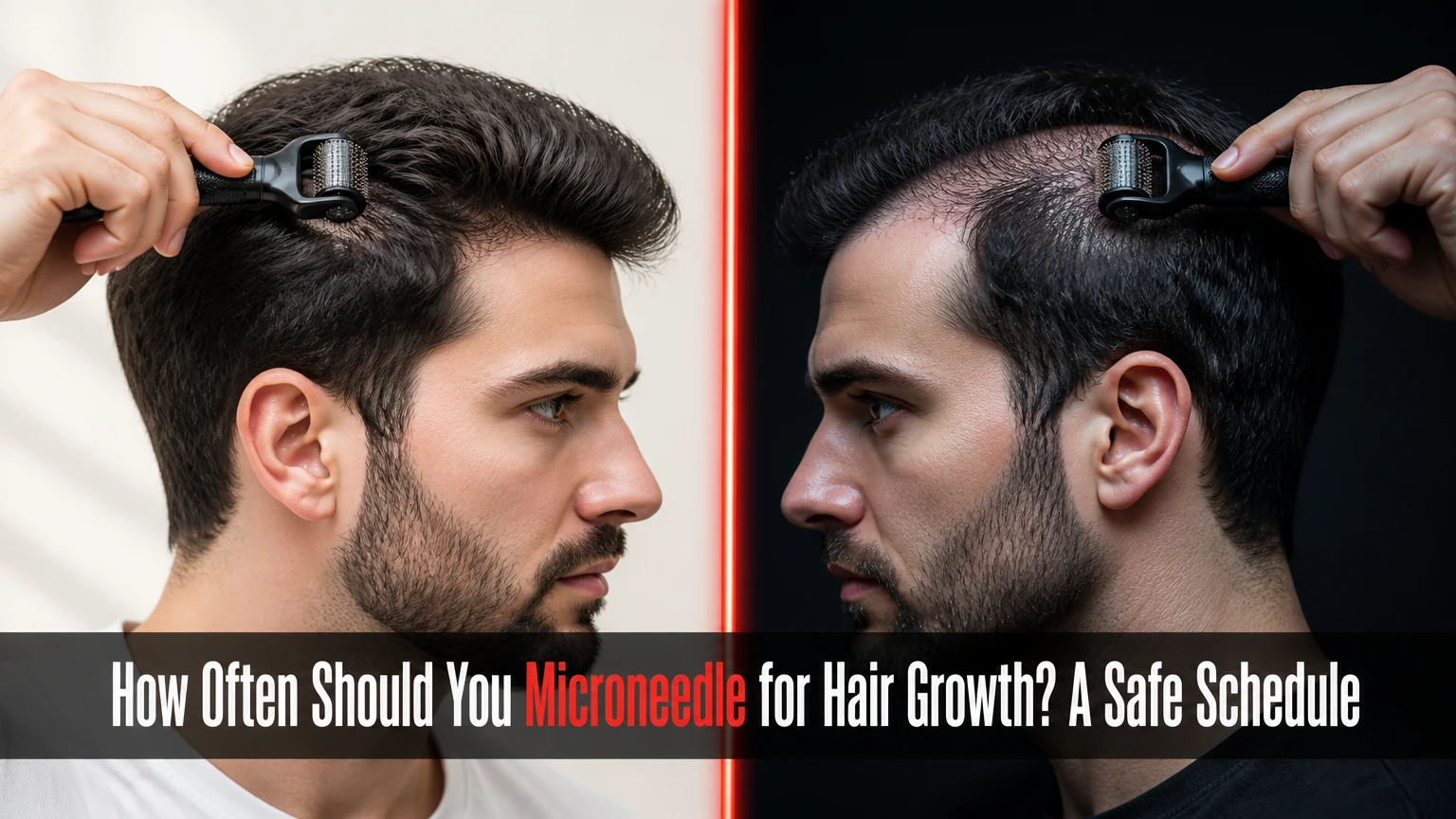
For scalp microneedling, a common at-home schedule is once weekly at 0.5-1.0 mm, while 0.25-0.5 mm superficial use may occur once or twice weekly for topical delivery. Treatments at approximately 1.5 mm should generally be performed by a trained clinician every 3-4 weeks. The correct interval depends on skin recovery, diagnosis, device, and accompanying medication.
Key Facts at a Glance
- Microneedling at 0.5-1.0 mm is commonly scheduled once weekly, but clinical studies have used different protocols.
- Superficial 0.25 mm treatment is mainly a cosmetic or delivery-focused procedure, not a proven substitute for medical hair-loss treatment.
- A scalp should be fully recovered before another session, with no persistent redness, tenderness, crusting, pustules, or open areas.
- Minoxidil should not automatically be applied immediately after deeper needling because injured skin may increase absorption and irritation.
- Microneedling has the strongest practical rationale as an adjunct to an established hair-loss plan, especially for pattern hair loss.
- Hair electrolysis removes individual unwanted hairs permanently; it does not stimulate regrowth in areas of scalp thinning.
How Often Should You Microneedle for Hair Growth?
The safest general schedule is once every seven days for 0.5-1.0 mm home treatment, provided the scalp has recovered completely. Use 0.25-0.5 mm no more than once or twice weekly when the goal is superficial product delivery, and reserve approximately 1.5 mm sessions for clinical care at intervals of about three to four weeks.
Frequency is not determined by needle length alone. A motorized pen, manual stamp, and roller can create different injury patterns even when their labeled depth is identical, and pressure, passes, scalp thickness, hair density, and the presence of inflammation all change the actual wound burden. The weekly schedule is therefore a practical starting point, not a universal prescription.
The most important rule is recovery-based spacing. If redness lasts beyond 24-48 hours, or tenderness, swelling, scaling, crusting, or pinpoint pustules develops, postpone the next session and investigate the cause. Longer intervals are safer than forcing a calendar schedule.
Frequency by Needle Depth and Purpose
| Needle depth | Main purpose | Typical interval | Suitable setting |
|---|---|---|---|
| 0.20-0.25 mm | Superficial product contact | 1-2 times weekly | Home, with sterile disposable equipment |
| 0.50 mm | Light stimulation or delivery | Every 7 days | Home only with conservative pressure |
| 0.75-1.00 mm | Deeper scalp stimulation | Every 7-14 days | Experienced user or clinician guidance |
| 1.50 mm | Medical microneedling | Every 3-4 weeks | Dermatology or qualified clinic |
| Above 1.50 mm | Deep tissue injury risk | Individually prescribed | Professional treatment only |
No high-quality evidence proves that a specific weekly frequency is optimal for every person. A 2013 randomized study by Dhurat and colleagues found better hair-count improvement when microneedling was combined with 5% minoxidil than with minoxidil alone, but that result does not establish that daily, twice-weekly, or weekly needling is universally superior.
Why Might Microneedling Help Hair Growth?
Scalp microneedling may support hair growth through controlled wound-healing signals and improved access of certain topical medicines to the skin. The proposed biological pathways include increased local growth-factor activity, altered perifollicular signaling, and temporary disruption of the stratum corneum.
Animal and laboratory research has associated microneedling-related wound repair with mediators such as vascular endothelial growth factor, Wnt signaling, and beta-catenin. Those mechanisms are biologically plausible, but a laboratory pathway is not the same as a guaranteed cosmetic result in humans. Human clinical evidence remains limited compared with the evidence for established treatments such as topical minoxidil.
The clearest practical role is adjunctive treatment for selected cases of androgenetic alopecia, also called male or female pattern hair loss. Microneedling cannot restore a follicle that has been destroyed by scarring, correct a nutritional deficiency, or identify the cause of sudden shedding.
What Does the Research Actually Show?
| Evidence type | Finding | Practical meaning | Main limitation |
|---|---|---|---|
| Dhurat et al., 2013 | Microneedling plus 5% minoxidil outperformed minoxidil alone in a small trial | Combination treatment may help pattern hair loss | Small sample and limited duration |
| Laboratory studies | Wound repair can activate hair-related signaling pathways | Provides a plausible mechanism | Laboratory biology does not predict every human result |
| Clinical reviews | Microneedling is usually studied as an adjunct | It should not replace diagnosis or proven therapy | Protocols vary in depth and frequency |
| Minoxidil labeling | Consistent topical use is required for benefit | Medication adherence remains central | Microneedling is not part of every approved label |
| Dermatology practice | Persistent inflammation and infection require evaluation | Recovery matters more than aggressive treatment | Home devices vary widely in quality |
Which Needle Depth and Schedule Fit Your Goal?
The correct depth depends on whether you are trying to stimulate the scalp or increase superficial contact with a topical product. Deeper treatment creates more injury and demands more recovery, while shallow treatment may cause less disruption but should not be described as equivalent follicle therapy.
A 0.25 mm device is generally too shallow to replicate professional collagen-induction treatment. It may alter surface permeability temporarily, but claims that it multiplies medication effectiveness several-fold are not established as a dependable clinical rule. A 0.5 mm device is a more common conservative home option, although accurate penetration cannot be assumed from packaging alone.
For a first session, use the shortest depth that addresses the intended purpose. Do not increase depth simply because a session produces more pain or bleeding.
| Goal or situation | Reasonable starting approach | Frequency | Reassessment point |
|---|---|---|---|
| Sensitive scalp | 0.25-0.50 mm, low pressure | Every 7-14 days | After 4-6 sessions |
| Pattern thinning with clinician approval | 0.50-1.00 mm | Usually weekly or less often | After 12 weeks |
| Product-delivery experiment | 0.20-0.25 mm | Once weekly initially | After 4 weeks |
| Professional treatment | Approximately 1.50 mm, clinician-selected | Every 3-4 weeks | Before each session |
| Active dandruff or scalp inflammation | No needling | Wait until controlled | Medical review if persistent |
Does More Frequent Microneedling Produce Faster Growth?
More frequent microneedling does not reliably produce faster hair growth, and repeated injury can worsen irritation, folliculitis, post-inflammatory pigment changes, or scarring. The scalp needs time to restore its barrier and complete the early inflammatory phase before another intentional injury is created.
A useful practitioner rule is to reduce frequency when the scalp remains visibly inflamed at the planned next session. Continuous redness is not evidence of stronger follicle stimulation. It is evidence that the tissue has not returned to baseline.
How Should You Microneedle the Scalp Safely?
Safe home scalp microneedling requires a clean scalp, a sterile or properly disinfected device, conservative pressure, limited passes, and strict separation from irritating products. A session typically takes 10-20 minutes after preparation, but the correct endpoint is mild, temporary redness rather than heavy bleeding.
Before You Start
| Requirement | Typical specification | Why it matters |
|---|---|---|
| Session time | 10-20 minutes | Allows sectioning without rushing |
| Device | Stamp or pen preferred over roller | Reduces dragging and hair snagging |
| Cleaning agent | Product-approved disinfectant or sterile single-use cartridge | Limits contamination |
| Scalp condition | Washed, dry, and free from pustules or open wounds | Reduces infection and irritation |
| Topical plan | Minoxidil timing decided in advance | Limits excess absorption |
| Replacement parts | New pen cartridge for every session | Prevents dull, contaminated needles |
Step 1: Check the Scalp and Device
Do not needle through active psoriasis, eczema, sunburn, open wounds, painful folliculitis, unexplained scabbing, or a suspected fungal infection. Inspect the device for bent needles, residue, corrosion, or a damaged cartridge.
A person taking anticoagulants, with a history of poor wound healing or keloid scarring, or receiving immunosuppressive therapy should obtain medical advice before treatment. Pregnancy and breastfeeding also warrant a medication-specific discussion, especially when minoxidil or prescription topicals are involved.
Step 2: Clean the Scalp and Hands
Wash the scalp with a mild shampoo, rinse thoroughly, and let it dry. Wash hands before touching the device or scalp, and keep styling products, oils, fragrances, and cosmetic serums away from the treatment area during the session.
Do not rely on a dirty bathroom surface or a reused open container of alcohol as a sterile field. Follow the manufacturer’s disinfection instructions because some cartridges and plastic components are damaged by prolonged immersion.
Step 3: Section the Thinning Areas
Create narrow parts so the needle head contacts scalp rather than hair. Work on a small region at a time, such as the frontal hairline, mid-scalp, or crown, and avoid repeatedly treating dense healthy areas.
A stamp should be lifted vertically after each placement. If using a roller, avoid forceful back-and-forth dragging because angled needles can snag hair and create more mechanical trauma than intended. Pen speed and depth should follow the manufacturer’s instructions.
Step 4: Use Minimal Effective Passes
Apply even, light pressure and make one controlled pass in each direction only if the skin tolerates it. Mild pinkness is an adequate endpoint for many home sessions; repeated passes until significant bleeding is unnecessary and increases tissue injury.
You will know the technique is conservative when the scalp feels warm or mildly tender but does not show heavy bleeding, tearing, or prolonged swelling. Pain is not a measurement of effectiveness.
Step 5: Protect the Recovery Period
Leave the scalp alone after treatment. Avoid scratching, tight hats, vigorous exercise, swimming, saunas, direct sun, and irritating hair products for at least the remainder of the day, or longer if the skin remains sensitive.
Apply only a product that a clinician or device manufacturer has specifically approved for post-treatment use. Hyaluronic acid is sometimes used in professional skin procedures, but a cosmetic serum is not automatically sterile or suitable for open microchannels.
Can You Apply Minoxidil After Microneedling?
Minoxidil should generally be delayed after deeper scalp microneedling, commonly for about 12-24 hours, unless a prescribing clinician gives different instructions. Open microchannels may increase irritation and absorption, and symptoms such as dizziness, palpitations, chest discomfort, or faintness require stopping the product and seeking medical advice.
The exact interval depends on depth, bleeding, skin sensitivity, formulation, and medical history. Immediate application after a very superficial 0.25 mm procedure is sometimes recommended by commercial protocols, but “possible” does not mean risk-free. Alcohol-containing solutions, propylene glycol, fragrances, and compounded prescription products may sting substantially on injured skin.
Continue ordinary minoxidil use on non-needling days according to the product label or prescription. Do not compensate for a missed application by applying extra product.
| Product or treatment | Conservative post-needling approach | Main concern |
|---|---|---|
| 5% foam minoxidil | Resume after skin closes and irritation settles, often 12-24 hours | Increased absorption and irritation |
| 5% liquid minoxidil | Wait until the scalp is calm, often at least 24 hours after deeper treatment | Alcohol and propylene glycol sting |
| Prescription topical finasteride | Follow prescriber’s written timing | Compounded formulations differ |
| Fragranced hair serum | Avoid on freshly treated scalp | Irritant or allergic dermatitis |
| Oils and occlusive pomades | Delay until redness resolves | Trapping heat and contaminants |
Which Device Is Best for Scalp Microneedling?
A derma stamp or a pen is usually easier to control on the scalp than a roller because vertical insertion reduces dragging and hair entanglement. A professional pen offers adjustable depth and replaceable cartridges, while a stamp costs less but requires careful, consistent placement.
The device label does not guarantee actual needle depth. Cartridge quality, pressure, motor speed, scalp curvature, and hair interference can change penetration. A cheap roller with bent needles can create more trauma than a shorter, well-maintained stamp.
| Device | Typical price | Control | Hygiene requirement | Best use |
|---|---|---|---|---|
| Derma roller | $10-$30 | Fixed depth, angled contact | Disinfect and replace frequently | Small budget, superficial use |
| Derma stamp | $15-$50 | Vertical manual placement | Disinfect according to instructions | Hairline and focused areas |
| Derma pen | $50-$150 | Adjustable depth and speed | Single-use cartridge | Consistent section-by-section work |
| Clinic microneedling | $100-$300+ | Clinician-selected depth | Professional sterile setup | Deeper or medically complex cases |
Never share a device. Replace a manual tool when needles become dull, bent, contaminated, or difficult to clean; a single-use pen cartridge should not be reused, even if it looks clean.
How Much Does Scalp Microneedling Cost?
Typical home scalp microneedling costs $10-$150 for the device, plus replacement cartridges or disinfectant, while professional treatment commonly costs $100-$300 or more per session. A complete six-month home plan can cost less than one clinic visit, but the lower price transfers diagnosis, hygiene, and technique responsibilities to the user.
Clinic prices vary by city, provider qualifications, whether platelet-rich plasma is added, and whether consultation or follow-up photography is included. Exosome packages deserve particular caution because products, regulatory status, and evidence vary considerably.
| Treatment plan | Typical unit cost | Six-month treatment count | Typical six-month total |
|---|---|---|---|
| Home stamp | $15-$50 | 20-26 sessions | $30-$100 plus replacements |
| Home pen | $50-$150 | 20-26 cartridges | $150-$500 |
| Clinic microneedling | $100-$300 per session | 5-7 sessions | $500-$2,100 |
| Clinic treatment with PRP | $300-$1,000 per session | 3-6 sessions | $900-$6,000 |
These are typical consumer ranges, not quoted prices. The cost of diagnosing the type of alopecia should be included in any rational comparison.
When Will Microneedling Results Appear?
Visible hair changes usually require at least 8-12 weeks, and a fair assessment often takes six months when microneedling is combined with a consistent medical treatment. Early fine hairs are not proof of permanent regrowth because hair cycles, lighting, and styling can create misleading impressions.
Take standardized photographs every four weeks using the same room, camera distance, hairstyle, parting, and lighting. Record scalp symptoms and topical adherence. Counting isolated short hairs by eye is unreliable.
Microneedling cannot reverse every type of hair loss. A widening part caused by iron deficiency, thyroid disease, medication, postpartum shedding, alopecia areata, or scarring disease requires a different plan.
Who Should Avoid Home Microneedling?
People with active scalp infection, uncontrolled inflammatory disease, bleeding disorders, poor wound healing, or unexplained rapid hair loss should avoid home microneedling until a clinician evaluates the condition. Needling a scarred or infected scalp can worsen the disease and delay appropriate treatment.
A dermatologist should assess sudden patchy loss, eyebrow loss, scalp pain, burning, shiny skin, pustules, heavy scale, or a rapidly receding hairline. Scarring alopecia can destroy follicles permanently, and cosmetic needling cannot recreate a follicle once it has been replaced by scar tissue.
Pattern Hair Loss Versus Other Causes
| Hair-loss pattern | Typical clues | Microneedling role | Priority action |
|---|---|---|---|
| Androgenetic alopecia | Gradual crown, part, or temple thinning | Possible adjunct | Confirm diagnosis and discuss minoxidil |
| Alopecia areata | Smooth round patches, exclamation hairs | Not a self-treatment | Dermatology assessment |
| Telogen effluvium | Diffuse shedding after illness or stress | Usually limited value | Identify trigger and monitor recovery |
| Scarring alopecia | Pain, burning, scale, pustules, shiny scalp | Avoid home injury | Prompt specialist evaluation |
| Tinea capitis | Scale, broken hairs, inflammation | Contraindicated until treated | Medical diagnosis and antifungal therapy |
What Problems Can Microneedling Cause?
The most common problems are temporary redness, tenderness, itching, dryness, and irritation; infection, prolonged inflammation, pigment changes, and scarring are less common but more serious. Risk rises with excessive pressure, excessive passes, contaminated equipment, active scalp disease, and applying irritating products through fresh channels.
Stop treatment and contact a clinician for spreading redness, warmth, pus, fever, severe pain, thick crusting, persistent bleeding, or swelling. Seek urgent care for facial swelling, breathing difficulty, fainting, chest pain, or severe palpitations.
| Symptom after treatment | Likely concern | Immediate response | Medical threshold |
|---|---|---|---|
| Mild pinkness under 24 hours | Expected irritation | Gentle cleansing and observation | Review if persistent beyond 48 hours |
| Burning after topical use | Chemical irritation or absorption | Stop topical and rinse if needed | Contact prescriber if severe |
| Pustules or painful bumps | Folliculitis or contamination | Stop needling; do not squeeze | Prompt clinical review |
| Heavy or persistent bleeding | Excess trauma or bleeding tendency | Apply gentle pressure | Urgent care if it does not stop |
| Dizziness or fast heartbeat | Possible systemic medication effect | Stop minoxidil and sit down | Urgent assessment for severe symptoms |
What Is the Most Common Technical Mistake?
The most common technical mistake is chasing pinpoint bleeding with repeated passes or heavier pressure. A practitioner should prioritize uniform, controlled contact and a short recovery period, because visible blood measures injury, not follicle activation.
A second mistake is treating the scalp on a fixed schedule despite unresolved inflammation. The calendar should yield to the skin. A third mistake is using a roller across long hair, where snagging causes traction and makes the labeled needle depth less meaningful.
How Does Microneedling Compare With Other Hair-Loss Treatments?
Microneedling is an adjunctive procedure, not a complete hair-loss diagnosis or replacement for established therapies. Topical minoxidil has a clearer treatment role for pattern hair loss, finasteride may be considered for appropriate men under medical supervision, and low-level light therapy offers a noninvasive option with variable device quality.
Platelet-rich plasma is delivered in clinics and may help selected patients, but it involves injections, cost, and protocol variability. Hair transplantation moves follicles from a donor area and does not treat the underlying tendency to miniaturize existing follicles.
| Option | Primary action | Typical schedule | Main limitation |
|---|---|---|---|
| Minoxidil | Prolongs growth phase and enlarges miniaturized follicles | Daily, product dependent | Requires ongoing use |
| Finasteride | Reduces conversion to dihydrotestosterone | Daily prescription | Sex-specific counseling and adverse effects |
| Low-level light therapy | Photobiomodulation | Several times weekly | Device quality and adherence vary |
| Microneedling | Controlled injury and possible delivery enhancement | Weekly to monthly | Home technique and evidence variability |
| PRP | Autologous platelet concentrate injections | Several clinic sessions | Cost and protocol differences |
| Hair transplant | Relocates donor follicles | One or more operations | Surgical limits and donor supply |
Is Hair Electrolysis an Alternative for Scalp Regrowth?
Hair electrolysis is not an alternative to microneedling for hair growth because electrolysis destroys individual follicles to provide permanent hair removal. The U.S. Food and Drug Administration recognizes electrolysis as a permanent hair-removal method, whereas scalp microneedling aims to support existing follicles.
Electrolysis may be useful for isolated unwanted hairs, such as a few coarse hairs on a scar or an irregular hairline, but it is inappropriate for diffuse thinning where the goal is regrowth. Treating a thinning scalp with electrolysis would reduce follicle count rather than increase it.
Laser hair removal has a similar mismatch when the objective is scalp restoration. Hair-growth plans should preserve viable follicles; permanent hair-removal procedures intentionally disable them.
What Is the Safest Practical Schedule?
A conservative schedule is to begin with 0.25-0.50 mm once weekly, observe the scalp for two weeks, and increase neither depth nor frequency until the skin remains calm between sessions. People using deeper treatment should extend the interval to seven to fourteen days at home, while approximately 1.5 mm treatment belongs in a clinic every three to four weeks.
Before continuing beyond three months, confirm that the diagnosis is compatible with microneedling and that the primary treatment is being used consistently. If photographs show no improvement after six months, or thinning accelerates, stop escalating the needle depth and arrange a dermatology review.
FAQ
Can I Microneedle My Scalp Every Day?
Daily scalp microneedling is not recommended, particularly at 0.5 mm or deeper. Daily injury can maintain inflammation, disrupt the skin barrier, increase infection risk, and cause irritation without proven additional hair growth. Superficial cosmetic devices still require clean equipment and should not be used daily unless a qualified clinician has given a specific protocol.
Should I Microneedle Before or After Washing My Hair?
Microneedle after washing and drying the scalp, not over sweat, sebum, styling product, or dry shampoo. Clean skin reduces contamination, while fully dry hair and clear partings improve device contact. Do not scrub aggressively immediately beforehand because abrasion adds unnecessary injury.
Can Microneedling Regrow a Completely Bald Scalp?
Microneedling cannot reliably regrow a completely bald area when follicles are absent or replaced by scar tissue. The procedure may have a role in early pattern hair loss where miniaturized follicles remain, but a dermatologist should distinguish miniaturization from scarring before treatment begins.
Should I Use a Derma Roller or Derma Stamp for the Hairline?
A derma stamp is usually easier to control at the hairline because it enters vertically and does not need to roll across individual hairs. A roller may cover a larger area faster, but dragging, snagging, and angled penetration create more opportunity for mechanical irritation.
What Should I Do if My Scalp Is Still Red One Day Later?
Delay the next session and avoid irritating products until the redness, tenderness, and heat resolve. Redness lasting more than 48 hours, worsening pain, pustules, spreading warmth, or discharge warrants medical review because those findings can indicate infection or excessive inflammation.
Does Microneedling Stop Hair Shedding Immediately?
Microneedling does not stop shedding immediately. Hair cycling changes gradually, and any improvement usually requires consistent treatment over several months. Sudden heavy shedding should prompt evaluation for telogen effluvium, medication effects, thyroid disease, nutritional deficiency, or inflammatory scalp disorders rather than more frequent needling.
The Bottom Line
How often should you microneedle for hair growth? For most conservative home routines, begin with once weekly at 0.5 mm, use longer intervals when redness or tenderness persists, and reserve 1.5 mm treatment for qualified clinical care every three to four weeks. Superficial 0.25 mm use may be performed once or twice weekly, but it should not replace diagnosis or proven hair-loss treatment.
Microneedling works best as a carefully controlled adjunct for suitable pattern hair loss, not as a cure for every form of alopecia. Stop when the scalp develops persistent inflammation, infection signs, heavy bleeding, or systemic symptoms, and seek dermatology advice before escalating depth or frequency.