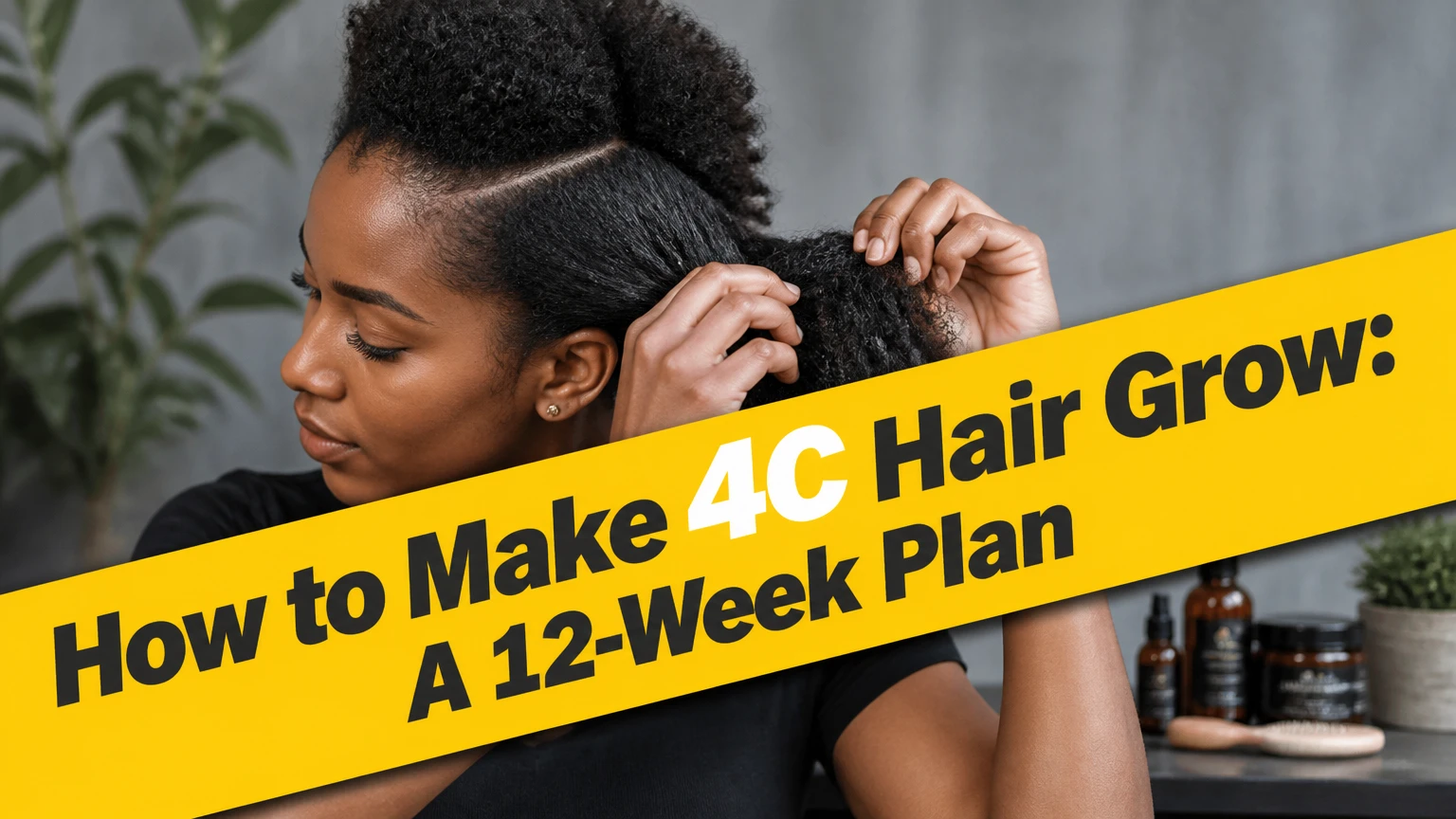
4C hair grows from the follicle at a genetically determined rate, usually close to 0.5 inches per month, but tight coils make new length difficult to see and fragile ends easier to break. To make 4C hair grow longer, protect the scalp, maintain flexible moisture, reduce friction and tension, and retain more length than you lose.
Key facts at a glance
- 4C hair does not have a permanently lower growth rate than other curl patterns.
- Typical scalp-hair growth is approximately 0.25-0.5 inches per month, although genetics, age, hormones, health, and medications affect the rate.
- Shrinkage can make 4C hair look 50-80% shorter than its stretched length.
- Hair care cannot permanently change the follicle’s genetically determined growth speed.
- Length retention depends more on preventing breakage than on finding a “growth oil.”
- Severe shedding, bald patches, scalp pain, or sudden thinning require a dermatologist’s assessment.
What makes 4C hair difficult to grow longer?
4C hair is tightly coiled hair with sharp changes in direction along the strand. The Andre Walker hair-typing system uses 4C as a descriptive category, but the category does not predict strand diameter, density, porosity, or damage resistance. Two people with 4C hair can need very different routines.
The central problem is retention. Sebum produced at the scalp has difficulty moving along a tightly curved shaft, while bends in the fiber create points that experience repeated stress during washing, combing, drying, and styling. The oldest hair at the ends has also survived the most friction and chemical exposure.
| Factor | Typical value or feature | Practical consequence |
|---|---|---|
| Scalp growth rate | 0.25-0.5 inches monthly | Measure progress over 3-6 months, not several days |
| Shrinkage | 50-80% of stretched length | Compare stretched photos, not wash-day appearance |
| Wash interval | 7-14 days for many routines | Adjust for sweat, buildup, dandruff, and style access |
| Deep-conditioning time | 20-30 minutes | Improves slip and flexibility when the product supports it |
| Protective-style duration | 2-6 weeks for many styles | Longer wear increases matting and buildup risk |
| Dusting interval | About 8-16 weeks when needed | Removes damaged ends without implying faster follicle growth |
Hair grows underneath the scalp during the anagen phase. A trim removes damaged fiber above the scalp; it cannot accelerate anagen activity. The useful purpose of trimming is to stop splits from traveling farther up the strand and forcing a larger cut later.
A practical measurement is the retention rate: new growth minus breakage over a defined period. If a person gains 1.5 inches at the scalp over three months but loses 1 inch from broken ends, the visible result is only 0.5 inches.
How to make 4C hair grow with a 12-week protocol
The most reliable protocol has six actions: cleanse the scalp, condition the lengths, detangle with slip, moisturize according to response, reduce manipulation, and inspect the ends. A complete wash day usually takes 60-120 minutes, costs approximately $8-$25 in product use, and requires more consistency than specialized products.
Before you start
| Requirement | Practical specification |
|---|---|
| Weekly time | 45-90 minutes for maintenance, 60-120 minutes for wash day |
| Basic products | Shampoo, rinse-out conditioner, leave-in conditioner, one styler |
| Tools | Sectioning clips, fingers, wide-tooth comb, microfiber towel or cotton T-shirt |
| Protection | Satin bonnet or satin pillowcase, plus a loose nighttime style |
| Measurement | Four stretched photos, one per month, using the same lighting |
| Starting check | Photograph edges, crown, temples, and ends before changing products |
Do not change five products at once. A single product change every 7-14 days makes it easier to identify residue, itching, stiffness, or inadequate conditioning.
Step 1: Cleanse the scalp every 7-14 days
Apply shampoo to the scalp and roots, then allow the lather to travel through the lengths during rinsing. Use a sulfate-free cleanser if conventional shampoo leaves the hair rough, but do not treat sulfate-free as automatically moisturizing or superior; cleansing strength depends on the complete formula.
Use a clarifying shampoo approximately every 3-6 weeks when oils, gels, mineral-heavy water, or styling products accumulate. People who exercise heavily may need cleansing every 5-7 days, while a dry scalp may tolerate 10-14 days if there is no odor, itching, flaking, or buildup.
You will know it worked when: the scalp feels clean without burning, the roots separate without a waxy coating, and the hair remains flexible after conditioning.
Common mistake: co-washing indefinitely while using heavy creams and gels. Conditioner cleansers may not remove all buildup, especially from the scalp.
Step 2: Condition in sections before detangling
Divide the hair into four to eight sections, depending on density and length. Apply enough rinse-out conditioner to create slip across the entire section; a typical starting amount is 1-2 tablespoons per section for shoulder-length hair, although thick or long hair may require more.
Let the conditioner sit for 3-10 minutes. Finger-separate large tangles before using a tool, and keep each completed section twisted or clipped so it cannot retangle.
You will know it worked when: fingers move through the section with reduced resistance and shed strands slide away without clusters of snapped short pieces.
Common mistake: applying conditioner only to the surface. The underside, nape, and ends usually need the most product because those areas receive greater friction.
Step 3: Deep-condition for 20-30 minutes
Apply a deep conditioner after cleansing, concentrating on the middle lengths and ends. Cover the hair with a plastic cap for 20-30 minutes; moderate warmth can improve comfort and product spread, but intense heat is not required to “open” the cuticle.
Use a protein-containing treatment when the hair feels unusually limp, weak, or overly stretchy, and use a moisturizing conditioner when it feels hard, rough, or brittle. Protein treatments vary widely in strength, so follow the product directions rather than scheduling strong protein every week.
You will know it worked when: the hair feels supple and controlled after rinsing, not gummy, stiff, coated, or impossible to separate.
Common mistake: treating every dry-feeling problem as a need for more moisture. Hygral fatigue, chemical damage, protein imbalance, high-pH products, and scalp inflammation can produce similar complaints.
Step 4: Detangle soaking-wet hair with high slip
Keep 4C hair wet and saturated with conditioner or detangling product. Work from ends toward roots in sections no wider than 2-4 inches, using fingers first and a wide-tooth comb only when the fingers have removed the largest knots.
Hold the hair near the roots while detangling the ends. That support reduces pulling on the follicle and limits force transmitted to the root area. Rinse each section only after it is detangled, then twist or braid it loosely.
You will know it worked when: the comb reaches the roots without repeated snagging, the shed hair is mostly long strands, and the ends do not feel rough after drying.
Common mistake: detangling a large, dry, unsectioned mass. That combines friction, leverage, and knot tightness at exactly the same time.
Step 5: Moisturize with the lightest effective layering system
Start with water or a water-based leave-in conditioner, then add a cream if the hair needs softness and a small amount of oil if the oil improves lubrication. The LCO order means liquid, cream, oil; the LOC order means liquid, oil, cream. Neither order is universally correct.
Choose based on the result after 24-48 hours. If hair becomes greasy but still feels dry, reduce oil and increase water-based conditioning. If hair dries too quickly, use a richer cream or a small amount of oil over damp hair, while avoiding heavy layers on an itchy or acne-prone scalp.
| Hair response after 48 hours | Adjustment | Quantity starting point |
|---|---|---|
| Dry, rough ends | Add water-based leave-in | 1 teaspoon per section |
| Soft but quickly frizzy hair | Add cream over damp hair | Pea to dime per section |
| Flexible hair with rapid moisture loss | Add lightweight oil to ends | 2-5 drops per section |
| Greasy, coated, dull hair | Remove oil or clarify | 1 clarifying wash |
| White residue or flakes | Reduce incompatible layers | One product at a time |
| Limp, overly soft strands | Test a mild protein treatment | Follow label timing |
Oils lubricate hair and can reduce friction, but they do not feed follicles or guarantee faster growth. Castor oil, rosemary oil, peppermint oil, and “growth grease” should not be presented as proven substitutes for diagnosing hair loss.
Step 6: Use low-manipulation styling and protect the ends
Choose a style that keeps the hair organized without pulling the hairline. Large twists, loose flat twists, braid-outs, and carefully installed knotless braids can reduce daily combing, but no style is protective when it causes pain, tightness, persistent bumps, or broken edges.
Cover the hair with satin or silk at night. A bonnet should fit securely without pressing the temples, and a satin pillowcase provides backup when the bonnet slips. Cotton does not literally remove all moisture from hair, but its rougher surface can increase friction and absorb some product.
| Style option | Typical wear period | Daily manipulation | Main risk |
|---|---|---|---|
| Large two-strand twists | 5-14 days | Low | Ends may dry if left exposed |
| Mini-twists | 2-4 weeks | Low | Long installation and tangling during takedown |
| Knotless braids | 3-6 weeks | Low | Tension, buildup, and extension weight |
| Glueless wig | 1-7 days per wear | Low | Friction, heat, and neglected scalp |
| Sew-in weave | 4-8 weeks | Low | Limited cleansing and traction |
| Wash-and-go | 1-5 days | Moderate | Frequent reshaping can increase breakage |
Hairline pain is a damage signal, not evidence that a style is “setting” the hair. The British Association of Dermatologists identifies repeated traction as a cause of traction alopecia, which can become permanent when follicles are destroyed.
Which 4C regimen is best for your lifestyle?
The best regimen is the one that gives the scalp adequate cleansing and the ends low friction without creating tension. Natural low-manipulation styling is usually the simplest starting point because it permits scalp access, while extensions and wigs can reduce daily handling but introduce weight, friction, or maintenance problems.
| Lifestyle | Recommended base routine | Wash access | Typical monthly cost |
|---|---|---|---|
| Frequent gym user | Large twists or mini-twists | Every 5-10 days | $15-$45 |
| Busy professional | Loose twists under a glueless wig | Every 7-14 days | $25-$100 |
| Sensitive scalp | Loose natural styles | Every 5-10 days | $15-$50 |
| Protective-style user | Knotless braids with light extensions | Clean scalp weekly if possible | $60-$250 |
| Minimalist | Four to eight large twists | Every 7-14 days | $10-$35 |
| Child or tender-headed wearer | Short, loose sections with conditioner | Every 7-10 days | $15-$60 |
Extensions are not automatically safer than natural hair. A heavy braid can create more root tension than a week of gentle styling, and an installed style that prevents cleansing can worsen itching or seborrheic dermatitis.
A wig is also not a substitute for a routine. Remove a glueless wig nightly when possible, cleanse the scalp regularly, and inspect the temples for redness or broken hairs. Avoid adhesive near thinning edges unless a qualified professional has assessed the area.
Do oils, vitamins, trims, or electrolysis make 4C hair grow faster?
Oils, vitamins, trims, and electrolysis do not reliably accelerate normal 4C follicle growth. Oils can reduce surface friction, trims can remove split ends, and medically indicated supplements can correct a deficiency, but unnecessary high-dose supplements may cause harm and electrolysis is designed to permanently remove unwanted hair, not grow scalp hair.
The American Academy of Dermatology Association recommends discussing supplements with a dermatologist because excess amounts of nutrients such as selenium, vitamin A, or vitamin E can worsen hair loss. Blood tests may be appropriate when shedding suggests iron deficiency, thyroid disease, hormonal change, or another systemic cause.
Electrolysis belongs to permanent hair-removal care. It uses an electric current to destroy individual hair follicles, so it should never be used as a scalp-growth method. This distinction matters when a searcher sees “hair electrolysis” mixed with hair-growth advice.
| Intervention | What it can do | What it cannot reliably do | Use rule |
|---|---|---|---|
| Jojoba or argan oil | Reduce friction and add shine | Increase follicle growth rate | Use a few drops on lengths |
| Castor oil | Add occlusion and lubrication | Prove faster hair growth | Stop if itching or buildup occurs |
| Rosemary oil | Has limited topical research | Replace medical treatment | Dilute and patch-test; avoid eyes |
| Multivitamin | Correct a documented deficiency | Help normal levels grow faster | Test or obtain medical advice first |
| Trim or dusting | Remove split, frayed ends | Stimulate roots | Cut only damaged fiber |
| Electrolysis | Permanently remove unwanted hairs | Regrow scalp hair | Do not use for hair-growth goals |
Dermatologist Wilma Bergfeld, MD, summarized the medical principle in a Cleveland Clinic discussion: “Hair loss is a symptom, not a diagnosis.” That principle applies to 4C hair because breakage and follicle-level shedding require different solutions.
What should you do when 4C hair stops retaining length?
When 4C hair appears stuck at one length, compare stretched photographs, inspect the ends, and separate breakage from shedding. Breakage produces short pieces with variable lengths and often no white bulb, while normal shedding commonly produces a full-length strand with a small club-shaped bulb.
| Symptom | Likely category | First correction | Escalation point |
|---|---|---|---|
| Short pieces on clothing | Shaft breakage | Stop dry brushing and reduce manipulation | No improvement after 6-8 weeks |
| Full strands with bulbs | Normal shedding or increased shedding | Track amount and recent changes | Sudden increase or visible thinning |
| Temple recession | Traction or inflammation | Remove tight styles immediately | Pain, shiny skin, or continued loss |
| Itchy greasy flakes | Dandruff or dermatitis | Seek clinician-approved scalp treatment | Persistent redness or sores |
| Crown thinning | Follicle-level hair loss | Photograph and book dermatology care | Any expanding patch |
| Rough split ends | Weathering and friction | Dust damaged ends, protect at night | Splits travel upward quickly |
Do not schedule automatic trims every three to four months if the ends remain healthy. Trim based on splits, single-strand knots, white dots, repeated tangling, and uneven damage. Cutting healthy hair on a fixed calendar does not create new growth.
A two-week break from combs can help when detangling causes severe breakage. Finger-detangle with conditioner, use larger sections, and postpone intricate styling until the hair feels flexible again.
How can you adapt the routine for porosity and scalp conditions?
Porosity is a useful observation about how hair behaves, not a precise diagnosis from a float test. Hair that resists water may need more soaking time and lighter layers, while hair that absorbs and loses water rapidly may benefit from richer conditioning and reduced heat exposure.
Low-porosity hair does not need extreme heat to force moisture into the shaft. Use warm water, sufficient saturation, a light conditioner, and thorough rinsing; excessive heavy oils can create a coating that makes later wetting more difficult.
High-porosity or chemically processed hair may lose water quickly because the cuticle is more weathered. Use a leave-in conditioner, a cream on damp hair, gentle drying, and occasional protein if the strands respond well.
Scalp disease changes the routine. Dandruff, psoriasis, folliculitis, and seborrheic dermatitis may require medicated shampoos or prescription treatment, and covering symptoms with grease can delay diagnosis.
How much does a 4C growth routine cost and how long does it take?
A basic 4C length-retention routine typically costs $10-$50 per month in products and takes 45-120 minutes per wash day. Salon braids, wigs, and extensions can raise monthly spending to approximately $60-$300 or more, depending on region, hair quantity, installation, and maintenance.
| Routine type | Product cost monthly | Service cost monthly | Time commitment |
|---|---|---|---|
| Minimalist natural routine | $10-$35 | $0-$60 | 1-3 hours weekly |
| Twists at home | $15-$50 | $0-$100 | 2-5 hours every 2-4 weeks |
| Knotless braids | $20-$60 | $60-$250 | 4-9 hours every 3-6 weeks |
| Glueless wig routine | $20-$75 | $0-$250 | 1-3 hours monthly |
| Sew-in routine | $25-$75 | $100-$300 | 3-6 hours every 6-10 weeks |
These figures are typical consumer ranges in the United States, not fixed prices. Local salon pricing, imported products, and professional detangling can change the total substantially.
The first visible improvement is usually less shedding during detangling or fewer broken ends after 4-8 weeks. Stretched length is more fairly assessed at 12 weeks, when a typical growth range is approximately 0.75-1.5 inches before accounting for breakage and shrinkage.
Common mistakes that cause 4C breakage
- Detangling dry hair: Add water and conditioner before separating knots. A wide-tooth comb cannot compensate for inadequate slip.
- Changing styles daily: Keep a style for several days when comfortable, then refresh with water and a small amount of leave-in rather than combing from scratch.
- Ignoring the nape: Reduce scarf friction, use conditioner on the area, and avoid tight ponytails that pull short hairs.
- Sleeping with loose hair on cotton: Use a satin bonnet or pillowcase and secure the hair in loose twists.
- Leaving braids installed too long: Remove the style when roots mat, the scalp cannot be cleaned, or takedown requires force.
- Applying strong heat without control: Use a heat protectant, the lowest effective setting, and limited passes. Repeated high heat can permanently alter the fiber.
- Overusing protein: Alternate with moisturizing conditioning when strands become hard or brittle.
- Greasing an inflamed scalp: Treat flakes and irritation medically instead of sealing them under heavy products.
A counterintuitive practitioner rule is that more product often creates more breakage. A coated strand can attract lint, resist water, and require aggressive cleansing or detangling later.
Another rule is to protect the ends before they look damaged. Ends that feel rough after washing are already receiving more friction than the routine can tolerate.
Frequently asked questions
Does 4C hair grow slower than straight hair?
4C hair does not inherently grow slower because of its curl pattern. Follicle growth depends mainly on genetics, age, health, hormones, and medications, while shrinkage and breakage make 4C hair appear shorter. Compare stretched photographs over at least 12 weeks to distinguish slow growth from poor length retention.
What is the fastest way to grow 4C hair?
The fastest practical route to longer 4C hair is consistent length retention: cleanse the scalp, condition the lengths, detangle wet hair in sections, limit tension, and protect the ends. No oil or styling method can guarantee a permanently faster follicle growth rate.
How often should 4C hair be washed for growth?
Many people can begin with washing every 7-14 days, then adjust for sweat, scalp oil, dandruff, and styling products. Frequent exercisers may need weekly cleansing, while a person with scalp disease may need a clinician-directed medicated schedule. A clean scalp does not require harsh shampoo.
Can braids make 4C hair grow?
Braids can help retain length by reducing daily manipulation, but braids do not increase follicle growth. Extensions that are heavy, tight, or worn too long can cause breakage and traction alopecia. Remove braids when the scalp hurts, edges thin, roots mat, or cleansing becomes impractical.
Why does 4C hair look shorter after washing?
4C hair contracts when water allows the coils to return toward their natural configuration. Shrinkage changes visible length without removing hair, so a wash-day comparison can be misleading. Measure one consistent section when stretched gently, and photograph it under the same conditions each month.
When should a dermatologist examine 4C hair loss?
See a dermatologist for sudden shedding, expanding bald patches, crown or temple thinning, scalp pain, pustules, severe itching, or shiny areas where follicles appear absent. The American Academy of Dermatology Association notes that early evaluation matters because some inflammatory and scarring hair-loss disorders can cause permanent follicle damage.
The bottom line
To make 4C hair grow longer, focus on retaining the 0.75-1.5 inches that typical growth may produce over 12 weeks. Cleanse the scalp every 7-14 days, condition and detangle in sections, moisturize according to hair response, avoid painful tension, protect the ends at night, and measure stretched length rather than shrinkage. If shedding or thinning begins suddenly, replace product experiments with a dermatology evaluation.