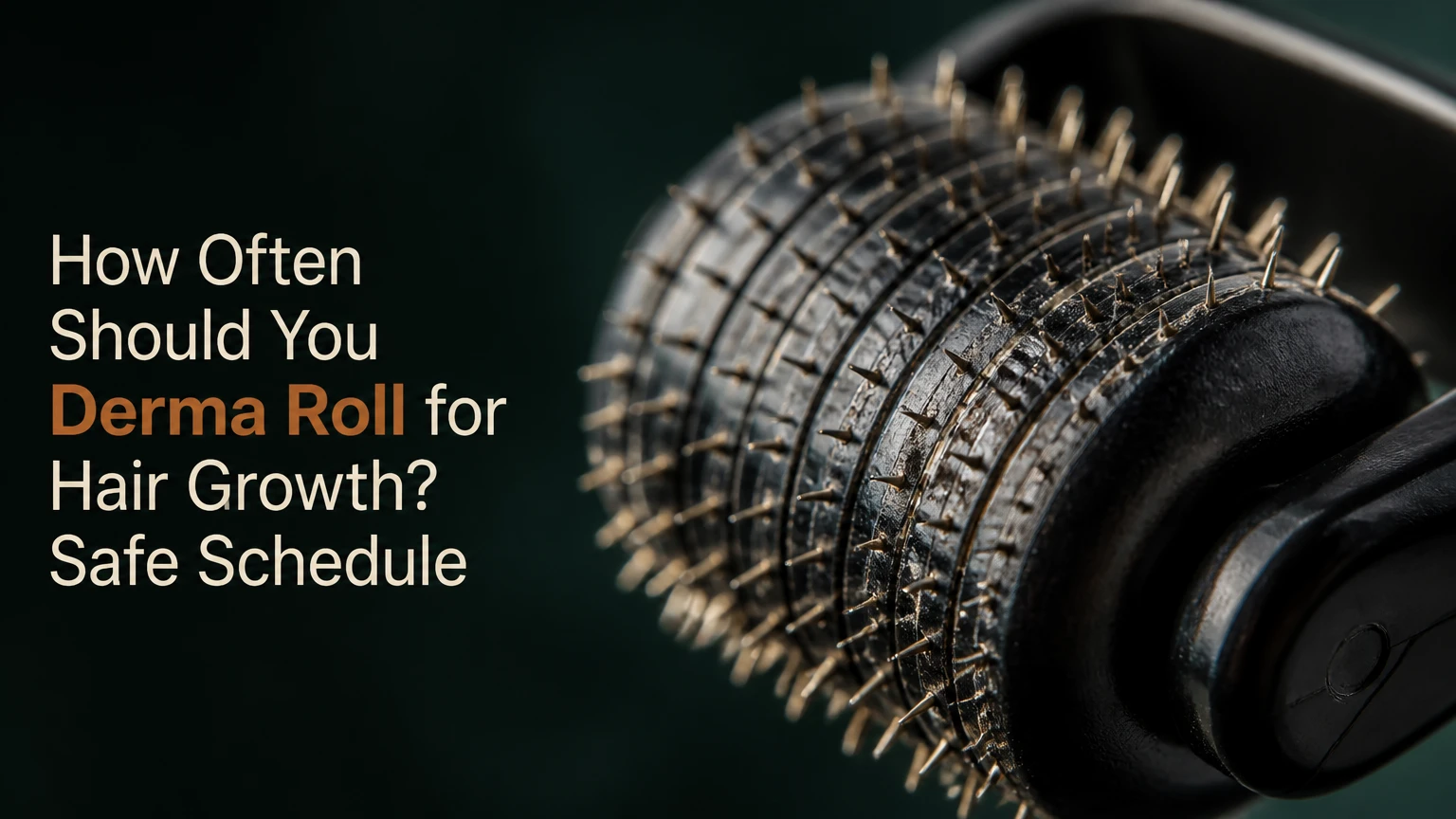
For hair growth, scalp derma rolling is usually performed once weekly at 0.5 mm or every 10-14 days at 1.0 mm; deeper 1.5 mm microneedling is generally better left to a trained clinician. The correct interval depends on needle depth, scalp recovery, hair-loss diagnosis, device sterility, and whether minoxidil is used.
Key Facts at a Glance
- Scalp microneedling frequency must increase in interval as needle depth increases.
- A 0.5 mm device is commonly limited to once weekly, not daily use.
- A 1.0 mm or deeper session needs several days of recovery before repeating.
- Immediate minoxidil application after deeper needling can increase irritation and absorption.
- Microneedling has the best supporting evidence as an adjunct to minoxidil for androgenetic alopecia.
- Electrolysis does not stimulate scalp regrowth; electrolysis permanently destroys treated follicles.
What Is Scalp Derma Rolling?
Scalp derma rolling is a form of microneedling that creates controlled punctures in the skin with a handheld roller. The punctures may trigger a wound-healing response, but home devices do not provide the same depth control, sterility, or diagnosis as medical microneedling.
Microneedling is not a universal hair-loss treatment. The published evidence mainly concerns androgenetic alopecia, also called pattern hair loss, and usually evaluates microneedling alongside topical minoxidil rather than as a replacement for diagnosis or medication. Dhurat and colleagues reported greater hair-count improvement with weekly microneedling plus minoxidil than with minoxidil alone in a 2013 randomized study, but the study was small and does not establish a single ideal home schedule.
How Does Microneedling Potentially Support Hair Growth?
Scalp microneedling may support hair growth through a controlled repair response involving cytokines, growth factors, vascular changes, and signaling pathways associated with follicle activity. The proposed biology includes platelet-derived growth factor, vascular endothelial growth factor, and Wnt-related signaling, although a mechanism does not prove that every consumer protocol will produce regrowth.
The main practical effect may also be improved delivery of a topical medication through temporarily disrupted skin. That benefit creates a safety trade-off: damaged skin can absorb more of a product and react more strongly to alcohol, fragrance, retinoids, essential oils, or minoxidil. The frequently repeated claim that microneedling increases topical absorption by exactly 300% is not a reliable scalp-wide clinical rule and should not determine treatment frequency.
How Often Should You Derma Roll for Hair Growth?
A conservative schedule is once weekly at 0.5 mm, once every 10-14 days at 1.0 mm, and no more often than every 2-4 weeks for 1.5 mm treatment under professional supervision. A session should be postponed whenever redness, tenderness, crusting, swelling, or burning remains from the previous treatment.
| Needle depth | Typical purpose | Conservative interval | Typical recovery checkpoint |
|---|---|---|---|
| 0.20-0.30 mm | Cosmetic product delivery | 2-3 times weekly | No tenderness or persistent redness after 24 hours |
| 0.50 mm | Shallow scalp stimulation | Once weekly | Scalp feels normal within 24-48 hours |
| 0.75-1.00 mm | Deeper stimulation in selected cases | Every 10-14 days | No soreness, crusting, or marked redness |
| 1.50 mm | Clinical microneedling protocol | Every 2-4 weeks, clinician-directed | Complete healing, commonly about 5-7 days |
These are practical ranges, not universally validated prescriptions. A device’s advertised depth may not equal its actual penetration because pressure, angle, hair density, needle sharpness, and skin thickness change the result. A home roller that causes bleeding is not automatically working better.
Why Does Needle Depth Change the Schedule?
Deeper needles create more tissue injury and require more time for the skin barrier to recover. Repeating a session before recovery can prolong inflammation, increase folliculitis risk, worsen discoloration, and create unnecessary scarring rather than improving follicle activity.
A useful practitioner rule is to schedule the next session from the recovery endpoint, not from the calendar. If a 0.5 mm session still causes soreness after two days, wait until the scalp is normal and reduce pressure or frequency. If a 1.0 mm session produces persistent crusts, stop home treatment and obtain clinical advice.
Which Needle Depth Should You Use?
For most beginners, 0.5 mm is the upper practical starting point for cautious home use, while 1.0 mm and 1.5 mm treatments warrant professional assessment. Needle depth should not be selected solely from the amount of visible thinning because hair-loss diagnosis and scalp condition matter more than the size of a bald area.
| User situation | More suitable starting point | Suggested interval | Reason to avoid going deeper |
|---|---|---|---|
| Mild thinning, healthy scalp | 0.5 mm stamp or roller | Once weekly | Deeper injury adds risk without established extra benefit |
| Dense long hair | Adjustable stamp at 0.5-1.0 mm | Every 10-14 days | A roller can catch and pull hair |
| Sensitive scalp or eczema history | Dermatology assessment first | Not self-set | Irritation may trigger a flare |
| Receding hairline with diagnosed pattern loss | Clinician-selected device | Usually 2-4 weeks if deep | Hairline skin is easy to over-treat |
| Sudden diffuse shedding | No self-microneedling initially | Until diagnosis | Telogen effluvium has a different cause |
| Smooth patches or scarring | Medical evaluation first | Do not self-treat | Needling may worsen active disease |
A 0.2 mm or 0.3 mm roller is usually a superficial cosmetic device, not a proven follicle-stimulation treatment. It may help spread a product, but frequent use can still irritate the scalp, especially when combined with alcohol-based solutions.
Does the Device Type Affect Frequency?
Device design affects tissue injury, hair entanglement, and depth consistency, but it does not justify more frequent treatments. A vertical stamp generally provides better control between hair shafts, whereas a roller can drag across the scalp and create angled microtears.
| Device type | Needle movement | Main control advantage | Typical consumer cost |
|---|---|---|---|
| Manual roller | Rotating, angled contact | Fast coverage of broad areas | $15-$40 |
| Manual stamp | Vertical press-and-lift | Precise part-by-part treatment | $20-$60 |
| Motorized pen | Vertical oscillation | Adjustable depth and speed | $80-$250 |
| Professional microneedling | Clinician-controlled vertical device | Sterile setup and diagnosis | $150-$500 per session |
Prices are typical United States consumer or clinic ranges and vary by brand, region, cartridge quality, and provider. A cheap roller with bent needles is a poor bargain because damaged needles can scratch or tear the scalp.
Is a Derma Stamp Safer Than a Derma Roller?
A derma stamp can be safer for long or dense hair because the needles enter vertically and the head lifts away rather than dragging through hair. A stamp is still capable of excessive pressure, contamination, and over-treatment, so its design does not remove the need for conservative intervals.
A motorized pen offers depth adjustment, but adjustable settings can encourage users to choose an unnecessarily deep setting. Disposable cartridges reduce cross-contamination only when the cartridge is genuinely single-use and the pen body is cleaned according to its manufacturer’s instructions.
How Do You Perform a Safer Scalp Session?
A cautious home session takes about 15-25 minutes, excluding cleaning and drying time. The essential sequence is clean scalp, clean device, small sections, light pressure, limited passes, and a recovery period without irritating products.
Step 1: Confirm That the Scalp Is Suitable
Do not microneedle over open sores, pustules, active folliculitis, cold sores, unexplained rash, sunburn, or a severe dandruff flare. Postpone treatment after scalp infection, dermatologic procedures, or significant irritation until the skin has fully recovered.
A dermatologist should assess sudden hair loss, painful scalp, scarring, scaling patches, or sharply defined bald spots. The American Academy of Dermatology notes that identifying the cause of hair loss is important because different conditions require different treatments.
Step 2: Wash and Dry the Scalp
Wash with a mild shampoo, rinse thoroughly, and allow the scalp to dry completely. Remove styling products, dry shampoo, oils, and heavy conditioners from the treatment area because residue can increase irritation and contamination.
Wash hands before touching the device. Do not apply rosemary oil, essential oils, acids, retinoids, or fragranced serums immediately before needling.
Step 3: Disinfect the Device Correctly
Follow the device manufacturer’s instructions for cleaning and disinfection. For compatible reusable tools, 70% isopropyl alcohol is commonly used for surface disinfection, but soaking a device for a fixed period does not make a nonsterile consumer roller equivalent to a sterile clinical instrument.
Never share a roller or stamp. Replace a device when needles bend, corrode, become dull, or fail inspection. Use a new cartridge for every pen session, then discard it in a puncture-resistant container.
Step 4: Treat Small Scalp Sections
Part the hair so the needle head contacts the scalp rather than the hair shaft. Use light, controlled contact; lift a roller before changing direction, and use a stamp with a press-and-lift motion rather than sliding.
Limit treatment to a few passes per section. Mild temporary redness can occur, but heavy bleeding, tearing, sharp pain, or widespread pinpoint bleeding indicates excessive pressure, excessive passes, or an unsuitable device.
Step 5: Protect the Recovery Period
Leave the scalp clean and avoid sweat, swimming, tight hats, scratching, and irritating products for the first day. Cool water and a bland, nonfragranced product may be more tolerable than active hair serums if the scalp feels dry.
A common mistake is treating redness as the desired endpoint. Redness is an inflammatory sign, not a measurement of follicle stimulation.
Can You Apply Minoxidil After Derma Rolling?
Do not automatically apply minoxidil immediately after scalp microneedling, particularly after 1.0 mm or deeper treatment. A cautious approach is to wait at least 24 hours after deeper needling, and longer if the scalp remains irritated, while following the product label and prescriber’s instructions.
The reason is exposure through a temporarily disrupted barrier. Minoxidil can cause burning, dermatitis, dizziness, palpitations, or unwanted systemic effects, and the risk may increase when the scalp is inflamed or damaged. The FDA-approved topical minoxidil labeling instructs users to apply it to a dry scalp and contains warnings about irritation and cardiovascular symptoms.
| Situation | Minoxidil decision | Practical timing |
|---|---|---|
| 0.2-0.3 mm, no irritation | Follow label and clinician advice | Often delayed until the scalp feels normal |
| 0.5 mm, mild redness only | Prefer a conservative pause | At least until the next day |
| 1.0 mm treatment | Avoid immediate application | Commonly wait 24 hours or longer |
| 1.5 mm clinical session | Follow clinician protocol | Resume only after the directed interval |
| Burning, swelling, or rash | Stop and seek advice | Do not restart over damaged skin |
Do not compensate for a missed minoxidil dose by applying extra product. Seek urgent medical help for chest pain, fainting, severe dizziness, rapid heartbeat, facial swelling, or breathing difficulty.
What Results and Timeframe Should You Expect?
Microneedling does not produce visible hair growth within days because follicles remain in biological growth cycles. A reasonable assessment window is three to six months, with standardized photographs and consistent lighting rather than daily mirror checks.
The 2013 Dhurat trial evaluated 12 weeks of treatment and found a statistically greater hair-count improvement in the microneedling-plus-minoxidil group than in the minoxidil-only group, but the sample was limited and the protocol used a controlled clinical setting. Later reviews have generally described microneedling as a promising adjunct while noting variation in needle depth, session interval, sample size, and outcome measurement.
| Time after starting | What may occur | What it does not prove |
|---|---|---|
| 0-48 hours | Redness, tenderness, mild sensitivity | Not evidence of new growth |
| 2-8 weeks | Possible shedding fluctuation or no visible change | Not treatment failure by itself |
| 3 months | Early change may appear in photographs | Does not establish permanent benefit |
| 6 months | More useful comparison point | Requires diagnosis and consistent treatment |
| 9-12 months | Maintenance decision becomes clearer | Continued loss may need a revised diagnosis |
Microneedling is not good for reversing established scarring alopecia, treating fungal infection, or correcting a nutritional deficiency by itself. It also cannot restore follicles that have been permanently destroyed.
What Are the Main Risks and Failure Modes?
The most common preventable problems are over-treatment, contamination, irritating topicals, and treating the wrong diagnosis. Home microneedling should stop when complications exceed mild, short-lived redness.
| Failure mode | Typical warning sign | Immediate response | Medical escalation |
|---|---|---|---|
| Excessive pressure | Bleeding, sharp pain, linear scratches | Stop and rinse gently | Persistent pain or open wounds |
| Infection | Pus, warmth, swelling, worsening pain | Stop all actives | Fever, spreading redness, drainage |
| Irritant reaction | Burning, rash, intense itching | Wash off products | Facial swelling or breathing symptoms |
| Folliculitis | Multiple tender scalp bumps | Stop needling and oils | Worsening or recurrent pustules |
| Scarring or pigment change | Firm texture or lasting dark marks | Stop treatment | Dermatology review |
| Hair entanglement | Hair wrapping around roller | Cut power or stop immediately | Painful traction or skin injury |
A practitioner rule worth remembering is that a clean device is necessary but not sufficient. A contaminated scalp, shared tool, reused pen cartridge, or poorly cleaned pen body can still transmit microorganisms even when the roller head was wiped with alcohol.
Which Alternatives Should You Consider?
The best alternative depends on the diagnosis, not on the depth of a needle. Pattern hair loss may warrant minoxidil, prescription treatment, low-level light therapy, or discussion of hair transplantation, while sudden shedding may require evaluation for illness, medication effects, thyroid disease, iron deficiency, or stress-related triggers.
| Approach | Best-supported use | Main limitation | Typical review point |
|---|---|---|---|
| Topical minoxidil | Pattern hair loss | Scalp irritation and ongoing use | 3-6 months |
| Oral prescription therapy | Selected pattern hair loss | Medical contraindications and monitoring | Clinician-directed |
| Low-level light therapy | Adjunct for selected thinning | Device quality and variable response | 4-6 months |
| Hair transplantation | Stable, suitable permanent loss | Surgery, donor-hair limits, cost | 6-12 months |
| Treating scalp disease | Infection, dermatitis, inflammation | Requires accurate diagnosis | Days to months |
| Scalp microneedling | Possible adjunct in pattern loss | Technique and evidence variability | 3-6 months |
Microneedling should not delay assessment of a rapidly changing scalp. The AAD recommends medical evaluation when hair loss is sudden, patchy, painful, associated with scaling, or accompanied by other symptoms.
Does Electrolysis Help Scalp Hair Growth?
Electrolysis does not help scalp hair growth because the procedure uses electrical current to destroy individual hair follicles. The United States Food and Drug Administration recognizes electrolysis as a permanent hair-removal method, so it is used to remove unwanted hairs rather than stimulate dormant follicles.
Electrolysis may have a narrow role after hair-transplantation planning or for isolated unwanted facial hairs, but it is not an alternative to microneedling for androgenetic alopecia. Laser hair removal has the same basic mismatch for this goal: reducing unwanted hair is the opposite biological objective from preserving or stimulating scalp follicles.
Which Routine Fits Your Situation?
For a Beginner With Mild Pattern Thinning
Use a clean 0.5 mm stamp once weekly only if the scalp is healthy and the hair-loss pattern has been assessed. Keep the scalp bare immediately afterward, avoid essential oils, and wait until the next day before considering minoxidil according to the label or clinician’s plan.
For Long or Dense Hair
A stamp is usually easier to control than a roller because it avoids wrapping hair around a rotating drum. Work between narrow parts every 10-14 days at a conservative depth, and stop if the device cannot contact the scalp without pulling hair.
For a Sensitive Scalp
Do not start by increasing frequency or reducing the interval. Address dermatitis, psoriasis, seborrheic inflammation, or allergy first, because repeated puncturing of an inflamed scalp can intensify symptoms and obscure the underlying diagnosis.
Frequently Asked Questions
Can Derma Rolling Cause Hair Loss?
Derma rolling can cause temporary shedding through inflammation or traction, but persistent worsening is not an expected goal or a sign that treatment is working. Hair loss after a contaminated, overly aggressive, or poorly targeted session may reflect folliculitis, dermatitis, scarring, or traction. Stop treatment and seek assessment if shedding continues or the scalp becomes painful.
Is Daily Derma Rolling Safe at 0.5 mm?
Daily 0.5 mm scalp microneedling is not a conservative routine because the scalp may still be recovering between sessions. Once weekly is a more cautious starting interval, with longer spacing if redness, soreness, crusting, or burning lasts beyond 48 hours. Shallow needles reduce injury but do not eliminate infection or irritation risk.
Can Women Use Microneedling for Diffuse Thinning?
Women can receive scalp microneedling when a clinician has identified a suitable diagnosis, such as female pattern hair loss. Diffuse thinning can also result from telogen effluvium, iron deficiency, thyroid disease, medication, or inflammatory disorders, so microneedling should not replace evaluation. Pregnancy, breastfeeding, and medication use also require individualized medical advice.
Should You Derma Roll a Receding Hairline?
A receding hairline should be assessed before microneedling because androgenetic alopecia, traction alopecia, alopecia areata, and frontal fibrosing alopecia can look different but require different treatment. If pattern loss is confirmed, a clinician may select a conservative protocol. Do not repeatedly treat a shiny, painful, inflamed, or scarred hairline at home.
How Should You Track Whether It Works?
Take standardized photographs once per month using the same room, camera distance, hairstyle, parting, and lighting. Record the device depth, session date, redness duration, minoxidil use, and adverse effects. Compare photographs at three and six months, because daily visual checks are too noisy to distinguish follicle change from styling or shedding variation.
When Should You Stop Microneedling?
Stop when the scalp develops pus, spreading redness, severe pain, persistent bleeding, marked swelling, new scarring, or a rash that does not settle. Stop routine use if no improvement appears after a consistent six-month plan and arrange a diagnostic review. Microneedling should be revised or abandoned when the diagnosis, device, or recovery response is uncertain.
The Bottom Line
The answer to “how often should you derma roll for hair growth” is usually once weekly at 0.5 mm or every 10-14 days at 1.0 mm, while 1.5 mm treatment should generally be clinician-directed every 2-4 weeks. Healthy scalp recovery, accurate hair-loss diagnosis, sterile technique, and cautious minoxidil timing matter more than increasing session frequency.